
Zero Company Creators Signal a Broader Star Wars Game Development Ambition
Star Wars: Zero Company has entered the gaming field with a clear tactical identity: a single-player, turn-based campaign set in the final phase of the Clone Wars. Its launch on PC, PlayStation 5, and Xbox Series X/S places a squad of irregular specialists under the command of Hawks, a former Republic officer operating beyond the predictable structure of clone battalions. This is not merely a change of genre. It is a deliberate study of how small units can influence a war defined by planetary-scale fronts.
The critical response has given the project useful strategic weight. With a Metacritic score above 86, Zero Company has been recognized as more than a narrow tactics release. Reviews have emphasized its cinematic presentation, its squad management, and its ability to adapt familiar XCOM-style systems to the culture, technology, and instability of the Clone Wars. A closer overview of the confirmed mechanics shows why the premise is more substantial than a simple reskin of established video games.
Bit Reactor founder and chief executive Greg Foertsch has indicated that the team would welcome the opportunity to develop additional entries in the Star Wars franchise. His comments reflect a rational production philosophy. The studio was built around the stewardship of established worlds rather than the expense and uncertainty of inventing an entirely new intellectual property. That approach matters. A licensed universe brings constraints, but it also provides recognizable military structures, political conflicts, visual languages, and audiences already trained to understand their stakes.
The collaboration among Bit Reactor, Respawn Entertainment, Electronic Arts, Lucasfilm Games, and Lucasfilm’s creative guardians created a layered command structure. Such arrangements often fail when authority is diffuse. Here, the result suggests that the partners maintained a common objective: make tactical play feel native to Star Wars rather than mechanically imported from another battlefield.
⚔️ The decisive asset is not the license alone; it is the ability to translate its culture into interactive decisions.
Why Zero Company’s Clone Wars Setting Supports Tactical Star Wars Video Games
The Clone Wars are particularly suited to turn-based tactics because the era combines formal armies with clandestine operations. Republic forces possess armor, artillery, starfighters, and vast clone formations, yet the conflict repeatedly turns on intelligence failures, local alliances, sabotage, and narrowly timed extraction missions. A conventional assault is often visible long before it succeeds. An elite team can operate beneath that visibility.
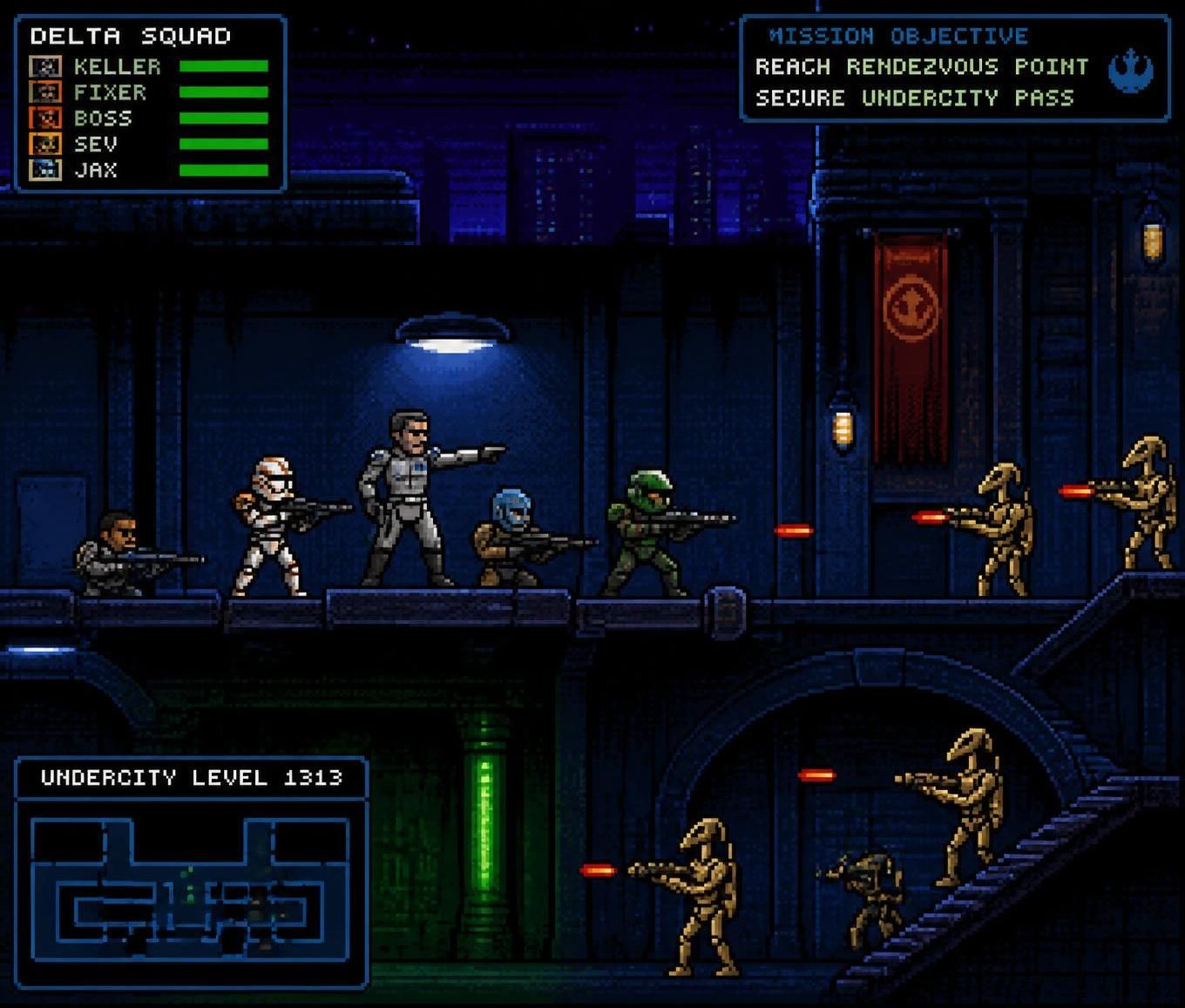
Zero Company is built around this condition. Hawks leads professionals for hire drawn from different backgrounds, each carrying loyalties and methods that do not automatically align. The squad’s internal tension is not decorative characterization. It is a battlefield variable. A unit assembled from soldiers, specialists, and outsiders must establish trust under pressure while confronting a threat capable of spreading across the galaxy if unchecked.
Readers familiar with Clone Wars campaigns will recognize the logic. The Republic’s greatest weakness was rarely a shortage of equipment. It was the tendency to treat every world as if it could be stabilized by the same chain of command. Local terrain, language, art, trade routes, and memory repeatedly altered the balance. On Ryloth, Onderon, and Mandalore, culture was not background detail; it shaped who could be recruited, who could be deceived, and who would resist.
The game’s premise also avoids a common structural failure in licensed video games: placing one heroic character at the center of every decisive event. Zero Company instead frames Hawks as the commander of a volatile instrument. This creates room for reconnaissance, positioning, rescue operations, infiltration, and sacrifice. An adversary with superior numbers can be defeated only when its assumptions are exposed.
For related context on the title’s stated era and production framework, the report on Zero Company’s Clone Wars development demonstrates how strongly the project relies on this historical period.
🛰️ A small squad becomes credible when the war around it is too large for a central command to observe completely.
Zero Company Reviews and the Creators’ Case for More Star Wars Titles
The creators’ interest in making more Star Wars titles follows a measurable outcome rather than vague enthusiasm. Strong reviews validate the central design decision: a methodical tactics game can coexist with a franchise more often associated with lightsaber duels, starfighters, and cinematic spectacle. The response indicates that audiences will accept a slower pace when every movement, ability, and target selection contributes to the fiction of command.
One assessment described Zero Company as an improvement on several XCOM conventions, producing a more cinematic experience while retaining the pressure of tactical risk. That distinction is important. A spiritual successor does not prevail by copying its predecessor’s systems. It prevails by identifying what the earlier system could not express. In this case, Star Wars provides recognizable soundscapes, planetary identities, droids, military doctrine, and a war where victory often has political consequences.
Foertsch’s statements also reveal a disciplined view of game development. Existing properties require curation. Developers must learn what audiences consider essential, which visual motifs carry meaning, and where a new story can operate without weakening established continuity. Lucasfilm offers a setting with extensive rules, but those rules can serve as productive limits. The best operations are designed around constraints rather than delayed by them.
There is a broader commercial lesson. A franchise should not assign every studio the same mission. One team may build action adventures; another may focus on space combat; a third may explore tactical command. This diversification reduces strategic exposure. If one style weakens, the broader Star Wars portfolio still retains multiple ways to engage players.
Coverage of the developers’ plans and official soundtrack reveal places those ambitions beside the release-day response. The timing is logical: successful execution creates leverage for the next proposal.
🎯 The creators have not merely asked for another assignment; they have demonstrated a format that can extend the franchise without repeating it.
Official Zero Company Soundtrack Release Turns Music into Battlefield Intelligence
The official Zero Company soundtrack arrived on digital platforms alongside the game’s release. Composer Gordy Haab, whose prior Star Wars work includes Star Wars: Battlefront, Star Wars: Battlefront II, and Star Wars Jedi: Survivor, composed all 25 tracks. The release runs for approximately two hours and ten minutes, an unusually substantial duration for a tactical game score.
Music in a command-focused title cannot function only as decoration. It must communicate the tempo of an operation. A player evaluating cover, range, reinforcements, or an escape route processes incomplete information. The score can clarify whether a mission remains controlled, whether an unseen threat is approaching, or whether a costly decision has become unavoidable. In military terms, the soundtrack regulates attention.
Haab’s track names suggest an organized narrative progression. “The Serolonis Job” signals a mission-specific opening. “Into the Undercity” and “Luunata Infiltration” imply descent and concealment. “Weapons Hot,” “Storm Basin,” and “Space Armada” indicate open combat. “Tel’s Past,” “Bennic,” and “Old Friends” identify character material, ensuring that the squad is understood as a collection of lives rather than a menu of combat abilities.
The strongest titles in the tracklist reveal a recurring operational principle: consequence. “Mission Gone Awry,” “Our Darkest Night,” “Eve of Battle,” and “Confronting Fathom” describe an escalation curve, not a sequence of disconnected skirmishes. The score appears designed to make attrition and resolve audible.
| 🎼 Soundtrack measure | ⚔️ Confirmed detail | Strategic implication |
|---|---|---|
| Composer | 🎵 Gordy Haab | Continuity with established Star Wars musical language |
| Composition count | 📀 25 tracks | Supports locations, characters, and mission phases |
| Total runtime | ⏱️ About 2 hours 10 minutes | Allows a broad campaign-scale musical arc |
| Release method | 📡 Digital streaming platforms | Extends the game beyond the screen |
🎼 A tactical score succeeds when it teaches the player to hear danger before it becomes visible.
Official Zero Company Soundtrack Tracklist and Its Campaign Structure
The complete official tracklist maps an operation from recruitment and initial deployment through confrontation and redeployment. Rather than treating titles as simple labels, it is useful to read them as the audio record of Hawks’ campaign. The opening cue is brief, while the longer pieces are positioned around investigation, hidden threats, large engagements, and the final confrontation.
- 🎵 Zero Company — 1:17
- 🎵 The Serolonis Job — 5:23
- 🎵 Into the Undercity — 6:17
- 🎵 Fathom — 9:21
- 🎵 The Investigation — 4:15
- 🎵 The Infinite Coil — 5:06
- 🎵 Weapons Hot — 3:12
- 🎵 Mission Gone Awry — 4:48
- 🎵 The Plague — 6:18
- 🎵 Tel’s Past — 6:47
- 🎵 Storm Basin — 4:23
- 🎵 To the Rescue — 6:05
- 🎵 Missives from the Front — 1:20
The middle of the soundtrack moves from frontline reports toward “A New Order,” then into darker and more personal territory. This is consistent with a campaign in which intelligence gradually exposes the enemy’s true scale. The use of titles such as “The Plague” and “The Infinite Coil” suggests a threat that spreads through systems rather than one confined to a single battlefield.
- 🎵 A New Order — 8:41
- 🎵 Our Darkest Night — 3:20
- 🎵 Bennic — 4:36
- 🎵 Old Friends — 4:36
- 🎵 Luunata Infiltration — 4:58
- 🎵 A Higher Purpose — 6:17
- 🎵 In the Shadows — 4:08
- 🎵 Space Armada — 6:32
- 🎵 Hawks’ Speech — 5:14
- 🎵 Eve of Battle — 3:26
- 🎵 Confronting Fathom — 8:32
- 🎵 Onto Our Next Mission — 5:26
“Confronting Fathom” is among the longest pieces, which marks it as a likely culmination. Yet “Onto Our Next Mission” follows it. This final placement rejects the illusion that one victory ends a galactic conflict. It presents resolution as temporary stabilization, a far more credible condition for the Clone Wars.
📀 The tracklist functions as a campaign map: discovery, disruption, confrontation, and renewed deployment.
How Zero Company Uses Squad Conflict as a Star Wars Storytelling Weapon
Hawks does not command a uniform clone unit. Zero Company is explicitly an unconventional group of hired professionals, and its members begin as uneasy allies. This composition offers a stronger narrative instrument than an immediately loyal team. Cohesion must be earned through mission outcomes, shared losses, and demonstrated competence.
In practical tactical terms, this enables character conflict to emerge from play. A rescue objective may force a player to expose a valuable specialist. An infiltration route may reward discretion but leave another operative without support. A direct attack may preserve time while damaging trust. These are not merely dialogue choices; they are decisions made under resource pressure.
Star Wars has long understood the value of incompatible allies. Rebel cells, clone commandos, smugglers, Jedi, senators, and local militias often share an enemy without sharing a worldview. The art of leadership is not to erase those differences. It is to identify the moment when each difference becomes useful. A demolitions expert sees structures as vulnerabilities; an infiltrator sees patterns of access; a former officer sees lines of command. Their perspectives become operational assets when directed toward one objective.
That approach also gives the game a distinct place among franchise releases. Players are not simply reenacting the decisions of famous film protagonists. They are asked to build an effective team from personnel whose history may complicate every order. The fictional threat becomes credible because the squad cannot rely on effortless unity.
For a wider look at how legacy Star Wars systems can be adapted into interactive entertainment, the discussion of Star Wars arcade design principles provides a useful contrast. Arcade design often rewards immediate execution; Zero Company gains its identity by making preparation, placement, and sacrifice equally significant.
🛡️ Zero Company’s true resource is not firepower. It is the disciplined conversion of disagreement into capability.
What More Star Wars Titles from the Zero Company Creators Could Explore
If Bit Reactor and its collaborators receive another Star Wars assignment, the logical path is not necessarily a direct sequel. A capable studio should preserve what it has learned while selecting a conflict that changes the operational problem. The Clone Wars offer abundant material, but the broader franchise contains other periods where small-unit tactics can reveal pressures that films and series observe only briefly.
An Imperial-era campaign could examine asymmetric resistance. A Rebel squad would lack armored superiority and would depend on sabotage, stolen intelligence, civilian networks, and escape planning. Such a game would require players to measure every shot against the risk of attracting overwhelming force. The Empire’s strength would be unmistakable, but its bureaucracy and dependence on predictable doctrine could create openings.
A New Republic setting would reverse the equation. Players could command a provisional security force attempting to restore order across worlds that distrust centralized authority after decades of war. Here, the adversary might not be a conventional army. It could be a criminal network, a remnant fleet, or an ideological movement using instability as cover.
The studio could also pursue a separate Clone Wars operation focused on naval boarding actions and planetary extractions. The key is to retain the principle that made Zero Company viable: tactical rules must emerge from the setting’s politics and culture. A squad operating on a trade world should face different choices from one moving through a sacred city, a Separatist factory complex, or a damaged Republic cruiser.
Collectors and dedicated players have already received signals that the property can support a sustained audience, including the Zero Company Collector’s Edition reveal and early soundtrack single. These measures are not proof of a sequel, but they establish a foundation for continued engagement.
🚀 The next operation should change the battlefield, not abandon the discipline that made this one effective.
Strategic Lessons for the Star Wars Franchise After Zero Company
Zero Company demonstrates that the Star Wars franchise remains strongest when it permits distinct forms of play. The galaxy is too large to be represented through one genre, one combat system, or one kind of protagonist. A tactical squad game can examine uncertainty and command. A starfighter title can examine speed and formation. An adventure game can examine individual survival. Each reveals a different pressure within the same conflict.
The relevant lesson for future game development is therefore organizational. Publishers should match studios to questions they are uniquely equipped to answer. Bit Reactor’s background in strategy makes it credible in a space where terrain, cover, unit roles, and escalating threat must remain legible. Respawn’s participation brings experience in cinematic Star Wars presentation. Lucasfilm’s oversight anchors the result in continuity. This division of labor is a strength when all parties understand the objective.
Players also benefit when official releases respect different levels of engagement. Some will pursue the campaign once for its narrative. Others will analyze squad combinations, mission outcomes, and soundtrack motifs. The digital score supports that second audience by allowing the campaign’s atmosphere to survive outside the game itself. This is how a release develops endurance beyond launch-week gaming news.
There is no need to assume that every successful entry must become an annualized sequence. Overexpansion weakens a concept by converting its strengths into routine. A more rational approach is to develop the next title only when its conflict, setting, and mechanics establish a new tactical problem. An intelligent adversary does not seek direct repetition. It waits until it can strike with a purpose that differs from the last operation.
⚖️ Zero Company establishes a durable principle for Star Wars video games: variety is effective only when every new perspective is governed by a precise strategic purpose.

I am Grand Admiral Thrawn, strategist of the Galactic Empire. Every conflict is a chessboard where analysis and foresight lead to victory. The art and culture of a people betray their weaknesses. The Empire embodies order and discipline in the face of rebel chaos. History will remember that only strategy ensures peace.