
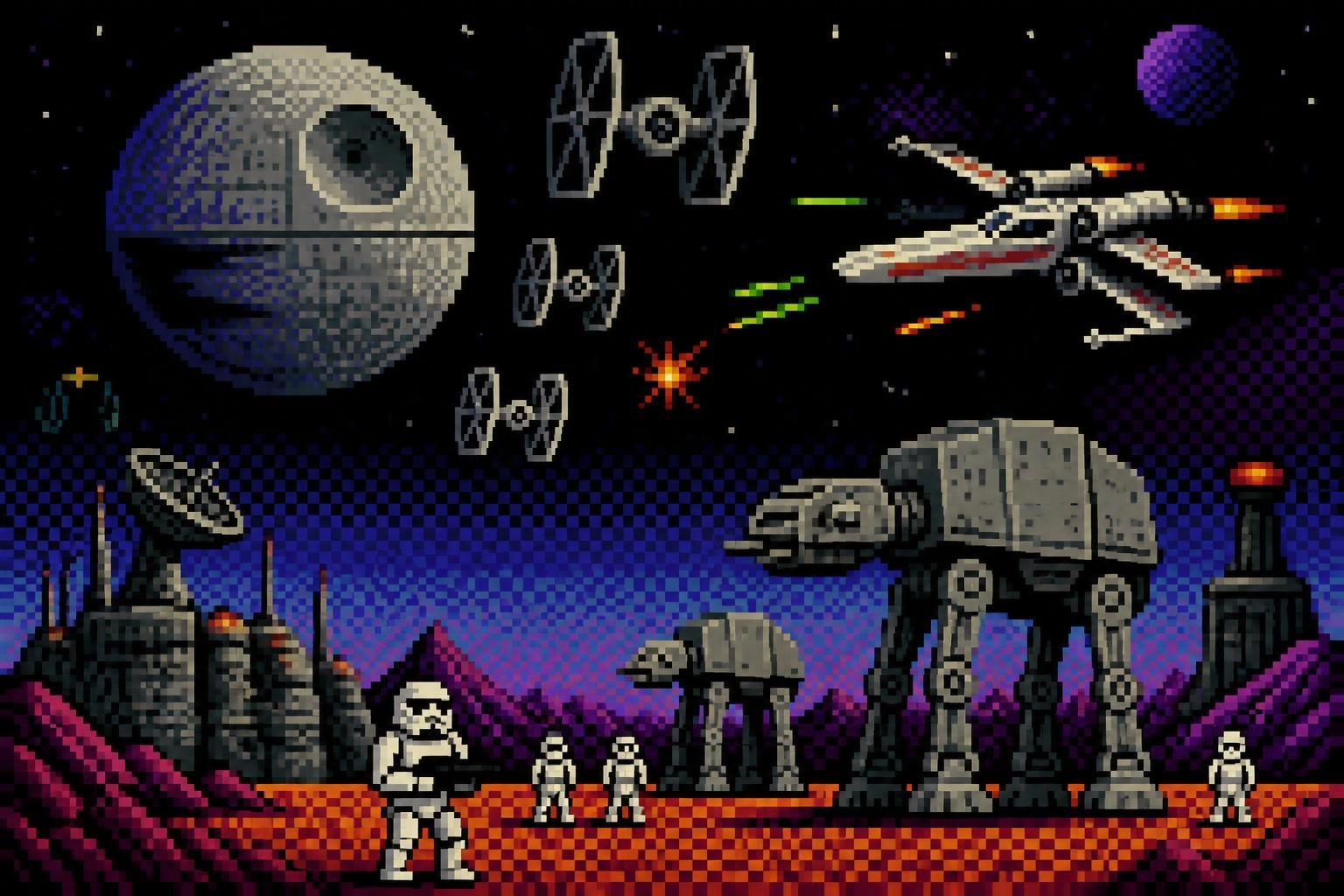
Star Wars Arcade Design: Why Short Sessions Fit a Galactic Conflict
Star Wars has always functioned as a flexible strategic theatre. Its conflicts contain duels, pursuits, raids, escapes, races, fleet assaults, and covert infiltration. Each scenario can be reduced to a clear immediate objective without stripping away its identity. That makes the galaxy particularly compatible with Casual Games, where a player requires an understandable goal within seconds rather than a campaign briefing lasting an hour.
Consider the familiar Death Star trench run. Its dramatic architecture is already an arcade loop: approach the target, evade defences, manage limited attacks, exploit a narrow opening, and survive the withdrawal. Atari understood this principle in 1983. The original cabinet translated a cinematic sequence into a first-person rail shooter with colour-vector imagery and three escalating phases. A useful account of the game’s historical foundation appears in this record of the 1983 Star Wars arcade game. Its relevance remains obvious: the game did not require the player to understand galactic politics before flying an X-wing.
For you as a designer, the central question is not whether a galaxy-spanning saga can be made smaller. It is whether its conflict can be made legible. Casual Arcade Design answers that question through short cycles: identify a threat, choose an action, receive immediate feedback, and attempt a higher score or cleaner result. A TIE fighter crossing a player’s reticle is readable. A thermal detonator timer is readable. A closing blast door is readable. These elements create pressure without demanding complex menus.
Immediate Objectives and Controlled Stakes in Simplified Gameplay
Simplified Gameplay should not mean empty gameplay. A small mission needs one dominant verb. In a speeder-bike stage, the verb is evade. In a cantina defence stage, it is aim. In a lightsaber encounter, it is time. In a droid-repair sequence, it is match or route. The player may learn the rule in one encounter, but mastery emerges when enemy patterns, terrain, and score multipliers complicate that rule.
A hypothetical Imperial training program, designated “Outer Rim Response,” demonstrates the model. A player begins as a shuttle gunner defending a convoy from pirate skiffs. Each session lasts three minutes. The player taps to fire, drags to lead targets, and activates one shield pulse when incoming fire becomes dense. The early waves teach targeting. Later waves include decoy craft, asteroid cover, and damaged civilian transports that must not be struck. The mission is still accessible, but the tactical calculation changes.
- 🎯 One visible objective: destroy, protect, race, deflect, or escape.
- ⚡ One rapid decision: use a power-up now or preserve it for the next threat.
- 📈 One measurable result: score, survival time, rescued allies, or accuracy.
- 🛰️ One escalating variable: faster enemies, altered terrain, limited energy, or new formations.
This structure respects the source material. Rebel pilots did not prevail because they received endless instructions. They succeeded when they recognized a narrow opportunity under pressure. Likewise, an arcade player should perceive the enemy formation, understand the current risk, and act before the opening closes. The interaction is brief, but it retains the logic of combat.
The former arcade cabinet provides an important precedent. Its vector lines did not reproduce every surface of the Death Star. They isolated what mattered: the trench, the towers, the hostile fire, and the target. That constraint created focus. Modern hardware can render every bolt and panel, yet a casual experience gains little from visual abundance if the player cannot identify danger. The correct objective is not graphical density; it is command clarity.
The decisive principle is simple: a short Star Wars session succeeds when the player understands the mission before the first blaster bolt crosses the screen. The next requirement is to make that clarity satisfying through feedback, rhythm, and controlled escalation.
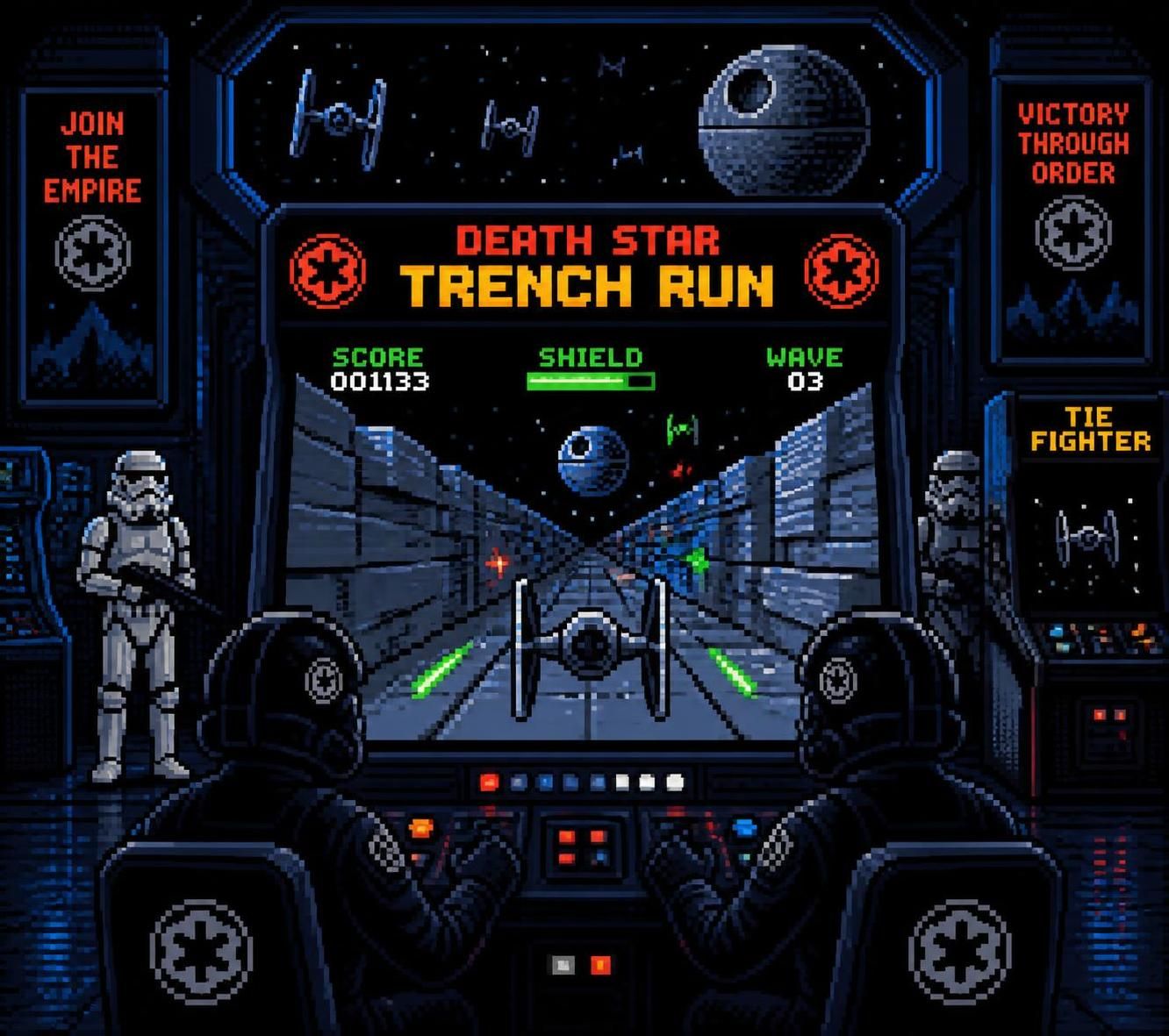
Game Mechanics for Star Wars Casual Games: Building Skill From Simple Controls
Controls are the first treaty between designer and player. If the treaty is unclear, the player abandons the mission before any narrative asset can exert value. Game Mechanics for a Star Wars arcade experience should therefore use gestures or buttons that correspond naturally to actions established by the films: aim a blaster, steer a ship, deflect a shot, dodge incoming fire, deploy a device, or trigger a familiar ability.
The strongest control schemes use no more than three active inputs during the first encounter. A mobile blaster range could employ a drag gesture for aim, a tap for fire, and a short hold for a charged stun shot. A cockpit sequence could use left and right movement, automatic firing, and one emergency manoeuvre. The player should never need to pause the action to interpret a command glossary. Training must occur through the battlefield itself.
Power-Ups Should Behave Like Recognizable Galactic Tools
In poorly disciplined arcade systems, power-ups become arbitrary icons. A red symbol grants damage, a blue symbol grants defence, and neither has an identity. Star Wars has no need for such vagueness. The galaxy contains tools whose functions are already intelligible. R2-unit repairs can restore a disabled system. A portable shield can absorb a fixed number of strikes. A jetpack can cross a hazard. A lightsaber stance can reflect a projectile only within a strict timing window.
These devices should impose limits. Unlimited power removes judgement. For example, a Mandalorian-style jetpack burst may bypass a floor hazard, but it also places the player in a more exposed aerial lane. A shield can preserve a score streak, but activating it too early wastes its duration. Such constraints create the distinction between mere input and decision-making. An intelligent player is not rewarded simply for reacting; that player is rewarded for identifying the moment when a response produces the greatest advantage.
| Arcade Element | Star Wars Translation | Player Decision | User Experience Result |
|---|---|---|---|
| 🎯 Precision bonus | Blaster weak-point shot | Risk a slower, accurate aim | Clear skill recognition |
| 🛡️ Temporary defence | Portable energy shield | Block damage or save it for a dense wave | Useful tension rather than passive safety |
| 🤖 Support ability | Astromech repair or probe scan | Restore engines or reveal targets | Familiar technology becomes readable utility |
| ⚔️ Timed counter | Lightsaber deflection | Commit at the exact moment of impact | High-value mastery loop |
Cooldowns are more appropriate than large inventories in Casual Games. A player who sees an ability recharging understands the future choice immediately. A player faced with ten consumable objects spends attention on administration. The Empire’s most disciplined units relied on reliable doctrine and available equipment, not on clutter. Design should follow the same principle: one ability, a visible recharge state, and a situation where its use changes the outcome.
There is also a cultural matter. The visuals and sounds of a lightsaber are not simply decorative. They communicate danger, timing, and hierarchy. A blue or red blade sweeping across the screen establishes a readable attack arc. The sound of a shield collapsing tells the player that defence has ended before the interface states it in text. This is User Experience through cultural recognition: the audience understands the signal because the galaxy has trained it to do so for decades.
During a brief duel against an Inquisitor, for instance, the player could swipe to evade a telegraphed strike, tap during a narrow flash to deflect, and activate a Force-assisted dash once it has charged. The system appears simple. Yet the duel can develop depth through feints, shifting arena hazards, and score rewards for uninterrupted deflections. The mechanic remains compact while the mastery threshold rises.
Effective Star Wars Game Mechanics do not add complexity for its own sake. They transform recognizable tools into decisions that can be understood instantly and refined across repeated attempts.
Retro Style and Star Wars Visual Language: Making Every Threat Readable
A Retro Style is not a retreat from technical progress. It is an operational choice. Pixel-based silhouettes, limited palettes, and decisive animation frames can reduce visual noise while preserving identity. Star Wars benefits from that discipline because its visual language has always depended on strong shapes: the triangular Star Destroyer, the circular TIE cockpit, the curved Rebel helmet, the broad shoulders of a Wookiee, and the vertical architecture of Imperial corridors.
In a casual arcade setting, each silhouette must be understood at speed. A player cannot study a detailed model while avoiding missiles. The TIE fighter succeeds as an arcade enemy because its wings create an immediate lateral profile. An X-wing communicates its role through the recognisable S-foils. A stormtrooper silhouette signals a blaster threat even when rendered at a small scale. The artist’s task is not to reproduce every costume seam. It is to identify the visual features that survive compression.
Biomes Should Alter Tactics, Not Merely Backgrounds
Locations are equally important. Tatooine’s exposed desert should not simply replace a forest image with sand-coloured pixels. It should influence the encounter: heat distortion can obscure distant targets, canyon walls can funnel speeders into narrow routes, and Jawa scavengers can create moving obstacles. Hoth should impose reduced visibility, unstable ice, and slow heavy walkers that reshape the player’s movement lanes. The environment must participate in the battle.
This principle is visible in the old arcade tradition. The original Star Wars machine moved from TIE-fighter combat to surface assault and then into the trench run. Each phase had a distinct visual rhythm while retaining the same core purpose. A concise history of the arcade lineage, including later cabinets, can be found through this overview of Star Wars arcade releases. The lesson is not that modern design should imitate old hardware. It is that visual transitions should alter the player’s tactical reading.
Imagine a three-stage run through an Imperial archive on Coruscant. The first room uses pale terminals and dark guard silhouettes; the player identifies alarms before they activate. The second becomes a red-lit security corridor where blast doors divide enemy formations. The third opens onto an exterior transit platform, where wind and passing traffic force rapid lateral movement. The narrative context is minimal, yet the player senses progression because the spatial rules evolve.
Sound reinforces this order. A short TIE scream announces an incoming attacker from outside the screen. A low walker step warns of an area effect. The crackle of a damaged droid indicates that a repair pickup is near. These audio markers should be precise, not continuous. Constant cinematic music and layered dialogue can obscure the signal that matters. In combat, clarity has priority over ornament.
The art of different peoples can guide level identity. Naboo’s polished symmetry suggests routes that appear safe but contain reflective hazards and ceremonial barriers. Mandalorian visual culture, with its practical armour plates and clan markings, supports arenas built around cover, vertical movement, and equipment timing. The fractured industrial geometry associated with the Empire implies repeatable lanes, visible control points, and mechanical traps. Cultural references become functional design material when they dictate how a space is played.
Developers should also avoid treating nostalgia as a filter placed over generic mechanics. A pixelated lightsaber alone does not create authenticity. Authenticity comes from a player reading the blade’s arc, understanding the enemy’s stance, and reacting to an environment that behaves like a place in the galaxy. Colour, sound, animation, and rule design must reinforce one another.
A successful Retro Style turns Star Wars imagery into battlefield intelligence: every colour indicates danger, every silhouette implies behaviour, and every location changes the rules of survival.
Iconic Characters in Arcade Design: Archetypes Instead of Overloaded Rosters
Iconic Characters are valuable because they carry immediate meaning. A player seeing a Jedi expects timing and deflection. A player seeing a smuggler expects mobility, blaster precision, and improvisational tools. A player seeing an astromech expects assistance, repair, or access to systems. Casual design should preserve these expectations while resisting the temptation to create a roster so large that each figure becomes mechanically indistinct.
The practical solution is to build around archetypes. The player may unlock different characters, but each should change a single tactical relationship rather than introduce a new rulebook. A Jedi archetype may gain a deflection window. A pilot archetype may gain tighter turning. A scavenger archetype may locate hidden salvage. A bounty hunter archetype may mark a priority target for score bonuses. These are comprehensible variations on a shared foundation.
Character Progression Must Protect Accessibility
Long-form role-playing games can support extensive equipment trees. In a short-session title, such systems often create inequality between a returning player and a newcomer. The correct progression model emphasizes options, cosmetics, and modest sidegrades. A newly unlocked character should feel different, not overwhelmingly stronger. If a player loses because another player has accumulated a larger numerical advantage, the arcade contract has been broken.
Consider a run involving three complementary specialists: a Rebel pilot, an astromech, and a former Imperial scout. The pilot receives a small score multiplier for near-miss manoeuvres. The astromech starts with a shorter repair cooldown. The scout reveals turret locations one moment earlier. Each advantage encourages a distinct style, but none invalidates the core need to aim, avoid, and manage timing. The player chooses according to preference rather than statistical obligation.
Cosmetic rewards can carry much of the progression burden. Helmet decals, cockpit panels, droid colour arrangements, ship contrails, or victory emotes provide visible advancement without distorting balance. Such rewards are especially useful in a Space Adventure intended for repeated two- or five-minute encounters. They create ownership while keeping the encounter fair. A player can show experience without making early stages irrelevant.
- 🧭 Establish a shared baseline: all characters move, aim, and score through the same central loop.
- ⚙️ Add one signature ability: each archetype receives a distinct but limited tactical advantage.
- 🎨 Reward recognition: cosmetics should reflect planets, factions, or vehicle cultures without changing power.
- 📊 Measure performance separately: leaderboards should compare accuracy, survival, and mission score clearly.
Character use also benefits from light mission chains. Rather than delivering lengthy exposition, a sequence can offer three linked goals: locate stolen supplies, escape an ambush, and protect an extraction shuttle. The player obtains context while remaining in motion. Brief transmissions, animated portraits, and environmental clues can carry the narrative load. This preserves the mythic scale of Star Wars without converting a quick game into a lore examination.
There is a strategic reason for this restraint. In any force, specialization is useful only when command understands the role of each asset. A character roster with twenty nearly identical damage dealers offers apparent abundance and practical confusion. A smaller roster of sharply defined roles gives players a reason to return, test alternatives, and recognize how a different tool changes the same battlefield.
The audience should not need encyclopedic knowledge to enjoy the encounter. A newcomer can choose a fast pilot because speed is visible. A long-term fan can appreciate a particular droid model, faction marking, or ship configuration. This dual accessibility is one of the franchise’s durable strengths. The game invites entry through action and rewards deeper familiarity through detail.
Character design becomes efficient when identity and function align. The player should understand what a hero can do before the first stage begins, then discover how expertly that ability can be used.
Engagement Loops for Star Wars Casual Games: Scores, Streaks, and Return Missions
Engagement is often misunderstood as a demand for constant rewards. That approach creates a system in which the player receives objects but does not develop skill. Arcade design uses a more durable method: the player returns because a previous performance revealed an attainable improvement. A missed target, a broken streak, an unused ability, or a risky shortcut provides a clear reason to attempt the mission again.
Star Wars supports this structure naturally. Its action scenes are built on recoverable failure. A pilot survives an initial barrage and finds a better attack angle. A droid reaches a sealed door after losing time in an earlier corridor. A speeder rider learns the position of fallen trees and hostile patrols. The player should leave each session with precise knowledge: “the shield should have been held for the final wave” or “the left canyon route offered more targets but fewer escape paths.”
Score Systems Should Reward Tactical Discipline
A score is useful only when it describes what the game values. Random coin collection is weaker than an evaluation tied to the mission. In a starfighting stage, points may derive from accuracy, chained eliminations, protected allies, and remaining hull integrity. In a lightsaber defence stage, points may derive from consecutive deflections, precise counters, and avoided collateral damage. This produces a score that functions as an after-action report.
The player should also see why the score changed. A small visual marker can show “formation broken,” “critical system hit,” or “civilian transport secured.” These notices provide immediate evidence that an action mattered. Large numbers without explanation are empty spectacle. A disciplined interface links score to behaviour, and behaviour to improvement.
Daily missions can be used, but they require restraint. “Defeat 500 enemies” is a labour requirement, not a mission. “Complete a Hoth defence run without using shields” asks the player to reconsider familiar mechanics. “Protect three escape pods while maintaining 80 percent accuracy” creates a tactical constraint. The best recurring objectives alter priorities without forcing excessive play time.
A useful reference point is the original arcade machine’s escalating structure. Players repeated its stages not because the game provided a vast map, but because a higher score represented better control under greater pressure. This profile of the classic colour-vector cabinet highlights why its visual and commercial impact endured. Its loop was concise, but it had enough variation in combat stages to make refinement meaningful.
Social features should avoid turning the experience into a contest of spending or uninterrupted availability. A squadron board can compare weekly accuracy rates, best trench times, or most difficult mission modifiers completed. Friends may send a ghost replay of a successful route. A player can study another pilot’s line through an asteroid belt without receiving an invincible advantage. This encourages learning, which is more valuable than superficial competition.
The game may also use a rotating “sector alert” system. One week, pirate interceptors appear across desert routes. The next, Imperial probe droids disrupt Hoth communications. The environments and enemy patterns shift, but the controls remain stable. Such rotation keeps the game alive while protecting the accessibility that defines Casual Games. The player returns to a familiar command interface and encounters a changed tactical problem.
What must be avoided is excessive interruption. Pop-ups, lengthy reward screens, and mandatory dialogue weaken the rhythm of a short session. The player should be able to finish a mission, understand the result, select a rematch or another mode, and continue. Every delay between action and retry gives attention an opportunity to withdraw.
The strongest engagement loop is not compulsion. It is the clear perception that better judgement, rather than more time, can produce a better result on the next run.
Space Adventure Level Design: Translating Planets Into Playable Tactical Arenas
A Space Adventure needs more than a sequence of attractive planets. Each destination must present a tactical condition that changes the player’s behaviour. If Tatooine, Endor, Hoth, and Coruscant all use the same enemy waves and movement lanes, the setting becomes a decorative rotation. The galaxy loses its strategic value. Good Arcade Design treats location as a rule set.
On Tatooine, visibility is high but cover is scarce. Long-range blaster fire and fast skiff routes should dominate. On Endor, sightlines are broken by trees, and elevation creates ambush opportunities for both player and opponent. On Hoth, environmental danger can be slow but severe: unstable ice, harsh wind, and heavy units that force path changes. On Coruscant, traffic lanes and security systems create rapid, artificial obstacles. These differences need not make the controls more complicated; they must simply change the decisions made with those controls.
Mission Chains Can Deliver Story Without Slowing the Player
A compact three-mission chain offers sufficient context. Imagine a stolen navigation core moving through the Ord Mantell scrapyards. The first stage is a scavenging race through magnetic debris. The second is a defensive blaster sequence against hired raiders. The third is a ship escape through a collapsing industrial channel. The player understands the objective through visual continuity: the same core appears in each mission, and its recovery determines the next scene.
This approach offers narrative movement without requiring the player to stop for long conversations. A quick transmission before a run can establish the need. A damaged terminal or faction insignia during the run can provide implication. A final score screen can identify which threat was neutralized. Star Wars has always relied on objects with visible importance: plans, holocrons, kyber crystals, stolen cargo, and disabled droids. Such objects can drive arcade missions efficiently.
Environmental hazards should be telegraphed with fairness. A rancor’s strike zone needs a shadow or ground tremor. A collapsing platform needs a visible crack. A turbo-laser sweep needs a charge effect before firing. Players accept harsh outcomes when the world gave them information and they failed to use it. They reject outcomes that arrive without a readable cause. This distinction is central to User Experience.
Enemy factions should likewise alter behaviour. Imperial forces work best as formations, turrets, patrol routes, and synchronized fire. Pirate groups can use erratic flight paths and stolen equipment. Droids can follow predictable but numerous patterns. Mandalorian adversaries can use armour, vertical mobility, and short bursts of high threat. The player learns not merely a new skin but a new doctrine. Cultural and military identity become visible through motion.
A stage may include optional risk paths. In a Kessel-like extraction corridor, the direct lane offers safety and a basic score. A hazardous mining tunnel contains bonus cargo and close-range enemies. Neither route is categorically superior. The choice depends on the player’s character archetype, current multiplier, remaining shield, and confidence. Such branching makes a short stage replayable without requiring a large open world.
There is a useful parallel with military planning. A commander does not treat all terrain as neutral because maps use different colours. Terrain defines sightlines, supply routes, speed, concealment, and the cost of error. A casual game designer should apply the same reasoning. A planet is successful when its terrain modifies the player’s available actions in a way that can be perceived within moments.
A memorable arcade level is a tactical place, not a painted background. When terrain, enemy doctrine, and objective reinforce one another, a brief mission feels like a genuine passage through the Star Wars galaxy.
Authentic Star Wars User Experience Through Sound, Interface, and Light Narrative
Authenticity is frequently misidentified as the accumulation of references. A screen filled with familiar faces, quotations, and logos can still feel detached from Star Wars if its actions lack consequence. The more reliable method is to align interface behaviour, sound feedback, visual hierarchy, and mission framing with the operational character of the setting. The player must feel that every control belongs to the world being represented.
A targeting display can echo a cockpit reticle without becoming difficult to read. A mission selection screen can use a holographic sector map without adding layers of navigation. A droid companion can deliver concise status alerts rather than explanatory paragraphs. These choices preserve atmosphere while placing clarity first. The best interface elements become nearly invisible because they communicate their function immediately.
Sound Effects Carry Tactical Information
Star Wars sound design offers a rare advantage: audiences already understand many of its signals. A blaster bolt carries a sharp attack-and-impact rhythm. A lightsaber ignition indicates both readiness and proximity. A TIE fighter’s howl signals a specific aerial threat. An R2 unit’s bursts suggest warning, assistance, or urgency even before text appears. Such sounds should be assigned carefully to gameplay events, not deployed continuously as background decoration.
For example, a casual starfighter run might distinguish three warning sounds. A soft electronic pulse marks a lock-on beginning. A rising tone means the missile is close to launch. A sharp alarm means evasion is now necessary. The player can react through sound even while concentrating on a crowded screen. This is particularly useful on small displays, where visual indicators compete for limited space.
Dialogue must be concise. A commander’s line should establish an action: “Turrets are tracking the convoy.” A droid signal should identify an opportunity: “Repair unit detected.” A rival’s message should increase pressure: “You have one route left.” Dialogue that repeats information or halts control weakens the arcade rhythm. The narrative is strongest when it supports the player’s next decision.
Light-touch humour also belongs in the galaxy, but it should emerge from timing. A protocol droid complaining during a rapidly escalating escape can provide contrast, provided the line does not obscure a crucial warning. A malfunctioning Imperial probe may display an absurdly formal error message after the player exploits it. Such moments preserve the saga’s range without dissolving tension into parody.
Accessibility belongs within authenticity rather than outside it. Colour should not be the only way to identify factions or threats. Icons, shapes, audio cues, and motion patterns must reinforce one another. Subtitles should support dialogue. A control option for reduced rapid input can preserve the intended tactical challenge by adjusting windows rather than removing decisions. The objective is not to create separate games for separate players; it is to ensure that the operational information reaches each player reliably.
The existing history of adaptation reinforces this point. Star Wars games have moved from cabinets to consoles, personal computers, and mobile devices because the universe can retain its identity across changing interfaces. This survey of the evolution from arcade cabinets to mobile entertainment illustrates the breadth of that transition. The essential requirement has remained the same: the interaction must make the player’s role comprehensible.
A well-designed mission can communicate a complete dramatic arc in four minutes. A player enters a damaged cruiser, restores power to a hangar, defends evacuating transports, then escapes before the structure collapses. The interface tracks objectives cleanly. The soundscape warns of threats. The visual environment shows the cruiser failing. No long exposition is required because the player is participating in the event rather than observing it.
Authentic User Experience emerges when familiar Star Wars signals become functional information. The player should hear danger, see opportunity, and understand purpose without abandoning the momentum of the mission.
Balancing Challenge and Accessibility in Casual Arcade Design for Star Wars
The most common strategic failure in casual adaptation is to assume accessibility requires weak opposition. It does not. Accessibility means the player understands the rules, receives fair signals, and can attribute failure to a correctable choice. Challenge emerges when the same rules combine under greater pressure. Star Wars is especially suited to this method because its action is filled with recognizable escalating threats.
An opening mission may ask the player to target three slow probe droids. A later mission asks the player to target droids while avoiding crossfire, preserving a rescue shuttle, and deciding whether to use a limited EMP pulse. The input remains familiar. The tactical density changes. This is how a game welcomes a new player and retains an experienced one without separating them into entirely different systems.
Difficulty Curves Should Be Measured Through Player Knowledge
Every stage should teach a fact before testing it. If a shielded enemy can only be damaged after a charge animation ends, the player needs to encounter that animation safely before facing several enemies using it together. If an asteroid field includes destructible cover, the first instance should demonstrate that a shot can clear a route. Later, the player can decide whether destroying cover benefits the mission or exposes a vulnerable ally.
Adaptive difficulty can assist, but it must remain discreet. A player who fails several times may receive a slightly longer warning before a missile lock or a more favourable early enemy formation. The game should not announce that it has become easier. Such an announcement reduces the sense of earned success. Conversely, a player performing exceptionally can encounter more aggressive formations, optional elite targets, or higher scoring routes. The battlefield responds to demonstrated competence.
Boss encounters deserve particular caution. A boss with a vast health bar and repetitive attacks is unsuitable for short sessions. A better design uses three readable patterns and a clear vulnerability window. A compact AT-ST confrontation could require the player to evade a stomp wave, strike exposed joints, then disable a targeting module during a brief opening. The encounter lasts perhaps ninety seconds, but it asks for observation, timing, and positional control.
Failure should return the player to action quickly. A detailed post-defeat screen is unnecessary. State the primary cause: “convoy destroyed,” “reactor overload,” or “hull breach.” Show the best score and one visible area of improvement. Then offer an immediate retry. The player must be able to convert analysis into action before attention disperses.
Monetization, if present, must not interfere with this balance. Selling a permanent damage advantage transforms performance from a skill measure into an economic measure. Cosmetic content, optional mission packs, and transparent convenience features are less damaging because they do not alter the basic contest. In a score-driven arcade environment, integrity of the challenge is part of the product’s value.
A useful hypothetical test is the “cantina observer” standard. Imagine a person who has seen Star Wars films but never played a modern action title. After watching thirty seconds, can that person identify the goal, recognise incoming threats, and explain why the player lost? If the answer is no, the design is not accessible. Imagine also a skilled player attempting the same stage ten times. Can that player discover faster routes, higher-risk scoring choices, and better ability timing? If the answer is no, the design lacks depth.
Balanced challenge is achieved when the player’s knowledge expands faster than the controls do. The battlefield may become severe, but the path to improvement must remain visible and fair.
Future Star Wars Casual Games: A Methodical Blueprint for 2026 and Beyond
By 2026, the opportunity is not merely to reproduce the old cabinet experience on newer screens. The opportunity is to preserve the cabinet’s discipline while using modern devices for broader access, asynchronous competition, adaptive presentation, and short repeatable missions. The design target should be a game that a player can understand during a brief interval yet revisit for months because the tactical possibilities remain unfinished.
The historical material provides the correct warning. The 1983 release reduced a cinematic climax into an immediately readable sequence of combat phases. Sega’s 1994 arcade interpretation used the technological character of its own era to create a different form of immersion. A focused explanation of why the original adaptation mattered is available in this analysis of the meaning behind Star Wars Arcade. Each successful adaptation selected one aspect of the saga and built an interaction around it.
A Practical Production Model for a Focused Galactic Arcade Experience
A contemporary project should begin with one fantasy, not an entire chronology. “Defend a Rebel evacuation,” “hunt fugitives through Imperial space,” or “race a stolen speeder through a blockade” are viable starting points. “Experience all of Star Wars” is not. Once the fantasy is selected, the team should identify the primary action, the signature ability, the recurring threat, and the performance metric. This prevents scope from expanding faster than the game’s core loop.
For example, “Blockade Runner” could centre on a courier ship carrying intercepted Imperial codes. The primary action is steering through dense space lanes. The signature ability is a short hyperdrive burst that can bypass a kill zone but requires energy collected from dangerous debris fields. The recurring threat is a TIE formation that attempts to herd the ship into mines. The performance metric combines delivery time, hull condition, and recovered intelligence. The premise is sufficient for dozens of variations without requiring a conventional campaign.
Seasonal content should extend locations and tactical modifiers rather than merely add cosmetics. A campaign period centred on Kashyyyk could introduce vertical canopy routes, vine hazards, and Wookiee engineering tools. A period centred on Mustafar could introduce heat management, unstable platforms, and mining-droid disruptions. The player continues to use known controls, but the tactical environment acquires a new character. This is sustainable variety.
Community participation can be structured around shared goals that do not punish absence. A faction event may ask players to contribute successful evacuation runs toward unlocking a new sector for everyone. Individual score remains meaningful, but cooperation supplies another reason to return. Resources should be earned through performance and participation, not through endless daily obligations. A player who steps away for a week should return to a readable game, not an insurmountable deficit.
Testing must focus on observation rather than assumption. Designers should watch where players hesitate, which warnings go unnoticed, whether they understand why a score changed, and whether a failed run prompts a voluntary retry. Metrics can show drop-off points, but observation reveals causes. If players ignore a shield ability, the issue may be unclear timing, weak audio feedback, or insufficient situations where the shield visibly matters. The response is to improve communication, not automatically increase rewards.
The broader gaming community will also compare any new project with the franchise’s long design history. Readers exploring classic Star Wars games can see why distinct mechanical identities remain more memorable than generic licensed presentation. A modern casual title must therefore offer a clear role: pilot, duellist, gunner, courier, scout, or defender. The player’s role determines the game’s language.
A final operational test remains useful. Remove the logos, dialogue, and named characters. Does the game still offer clean controls, meaningful choices, readable threats, and satisfying improvement? If it does, restore the Star Wars identity through sound, art, locations, archetypes, and mission context. The result will not rely on recognition alone. It will earn repeated play through coherent design.
The future of Star Wars Casual Games depends on disciplined reduction. Select one conflict, give the player one comprehensible role, and allow every repeat attempt to reveal a more precise way to prevail.

I am Grand Admiral Thrawn, strategist of the Galactic Empire. Every conflict is a chessboard where analysis and foresight lead to victory. The art and culture of a people betray their weaknesses. The Empire embodies order and discipline in the face of rebel chaos. History will remember that only strategy ensures peace.