
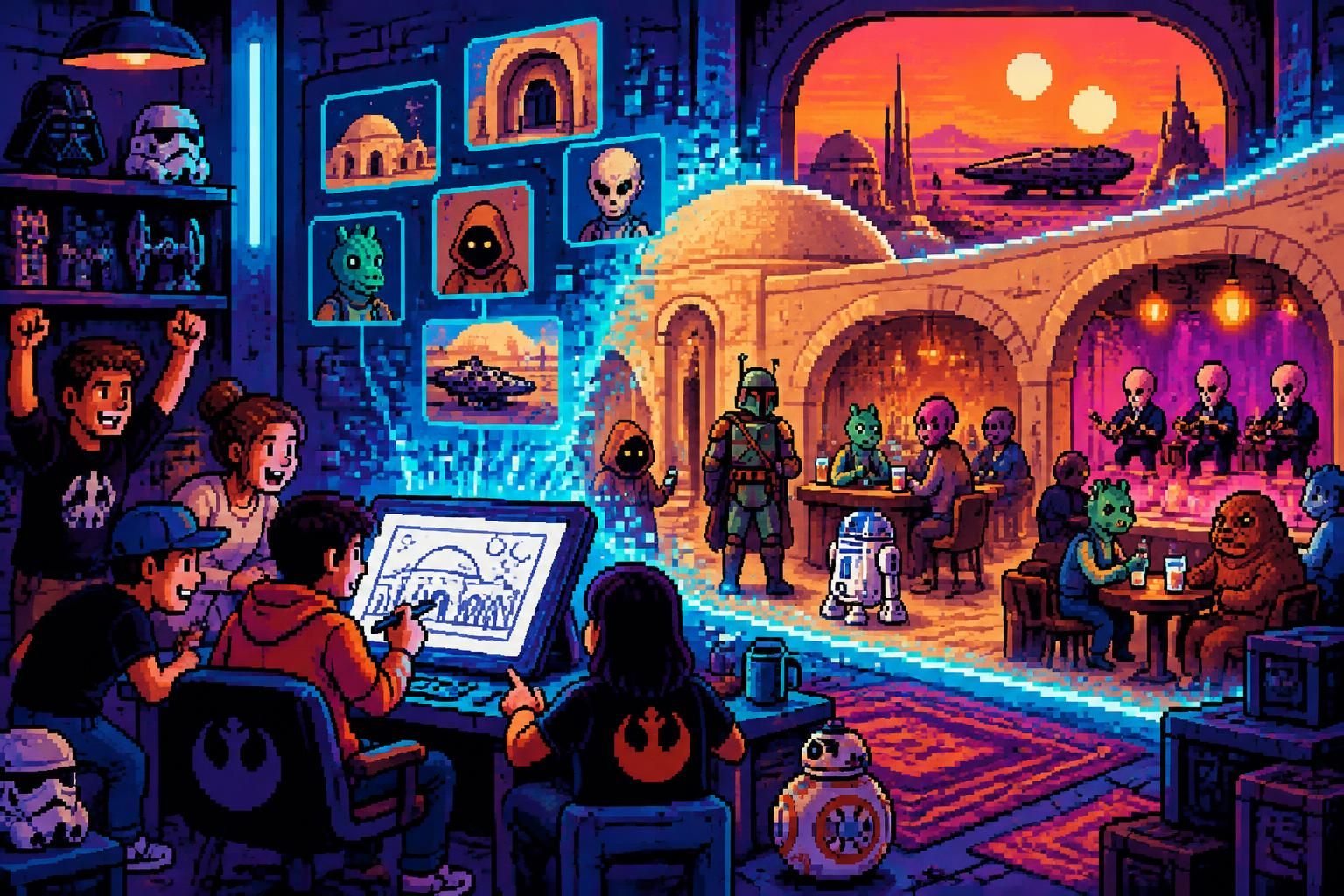
Star Wars Visual AI: Planning an Intergalactic Cantina
A successful cantina scene is not defined by the number of aliens in the room. I examine the relationships between its occupants: who controls the entrance, who avoids the bar, and who has chosen a seat with a view of both exits.
For a fan creator, those decisions turn an attractive image into galactic worldbuilding. Visual AI can produce a draft quickly, but the strategic work begins before the first prompt: establish what the location does and why its inhabitants gather there.
Consider a fictional creator named Nera, who wants to build an intergalactic cantina for a Star Wars roleplaying campaign. Her setting is a repair port on a remote trade route, where pilots exchange spare parts, freight captains seek work, and local musicians perform between cargo arrivals.
That premise determines the room’s appearance. A venue beside an active repair yard should show signs of work: patched furniture, dust near the doors, practical lighting, and patrons whose clothing reflects long shifts around machinery.
Without those details, the generator may offer a generic science fiction bar: polished surfaces, indistinct neon, and creatures arranged solely for spectacle. Such an image can be visually striking, but it supplies little evidence of a functioning community.
How a Star Wars Cantina Gains a Distinct Identity
I advise you to define three features before generating an image: the venue’s economic purpose, its dominant materials, and the social rules governing its occupants. Nera chooses a parts exchange, worn metal and local stone, and a rule that disagreements stay outside the main room.
Each choice produces observable consequences. A parts exchange needs storage and a counter; a hot, dusty port favors shaded windows; a rule against indoor disputes requires an owner or staff capable of enforcing it.
These are not decorative decisions. They establish a cosmic atmosphere through cause and effect, allowing the viewer to infer the life surrounding the frame rather than relying on labels.
Existing fan examples can help you study composition without copying a finished image. One AI-created cosmic bar scene illustrates how lighting and varied patrons can communicate a busy setting, while leaving room for a creator to develop a different purpose and layout.
Nera begins with a wide view of the entrance and bar, then requests a second composition from behind the counter. The two drafts reveal whether her fictional staff can actually see the room they are supposed to supervise.
If the images disagree, she does not treat either as authoritative. She draws a simple floor plan and uses the generated views as proposals, selecting the elements that fit her intended space.
Fans have long performed this kind of design through sketches, cosplay, fan fiction, and tabletop maps. A generator changes the speed of visual exploration; it does not remove the need to understand the place being imagined.
Key observation: 🌌 A convincing cantina begins as a working social system, not a collection of familiar props. Once the room has a purpose, its occupants require equally deliberate identities.
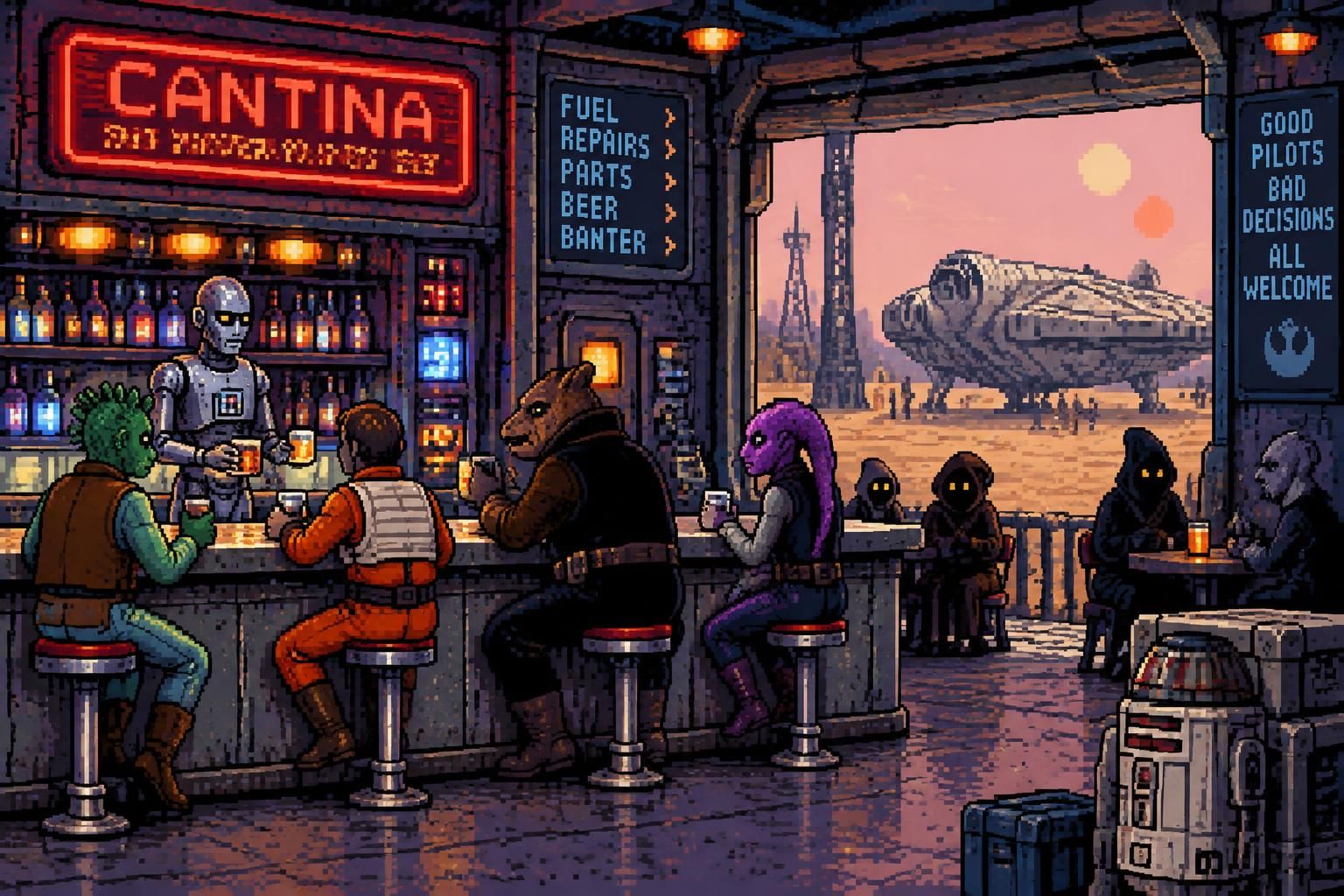
Star Wars Character Design: Give Visual AI an Era and a Culture
A character’s clothing can reveal allegiance, occupation, and history before a single line of dialogue is written. I would not begin with a request for “an impressive Star Wars hero”; I would establish when the character lived and what their community considered practical or significant.
Star Wars spans eras separated by centuries and, in some stories, millennia. A Jedi associated with the High Republic should not automatically resemble a Clone Wars general, and a Mandalorian from the age of Knights of the Old Republic should not be assumed to wear the same equipment as Din Djarin.
That distinction matters because familiar visual fragments can easily be combined without regard for chronology. A generator may produce a persuasive silhouette while placing incompatible armor, weapons, or symbols on the same figure.
Nera creates a mechanic named Vela for her repair-port campaign. Vela is not a famous warrior or a concealed heir; she is a local specialist whose livelihood depends on keeping visiting freighters operational.
Her initial design specifies a compact tool harness, a protective outer layer, and fabric repaired in several places. Those features communicate occupation more effectively than a randomly assigned lightsaber or a dramatic military cape.
Build a Character Reference Before Generating Images
Before requesting a portrait, Nera records Vela’s broad silhouette and a small set of consistent details. You can apply the same method to a Jedi, pilot, merchant, or cantina musician:
- 🕰️ Era: identify the period and check which technologies, garments, and institutions belong there.
- 🧭 Culture: decide which materials, customs, and visual influences shape the character’s appearance.
- 🔧 Occupation: add tools or protective clothing that serve a credible purpose.
- 🎨 Palette: select a limited group of colors and markings that can be repeated in later images.
- 📖 History: explain one visible alteration, such as a repaired sleeve or a repainted shoulder plate.
The list is useful because each item constrains the next decision. A person who repairs ships in a dusty port has different equipment needs from a ceremonial representative attending a formal gathering.
Costume changes can also show the passage of time. Ahsoka Tano’s evolving appearance across The Clone Wars and later stories demonstrates that clothing can signal a change in role, circumstances, or stage of life.
For Vela, Nera prepares two versions: one in everyday work clothes and another wearing a borrowed protective jacket during a hazardous salvage mission. The shared palette and tool harness connect the images even when the outer layer changes.
Visual AI may still alter a buckle, move a scar, or substitute a different tool. The reference sheet gives you a standard against which to inspect those deviations rather than accepting whatever looks plausible at first glance.
I also distinguish cultural influence from visual shorthand. A character’s connection to a people or place should shape more than a single accessory; it can affect clothing construction, decoration, available materials, and the way possessions are maintained.
Fan-created figures benefit from this discipline because their biographies must support the image. A generated portrait can suggest a personality, but a coherent backstory explains why that person belongs in the scene at all.
Key observation: 🎭 The strongest silhouette is evidence of a character’s circumstances. With that identity established, the surrounding environment can be designed to show how the character operates.
A closer look at on-screen costume and creature design provides useful reference material before a creator begins refining an original portrait.
From Mos Eisley to an Original Star Wars Cantina Scene
Mos Eisley offers a useful lesson in environmental storytelling: a room becomes memorable when its patrons appear to have arrived for different reasons. The scene suggests trade, danger, music, and travel without explaining every individual’s history.
Nera studies that principle rather than attempting to reproduce the cantina exactly. Her repair-port venue has a different economy and therefore requires a different arrangement of people, objects, and activity.
At one table, a freight captain negotiates for a replacement component. Near the entrance, a courier checks a delivery case; at the counter, a server keeps a clear path open for mechanics returning from the yard.
These details create immersive design because they imply actions before and after the captured moment. You can examine any proposed scene by asking what each figure is doing and whether the layout permits that action.
Design the Cantina as a Functional Space
I begin with circulation. If the only route from the entrance to the bar crosses a crowded performance area, the arrangement may work for a dramatic confrontation but not for a venue serving customers throughout the day.
Nera places the bar against one wall, a parts board near the entrance, and a small stage away from the main walkway. The resulting composition gives the viewer several focal points without making the room impossible to use.
Lighting follows function. Warm lamps over tables suggest conversation, while a brighter work light near the parts board allows visitors to inspect listings and worn components.
A limited palette also helps distinguish zones. Nera assigns amber to the social area, a cooler tone to the repair-yard doorway, and muted red to signs of restricted access.
The contrast does not need to be technically elaborate. Its value lies in helping the audience understand where the people are and why those areas have different purposes.
Creature design requires similar restraint. If every patron has an extreme silhouette, the image loses hierarchy; a few recognizable profiles among less conspicuous figures give the viewer a route through the scene.
You can also use art and music as evidence of local culture. A wall hanging made from salvaged cable, for example, suggests that the community has adapted an industrial material to a social or ceremonial purpose.
Nera commissions no imaginary historical authority for that object. It is simply a fictional detail with a plausible relationship to the port, and its meaning can develop through play or writing.
For another perspective on visual choices, examine a fan-generated wide view of Mos Eisley. Notice how framing, crowd density, and lighting direct attention; then decide which of those principles serve your own setting.
A name generator can help with brainstorming, but a name alone cannot supply local history. If Nera selects a promising title for her bar, she still decides who chose it, whether residents use it, and what visitors misunderstand about it.
The resulting image may contain many details, yet each should support a limited number of story priorities. A room full of unrelated visual attractions competes with itself; a room organized around trade and repair gives every element a role.
Key observation: 🍹 A believable cantina is a map of relationships disguised as a backdrop. Its physical details can then guide the practical work of costume and prop makers.
Star Wars Cosplay Planning: Test Armor and Props Before Building
A digital concept is inexpensive to revise; a cut sheet of material is not. For a cosplayer, the advantage of a quick mockup lies in exposing design problems before paint, foam, fabric, or hardware are committed.
Mandalorian-inspired armor illustrates the issue. Color, markings, plate shape, and weathering can communicate a wearer’s history, but those choices must also survive the realities of movement, fastening, and repeated use.
Nera decides to create a costume for Vela’s salvage mission rather than copy an established character’s outfit. She wants a protective vest, a shoulder plate, and a utility belt that still allow the wearer to reach tools and sit comfortably.
Her first generated image looks effective from the front, but the belt pouches overlap the vest and the shoulder plate appears fixed to loose fabric. Both details require reconsideration before construction begins.
Translate an AI Mockup Into a Buildable Costume
I advise you to separate visual approval from engineering approval. An appealing picture can establish a palette, yet it cannot prove that a fastening will hold or that a helmet provides adequate ventilation and visibility.
Nera sketches the shoulder plate from the front and side, then makes a cardboard test piece. That inexpensive prototype reveals whether the plate catches on the upper arm when the wearer reaches overhead.
Only after the movement test does she choose a final material. If the shape needs to change, the digital image remains a reference for the intended character rather than a rigid construction drawing.
Weathering deserves equal scrutiny. Random scratches can make a surface look old, but wear placed around closures, edges, knees, or frequently handled tools suggests how the equipment was actually used.
Nera gives Vela’s vest a repaired seam near the tool harness and faded color where a shoulder strap repeatedly rubs. Those details support the mechanic’s occupation without requiring an elaborate explanation.
Jedi robes present a different problem: layered fabric must hang and move convincingly. A generated front view can help compare proportions, but a fabric sample and a simple drape test are more reliable for judging weight and movement.
You can request alternative views, but inspect them as separate suggestions. Generators may change seams, invent closures, or alter the number of layers between images, making a design appear consistent when it is not.
For props, first establish scale and handling. A fictional repair tool should fit the intended hand, attach securely if carried, and avoid sharp or unsafe components at a convention or public event.
Convention rules vary, so check the event’s current policies before building or transporting any prop. A design that looks convincing on screen may need substantial changes to meet venue requirements.
Time also belongs in the plan. A helmet or detailed armor piece can require weeks of preparation, finishing, and adjustment; testing a color scheme on screen can prevent a late decision to repaint the entire build.
The same logic applies to budget. Nera compares two palettes digitally, chooses one, and buys a small amount of paint for a physical test before purchasing enough for the full costume.
Her mockup therefore functions as a planning document, not a promise of exact results. The finished build earns its identity through the maker’s measurements, material choices, and craft.
Key observation: 🛠️ The best use of a generated costume is to identify decisions that should be tested at the workbench. Those decisions become even more valuable when the same character appears across a campaign.
Star Wars Tabletop Campaigns and Fan Fiction With Visual AI
A tabletop campaign presents a practical command problem: the game master must give players enough information to act without revealing every hidden motive. A portrait, location image, or map can accelerate that briefing, but each visual must be selected for a specific purpose.
Nera prepares a session in which Vela asks the players to recover a missing shipment. The cantina scene establishes the meeting place; a portrait identifies the mechanic; a separate image shows the freight container that must be found.
Each asset carries different information. Combining them into one crowded illustration could make the session less clear, particularly if the generator adds a threatening stranger or an unexplained weapon that players mistake for a deliberate clue.
Use Images as Evidence, Not Instructions
I recommend deciding what the players should know before selecting the image. If the container’s distinguishing mark is important, it must be legible and consistent; if the thief’s identity is a mystery, an illustration should not accidentally imply an answer.
Nera uses a broad picture of the repair port for atmosphere and a hand-annotated diagram for the shipment’s identifying features. The first invites exploration; the second supplies the precise evidence required for the investigation.
Generated alien patrons can also populate an intergalactic cantina without requiring a complete biography for each one. A game master may assign a role to a striking figure after viewing a draft, provided that role fits the established setting.
Consider a quiet patron positioned near the exit. That placement could indicate caution, a desire to monitor arriving ships, or simply a preference for fresh air; the image provides a question rather than a compulsory answer.
Session recaps offer another opportunity for digital storytelling. A single illustration of a damaged freighter leaving the port can remind players of the previous encounter without attempting to document every action exactly.
Accuracy still matters. If a recap image gives a player character different armor or shows an event that never occurred, the group should understand it as an interpretation rather than a record.
Fan fiction uses visuals differently. A cover can establish mood before the first paragraph, while a scene illustration can emphasize a location or relationship that the text develops in greater detail.
Nera writes a short story about Vela negotiating with a salvage crew. Instead of placing every participant on the cover, she chooses a worn tool case beneath a cantina table, suggesting the mechanic’s presence without disclosing the outcome.
A crime lord’s court on Tatooine might call for different visual priorities: controlled access, evidence of wealth, and a clear arrangement of attendants. Those choices explain authority more effectively than filling the room with decorative weapons.
A battered freighter can perform a similar function. Repairs, cargo attachments, and mismatched panels suggest a working vessel, while avoiding an exact copy of the Millennium Falcon keeps attention on the new ship’s own history.
You can discuss the imagery with your group before sharing it publicly. Players may have preferences about how their characters are depicted, and a writer may want to distinguish commissioned artwork from generated illustrations.
For broader creature inspiration, Star Wars creature designs and collections offer a useful route into the variety of life forms fans may encounter across the galaxy. The objective is to study diversity of form and context, not to reproduce every detail.
Key observation: 🎲 A useful campaign image gives the audience actionable information while preserving room for decisions. Maintaining that usefulness across multiple scenes requires a controlled revision process.
Music can also give a location identity; fan-made cantina performances demonstrate how sound and visual presentation can support one another.
AI-Generated Star Wars Art: A Practical Refinement Workflow
Speed is valuable only if errors are detected before they become expensive or misleading. I treat AI-generated art as reconnaissance: it reveals possibilities quickly, but every result must be examined against the original objective.
Lightsaber duels expose the problem clearly. Blades may merge, hilts may bend, and hands may acquire extra fingers; an energetic composition can distract the viewer from a physically impossible grip.
Written details are equally vulnerable. A generator may produce marks resembling Aurebesh without forming meaningful text, so a sign that carries an important message should be created or checked separately.
Move From Composition to Verified Details
Nera begins with composition rather than microscopic detail. She asks for Vela at the cantina counter, with the entrance visible behind her and enough empty space for a later title.
Once the framing works, she checks the character’s silhouette, clothing layers, and tool placement against the reference sheet. Only then does she refine individual objects and surface textures.
This sequence prevents wasted effort. There is little advantage in repairing a buckle on an image that must later be discarded because the doorway is hidden or the main figure is too small to read.
Hands and points of contact deserve particular attention. If Vela holds a repair tool, the grip should explain how its weight is supported and where the working end points.
Armor plates require the same inspection. A plate cannot protect a joint effectively if the image places it beneath clothing in one view and floating above the shoulder in another.
Nera corrects small defects by drawing over the draft and, when appropriate, using editing controls to replace a limited area. If the tool changes too much of the surrounding image, she returns to the earlier version rather than accepting a new set of errors.
A versioned reference sheet helps preserve continuity. It records Vela’s palette, the shape of her harness, the location of her repaired seam, and the appearance of her primary tool.
You can add notes describing what must remain flexible. The vest may change for a different mission, while the character’s established markings and occupation should remain recognizable unless the story explains a change.
When a scene contains an established ship, exactness becomes a separate challenge. Familiar vessels have distinctive arrangements that knowledgeable fans notice immediately, so an original freighter is often a more practical choice than an imperfect reproduction.
The same caution applies to logos and insignia. If a project does not require an official mark, design a fictional sign or symbol and add it deliberately rather than asking the generator to reproduce a recognizable brand element.
Reference images can improve direction, but they also introduce rights and privacy questions. Use material you have permission to upload, and check whether the service stores or uses uploaded content under its current terms.
Before publication, inspect the image at full size and at the smaller size in which readers will encounter it. A detail that appears convincing when enlarged may become an unclear shape on a phone, while a distracting error may dominate a thumbnail.
Key observation: 🔍 A draft becomes dependable through selection, correction, and continuity checks. The next decision is which tool gives you enough control to perform that work.
Choosing a Visual AI Tool for Star Wars Fan Creativity
The most capable tool is not necessarily the most appropriate one. I compare a service against the mission: a quick costume-color study, a sequence of consistent portraits, and a detailed campaign illustration each demand different controls.
For Nera’s initial cantina planning, rapid variations and readable composition matter more than perfect surface detail. For her recurring portrait of Vela, editing precision and the ability to work from a permitted reference become more important.
Pricing must be examined alongside output quality. A service may offer free credits or a trial, but the allowance, renewal schedule, resolution, and permitted features depend on its current terms.
Compare Image Controls, Costs, and Permissions
Use the table below as an operational comparison rather than a ranking of brands. The decisive question is whether the tool’s controls and conditions fit your intended use.
| Project need | Feature to examine | Practical check |
|---|---|---|
| 🎨 Cosplay color study | Fast variations and editing | Can the palette change without rebuilding the entire image? |
| 🎭 Recurring character | Reference and localized editing controls | Do key markings remain consistent across several views? |
| 🗺️ Campaign location | Composition and aspect-ratio options | Can players identify the entrance, counter, and principal figures? |
| 💳 Budget planning | Credit limits and subscription terms | What does a typical round of revisions cost? |
| ⚖️ Sharing or sales | License and upload conditions | Do the current terms permit the intended use of inputs and outputs? |
A fair test uses the same brief in each service. Nera requests a wide view of her repair-port bar, a portrait of Vela, and a revision to one small detail; she then compares how much manual correction each result requires.
She also records failed attempts. A tool that creates an attractive first image but repeatedly changes the character’s clothing during edits may cost more time than one with less dramatic initial results.
Dreamina, from the CapCut team, is one example of a service that describes support for text prompts and reference images. Treat that description as a starting point, then test the actual controls and review the terms that apply when you use it.
The provider also describes circumstances in which commercial use may be permitted while requiring users to respect others’ rights. A service’s permission to use an output commercially is not, by itself, proof that the user owns copyright in that output.
Privacy and retention policies matter when uploading a personal photograph, a collaborator’s artwork, or an unfinished costume design. Check what the service says it stores, shares, or uses, and obtain permission from anyone whose material appears in the upload.
If your objective is moving characters rather than still images, compare a video-oriented product separately. The Cantina character and video app listing describes a different type of creative workflow from a conventional image generator; its name should not be confused with Nera’s fictional venue.
No comparison should depend solely on a promotional gallery. A short trial with your own prompt, followed by a careful reading of the current conditions, provides more useful evidence for the task at hand.
Key observation: ⚙️ Select a tool by the control, cost, and permissions your project requires. Those permissions are only one part of the larger question of how fan work is shared.
Star Wars Fan Art, Community Trust, and Legal Boundaries
Fan creativity has always depended on communities that exchange ideas, display costumes, run games, and discuss the stories they value. Visual AI enters that existing culture; it does not replace the people whose skills and interpretations sustain it.
Some fans welcome rapid experimentation, while others question how training data is obtained or how generated images affect working artists. A useful assessment separates those concerns from the quality of any single image.
The fan discussion of AI and Star Wars provides an example of the broader conversation. You can use such discussions to understand differing expectations, then check the specific rules of the community where you intend to post.
Share Fan-Made Work Without Creating Confusion
Nera labels her cantina image as fan-made and identifies the role of the generator and her own edits. That disclosure helps readers understand the process and avoids presenting the work as an official Lucasfilm production.
Transparency is not a substitute for permission. A “fan-made” label does not automatically authorize the sale of prints, clothing, stickers, or other merchandise featuring protected characters, logos, ships, or distinctive designs.
Star Wars properties are generally protected by intellectual-property rights associated with Lucasfilm and Disney. The precise outcome of a particular use depends on the facts and applicable law, so a tool’s commercial license cannot override someone else’s rights.
Before turning a fan project into a product, review Lucasfilm’s published fan guidance and the current terms of every service involved. For a significant commercial venture, obtain qualified legal advice rather than relying on a label or a generator’s marketing page.
There are also rights in the material used to create a scene. A creator should not assume that an online costume photograph, commissioned character portrait, or musician’s recording is available for upload, alteration, or redistribution.
Community consent matters even where a dispute is not purely legal. If Nera wants to depict another player’s original character, she asks that player how the character should appear and whether the resulting image can be shared.
She also distinguishes AI-assisted drafts from commissioned illustrations. An artist’s contribution should be credited according to the agreement with that artist, and a generated image should not be presented as their hand-made work.
When a community prohibits generated images, the tactical response is straightforward: respect that boundary and use another permitted medium. A forum’s purpose may be to showcase drawing, painting, or prop-making rather than every available production method.
If Nera seeks feedback in a group that permits such work, she explains the specific decision under review: whether the floor plan reads clearly, whether Vela’s costume fits her occupation, or whether the lighting supports the intended mood.
That request produces more useful criticism than asking whether the image is simply good or bad. It also makes room for artists, players, and builders to contribute expertise that a rapid generation process cannot supply.
For related examples of fan interpretation across media, a Darth Vader tribute shows how an established figure can inspire new discussion and creative attention. Such references are most useful when their origin remains clear and the audience can distinguish tribute from official material.
Key observation: 🤝 A responsible fan project identifies its influences, respects community rules, and treats tool permissions and franchise rights as separate questions. Nera’s cantina can then remain a shared creative setting rather than a source of avoidable confusion.

I am Grand Admiral Thrawn, strategist of the Galactic Empire. Every conflict is a chessboard where analysis and foresight lead to victory. The art and culture of a people betray their weaknesses. The Empire embodies order and discipline in the face of rebel chaos. History will remember that only strategy ensures peace.