
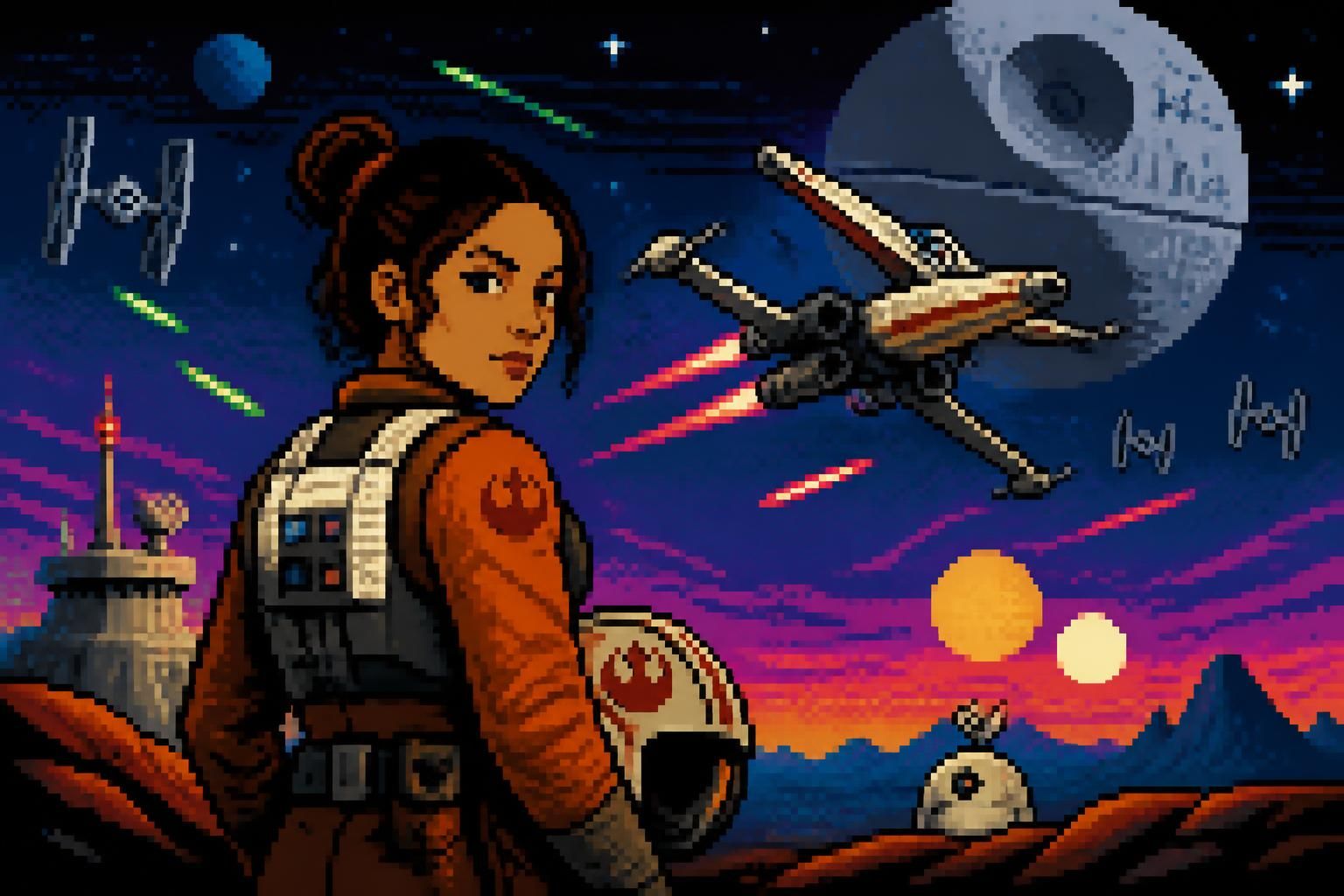
Star Wars Large Formats: Why IMAX 70mm Changes the 2026 Cinema Campaign
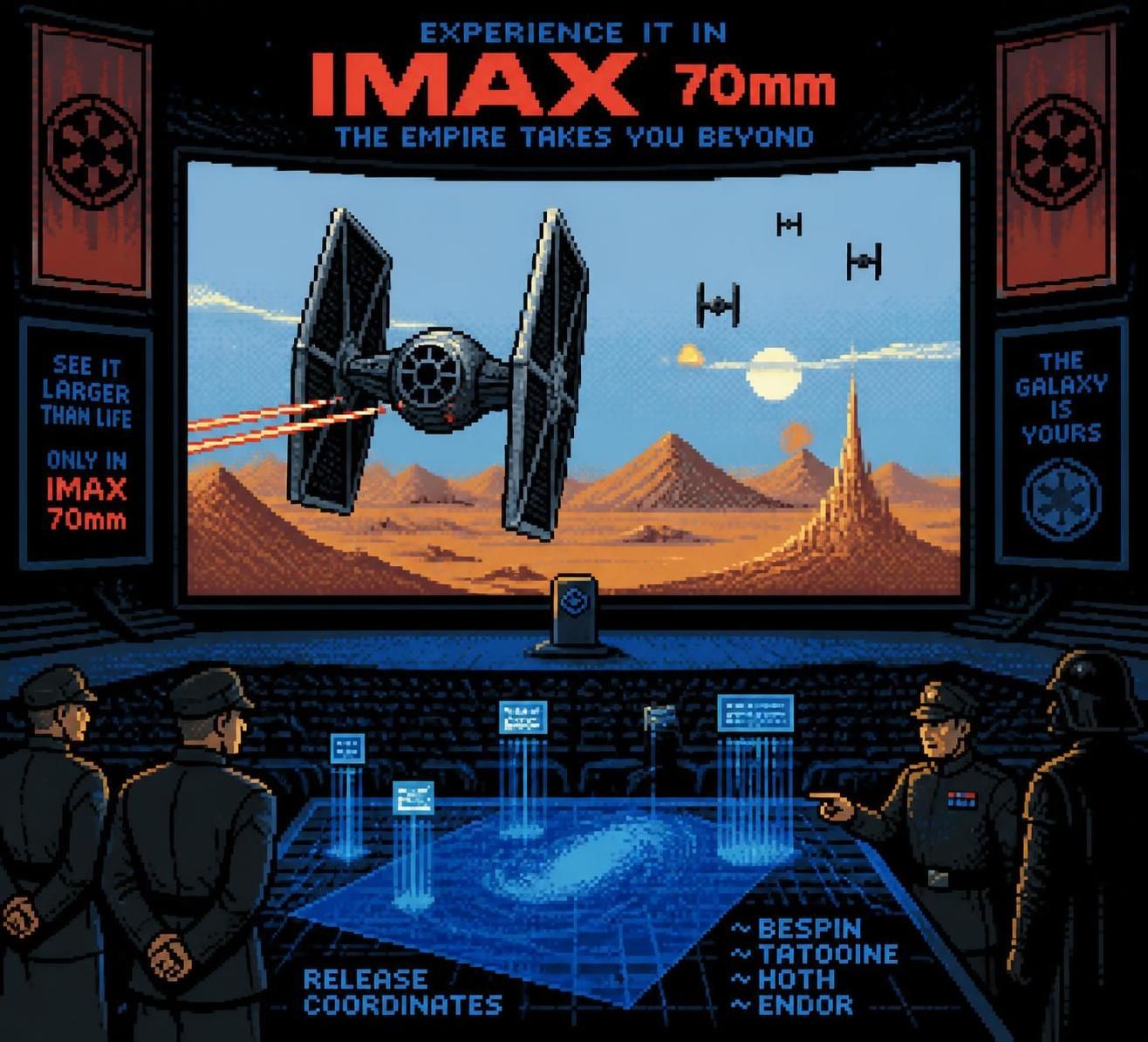
The confirmation that Star Wars will return to theatrical screens in IMAX 70mm establishes a precise objective: turn familiar material and a new release into distinct cinema events. A New Hope is scheduled for a February re-release, while Starfighter is positioned for May. Both are planned for IMAX presentation, and the large-format strategy gives distributors a visible point of difference in a crowded 2026 release calendar. 🎬
The two projects do not begin from the same technical position. A New Hope was not photographed on 70mm film. Its presentation therefore depends on restoration, remastering, projection, and marketing rather than a native large-gauge image pipeline. That does not make the release meaningless. It changes its purpose. The audience is being offered scale, communal viewing, and a renewed encounter with a foundational work of Science Fiction, not a claim that the original production was designed around modern premium screens.
Starfighter, by contrast, can incorporate large-screen expectations from the beginning of its campaign. A new film can plan sound design, visual compositions, and promotional materials around the premium environment. The tactical distinction matters. Reissues rely on cultural memory; original releases must create anticipation without losing clarity about what makes them new.
Large Formats as a Deployment Decision
Large Formats are not merely bigger screens. They require audiences to travel, select limited venues, and accept premium ticket prices. A successful campaign must communicate why the format is essential. The Death Star trench run, the opening pursuit above Tatooine, and the first view of a Star Destroyer are examples of sequences whose spatial design benefits from theatrical scale. Their power comes from legible geometry: a small target, overwhelming machinery, and a narrow route through hostile space.
That lesson applies directly to modern release planning. A premium format should amplify a film’s visual strategy, not attempt to replace one. The most relevant IMAX 70mm release analysis frames the decision as a question of event value rather than empty technical prestige. The format must serve the image, just as an Imperial fleet must serve a defined strategic purpose.
The key measure is not screen size alone; it is whether the audience can identify a reason to experience this Galaxy at its largest.
Adria Arjona’s Alternate Role in Solo and the Casting Logic Behind Bix Caleen
Adria Arjona’s disclosure that she auditioned for Qi’ra in Solo: A Star Wars Story reveals a useful truth about casting within a long-running Franchise: an unsuccessful audition is not necessarily a rejected strategic fit. Arjona reportedly progressed far enough to screen-test opposite Alden Ehrenreich while original directors Phil Lord and Chris Miller were present. Emilia Clarke ultimately played Qi’ra. Years later, Arjona became Bix Caleen in Andor, a role shaped by a very different dramatic environment.
Qi’ra operates in a heightened criminal fable. Her story involves survival, deception, Crimson Dawn, and an unresolved bond with Han Solo. The character must be immediately readable inside a fast-moving adventure structure. Bix functions differently. She is rooted in Ferrix, in work, friendship, grief, intimidation, and the escalating price of resistance. Her scenes demand accumulated history rather than instant mystery.
The contrast explains why this Alternate Role is more than trivia. Casting is an alignment between performer, script, director, rhythm, and the cultural world around a character. Ferrix is not simply a location. Its bells, brickwork, communal rituals, and industrial habits form a civic language. Bix belongs to that language. Her choices matter because the audience can see the ordinary systems that the Empire disrupts.
Two Characters, Two Narrative Missions
Qi’ra is designed to keep information controlled. Bix is designed to show what control does to a community. One character moves through the underworld’s polished surfaces; the other reveals the cost beneath them. A report on Arjona’s earlier Star Wars audition correctly makes the connection between the two opportunities, but the deeper lesson concerns fit rather than rivalry.
Clarke’s Qi’ra carries the poised ambiguity required by Solo. Arjona’s Bix carries practical intelligence and visible endurance, which Andor needs to make Imperial oppression feel concrete. Neither outcome invalidates the other. The projects demanded different weapons.
A capable commander does not assign identical personnel to every operation. Casting succeeds when the performer’s strengths meet the mission’s exact terrain.
How Adria Arjona’s Star Wars Path Strengthened Andor’s Ground-Level Conflict
The significance of Adria Arjona’s move from a near-casting in Solo to Bix in Andor becomes clearer when the two productions are assessed by scale. Solo follows exceptional figures: a gifted pilot, a Wookiee co-pilot, criminal syndicates, and a legendary ship. Andor studies the systems that make ordinary people vulnerable before they become politically active. This is not a lesser arena. It is the arena where rebellion either finds support or fails.
Bix Caleen is crucial because she is neither a senator nor a Jedi nor a military commander. She is a mechanic and community member with contacts, responsibilities, and limits. The Imperial apparatus cannot treat Ferrix as a conventional battlefield because the settlement’s cultural behavior becomes its defensive terrain. Residents use sound, movement, shared knowledge, and local architecture to resist intrusion. The funeral procession later demonstrates this principle in its most disciplined form.
An adversary often seeks direct confrontation because direct confrontation is easy to measure. Ferrix offers another model. Its people use social cohesion as infrastructure. The brass instruments, the procession, and the collective silence carry the same strategic value as barricades because they force occupying personnel to respond under public scrutiny. Art does not remain decorative when a population understands its own rituals. It becomes organization.
Bix Caleen and the Cost of Imperial Pressure
Bix’s arc also exposes a recurring Imperial flaw: the assumption that fear produces durable compliance. Fear can secure immediate information or temporary withdrawal. It cannot reliably eliminate memory, loyalty, or shared resentment. The harsher the pressure becomes, the more the population learns which institutions threaten it. That process transforms passive civilians into active allies of resistance.
Readers following the wider This Week in a Galaxy Far, Far Away archive can observe how small production updates gain larger meaning when placed beside character developments. Entertainment News is most useful when it traces cause and effect, not when it simply counts announcements.
Bix works because she gives the conflict a human supply line: trust, labor, and local knowledge become resources the Empire cannot manufacture.
Star Wars Video Game Signals: Eclipse, KOTOR, and the Value of Controlled Visibility
National Video Games Day in the United States brought a Lucasfilm promotional reel that included footage from Star Wars Eclipse and the Knights of the Old Republic remake. The notable factor was not only that these titles appeared. It was that both were shown within a broader celebration of the interactive history of the Galaxy. Such placement functions as controlled visibility: enough to remind audiences that the projects exist, but not enough to establish release schedules or operational details.
This approach is rational when development timelines are long and public expectations are high. A game announcement can create initial momentum; repeated silence can then convert anticipation into suspicion. A short reel does not resolve that problem by itself. It can, however, indicate that the holder of the Franchise still considers the projects strategically relevant. The next decisive signal would be a focused presentation with gameplay, platforms, developer context, and a credible release window.
Why the KOTOR Remake Requires Precision
Knights of the Old Republic is not merely a familiar title. It is a foundational role-playing experience whose appeal rests on player agency, moral choices, companions, and a historical setting far removed from the Skywalker era. A remake cannot rely exclusively on improved visuals. It must preserve the feeling that the player’s decisions shape identity and allegiance.
Star Wars Eclipse faces a separate task. Its High Republic setting offers visual and political territory outside the Empire-versus-Rebellion cycle. That distinction could expand the interactive Space occupied by the brand. Yet unfamiliar eras need clear communication. Audiences must understand the conflict, the protagonists, and the form of play before visual spectacle can become sustained interest.
- 🎮 Eclipse needs a clear explanation of its High Republic setting and gameplay identity.
- 🕹️ KOTOR needs fidelity to player choice, party dynamics, and the original’s moral tension.
- 📡 Both projects need communication paced to verified milestones, not speculation.
The most effective digital strategy treats each game as a separate campaign with its own terrain. A useful perspective on Star Wars digital storytelling shows why interactive narratives cannot be promoted like passive screen releases. Players do not only witness a Galaxy; they test its rules.
Controlled visibility is useful only when it leads toward clear orders. Without that next step, recognition becomes an unspent resource.
Star Wars Publishing Updates: Horror, Adaptation, and the Edge of the Abyss
Publishing remains one of the most flexible fronts in Star Wars storytelling because it can test tone, period, and character perspective without the logistical burden of a film set. Recent discussion includes Hiding from the Dark, Kiersten White’s horror-tinged middle-grade novel; the first comic-book adaptation issue of The Book of Boba Fett; and an excerpt from the forthcoming adult novel Edge of the Abyss. These works are not interchangeable. Each serves a different readership and a different narrative function.
Hiding from the Dark uses a younger-reader framework while drawing on horror techniques: enclosed danger, uncertainty, and the sense that familiar settings can become hostile. Horror is compatible with Star Wars when it respects the Galaxy’s core logic. The unknown should expose character choices rather than merely provide creatures or darkness. The best examples make the reader ask what a group does when equipment, authority, and certainty fail at the same moment.
Adaptation as Reconnaissance
A comic adaptation of The Book of Boba Fett has a different mission. It translates screen pacing into panels, page turns, captions, and visual emphasis. An action sequence that lasts seconds on television may require several pages in comics if the reader is to understand its geography. This makes adaptation an act of reconnaissance: the creators must identify which gestures, images, and lines carry the narrative’s command structure.
Edge of the Abyss, arriving the following Tuesday in the reported publishing schedule, represents the adult-fiction flank. Excerpts are valuable because they reveal voice and atmosphere before the entire book is deployed. They should be assessed for clarity of character goal, setting detail, and narrative pressure. An excerpt that only withholds information cannot sustain a campaign. One that establishes a problem can.
| Publishing front | Current purpose | Strategic reader value |
| 📘 Hiding from the Dark | Horror-inflected middle-grade fiction | Builds tension through accessible stakes and fear of the unknown |
| 💬 The Book of Boba Fett comic | Screen-to-page adaptation | Reframes visual action through sequential art |
| 📚 Edge of the Abyss | Adult novel release | Expands character-driven narrative territory |
Coverage of the new Star Wars horror novel is useful because it recognizes that tonal variation keeps a large fictional universe from becoming predictable. A Galaxy survives creatively when every medium receives a mission suited to its strengths.
New York Comic-Con and the Strategic Importance of Star Wars Fall Announcements
New York Comic-Con, scheduled for October 8 through 11, is a logical point for a major adult-novel announcement and possible new comic-series information. The publishing side of Star Wars has remained difficult to forecast because several lines have shifted over recent months. That instability should not be mistaken for absence. It indicates that the next set of announcements must establish direction, creative teams, and eras with greater precision.
A convention announcement performs several tasks at once. It informs existing readers, provides trade publications with a calendar item, gives retailers material for ordering, and signals whether the Franchise is consolidating around a particular era or widening its range. A vague reveal may generate brief conversation. A reveal with cover art, synopsis, author, date, and continuity placement creates a usable commitment.
Forecasting Without Inventing Certainty
The most disciplined forecast does not pretend to possess unconfirmed details. It identifies the incentives. An adult novel announced in October can build a long pre-release campaign through cover reveals, excerpts, interviews, convention appearances, and bookstore partnerships. New comic runs can use the same structure, though monthly publishing requires early clarity about artists and issue cadence.
The fall schedule also creates an opportunity to connect publishing with other Movie Updates without forcing every story into screen continuity. A novel set near a familiar event can explore civilians, scouts, diplomats, or local leaders whose experiences would not fit a two-hour film. This is where written fiction has an advantage. It can occupy the empty corridors of history.
Consider the art of the Chiss Ascendancy, where layered symbolism can reveal hierarchy, memory, and strategic intent to a trained observer. Publishing operates similarly. Cover design, subtitle, character choice, and era are not random ornaments. They are signals about intended readership and future narrative routes.
The strongest convention announcement does not simply reveal a product; it makes the next phase of the publishing map understandable.
Science Fiction Event Strategy: Comparing A New Hope and Starfighter in Space
The pairing of A New Hope and Starfighter offers a practical case study in Science Fiction event strategy. One is a durable cultural artifact approaching its fiftieth anniversary period; the other is positioned as a new theatrical operation. Their shared label, Star Wars, provides recognition. Their campaigns must still avoid treating recognition as a substitute for purpose.
A New Hope has the advantage of iconography. The binary sunset, Mos Eisley, the Millennium Falcon, Leia’s holographic message, and the Death Star are instantly legible even to viewers with limited familiarity. Its re-release must emphasize the experience of seeing these compositions with an audience. The goal is not to explain why the film matters; decades of influence have already accomplished that. The goal is to show why this particular viewing environment matters now.
A New Film Requires a Different Formation
Starfighter has no comparable reserve of nostalgia. Its advantage is forward movement. A new story can introduce unknown pilots, factions, worlds, and flight dynamics, provided the campaign states what makes those elements distinct. The title itself emphasizes motion and conflict in Space. Marketing should therefore demonstrate the characters’ tactical situation, not only display spacecraft against starfields.
The central risk is excessive dependence on format language. IMAX, 70mm, premium sound, and giant screens are enhancements. They cannot explain a protagonist’s objective, a villain’s leverage, or a squadron’s stakes. The original trilogy understood this. The Battle of Yavin works because the audience understands the countdown, the target, the route, and the consequences. Visual scale serves narrative clarity.
The wider Star Wars fall preview demonstrates why release calendars must be read as coordinated movements rather than isolated dates. Publishing, games, streaming discussion, and theatrical exhibition all compete for attention. Timing determines whether those forces reinforce one another or collide.
Premium presentation magnifies a clear mission; it cannot rescue an undefined one.
Entertainment News and the Sith Question: Separating Evidence from Speculation
A recent SWNN Live discussion considered possible future directions for the Sith. This is a productive subject because the Sith are often treated as visual shorthand rather than an ideology with methods, traditions, and internal contradictions. Yet Entertainment News must distinguish between confirmed development and informed speculation. A conversation about potential Sith stories can examine narrative opportunities without presenting them as announced projects.
The Sith endure because they offer a concentrated form of political temptation. They promise order through personal mastery, knowledge without restraint, and decisive action without accountability. Their symbols—red blades, black architecture, hidden temples, masks, relics—are visual expressions of that doctrine. The art is important. Sith design often uses severe symmetry, oppressive scale, and darkness interrupted by red light. These choices prepare the observer for hierarchy and domination before dialogue begins.
What Future Sith Stories Must Avoid
A future story centered on Sith themes should not reduce them to a collection of artifacts. A holocron has value only if it tests a character’s judgment. A masked warrior has value only if the mask represents a chosen identity, a lie, or a burden. The most enduring Star Wars conflicts do not arise because one side has darker clothing. They arise because people choose between control and responsibility under pressure.
This also applies to audience discussion. Rumors move rapidly across social platforms because ambiguity attracts attention. A disciplined reader should ask four questions: What has been officially named? What source describes the claim? What production evidence exists? What remains interpretation? These questions prevent conjecture from becoming a false operational map.
- 🔎 Identify whether the update is official, reported, or speculative.
- 📅 Check whether a date, creator, or platform has been confirmed.
- ⚔️ Separate character possibility from actual story commitment.
- 🧭 Measure every claim against the Franchise’s established narrative logic.
The discussion around Adria Arjona’s current screen work and Star Wars future follows the same principle. A performer’s openness to returning is not the same as a confirmed production order. The distinction protects both reporting and audience expectations.
Information becomes strategically useful only when its level of certainty is clearly marked.

I am Grand Admiral Thrawn, strategist of the Galactic Empire. Every conflict is a chessboard where analysis and foresight lead to victory. The art and culture of a people betray their weaknesses. The Empire embodies order and discipline in the face of rebel chaos. History will remember that only strategy ensures peace.