
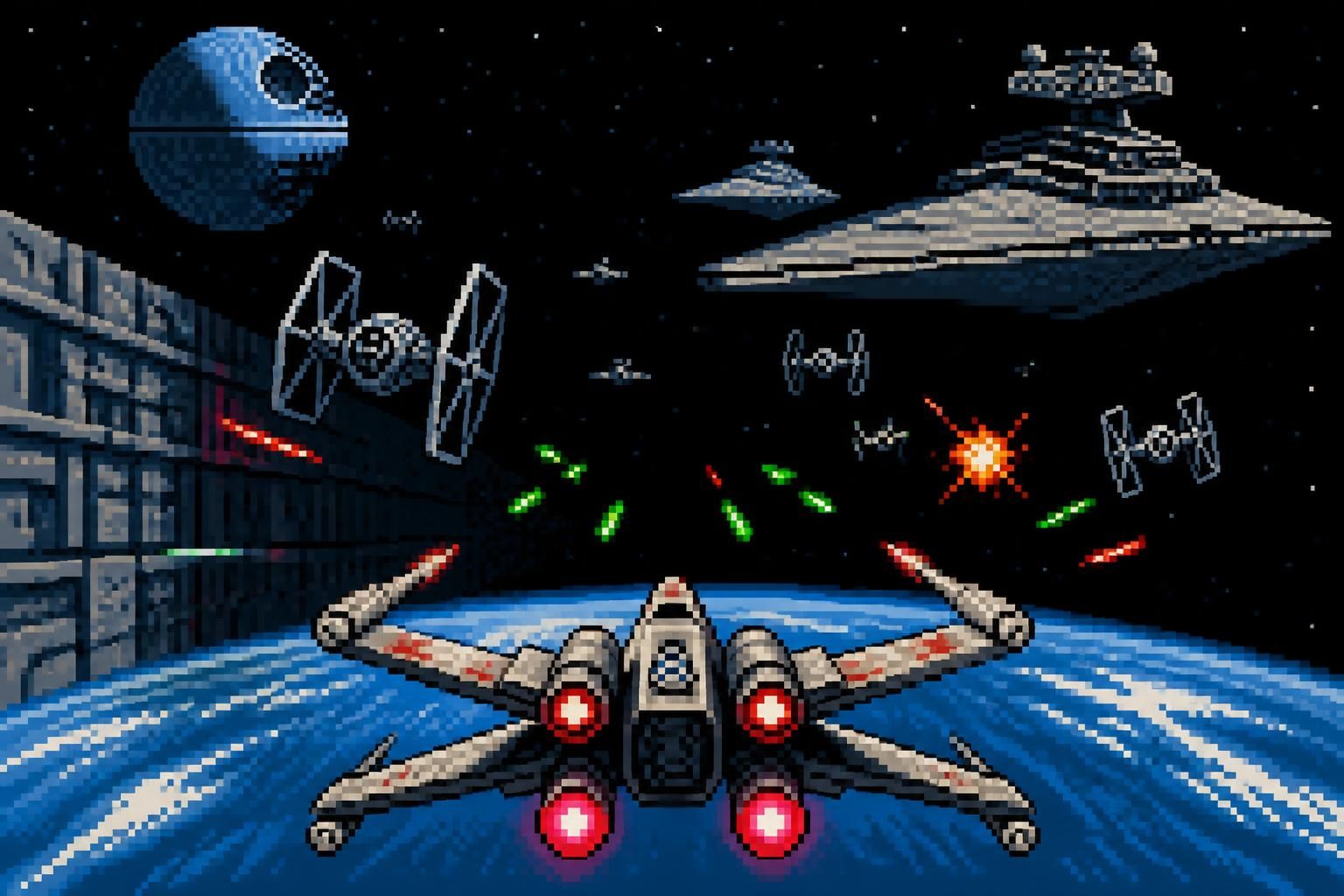
Star Wars (1977) in IMAX 70MM: A Historic 50th Anniversary Deployment
The 2027 release plan establishes an unusual cinematic formation: the Original 1977 Star Wars and the new Star Wars: Starfighter will both receive presentations in IMAX and IMAX 70MM. The first operation begins on February 19, 2027, when the film later known as Star Wars: A New Hope returns to theaters for a limited anniversary run. The second follows on May 28, 2027, the 50th-anniversary weekend of the franchise’s original theatrical arrival.
You should distinguish this from an ordinary repertory screening. The 1977 film has never before been shown in any IMAX format, whether digital or film-based. That fact gives the release strategic weight. A Classic movie long associated with wide theatrical screens will enter the largest premium format available, allowing audiences to inspect its practical craft, optical effects, and theatrical composition at a scale previously unavailable.
The campaign also arrives at a relevant moment. In 2026, IMAX 70MM engagements remain rare because the format requires specialized projection equipment, trained operators, physical prints, and venues capable of maintaining the system. Demand has been reinforced by major large-format events, including the extended IMAX 70MM run of The Odyssey. Scarcity is not an accident; it is a filter. A limited deployment makes every participating auditorium a destination rather than a convenient option.
Lucasfilm’s official announcement identifies the 1977 feature as a newly restored version that will play in a select number of IMAX 70MM locations, while additional select theaters will host the wider limited engagement. This distribution structure recognizes a practical reality: not every sector of the audience can reach a film-print IMAX venue. The distinction matters. A standard screening preserves access; an IMAX 70MM screening changes the physical scale of the Experience.
| Release operation | Date | Format position | Viewer objective |
|---|---|---|---|
| 🎞️ Star Wars (1977) | February 19, 2027 | First-ever IMAX presentation, including selected 70MM film sites | Study the Original visual language at maximum theatrical scale |
| 🚀 Star Wars: Starfighter | May 28, 2027 | IMAX release with 70MM film-print presentations at selected venues | Assess a new Sci-Fi Movie designed for large-format exhibition |
| 📽️ Select theaters | Limited 2027 windows | Conventional theatrical presentation | Maintain wider access to the anniversary program |
The dates also form a deliberate sequence. February places the foundational work before the contemporary one. May then places Starfighter on the anniversary weekend itself. This is not merely promotional symmetry. It lets you observe how one visual system evolved into another across five decades: the weathered machinery of the Rebel blockade runner, the sparse menace of the Death Star corridors, and then a new story built for a different era of screen technology.
An intelligent viewer does not approach this pairing as a contest between old and new. The 1977 film is the operational blueprint. Starfighter is the new field test. Their shared IMAX 70MM deployment turns the anniversary into a controlled comparison of cinematic scale, production method, and galactic mythmaking. 🎯
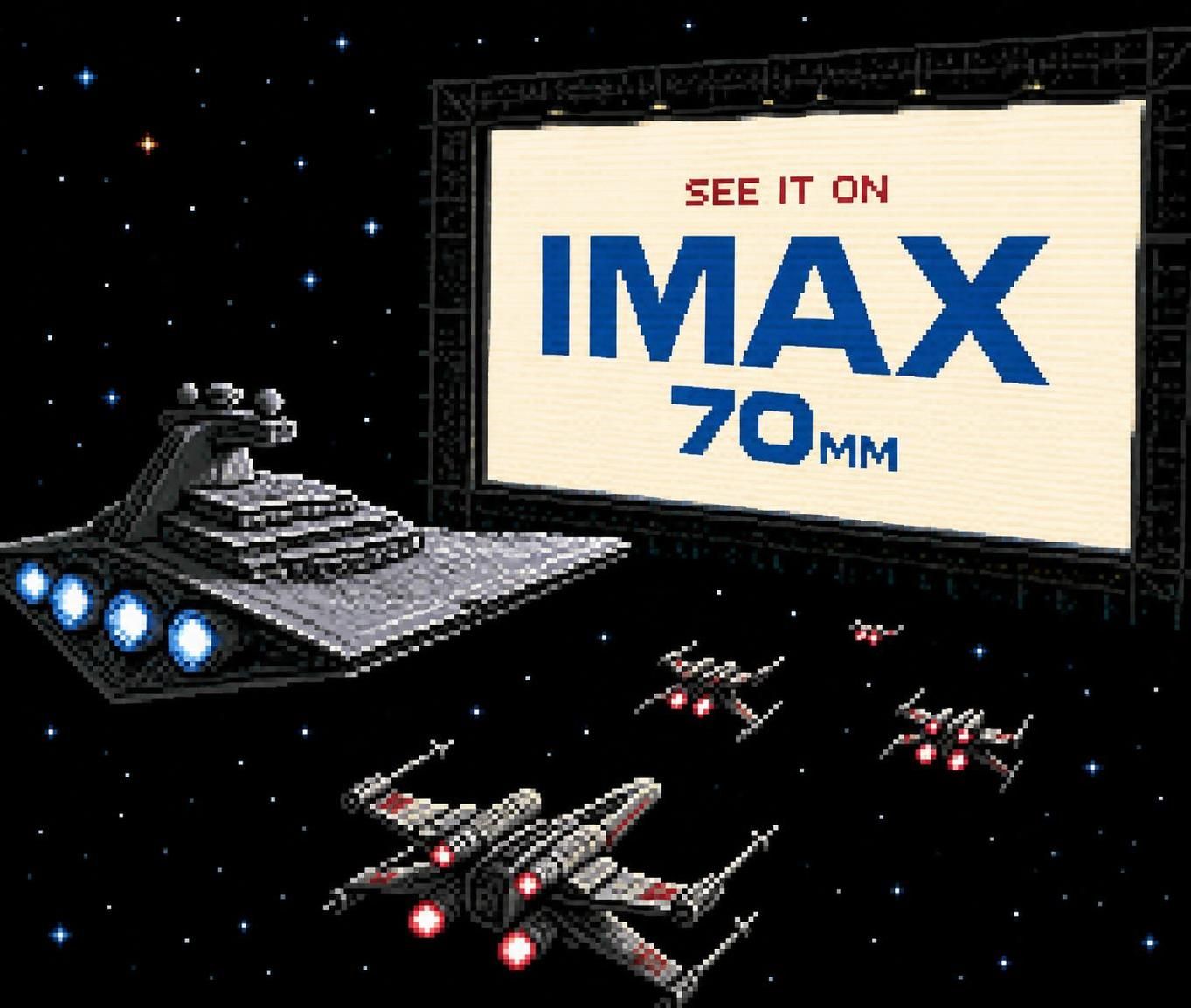
Why the Original 1977 Star Wars Changes Under an IMAX 70MM Screen
The Original Star Wars was engineered for theatrical impact, not for casual background viewing. Its first images establish a hierarchy of scale: a small blockade runner crosses the frame, then an Imperial Star Destroyer follows it with a length that appears to exceed the screen itself. On an ordinary display, the contrast is understood. In IMAX 70MM, it becomes physical. You do not merely register Imperial mass; you are positioned beneath it.
This difference is essential because George Lucas’s 1977 film uses scale as narrative information. The Rebel Alliance begins as a small, vulnerable force. The Empire is presented as industrial, standardized, and seemingly inexhaustible. The opening pursuit communicates that imbalance before any exposition is delivered. A larger screen does not rewrite the scene. It restores the intended asymmetry between a fleeing vessel and a war machine.
The practical design work gains equally from this environment. Ralph McQuarrie’s concept art influenced the visual architecture of the saga, but the finished film avoided sterile perfection. Sandtrooper armor is marked by use. Moisture vaporators interrupt Tatooine’s horizon. The Millennium Falcon carries exposed conduits and uneven surfaces. These choices resemble the cultural patterns of frontier societies: devices are repaired, inherited, modified, and kept in service because survival has priority over elegance.
At a premium film presentation, such details can no longer hide in peripheral vision. You can examine the hand-built nature of the Miniature and effects work without reducing its power. That is a useful paradox. The Original movie’s illusion is strengthened when its construction becomes visible, because the construction is coherent. A Star Destroyer is not merely a visual object; its geometry conveys an Imperial preference for intimidation, order, and central authority.
IMAX 70MM and the Tactical Value of Film Grain
Film grain is often misread as an imperfection to be removed. That approach misunderstands the material. In a restoration, grain preserves texture, photographic depth, and the continuity between actors, sets, models, and optical effects. Excessive digital smoothing can separate those elements. The audience may see a clean image, but it no longer appears to occupy one unified world.
IMAX 70MM makes texture particularly important because the image is expanded across an immense surface. Fine detail is no longer a decorative feature. It becomes part of the scene’s credibility. The dark corridors of the Death Star need shadow and contrast. The desert exterior needs visible heat, stone, fabric, and weathered metal. The cantina needs a crowded visual field in which every alien design contributes to the sense of a functioning port settlement.
You should also consider the soundtrack’s role. John Williams’s score is built around command signals: brass announces Imperial authority, while the main theme frames Luke’s journey as a mythic advance. On a properly calibrated IMAX system, sound and image cooperate as a single tactical system. The score does not simply accompany the Battle of Yavin. It measures the escalation, the uncertainty, and the narrow opening through which victory becomes possible.
- 🚀 Opening pursuit: the Star Destroyer’s scale clarifies the Empire’s material superiority.
- 🏜️ Tatooine textures: grain and restoration detail reveal a frontier world shaped by scarcity.
- ⚔️ Death Star interiors: vast black space and rigid geometry express centralized control.
- 🎼 Williams’s score: large-format sound gives each military and mythic motif greater force.
The strategic lesson is direct: cinematic scale matters only when it serves information. In Star Wars, it does. The IMAX 70MM presentation should expose the original design logic rather than overwhelm it. The Empire’s strength must look immense, because the later Rebel victory is meaningful only when defeat first appears inevitable.
The 1977 Restoration and the Importance of the Original Theatrical Version
The phrase “restored version” demands precision. The 2027 presentation concerns the original 1977 version of Star Wars, not a casual reconstruction of audience memory. This distinction carries unusual importance because the film’s later history includes revisions, altered effects, modified scenes, and changes that have divided viewers for decades. Preservation and alteration are separate operations. One protects a historical object; the other creates a new edition.
The 1977 theatrical cut is not valuable merely because it arrived first. It is valuable because it records the creative decisions that transformed an uncertain production into a cultural landmark. The pacing of the Mos Eisley approach, the timing of Obi-Wan Kenobi’s confrontation with Darth Vader, and the visual rhythm of the Death Star assault belong to a specific cinematic object. If the anniversary release is built around that object, then the event serves archival clarity as well as spectacle.
You may compare this to the restoration of a military archive. A recovered tactical map should show the original markings, including their limitations. Replacing every faded line with modern symbols may make it easier to read, but it prevents later analysts from understanding how commanders actually perceived the battlefield. The same principle applies here. A careful restoration can stabilize, repair, and faithfully reproduce the film without replacing its historical identity.
The official reporting describes the February release as the first IMAX engagement for the movie in either digital or film presentation. Coverage from the official Star Wars anniversary announcement confirms the central components: a newly restored 1977 feature, selected IMAX 70MM film locations, and a limited theatrical return beyond those specialized venues. These details establish a clear chain of command for the release rather than leaving the format claims vague.
What a Restoration Must Preserve
A proper restoration must preserve proportion before it pursues polish. The original effects were achieved through motion-control photography, matte paintings, optical compositing, miniatures, and physical sets. Each technique carries characteristics that belong to the film’s visual language. A slight edge around a composited spacecraft may not represent failure; it may represent the process that made the spacecraft possible in 1977.
The same rule applies to color. Tatooine cannot become a generic digital desert. The Death Star cannot become a uniformly gray environment with no variation in black level. The Rebel base on Yavin 4 requires its jungle contrast: stone surfaces, damp greens, and military equipment placed inside a location that was never designed for a modern war. A restoration should make these relationships legible, not impose contemporary visual fashion upon them.
For the audience, this means preparation is useful. Do not enter the theater expecting a manufactured simulation of modern digital sharpness. Enter expecting an archival work presented with expanded physical presence. The reward lies in observing how much the Original Movie accomplished through disciplined limitation. Scarcity forced invention. The production could not generate unlimited imagery, so it concentrated its visual resources on decisive moments: the first reveal of the Death Star, the Falcon’s escape, and the trench run.
Preservation is not nostalgia. It is the maintenance of evidence. When the 1977 cut reaches IMAX 70MM screens, the task is not to make an old film pretend it was made in 2027. The task is to let its original choices occupy the largest possible field of view without losing their identity. 📽️
Star Wars: Starfighter and the 2027 IMAX 70MM Mission
Star Wars: Starfighter has a different assignment. It is not an archival deployment; it is a new standalone adventure entering theaters on May 28, 2027. The film is directed and produced by Shawn Levy and stars Ryan Gosling as Kade Auberon, a cynical rogue compelled by a mysterious past into a dangerous journey across the galaxy. The description establishes a familiar Star Wars structure: a reluctant figure, concealed history, escalating pursuit, and an encounter with destiny.
Familiar structure is not strategic weakness. The Star Wars myth has repeatedly used recognizable narrative shapes because those shapes provide orientation in a vast setting. Luke Skywalker begins as an isolated farm boy. Han Solo operates as a self-interested smuggler before accepting responsibility. Cassian Andor becomes effective because he understands the cost of survival under an authoritarian regime. Kade Auberon’s cynicism suggests a character who has learned to regard ideals as liabilities. That condition creates a clear pressure point for the story.
The production method is equally relevant. Starfighter was shot with IMAX-certified film cameras for IMAX release, then converted into IMAX 70MM film prints for selected IMAX film venues. This establishes a distinction that should not be ignored. The movie was designed with large-format exhibition in mind, but its 70MM presentation involves a conversion process rather than the straightforward exhibition of footage originally captured on IMAX 70MM negative.
That is not a deficiency. It is a technical fact that helps viewers judge the result accurately. The objective is not to invent a false hierarchy between formats. The objective is to understand how a modern production can use IMAX camera work, expanded imagery, and film-print exhibition to create an event presentation. The film’s success will depend on composition, movement, lighting, sound, and story discipline—not on a format label alone.
Reporting on the double release has emphasized that the 2027 schedule joins the franchise’s beginning to its newest screen story. The industry report on the IMAX 70MM releases frames the pairing as part of the broader fiftieth-anniversary campaign. The timing makes the comparison unavoidable. You will have the opportunity to see what a 1977 production achieved by building its universe physically, then assess how a 2027 production uses contemporary tools under the same large-format conditions.
Kade Auberon as a Strategic Variable
The announced synopsis identifies Kade as a rogue whose past forces him onto a collision course with destiny. Such a figure is useful in galactic conflict because cynicism is often a survival strategy. A person who has seen institutions fail, contracts betray, and alliances fracture will hesitate before choosing a cause. The narrative question is therefore not whether Kade can fight. It is whether he can determine what is worth fighting for.
Shawn Levy’s work frequently combines momentum, character friction, and accessible genre architecture. Ryan Gosling’s screen presence has also moved effectively between controlled detachment and sudden vulnerability, as demonstrated across projects as different as Drive, Blade Runner 2049, and Barbie. These are not guarantees of outcome. They are indicators of the tools available to the production.
The release’s strongest strategic asset is its placement. It arrives after audiences have revisited the Original template on an enormous screen. Starfighter must therefore demonstrate purpose, not merely reference. A new vessel is not valuable because it resembles an earlier fighter. It is valuable because its design, pilot, and mission reveal something the galaxy has not previously shown. 🚀
How IMAX 70MM Shapes the Star Wars Experience
IMAX 70MM is frequently discussed as if it were a simple increase in resolution. That description is insufficient. The format alters the relationship between screen, sound, frame, and spectator. A large-format print projected in a properly equipped IMAX auditorium occupies a far greater visual field than conventional exhibition. The audience does not merely observe an image from a distance; the image becomes an environment with greater physical authority.
This matters for Star Wars because the franchise depends on spatial comprehension. The viewer must understand where a fighter is in relation to a capital ship, where a corridor leads in relation to a hangar, and where a character stands within a social hierarchy. The Death Star trench is effective because it transforms a massive station into a navigable obstacle course. The Battle of Hoth is effective because the white landscape turns distance into danger. Larger presentation can clarify those relationships when the projection and sound systems are properly maintained.
Yet scale can also expose weakness. A crowded digital frame with no compositional priority may become confusing when enlarged. A battle designed only for rapid cutting may lose geography. The 1977 film avoids this problem in the trench run by maintaining a basic chain of command: target, approach, pursuit, defense, and escape. Each cut advances the mission. That is why the sequence still functions as a Classic piece of Sci-Fi cinema rather than an indistinct collection of explosions.
For Starfighter, the challenge is identical but modernized. Contemporary viewers have seen countless aerial and space-combat images. To create distinction, the filmmakers must establish rules: what ships can do, what they cannot do, how pilots communicate, and what environmental pressure shapes a fight. A vessel moving through a debris field is not automatically interesting. It becomes interesting when the debris field changes choices, disables advantages, or reveals the pilot’s tactical character.
- 🎬 Choose the venue carefully: confirm whether the theater is presenting the IMAX 70MM film print or another IMAX configuration.
- 🗓️ Plan early: selected film locations will have limited capacity and finite engagements.
- 🔊 Arrive before the feature: calibration, trailers, and the auditorium’s scale are part of understanding the presentation environment.
- 👁️ Watch frame geography: track ship positions, entrances, exits, and objective markers instead of following spectacle alone.
- 📜 Compare methods, not eras: examine how the 1977 film and Starfighter solve visual storytelling with different tools.
The title “IMAX 70MM” should therefore be treated as a promise of conditions, not as an automatic verdict of quality. It provides a battlefield with more room. What matters is how filmmakers use that room. Scale is effective only when discipline governs it.
The Military Design Language of the Empire, Rebels, and Starfighter
Star Wars has always communicated political structure through objects. Imperial vessels are angular, monochrome, symmetrical, and centrally controlled. Rebel craft are patched, individual, and visually diverse. These are not merely decorative differences. They are cultural documents. An Empire that relies on intimidation builds ships that dominate the skyline. A rebellion dependent on recovery and adaptation keeps old equipment operational and assigns value to individual skill.
Consider the TIE fighter. Its central cockpit and vertical wing panels give it a silhouette that resembles a symbol rather than a machine built for comfort. It is instantly recognizable, efficient in visual design, and expendable in narrative logic. The Empire can field many of them because its doctrine assumes quantity, command coordination, and replaceable personnel. The X-wing carries a different message. Its wings open mechanically, revealing a machine that transforms according to tactical need. It is a tool of flexibility.
These visual philosophies are reinforced by sound. The TIE fighter’s scream announces speed and threat, but it also suggests instability. The X-wing’s engine sound is steadier and more mechanical, aligning with the pilots’ dependence on precision. In the 1977 Movie, the Battle of Yavin works because audiences can recognize a fighter’s allegiance and function before dialogue explains it. Art becomes operational intelligence.
That principle should remain relevant to Star Wars: Starfighter. New ships must not merely possess new shapes. Their silhouettes should indicate faction, resources, risk tolerance, and doctrine. A pirate craft should look maintained through improvisation. A corporate security vessel should suggest efficiency and surveillance. A forgotten military fighter should carry evidence of its prior war. If Kade Auberon is truly shaped by a mysterious past, the machinery around him can provide clues long before exposition does.
Art as a Map of Conflict
Across the Star Wars galaxy, art and warfare overlap. Mandalorian armor records lineage, clan memory, and survival; it is both protection and declaration. Imperial uniforms erase individuality in favor of institutional identity. Jedi artifacts imply a tradition that values patience, balance, and long observation. Each culture’s artistic choices reveal how it expects conflict to occur.
You should watch the 2027 releases with this method in mind. In the 1977 film, note how Imperial spaces remove clutter while Rebel spaces accumulate equipment, people, and improvisation. The contrast tells you which side has resources and which side has urgency. Neither visual language is accidental. The Empire’s weakness is not lack of force. Its weakness is the belief that force and order eliminate the need to understand irregular opponents.
At Endor, the Imperial garrison had superior equipment. Its failure emerged because local variables were treated as irrelevant. The Ewoks were not a decisive military power at the beginning of the operation. They became decisive once terrain, surprise, and underestimated cultural knowledge altered the battlefield. The same analytical method applies to film design: neglected details often reveal the forces that will matter later.
In Star Wars, a ship’s silhouette is often a strategic report. IMAX 70MM enlarges that report, giving viewers more evidence with which to read the galaxy’s competing systems. ⚔️
Planning the Best 2027 IMAX 70MM Star Wars Screening
A limited large-format engagement rewards preparation. The February 19 return of the Original film and the May 28 arrival of Starfighter will not be interchangeable events. One is an anniversary restoration with historical significance; the other is a new release designed for IMAX presentation. You should plan for both according to different objectives.
For the 1977 release, priority should be authenticity of presentation. Verify the exact theater listing rather than assuming that every auditorium using the IMAX name will project the same format. A venue may offer digital IMAX, while only a smaller number will screen an actual IMAX 70MM print. Both can be valuable, but they are different experiences. Precision prevents disappointment.
For Starfighter, early booking will likely matter because its May date aligns with the franchise’s anniversary weekend. The wide appeal of a new Star Wars feature, Ryan Gosling’s casting, and the scarcity of 70MM film locations create a predictable pressure on premium seats. A rational strategy is simple: identify the nearest qualified venue, monitor official ticket announcements, and choose a screening time that allows attention rather than hurried arrival.
The best seat is not always the closest one. In a towering IMAX auditorium, extreme proximity can make it harder to track the whole frame during fast movement. A central seat, positioned where the screen fills the field of view without forcing constant head movement, usually supports better spatial analysis. The objective is not to be overwhelmed. It is to retain command of the image.
| Preparation step | Reason | Operational result |
|---|---|---|
| 📍 Confirm the projection format | IMAX branding includes more than one technical configuration | ✅ You know whether the screening uses a 70MM film print |
| 🎟️ Monitor advance tickets | Selected sites have limited seats and runs | ✅ Better choice of date and auditorium position |
| 🪑 Select a centered seat | Large frames require broad visual coverage | ✅ Improved understanding of action geography |
| 📵 Remove distractions | Both films depend on sound, rhythm, and environmental detail | ✅ A more complete Movie Experience |
There is also value in seeing the films in chronological order. The February screening can establish the original visual grammar: heroic framing, used-world detail, mythic score, and sharply defined faction design. The May screening can then be assessed with fresh evidence. Does the new film use its larger canvas to create new geography? Does it understand that a Starfighter sequence needs a mission, not merely motion? Does its protagonist’s past influence the visual and tactical world around him?
These questions transform attendance from passive consumption into deliberate observation. The strongest theater visit is one in which the screen remains entertaining while also revealing how its systems are constructed. Preparation gives the viewer the advantage before the lights go down. 🎯
What the IMAX 70MM Double Release Means for Future Star Wars Cinema
The 2027 double release offers a test for Lucasfilm, IMAX, exhibitors, and audiences. It tests whether film-based premium exhibition can remain a meaningful event in an era of abundant home viewing. It tests whether a foundational work can return without being reduced to a disposable brand exercise. It also tests whether a new Star Wars story can use the legacy of the Original without becoming dependent on repetition.
The paired releases have a clear advantage: they create context. The 1977 feature demonstrates that limitations can produce visual discipline. Its effects had to be planned, built, photographed, and composited. Each major spectacle moment represented significant cost and coordination. That pressure encouraged selection. The film does not attempt to make every second visually maximal. It chooses when to deploy scale.
Starfighter enters a different environment. Modern filmmaking can generate vast imagery with greater flexibility, but flexibility carries risk. When nearly anything can be shown, the audience needs a reason to care about what is shown. The decisive resource is not technological capacity. It is narrative prioritization. A chase must reveal character. A battle must change the situation. A large screen must reveal information unavailable at smaller scale.
This is where the 50th-anniversary framework becomes more than ceremonial. The Original Star Wars can function as an operational reference point. Its characters are introduced through action: Leia resists interrogation, Luke looks beyond his horizon, Han negotiates under pressure, Vader pursues with cold certainty. Their roles are visible before their histories are fully explained. Future films can apply the same logic. Let the audience infer the world through decisions, material culture, and consequences.
The use of IMAX 70MM also signals that theatrical exhibition remains capable of offering something distinct from streaming. A home screen can deliver convenience and repeated access. It cannot duplicate the mechanical presence of a large film print, the communal silence before an opening image, or the sensation of a Star Destroyer extending beyond ordinary visual expectation. Those elements are not sentimental artifacts. They are conditions that change perception.
A Durable Lesson From the Original Star Wars
An adversary—or a filmmaker—does not need unlimited resources to achieve dominance. It needs clarity about where force should be applied. The 1977 production concentrated its attention on readable mythology, bold design, practical texture, and a final battle with unmistakable stakes. Its influence did not emerge from complexity alone. It emerged from coherent choices reinforcing one another.
The future of Star Wars cinema can benefit from that model. New worlds should carry social logic. New heroes should reveal themselves through decisions. New antagonists should possess doctrine rather than generic menace. New battles should use terrain, timing, and uncertainty. If these elements are present, IMAX 70MM becomes an amplifier rather than a disguise.
For audiences, the 2027 program supplies a rare opportunity: a Classic Original and a new Starfighter story, both presented as major theatrical operations. The first shows how a galaxy was built from physical craft and precise visual strategy. The second must demonstrate how that galaxy can continue to expand with purpose. The largest screen is most valuable when every image has something important to report. 🌌

I am Grand Admiral Thrawn, strategist of the Galactic Empire. Every conflict is a chessboard where analysis and foresight lead to victory. The art and culture of a people betray their weaknesses. The Empire embodies order and discipline in the face of rebel chaos. History will remember that only strategy ensures peace.