
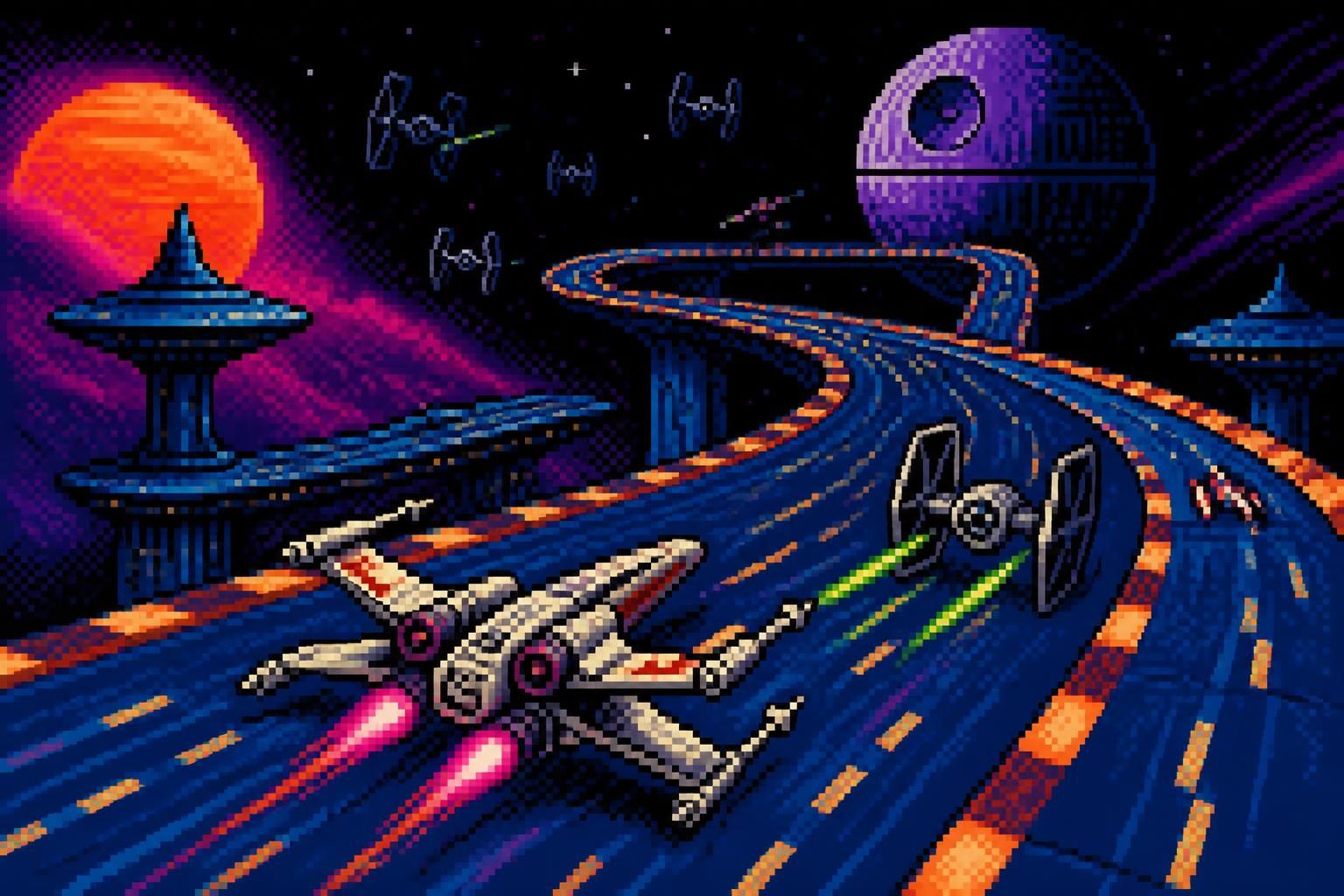
Star Wars: Galactic Racer Official Soundtrack Release Aligns Music With Launch Day
The release plan for Star Wars: Galactic Racer is built around a precise operational decision: the complete official soundtrack arrives on October 6, the same day the game becomes available worldwide. The game’s music is therefore not being treated as secondary promotional material. It is being positioned as a parallel component of the experience, available to listeners before, during, and after their first competitive runs across the galaxy.
You should note the advantage of this arrangement. A racing game depends on immediate sensory direction: speed must be felt before it is measured, danger must be anticipated before a collision occurs, and a rival must appear significant before the player sees their name on the grid. A soundtrack released at the moment of launch can support all three objectives. It gives the game’s sonic identity a fixed presence rather than allowing it to become an unnoticed layer beneath engine noise and visual spectacle.
Fuse Games and publisher Secret Mode have set Galactic Racer in the early era of the New Republic, a period defined by unstable borders, commercial opportunity, local power struggles, and the remnants of prior galactic conflict. This setting matters because competitive racing is not merely entertainment in such conditions. It is a visible contest for status, sponsorship, influence, and access to increasingly valuable routes between worlds.
The official material establishes that the score contains 21 tracks and runs for approximately one hour. That scale indicates a musical plan extending beyond a single menu loop or a collection of short circuit cues. It permits distinct identity markers for racing environments, character encounters, upgrades, pursuit sequences, results screens, and narrative turns. In tactical terms, the music can establish the player’s understanding of a situation before dialogue or gameplay systems explain it.
The soundtrack’s rollout also has a measured promotional sequence. The main title theme, “The Soul of Racing,” has been released ahead of the full album. This initial piece functions as reconnaissance: it allows the audience to study the game’s central musical language without revealing every terrain cue, rival motif, or dramatic escalation contained in the larger score. The complete album remains reserved for release day, preserving material for those who enter the campaign and multiplayer circuits.
For players assessing the game’s broader context, the Galactic Racer news archive places the soundtrack announcement alongside trailers, release information, and updates concerning the project. The pattern is clear. The game is being deployed as a unified Star Wars production, not as a race simulator decorated with familiar symbols after its central design was complete.
That distinction has consequences. In a generic sci-fi racer, music can simply maintain momentum. In Star Wars, musical choices carry accumulated meaning from cinema, animation, television, and earlier games. A brass figure may suggest public ceremony, a low string texture can imply concealed authority, and a rhythmic ostinato can turn an open desert route into an arena of imminent danger. The composer must use those associations without allowing them to dictate every decision.
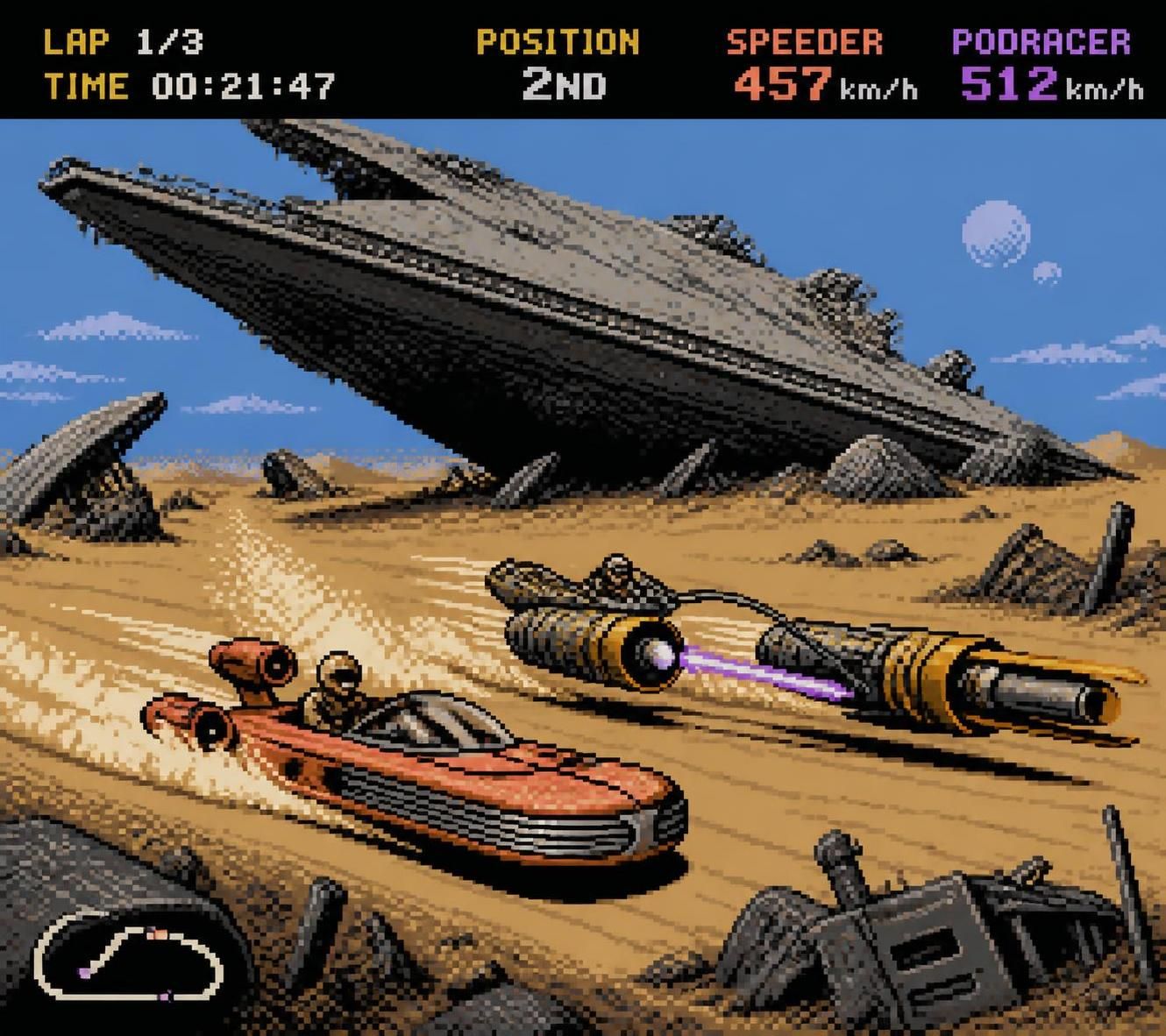
Consider Jakku, one of the worlds named for the game’s racing action. Its visual identity is built from wreckage, sand, scavenger economies, and the remains of a vast military defeat. A course through such terrain cannot be scored as though it were a polished Republic capital circuit. The sound must account for exposed metal, heat, instability, and the persistent evidence of machines that failed long before the race began. A well-designed cue makes the terrain a participant in the contest.
The same principle applies to the release date. October 6 is not only a commercial marker. It becomes the moment when the player, the soundtrack listener, and the competitor inside the game’s fiction encounter the same central proposition: velocity is meaningful only when it has direction. The music must define that direction with greater discipline than raw acceleration alone can provide.
⚡ The official release strategy establishes the score as a navigational system for Galactic Racer, not merely an accessory to its engines.
The Soul of Racing Main Title Theme Defines Galactic Racer’s First Tactical Impression
“The Soul of Racing (Main Theme)” is the first complete track made public from the Star Wars: Galactic Racer soundtrack, and its assigned function is strategically significant. It is intended to play at the loading screen, making it the first sustained piece of music heard when the game begins. Before the player chooses a vehicle, evaluates a course, or meets a rival, this cue establishes the terms of engagement.
You should not underestimate the loading screen. It is a threshold where anticipation can either sharpen attention or dissipate it. In an effective racing title, this interval is not empty time. It is an opportunity for the music to convert waiting into readiness, presenting an aural image of the world that the player is about to enter.
The revealed theme builds with urgency rather than remaining static. That construction is appropriate for space racing, where speed is not represented simply by a faster tempo. Speed is created through escalation: percussion may narrow the listener’s sense of space, strings may tighten into repeated motion, and brass may expand the apparent scale of the route ahead. The listener perceives a machine approaching ludicrous speed even while standing still at a menu.
Its title also requires attention. “The Soul of Racing” does not frame competition as an engine test. It points toward a more complex idea: racing as a culture with memory, personal ambition, risk, craft, and ritual. On Tatooine, podracing is bound to crowds, gambling, mechanics, local prestige, and brutality. On more organized worlds, racing may become league sport, commercial spectacle, or political influence. Galactic Racer can draw from each of these forms without reducing itself to an imitation of any one of them.
The game’s protagonist, Shade, enters the Galactic League as an emerging racer with a grievance against the well-connected Kestar Bool. A title cue must therefore serve two audiences within the fiction. It must sound like a public anthem for the League’s spectacle, but it must also carry enough tension to suggest that the system is not neutral. A racer without connections must win through observation, alliances, mechanical preparation, and calculated risk.
This is where the Star Wars musical tradition becomes useful rather than restrictive. A familiar film score language can communicate scale and mythic possibility quickly. Yet the game needs an original sonic signature, because Shade’s ascent is not a retelling of a Jedi campaign or a fleet engagement. It is a struggle conducted in garages, launch lanes, damaged canyons, commercial districts, and rapidly changing race positions.
The theme’s early release also performs a practical function for the audience. It gives listeners a reference point before the rest of the 21-track album arrives. When a player later hears a more restrained mechanical cue, a hostile rival motif, or a broad victory arrangement, the main title theme can act as the central standard against which those pieces are understood. It creates cohesion across a game that moves among several vehicle classes and varied worlds.
An isolated track can be examined through repeated listening in a way that gameplay often prevents. During a difficult race, the player will focus on braking points, obstacles, shortcuts, weaponized hazards, and opponents. Outside the game, the main title theme reveals its structure more clearly. This is why its availability on streaming platforms before launch matters: it transforms promotion into familiarity, then allows familiarity to deepen immersion once the campaign starts.
The current soundtrack listing on the official album page gives listeners a direct route to the release information surrounding the score. The decisive point remains the same: the cue is designed to become associated with the first activation of the game, a moment repeated by every player who returns to the garage, the race calendar, or an unfinished rivalry.
For comparison, the strongest Star Wars themes have frequently attached themselves to actions rather than abstract ideas. They accompany pursuit, discovery, resistance, arrival, sacrifice, or the emergence of a threat. “The Soul of Racing” applies this discipline to competitive motion. It does not need to tell the player that the galaxy is vast. It needs to make the next starting signal feel consequential.
🎵 The main title theme succeeds as a mission statement when it makes every loading screen feel like the seconds before a decisive launch.
Gordy Haab Brings a Star Wars Film Score Discipline to Galactic Racer Music
The selection of Gordy Haab as composer provides Galactic Racer with an advantage that is easy to identify. His prior work in Star Wars games demonstrates an understanding that this universe does not rely on imitation alone. Its musical continuity depends on recognizing why certain orchestral colors, melodic contours, and dramatic structures endure, then applying those principles to a new tactical situation.
Haab has scored multiple Star Wars projects, including the turn-based strategy title Star Wars: Zero Company. That previous assignment required a different form of musical reasoning. A strategy game operates through deliberation, command decisions, deployment, uncertainty, and the consequences of incomplete intelligence. Galactic Racer operates through reaction, timing, spatial awareness, and the ability to transform a narrow opening into a sustained advantage.
The contrast between those game types is useful. In Zero Company, a cue can support planning and controlled escalation. In Galactic Racer, the same composer must account for immediate physical momentum. Music cannot hesitate when the player has entered a dangerous bend, deployed a boost, or found a route beneath a competitor’s line of sight. Its structure must acknowledge that victory may change hands within seconds.
The published account of Gordy Haab’s work on Zero Company helps establish the wider context for this transition. The composer’s value lies not in repeating one solution across every project. It lies in adapting a recognizable Star Wars framework to the distinct requirements of a new genre. A tactical battlefield and a high-speed circuit both require clarity, but they demand different rhythms of decision.
Haab has explained, through official behind-the-scenes material, that he sought a sound that was fresh while still belonging naturally within the established Star Wars musical landscape. This is the correct objective. A score that relies too heavily on established themes risks turning Galactic Racer into a museum of references. A score that rejects the franchise’s musical heritage entirely risks making the game feel detached from the galaxy it claims to depict.
You can observe this balance in the demands of the setting. The early New Republic is neither the confident order of the Republic’s height nor the rigid military hierarchy of Imperial control. It is an era of reconstruction, improvised authority, and competing local interests. The music should therefore contain energy and openness, but it must leave room for instability. A race league may be a celebration of mobility, yet it can also expose economic inequality, political favors, and personal vendettas.
Haab’s score must also account for the engine sounds and environmental effects inherent to the genre. A composer writing for space racing cannot occupy every frequency range. Landspeeders, speeder bikes, skim speeders, crowds, warning systems, impacts, and weather must remain intelligible. The most effective music will not compete with these elements; it will arrange itself around them. Percussion can support acceleration without obscuring mechanical feedback. Brass can signal a new phase without drowning out a rival approaching from behind.
That balance resembles fleet doctrine. A commander who commits every vessel to the same firing lane creates congestion, not superiority. Each unit needs a defined role. In audio design, the score provides dramatic perspective, while effects provide operational information. If either overwhelms the other, the player loses either emotional direction or practical awareness.
The Star Wars tradition has always benefited from composers who understand musical architecture. Themes return in altered conditions; motifs reveal a changing relationship; orchestration determines whether a familiar idea becomes heroic, compromised, ironic, or threatening. Galactic Racer can use this architecture for characters such as Shade, Hibi, Sebulba, and Kestar Bool. Their musical material does not need to appear as simplistic labels. It can evolve as alliances, risks, and competitive standing change.
Such development is particularly important for a game that combines racing with adventure elements. A single circuit can be exciting, but a campaign requires memory. The player must sense that an earlier defeat influenced the next encounter, that a mechanic’s aid altered the machine’s potential, or that a rival’s public confidence conceals a tactical weakness. Music is capable of recording those shifts without stopping the action to explain them.
🎼 Haab’s task is not to make Galactic Racer sound familiar; it is to make a new form of competition sound inevitable within Star Wars.
Galactic Racer Vehicle Classes Require Distinct Soundtrack Strategies
Galactic Racer does not restrict the player to one machine type. Shade will pilot landspeeders, speeder bikes, and a newly introduced craft called the skim speeder. Certain levels also allow the operation of podracers connected to familiar characters from The Phantom Menace. This variety is not a minor feature. It demands a soundtrack capable of distinguishing movement styles without fragmenting the game’s broader identity.
A landspeeder suggests controlled hovering mass and stability across uneven surfaces. Its musical support can emphasize broad forward motion, sustained propulsion, and the confidence of a vehicle built to absorb difficult terrain. A speeder bike requires another approach. It is narrow, exposed, agile, and dependent on reflexes. The music accompanying it should allow for sharper rhythmic changes, tighter orchestration, and more sudden tactical pivots.
The skim speeder presents the most useful unknown. Because it is a new vehicle category, its sound and handling can become a central part of Galactic Racer’s identity. The name implies close interaction with a surface, perhaps exploiting terrain in ways that a conventional landspeeder cannot. If so, its music should stress precision and proximity. The player should feel that every ridge, wall, and debris field could either become an advantage or end the run.
Podracers require a different cultural reference. Their legacy begins with Boonta Eve, where the machinery is excessive, the risks are public, and speed is inseparable from spectacle. A podracer is not merely a fast vehicle. It is an unstable arrangement of engines, cables, heat, noise, and pilot nerve. Music for these levels should recognize the tradition without simply reproducing past sound. The player is not watching a historical race from a grandstand; the player is responsible for surviving one.
The full track list, reported in the soundtrack track listing coverage, confirms the scale of the musical program. With 21 pieces available, the score has sufficient room to identify vehicle forms, environments, story sequences, and high-pressure racing events. The most disciplined use of that capacity will assign musical purpose rather than treating every track as a variation of acceleration.
| Vehicle class | Operational character | Soundtrack requirement |
|---|---|---|
| 🚗 Landspeeder | Stable hover travel across demanding ground | Broad propulsion, durable rhythm, expanding orchestral space |
| 🏍️ Speeder bike | Agile movement with high exposure to hazards | Tighter pulse, abrupt turns, alert percussion |
| ✨ Skim speeder | New surface-skimming racing technology | Precise textures, fast transitions, distinctive sonic identity |
| 🔥 Podracer | Extreme velocity and mechanical instability | Layered intensity, crowd-scale spectacle, controlled chaos |
You should view the table as a framework rather than a rigid rule. A landspeeder can become desperate when it is being hunted through a narrow industrial route. A speeder bike can become triumphant when it finds a shortcut through an open canyon. The point is that the score should begin with the vehicle’s core behavior, then transform as the race situation changes.
These distinctions also help the player learn. When a musical phrase changes as a skim speeder enters an advantageous surface lane, the soundtrack can reinforce the game’s physical logic. When percussion becomes clipped as a speeder bike moves into a dangerous forest or wreckage corridor, the player’s attention is directed toward risk. This is not manipulation in the crude sense. It is an efficient alignment of audio, machine behavior, and player perception.
Hibi, Shade’s Ardennian mechanic, provides a narrative mechanism for this system. A mechanic understands that a machine’s limits are never abstract. Cooling, grip, balance, energy distribution, and component quality determine whether a racer can capitalize on an opening. The score can mirror this relationship by growing more confident or more complex as the player learns how each craft performs.
The strongest example will come when the game places the player in a vehicle that feels initially unfamiliar. A new control scheme can create confusion. A focused musical identity can reduce that confusion by making the craft’s intended rhythm perceptible. The player begins to understand not only what the machine does, but how it wants to move through the course.
🏁 Vehicle variety becomes meaningful when the music gives every machine a distinct tactical voice.
Shade, Hibi, Sebulba, and Kestar Bool Create a Competitive Star Wars Music Drama
The campaign structure of Galactic Racer is built around more than lap times. Shade is an aspiring competitor entering the Galactic League with a personal grievance against Kestar Bool, a figure protected by strong connections. This establishes a familiar strategic imbalance: one side possesses access and institutional advantage, while the other must build capability through skill, intelligence, and carefully chosen alliances.
Shade’s friendship with Hibi provides the first counterweight to that imbalance. An Ardennian mechanic is not merely an assistant standing beside a vehicle. In racing, the mechanic is an intelligence officer, quartermaster, engineer, and adviser combined. Hibi can identify weaknesses that a driver cannot see at speed, interpret mechanical failures, and turn limited resources into a reliable competitive edge.
Sebulba’s presence introduces another factor. His name carries the legacy of podracing, where intimidation, aggression, and opportunism are accepted tools. He is useful because he represents experience that Shade cannot obtain through raw determination alone. Yet experience in this galaxy is rarely neutral. A veteran can teach an emerging racer how to survive, but the student must still determine which methods preserve a future and which only win a single race.
The music should reflect these relationships through development rather than simple assignment. It would be inefficient for every appearance of Shade to receive the same melodic statement. Early cues might present an incomplete line, reflecting unproven potential. As Shade gains control over different vehicles and begins to understand the League’s structure, that material can become firmer, more expansive, or more rhythmically assured.
Hibi’s material could emphasize construction and adaptation. The goal would not be to create a decorative “mechanic theme,” but to signal practical ingenuity: a pattern that accumulates layers, finds order among disparate parts, or turns apparent noise into coordinated motion. Such a method would suit a character whose contribution is measured through preparation rather than public applause.
Kestar Bool requires a more controlled approach. A well-connected rival does not need constant musical threats to appear dangerous. The more effective choice is often restraint. A polished, confident figure can imply resources, access, and influence without revealing direct aggression. If the score becomes more unstable around Kestar as the campaign develops, the listener can infer that the apparent order was always supported by pressure beneath the surface.
For Sebulba, the challenge is cultural memory. The character is associated with podracing’s rougher traditions, and any musical reference must acknowledge that history without allowing nostalgia to replace narrative function. A brief rhythmic shape, an abrasive instrumental color, or an altered race motif may be enough. The score does not need to announce his arrival with excessive force. His reputation already performs part of that task.
The useful parallel is found in military alliances. An ally’s strength is not measured only by how much power they bring. It is measured by whether their experience addresses the problem actually facing the force. Shade’s problem is not simply to drive faster. It is to enter a hierarchy designed to favor those who already possess influence. Hibi’s technical knowledge and Sebulba’s competitive history address different parts of that challenge.
- 🏎️ Shade represents developing capability under pressure from an unequal system.
- 🔧 Hibi represents preparation, engineering judgment, and the conversion of maintenance into advantage.
- ⚙️ Sebulba represents hard-earned racing knowledge and the dangerous lessons of past circuits.
- 🏆 Kestar Bool represents established access, status, and a rival position that must be dismantled through evidence.
Music can make these roles legible even when the player is occupied with a race. A short recurrence before a difficult event may remind the player why the contest matters. A changed orchestration after a defeat can indicate that the opponent’s influence has expanded. A more open statement after a successful race can show that Shade’s options have widened. These are subtle operations, but subtlety is often more durable than explanation.
Where a conventional sports game might use generic rival cues, Galactic Racer can construct a space racing narrative in which every relationship affects the sound of forward movement. The player is not advancing through isolated tracks. The player is advancing through a league shaped by people, machines, reputations, and cultural histories.
🎯 The central conflict is not speed against speed; it is earned competence against influence, and the score must expose that difference.
Jakku and the Early New Republic Give Star Wars Galactic Racer a Distinct Sci-Fi Racing Identity
The early New Republic setting is an important structural choice for Galactic Racer. It avoids the administrative certainty of Imperial rule while also avoiding the fully stabilized optimism that later generations may imagine. Authority exists, but it is uneven. Local actors can build influence quickly, and commercial organizations can become powerful in spaces where government oversight remains incomplete.
In this environment, racing can serve several purposes simultaneously. It can entertain citizens, attract sponsors, move technology, settle rivalries, and create local heroes. It can also reveal the division between competitors who have access to training, parts, transport, and publicity and those who must assemble their opportunities from scarce resources. Shade’s conflict with Kestar Bool becomes credible because the era permits such disparities to operate in public view.
Jakku provides a particularly effective arena for this premise. The planet is marked by the debris of war, especially the remains of Imperial military equipment that transformed its landscape. To race there is to move through a historical record written in corroded hull plates, sand-covered machinery, and discarded power. The course itself becomes evidence that massive force does not guarantee lasting control.
That observation should shape the soundtrack. A cue for Jakku should not rely only on desert clichés. Its defining characteristic is not sand alone, but sand interacting with ruins. The music can use dry rhythmic figures and open intervals, yet it should also imply weight, collapse, and forgotten scale. A distant brass sonority could evoke the ghost of a military past; a fractured mechanical pulse could suggest scavenged technology still functioning against expectation.
This is where cultural analysis becomes useful. The art of a people reveals what they choose to preserve, what they fear, and what they are prepared to rebuild. Jakku’s scavenger culture is born from reuse. An abandoned Imperial component is not merely debris; it may be shelter, trade goods, a repaired engine part, or proof of a lost battle. A racing circuit through that territory should sound improvised, resourceful, and wary of overconfidence.
Other worlds in Galactic Racer can create different musical challenges. A dense urban route requires the score to negotiate traffic signals, crowds, verticality, and commercial spectacle. A forested speedway needs alertness and narrow spatial perception. A remote industrial course can emphasize repetitive machinery and heavy infrastructure. The soundtrack’s purpose is not to force identical excitement onto each location. Its purpose is to reveal what each environment asks of the racer.
You should also consider the relationship between the New Republic era and the game’s arcade energy. The term sci-fi often implies technological novelty, but Star Wars has always paired advanced machinery with visible wear, personal improvisation, and political history. Galactic Racer has the opportunity to preserve that balance. Its vehicles may move at extraordinary velocity, but their engines should still feel tuned, repaired, and dependent on people who understand their limits.
The game’s adventure elements reinforce this approach. A route is not only a track; it is a location in a galaxy recovering from conflict. The player may race for glory, but the surrounding world carries evidence of earlier decisions. This creates a stronger foundation for music than empty visual spectacle would provide. The composer has terrain, culture, factional memory, and character ambition to work with.
The official reveal material for the Galactic Racer trailer establishes the game’s broader premise of high-speed competition within this familiar but evolving galaxy. The soundtrack announcement now gives that visual proposition an audible counterpart. Both must work together if the setting is to feel inhabited rather than assembled from references.
There is a practical lesson here. An adversary who sees terrain as background will be defeated by someone who understands it as a weapon. A racer who sees Jakku only as a desert may miss the opportunities and hazards created by its wreckage. The music can teach the player to hear those distinctions before they become visible at full speed.
🌌 Galactic Racer’s worlds matter because their histories alter the race, and the score must make those histories audible.
How the Complete Galactic Racer Soundtrack Can Support Gameplay Beyond the Main Title Theme
A complete game soundtrack must solve a problem that an album does not. An album is heard in a fixed order, with no interruption from player choices. A video game score must remain coherent when the player retries an event, pauses in a garage, changes vehicle class, loses a lead, discovers a shortcut, or returns to a previously completed world. Galactic Racer’s approximately hour-long release therefore represents a curated listening experience, while the game itself requires adaptive musical logic.
The main title theme is the initial signal, but it cannot carry every task. If the game repeated “The Soul of Racing” during each event without alteration, the cue would lose authority. Its power comes from its position at the threshold and from its potential to return in modified form at pivotal moments. A final championship race, for instance, might use fragments of the title material within a more aggressive arrangement, allowing the player to recognize the destination without being told directly.
Race music should be organized around phases. The opening phase needs clarity: countdown, launch, early positioning, and the recognition of route conditions. The middle phase can introduce pressure through pursuit, obstacles, weather, or competitive interference. The final phase must avoid predictable escalation. If every race simply becomes louder at the last lap, the player will learn the formula rather than respond to the circumstances.
A better method is conditional intensity. A close race can heighten percussion and harmonic tension. A substantial lead can open the texture but leave a restrained warning beneath it, reminding the player that confidence must be justified. A sudden crash, ambush, or route collapse can strip away layers briefly, allowing the recovery moment to feel earned. This produces dynamic contrast, which is more valuable than constant volume.
Menus and garages deserve equal attention. These are the spaces where Shade’s position in the Galactic League can be considered, where Hibi’s work gains meaning, and where the player makes decisions that affect the next contest. The music here should not resemble a passive waiting room. It should suggest preparation. Light mechanical motifs, incomplete versions of race material, or quieter character figures can communicate that the next victory begins before the engines start.
The score can also clarify narrative stakes without relying on excessive dialogue. If Kestar Bool’s influence is felt in an event, a controlled harmonic color may appear in sponsor announcements, crowd arrangements, or pre-race scenes. If Shade gains a new ally or earns access to better equipment, the music may become more integrated rather than simply more triumphant. Progress is not always louder. Often it is more stable.
The history of Star Wars music demonstrates the value of thematic transformation. A recognizable melodic idea can change meaning when tempo, harmony, instrumentation, or context changes. This principle is especially useful for a game about racing because repeated play is unavoidable. The same course may be attempted many times, but the listener’s experience can remain fresh if the music responds to new conditions rather than remaining locked in one arrangement.
For listeners interested in how contemporary Star Wars scores are received outside the game itself, the broader discussion of the impact of Star Wars soundtrack releases shows why individual tracks continue to matter after their original scenes or missions are complete. Galactic Racer can benefit from that tradition. A cue associated with a difficult Jakku event or a decisive confrontation may become memorable precisely because players attach it to their own attempts and successes.
There is also a restraint requirement. Not every moment needs a grand orchestral declaration. The absence of a dominant melody can make a quiet repair scene, a tense briefing, or a solitary drive through a damaged route more effective. Silence, reduced texture, and controlled sound design can create room for the next major musical statement to exert real force.
The album format will reveal only part of this architecture. Players will discover the rest through interaction. They will learn which cues accompany their preferred vehicles, which musical shifts warn of a changing race state, and which themes become attached to rivals or locations. This is the advantage of a score built for play rather than merely placed beside it.
🔊 The full soundtrack earns its strategic value when it reacts to player action while preserving a clear musical chain of command.
Official Release Timing Makes Galactic Racer Music a Shared October 6 Event
The simultaneous arrival of the game and its complete soundtrack on October 6 creates a unified event for several different audiences. Players can discover the music in context, dedicated soundtrack listeners can study the album independently, and Star Wars fans can compare the score’s new material with the franchise’s established musical heritage. This coordinated deployment is more effective than delaying the album until after public attention has shifted elsewhere.
For a game scheduled for PlayStation 5, Xbox Series X|S, and Windows, launch day is fragmented across hardware ecosystems. The soundtrack creates a point of common access. A listener does not need to own the same platform as a competitor in order to recognize the title cue, discuss a character motif, or anticipate the sound of a particular circuit. Music can cross those divisions with little resistance.
The complete release is especially useful because Galactic Racer is positioned as both a competitive racing game and an adventure-driven story. Competitive players may focus on handling, time trials, and multiplayer advantage. Narrative-focused players may track Shade’s rivalry, Hibi’s role, Sebulba’s involvement, and the political imbalance represented by Kestar Bool. The score can serve each group without requiring separate versions of the experience.
Streaming access also changes the life of the material. Before such distribution, a game’s score might remain tied to the player’s memory unless a separate physical release was produced. Now a listener can return to the title music during travel, work, exercise, or preparation for another session. The track becomes part of an ongoing relationship with the game rather than a sound heard only within a loading screen.
This does not diminish the game’s importance. It strengthens it. When listeners recognize a cue outside the game, they often return with heightened attention. A phrase that seemed like background during a difficult race may become distinct after repeated listening. On the next attempt, the player hears its warning, its momentum, or its character association more clearly. The music and the game reinforce each other through repetition.
The official release plan also permits the score to be judged on its own construction. A 21-track album must sustain interest without the immediate visual support of a race. That requires variation in pacing, orchestration, and dramatic scope. It requires tracks that function as locations, characters, transitions, and climaxes rather than a continuous sequence of similar engine-driven crescendos.
The early release of “The Soul of Racing” is therefore a controlled advance rather than a replacement for the album. It offers one clear signal while withholding the larger formation. The audience knows the game’s central musical attitude: forward movement, urgency, and a distinctly Star Wars sense of scale. The remaining tracks can now expand that signal through terrain, narrative, vehicle technology, and competitive pressure.
It is useful to compare this decision with the traditions of film score marketing. A lead theme frequently establishes public recognition before an entire score is available. In games, however, the main title cue gains an additional purpose because it may be heard repeatedly as part of the interface. It must function both as a standalone listening track and as a durable ritual of entry. That dual role demands careful melodic and structural design.
The result is a release model suited to Galactic Racer’s subject. Racing is about coordinated timing. A launch signal delivered too early wastes momentum; one delivered too late loses the field. By releasing the full soundtrack with the game while unveiling the central theme in advance, the production aligns promotion, discovery, and replay value with unusual precision.
📅 October 6 turns the Galactic Racer soundtrack into a synchronized Star Wars event: one launch, multiple routes into the same competitive world.
Future Star Wars Space Racing Lessons Begin With Sound, Culture, and Controlled Speed
Galactic Racer offers a useful model for future Star Wars games because it does not treat speed as a substitute for world-building. The central machines may be landspeeders, speeder bikes, skim speeders, and podracers, but their importance comes from the societies that build, repair, finance, race, and remember them. The soundtrack is positioned to make those layers audible.
You should consider what occurs when a game ignores this principle. A vehicle can be technically detailed, fast, and visually impressive, yet still feel interchangeable if it is not connected to a culture or a story. The player needs to know why a route matters, why a rival is dangerous, why a mechanic’s upgrade changes the situation, and why the setting carries risks beyond the next sharp turn. Music can support each answer without obstructing play.
The early New Republic is well suited to that task because it resists simplistic order. It contains freedom, uncertainty, commercial expansion, political fragmentation, and unresolved consequences from the Imperial era. In such a period, a Galactic League can be both aspirational and compromised. Shade’s rise has meaning because success is not distributed evenly. The soundtrack should preserve this complexity even during moments of apparent victory.
Future space racing projects can learn from the decision to begin with a strong main title theme but not depend on it exclusively. A main cue should establish identity. It should be memorable enough to survive outside the game, flexible enough to return in altered form, and precise enough to signal the game’s central conflict. It should not exhaust every idea before the player reaches the first starting line.
The same lesson applies to familiar legacy characters. Sebulba’s inclusion can provide historical continuity, but continuity must serve the new story. His presence matters because his experience intersects with Shade’s training and with the older, harsher culture of competitive racing. It would be a strategic failure to use him only as a symbol. A recognizable asset that contributes no operational value becomes a distraction.
World selection follows the same rule. Jakku is valuable not merely because it is known to Star Wars audiences. Its terrain reflects a past military collapse, a salvage economy, and the transformation of abandoned power into local opportunity. The score can turn those facts into atmosphere. A different world should receive different musical treatment because its people, architecture, risks, and visual art create different forms of competition.
There is also a lesson in restraint. Racing games can be tempted to pursue constant intensity, as though unbroken noise proves excitement. It does not. Unbroken intensity removes contrast, and without contrast the player cannot recognize escalation. The most effective soundtrack will allow preparation, doubt, concentration, acceleration, disruption, and release to have separate shapes. A decisive burst of orchestral force matters only when the preceding material has made room for it.
Star Wars has long understood that technology alone does not create drama. A starfighter is significant because of its pilot, mission, limitations, and place within a wider conflict. A racer’s craft follows the same logic. Its engine note, visual silhouette, and musical support must express whether it is built for brute endurance, impossible agility, experimental surface control, or reckless raw velocity.
Galactic Racer’s official soundtrack release gives listeners an opportunity to assess whether these principles have been applied with discipline. Gordy Haab’s experience provides a credible foundation, the 21-track format provides sufficient space, and the advance unveiling of “The Soul of Racing” provides a clear central reference. The final measure will be whether players hear the score as a separate album and still recognize the tactical situations that produced each cue.
A capable opponent does not seek direct confrontation until the conditions favor a precise strike. In racing, that strike may be a late overtake, a hidden route, an expertly timed boost, or a repair that keeps the machine functioning one lap longer than its rival. The soundtrack’s responsibility is to make the player feel the approach of that moment, then understand why it succeeded.
🚀 Galactic Racer’s enduring advantage will depend on whether its music makes controlled speed feel like culture, strategy, and survival rather than noise alone.

I am Grand Admiral Thrawn, strategist of the Galactic Empire. Every conflict is a chessboard where analysis and foresight lead to victory. The art and culture of a people betray their weaknesses. The Empire embodies order and discipline in the face of rebel chaos. History will remember that only strategy ensures peace.