
Star Wars: The High Republic Adventures – Pathfinders #6 Turns a Murder Mystery into a Communications Crisis
Spoilers ahead: the final issue of The High Republic Adventures: Pathfinders resolves the murder of Atticus Cale by placing its investigators inside a much larger emergency. Jedi Master Temesh, his Padawan Anula, Pol, and their companions confront the operators of Zirtona Listening Station as a private obsession threatens an entire communications network.
I find the escalation tactically sound. A murder investigation begins with one victim and a limited set of suspects; by the series finale, the same relationships that produced the killing also endanger the station and the sector’s communications buoys. You can trace the expansion of the threat without losing sight of its source.
Writer George Mann gives the mystery an unusual Star Wars mechanism: listening itself becomes both a necessity and a hazard. Iza, a Pantoran stationed at Zirtona, is consumed by the desire to monitor galactic transmissions. His partner Rike, desperate for relief from the constant noise, turns that desire for silence into a violent campaign.
Why the Zirtona Listening Station Matters in Pathfinders #6
The station is more than a backdrop for the final confrontation. It is the infrastructure that allows Iza’s fixation to become consequential: the equipment gathers information, while the nearby buoys connect the facility to a wider communications system. When Rike initiates self-destruction, the danger extends beyond whoever happens to be standing inside the building.
That distinction matters. A Jedi team can confront an attacker with a lightsaber, but a collapsing communications network presents a different problem. Rescue coordination, warnings, and ordinary contact between settlements may all depend on systems the investigators cannot simply replace in the middle of a fight.
Temesh has already experienced the threat personally. Rike’s sonar weapon strikes the Jedi Master at close range, making the investigation’s central theme physically immediate. Sound is no longer only information or atmosphere; in this comic book, it can also be directed against a living target.
The premise gives Mann room for the strange blend of murder mystery and space-fantasy adventure that has characterized the series. A monstrous machine, a stolen lightsaber, a listening station, and a desperate plea for quiet are not separate attractions. Each belongs to the same chain of cause and effect.
The publisher’s listing for Pathfinders #6 identifies the confrontation with the rogue communications team as the issue’s central encounter. The story’s more interesting decision is to make that encounter depend on understanding the people behind the threat, rather than merely destroying their equipment.
Consider the alternatives available to the Pathfinders. They must protect the sector, identify the killer, survive an armed opponent, and determine whether the station’s operators can still be reached. Success on only one front would leave the mission incomplete.
For you as a reader, the result is a finale with a clear operational objective and an equally clear emotional question: can communication be restored before the machinery built to carry it is lost? The answer depends first on separating the two people who created the crisis.
Pathfinders #6 Review: Iza and Rike Make Silence a Dangerous Objective
Rike emerges as the immediate antagonist when he activates the station’s destruction sequence. Iza, by contrast, assists the Pathfinders once the scale of the threat becomes apparent. Their objectives, previously bound together by isolation and habit, finally separate under pressure.
Iza’s contribution to the disaster is nevertheless significant. His fixation on hearing everything has left little room for the needs of the person beside him. The previous issue supplied their shared history; this one tests whether that history can still be altered.
Rike’s response is catastrophic. The murder of Atticus Cale and the use of the sonar weapon cannot be reduced to an ordinary disagreement about noise. His desire for silence becomes an attempt to impose it through violence, threatening people who had no part in his conflict with Iza.
The Strategic Difference Between a Need and a Threat
I would distinguish Rike’s underlying need from his chosen method. Wanting relief from overwhelming noise is intelligible; killing and endangering a sector are actions requiring immediate intervention. That separation allows the Jedi to stop the threat without pretending its origin is irrelevant.
It also prevents an unhelpful reading of the story’s mental-health themes. A person’s distress does not inherently make them violent, and the comic’s fantastical weaponry should not be treated as a general account of mental illness. Rike is responsible for specific acts within a fictional crisis; other people experiencing distress are not defined by those acts.
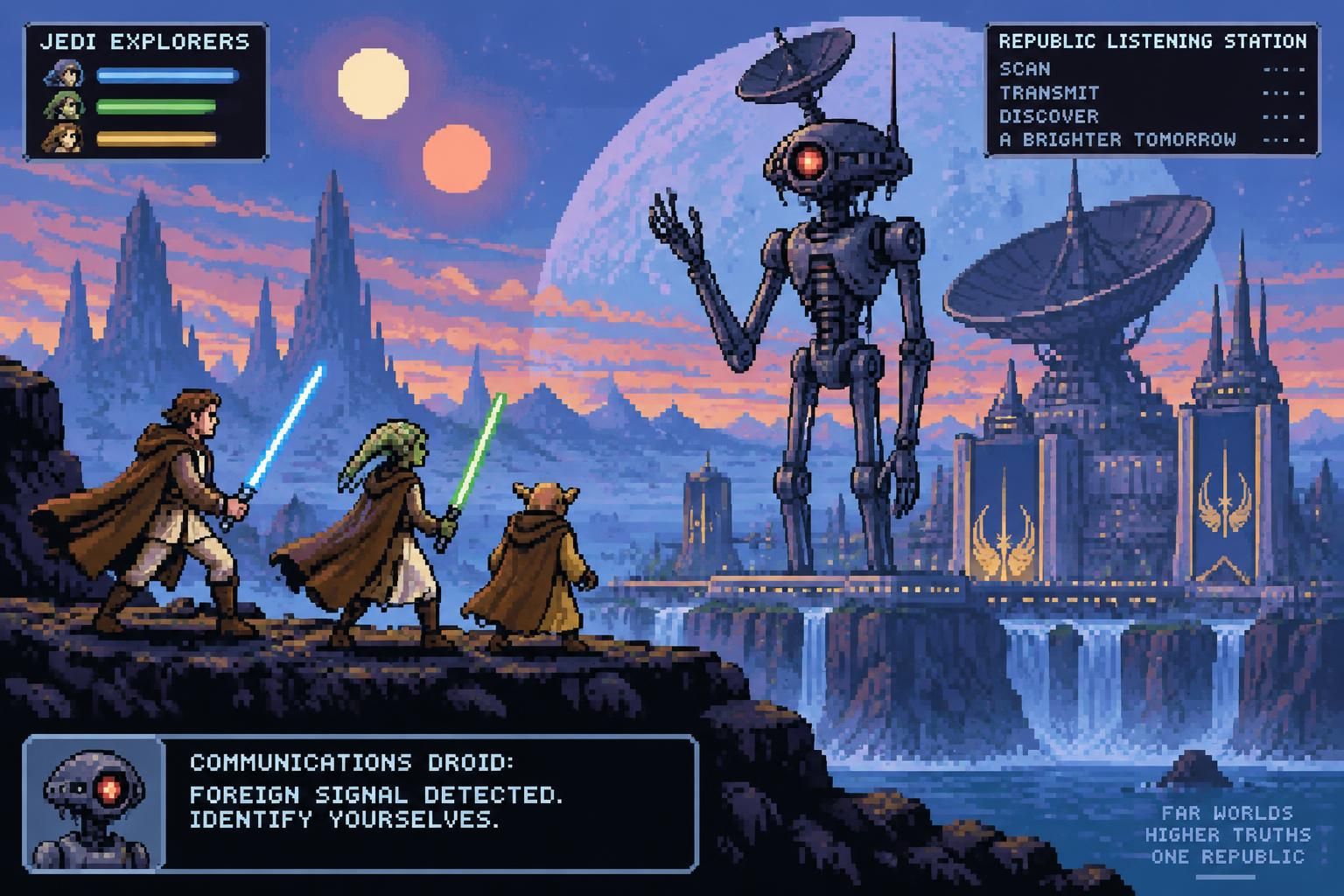
The giant droid that confronts Temesh and Anula gives Rike’s objective a blunt public form. It repeats his promise of silence while acting as an obstacle between the Jedi and their target. As a tactical instrument, it delays pursuit; as a piece of storytelling, it makes the villain’s fixation impossible to miss.
The machine’s usefulness has limits. The Jedi overcome it and continue, so the encounter does not fundamentally change the balance of the conflict. Its strongest function is illustrative: Rike has acquired enough power to project his grievance, but projection alone does not produce a sustainable solution.
Imagine the situation from the viewpoint of a settlement relying on a nearby buoy. Its inhabitants would not know the details of Iza and Rike’s relationship when their communications failed. They would experience the consequences first, which is why the Pathfinders must treat the self-destruct sequence as a public emergency, not merely a private dispute.
That public dimension makes Iza’s eventual cooperation important. He possesses both a personal connection to Rike and knowledge of the situation that the Jedi lack. Neither asset guarantees a peaceful outcome, but together they offer an alternative to fighting through every obstacle.
The distinction is familiar in Star Wars history. At Endor, the Empire possessed a formidable fleet and a battle station, yet its plan depended on assumptions about local resistance and the enemy’s freedom to act. A force that overlooks human motives can hold superior equipment and still misunderstand the field.
Here, the neglected factor is not an army but a relationship. Rike’s weapon creates the emergency; Iza’s failure to listen helps explain why the emergency developed. The next decisive intervention comes from a Pathfinder who recognizes that listening need not mean hearing.
The High Republic Adventures: Pol and Iza Redefine Communication
Pol remains with Iza while Temesh and Anula pursue Rike. The division of responsibilities is practical: the Jedi address the armed threat, while another member of the team stays with a person whose behavior and knowledge may affect the outcome. It also gives Pol a scene that reveals what the larger investigation has been missing.
Iza insists on receiving the station’s incoming transmissions even as the volume of information visibly strains him. Pol interrupts the flow, and his immediate reaction is frantic. She then embraces him, creating a moment of contact that does not depend on the apparatus he has treated as indispensable.
Iza recognizes that Pol cannot hear the transmissions, yet understands more about his condition than his surveillance has allowed him to understand about himself. The scene does not suggest that deafness is a magical ability. It demonstrates, more carefully, that communication has forms beyond sound.
Disability Representation and the Value of Attention
I consider the scene effective because Pol acts rather than serves as a symbol for someone else’s lesson. She observes a problem, intervenes, responds to Iza’s distress, and establishes contact on terms the equipment cannot provide. Her contribution is distinct from the Jedi’s combat skills and equally relevant to the mission.
There is a complication worth acknowledging. Switching off a source of information without Iza’s consent initially intensifies his distress, even if Pol intends to help. The embrace matters because it answers that reaction with presence rather than treating the interruption itself as a complete solution.
For you, the distinction can change how the moment reads. Pol does not simply prove that technology is harmful or that quiet is universally preferable. She reveals that a continuous stream of signals can occupy so much attention that the person receiving it fails to notice what is happening nearby.
That concern has a particular resonance in the High Republic, an era associated with exploration, cooperation, and connections between communities. A network can make distant worlds accessible, but the existence of a connection does not ensure that anyone is being understood. The listening station embodies the gap between collecting information and interpreting it.
The issue’s positive treatment of disability has also drawn attention in Mynock Manor’s review of the finale. The most persuasive evidence is Pol’s place in the action: her perspective changes what Iza can do next.
The scene also gives the mystery a humane counterweight. Atticus Cale’s death remains real, and Rike’s threat remains active, but the comic refuses to make punishment the only imaginable response to a crisis. It asks whether understanding the cause can help prevent another act of harm.
There are limits to what one embrace can establish. A lasting change in Iza and Rike’s relationship would require more than a single moment of clarity, and the comic moves quickly from recognition to resolution. Still, the moment supplies a credible reason for Iza to approach Rike differently.
In cultural terms, the scene contrasts two forms of expression: the station’s constant mechanical chorus and a direct, embodied gesture between individuals. Star Wars often uses visual symbols to express allegiance or inheritance; here, physical contact communicates a simpler proposition. Attention becomes useful only when it allows another person to be understood.
That insight prepares Iza for the task the Jedi cannot perform by force alone: persuading Rike to stop the countdown. Before that conversation can occur, however, the Pathfinders must survive a confrontation that exposes a different weakness in the finale.
Pathfinders #6 Jedi Battle: Rooper Nitani and Vix Fonnick Shift the Balance
Jedi Master Vix Fonnick answers the distress call and arrives on Zirtona, where Rike attempts to catch her at a disadvantage. His opportunity closes when a shield enters the fight. It belongs to Rooper Nitani, who inherited it from Silandra Sho.
The shield is a concise piece of High Republic visual history. It connects Rooper’s intervention to an earlier Jedi and turns an object of defense into a sign of continuity. You do not need a lengthy explanation of its lineage to understand what it accomplishes in the scene: it interrupts an attack before Rike can exploit his position.
Rike then ignites Atticus Cale’s former lightsaber. The weapon links the current confrontation to the murder that brought the Pathfinders to Zirtona. It also gives him a means to contest the Jedi directly, though possession of a Jedi weapon does not make the surrounding situation favorable to him.
Four Jedi Against One Opponent
Temesh and Anula join Fonnick and Rooper, leaving Rike opposed by four Jedi. I regard the numerical imbalance as the decisive tactical fact. Rike has a dangerous weapon and the advantage of familiarity with the crisis, but he can no longer isolate an individual opponent as easily.
The conflict illustrates several distinct contributions:
- 🛡️ Rooper’s shield disrupts Rike’s opening attack and protects an ally.
- ⚔️ Fonnick’s arrival brings reinforcement at the point where the local team is already under pressure.
- 🔍 Temesh and Anula’s pursuit keeps the original investigators engaged with the immediate threat.
- ⏱️ Iza’s later appeal addresses the countdown, a problem that combat alone does not resolve.
Each action serves a different purpose. The shield prevents an immediate injury; the additional Jedi reduce Rike’s freedom of movement; the appeal reaches the person controlling the self-destruct sequence. The mission succeeds because these measures address different parts of the problem.
Yet the reinforcement has a narrative cost. Temesh and Anula are the protagonists readers have followed through the investigation, and the final battle offers a conspicuous opportunity to show why their partnership matters. The arrival of two established Jedi makes the fight more secure, but it also makes the principal pair less distinctive.
That is not an argument against cameos. Familiar characters can make a shared universe feel connected, particularly when an inherited object such as Sho’s shield carries cultural meaning. The question is whether their intervention strengthens the central characters’ choices or replaces them.
Here, Fonnick and Rooper contribute so visibly to the rescue that the balance shifts toward the latter. Temesh and Anula remain present, but the finale gives the newcomers a memorable entrance at precisely the moment the leads need their own defining action.
A different arrangement could have preserved both advantages: the reinforcements might have held Rike’s attention while Temesh and Anula executed a plan established earlier. Such a choice would still acknowledge the danger while assigning the protagonists a clear causal role in overcoming it.
As presented, the encounter is easy to follow and efficient as action. Its weakness lies not in the Jedi cooperating, but in the distribution of emphasis. A successful defense is not automatically a satisfying demonstration of the leads’ agency.
The High Republic Adventures Finale: Mercy, Accountability, and Atticus Cale
Iza eventually persuades Rike to cancel the self-destruct sequence. The two agree to listen to one another, and the immediate danger to Zirtona and the sector’s communications buoys ends. The finale then moves to Batuu, where Atticus Cale is laid to rest.
That funeral matters because it prevents the restored relationship from erasing the victim. Cale’s death initiated the investigation, and his burial gives the loss a place in the story after the urgent mechanics of the countdown have been settled. The scene establishes that saving the sector and resolving a murder are related but separate obligations.
Iza and Rike receive help rather than formal punishment, according to the issue’s resolution. This is consistent with the Jedi’s preference for preserving life and addressing the causes of harm when an alternative to further violence is available. It is also the finale’s most debatable decision.
What a Second Chance Resolves—and What It Leaves Open
I would separate three questions: whether the threat has stopped, whether the individuals involved need care, and whether those harmed have received an adequate response. The first is answered when Rike cancels the countdown. The second is addressed by the promise of help. The third receives less attention within the available pages.
For a story aimed at a broad audience, a hopeful ending is an intelligible choice. It allows the Jedi to demonstrate compassion through action rather than merely through rhetoric. It also avoids presenting isolation and distress as conditions that can only end in permanent exclusion.
But compassion and accountability are not opposing strategies. A response could provide treatment while also examining Cale’s murder, the danger to the sector, and the needs of those affected. The issue’s relatively quick resolution leaves those practical questions largely outside its frame.
You can see the difference by returning to the imagined settlement dependent on a communications buoy. Its residents might be relieved that the network survives and still want to know what safeguards will prevent another disruption. Their concern would not invalidate Iza and Rike’s need for assistance.
The promise that the two men will listen to each other is meaningful precisely because their earlier failure to do so had consequences. Yet a promise is an initial measure, not proof that a pattern has changed. The comic closes on the possibility of recovery rather than showing the longer work that recovery would require.
That compression is understandable in a six-issue adventure with a final battle, a funeral, and a return to duty still to cover. It also explains why the ending can feel unusually clean. The mechanisms of danger occupy substantial attention, while the aftermath is settled in comparatively little space.
The Jedi response remains valuable as an expression of High Republic culture. The Order’s public role involves mediation and protection as well as combat; a rescue that includes the people responsible for a crisis is therefore not out of character. What would strengthen the scene is a clearer distinction between mercy for the perpetrators and care for everyone affected.
The final development sends the Pathfinders toward another distress call involving pirates. That choice restores the rhythm of their work without requiring the murder to be forgotten. The case ends, but the obligation to answer the next call remains.
Pathfinders Comic Book Review: Temesh and Anula Need Stronger Agency
Temesh and Anula provide the series with its central Jedi partnership: an experienced Master and a Padawan investigating a mystery beyond the familiar comforts of the Order. In principle, that relationship offers a useful contrast between established judgment and developing perspective.
In practice, the finale gives them fewer defining choices than their position warrants. They pursue Rike, overcome the droid, and participate in the final confrontation, but Pol’s intervention with Iza and the arrival of Fonnick and Rooper supply some of the issue’s most distinctive turning points.
I do not confuse activity with agency. A character can appear in several action scenes without shaping the outcome in a way that reveals individual priorities. For you, the more revealing question is not simply whether Temesh and Anula are present, but whether their decisions produce consequences that another competent Jedi would not have produced in the same way.
How the Master and Padawan Could Have Defined the Investigation
The murder mystery offered several opportunities. Temesh might have made a difficult call about protecting the communications network while pursuing the killer; Anula might have interpreted a clue differently from her Master, forcing the pair to test competing explanations. Either choice could have made their relationship instrumental to the solution.
Such possibilities do not require the story to become darker or more complicated. A concise exchange before the confrontation, followed by a decision with visible consequences, would have established how the two Jedi think. The finale could still reach its compassionate outcome while making the route there more specifically theirs.
Pol provides a useful contrast. Her scene with Iza has a clear sequence: she notices distress, interrupts the transmissions, and responds when the interruption unsettles him. Whatever judgment you make about that intervention, her conduct changes another character’s understanding and affects the route toward resolution.
Rooper’s shield performs a similar function in the battle. Its appearance tells the reader what she contributes, and its inherited history gives that contribution cultural weight. Temesh and Anula have less immediately recognizable material of their own in the issue’s climactic sequence.
The concern extends beyond a single fight. As leads in a High Republic adventure, they carry the responsibility of making a new corner of the setting feel worth revisiting. A reader can appreciate the setting, the mystery, and the supporting cast while still wanting a sharper sense of what distinguishes this Master and Padawan from other Jedi teams.
That weakness does not erase their competence. Temesh survives the sonar attack and returns to the mission; Anula continues alongside him despite the threat. Their reliability is established. The missing element is a more individual use of that reliability under pressure.
A tactical analogy clarifies the problem. An officer who follows the correct route may execute an assignment effectively, but a commander learns more from the decision made when the route is blocked. The finale supplies several obstacles, yet often lets supporting characters provide the most memorable answers.
The next distress call offers a useful implication: Temesh and Anula have further opportunities to develop if their adventures continue. The issue itself, however, must be assessed on what it places on the page. Their partnership anchors the mission, but the finale does not fully exploit its potential.
Vincenzo Riccardi’s Pathfinders #6 Artwork Gives the Finale Its Scale
Vincenzo Riccardi illustrates the final two issues, including an action-heavy sixth installment that moves between intimate communication, a mechanical confrontation, and a multi-Jedi fight. The range is important: a finale built only around spectacle would struggle to accommodate Pol and Iza’s quieter exchange.
The issue’s visual storytelling must establish who is threatened, where the danger comes from, and why each intervention matters. The shield’s arrival is especially efficient in this respect. Its defensive function is legible in the action, while its history rewards readers familiar with Silandra Sho and Rooper Nitani.
I find the contrast between objects particularly useful. Rike’s sonar weapon turns sound into force; Cale’s lightsaber carries the consequence of the murder into the final battle; Rooper’s inherited shield embodies protection. Each object contributes to the conflict before a reader considers its symbolic associations.
Action, Expression, and High Republic Visual Culture
The giant droid gives the issue a different scale from the earlier character-focused scenes. It externalizes Rike’s demand for silence in an imposing form, allowing the Jedi to confront an obstacle that is immediately recognizable as a threat. The fight is comparatively straightforward, which keeps it from delaying the more consequential confrontation.
Pol and Iza’s interaction works on the opposite principle. The scene depends on a change in attention and a physical gesture, not on a new weapon or an elaborate explanation. Its placement alongside the larger action makes the contrast clear: the finale needs both decisive movement and a moment of stillness.
That variation suits The High Republic, where Jedi culture is expressed through distinctive equipment, personal relationships, and a shared sense of public responsibility. Sho’s shield is not merely a prop transferred between characters. Its presence suggests a tradition in which defense can be as recognizable as a lightsaber attack.
The artwork also supports the series’ blend of genres. A murder mystery asks the reader to consider evidence and motive; a Star Wars adventure promises danger and momentum. Riccardi’s task is to carry both modes into the same issue without making the final revelation feel detached from the action around it.
The result is strongest when an image carries more than one function. The stolen lightsaber identifies Rike as an armed opponent and recalls Cale’s death. The shield protects Fonnick and brings an earlier Jedi’s legacy into the present. Those details make the fight part of the investigation rather than a separate spectacle.
There is still a structural limit to what illustration can solve. Strong staging can make a character’s entrance memorable, but it cannot by itself give Temesh and Anula decisions the script does not assign them. Indeed, the clarity of Rooper’s intervention makes the imbalance in protagonism easier to notice.
For readers comparing the issue with other responses, Comic Book Roundup’s issue page offers a place to find critical reactions. The relevant standard remains visible on the page itself: whether the visual sequence tells you what changes and why.
On that measure, the finale’s action is accessible and its quieter scene has room to register. Riccardi’s contribution is not simply scale; it is the ability to make different kinds of intervention readable within the same crisis.
Pathfinders #6 Rating and the Future of All-Ages Star Wars Comics
Rating: 7/10. ⭐ The finale resolves its central mystery with a coherent thematic design, gives Pol a meaningful role, and uses Riccardi’s illustrations to carry both spectacle and character interaction. Its principal weaknesses are the rapid treatment of consequences and the limited agency afforded to Temesh and Anula.
I would evaluate the issue by the objectives it establishes rather than by the quantity of events it contains. The table below separates those objectives so you can see where the finale is most effective and where its choices impose a cost.
| Review criterion | What the finale achieves | Assessment |
|---|---|---|
| 🔍 Mystery | Connects Cale’s murder to Iza and Rike’s history and the station’s technology. | Strong thematic fit |
| 🗣️ Communication | Uses Pol’s intervention to show understanding beyond sound. | Distinctive and purposeful |
| ⚔️ Jedi action | Combines a droid encounter, reinforcements, and a lightsaber confrontation. | Clear, though the leads share the spotlight |
| ⚖️ Aftermath | Offers help to Iza and Rike and gives Cale a funeral on Batuu. | Hopeful, but compressed |
| 🎨 Visual storytelling | Balances large-scale threats with quieter character moments. | One of the issue’s strengths |
The score reflects a difference between a successful resolution and a flawless one. The countdown stops for reasons connected to the story’s central concern, and the Jedi’s response fits their values. At the same time, the finale leaves room for a more developed account of accountability and a stronger demonstration of its central partnership.
Dark Horse’s Pathfinders and the Next Publishing Chapter
The issue also occupies a transitional position in all-ages Star Wars publishing. With the license moving to Mad Cave Studios, this finale can be read as an unofficial farewell to Dark Horse’s current run of adventures. That publishing context does not change the events on Zirtona, but it makes the decision to end on another rescue call especially apt.
For readers following the release schedule, the October Star Wars comics guide places the issue among its contemporaries. The January 2027 comics guide offers a later point of comparison for the franchise’s continuing publishing activity.
The contrast between those schedules is useful because a publisher’s departure from a particular license does not end the larger setting. Characters, artistic traditions, and narrative approaches can continue to influence future work even as the companies producing it change.
Pathfinders demonstrates one approach worth retaining: an all-ages adventure can combine an accessible conflict with questions about technology, isolation, disability, and mercy. It need not explain every moral question exhaustively, but its most effective moments allow those concerns to alter the action.
There is a lesson for future conflicts within the story as well. A communications system should be assessed not only for its reach, but also for the people operating it and the safeguards surrounding it. Had the strain inside Zirtona been recognized earlier, the investigation might not have required a murder, a weapon, and an endangered sector to expose it.
The final pirate distress call places the Pathfinders back in motion rather than promising that their next assignment will be simple. The practical measure of their future adventures will be whether the team’s own choices become as memorable as the crises they answer.

I am Grand Admiral Thrawn, strategist of the Galactic Empire. Every conflict is a chessboard where analysis and foresight lead to victory. The art and culture of a people betray their weaknesses. The Empire embodies order and discipline in the face of rebel chaos. History will remember that only strategy ensures peace.