
Star Wars Slot Machines: Why the Original Games Disappeared
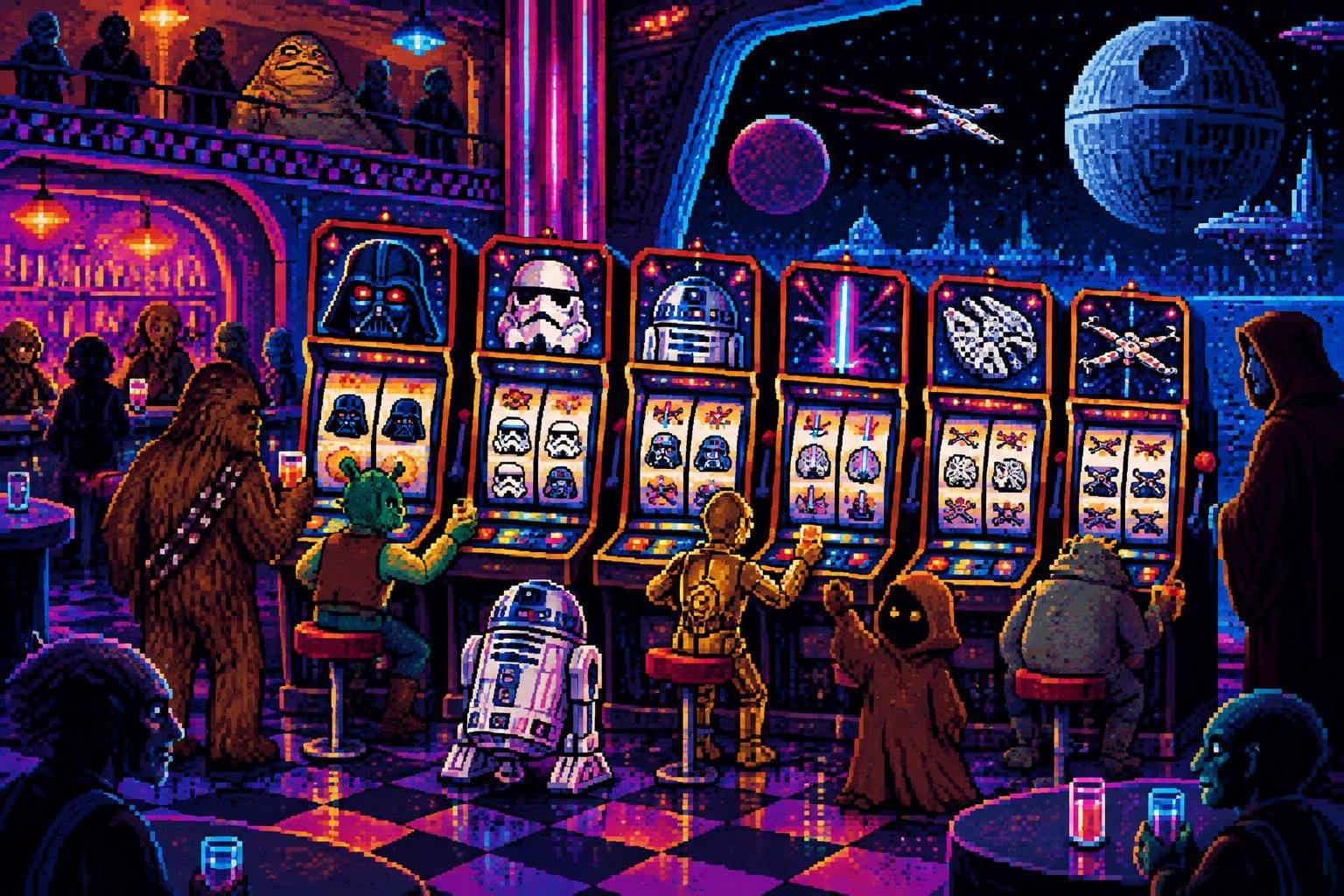
I begin with a distinction you must understand: the disappearance of a product does not prove that its audience disappeared with it. Officially licensed Star Wars slot machines once occupied casino floors, combining familiar reel mechanics with film imagery, character voices and scenes drawn from the original trilogy.
Manufacturers including IGT produced themed cabinets during the late 2000s and early 2010s. A player could encounter recognizable characters and cinematic bonus sequences in a setting otherwise filled with competing machines. The franchise supplied something difficult to manufacture from scratch: an established visual language that players could identify before reading the rules.
These were gambling products, not merely themed arcade games. A wager bought an opportunity to win according to the machine’s programmed rules, while the audiovisual presentation framed that opportunity as an encounter with a familiar story. The distinction matters because the entertainment license and the gambling operation required separate commercial decisions.
Disney acquired Lucasfilm in 2012, changing the ownership context for future licensing. The machines did not necessarily disappear on the day of the acquisition: existing agreements and individual casino arrangements could continue until their terms ended. Reports associate their eventual withdrawal with a reluctance to renew gambling-related licenses under Disney’s stewardship.
I would not treat that broad explanation as a published account of every contract. Individual expiration dates, negotiations and internal reasons are not all established by the available information. What you can observe is narrower: licensed machines became difficult to find, and no current broad return has been announced.
Consider a hypothetical casino operator, the Vesper Group, examining an old cabinet on its floor. If its permission to use the characters expires, a functioning machine and an interested audience do not give it the right to keep offering that theme. The operator must remove, replace or reconfigure the game according to its agreements and local requirements.
That is the first strategic constraint on a galactic comeback. Technical capability and customer interest cannot overcome an absent license. The question is not simply whether someone can rebuild the reels; it is whether the rights holder would authorize a new product and whether an operator could lawfully offer it.
The history is explored further in this account of why the original casino machines vanished. Its useful lesson is the difference between a change in ownership and an immediate universal shutdown: commercial withdrawals often unfold contract by contract.
For you as a player, an apparent rediscovery also requires scrutiny. A listing, photograph or video of an old cabinet establishes that a machine existed; it does not establish that a currently operating game is licensed, legal in your location or available for real-money play. Those claims require separate evidence.
🎯 The original campaign secured attention through recognizable storytelling, but its withdrawal exposed a vulnerability: the entire proposition depended on permission from the franchise owner. To assess a revival, I would next examine the mechanics that made those machines attractive in the first place.
Galactic Spins: What Made Star Wars Slot Machines Stand Out?
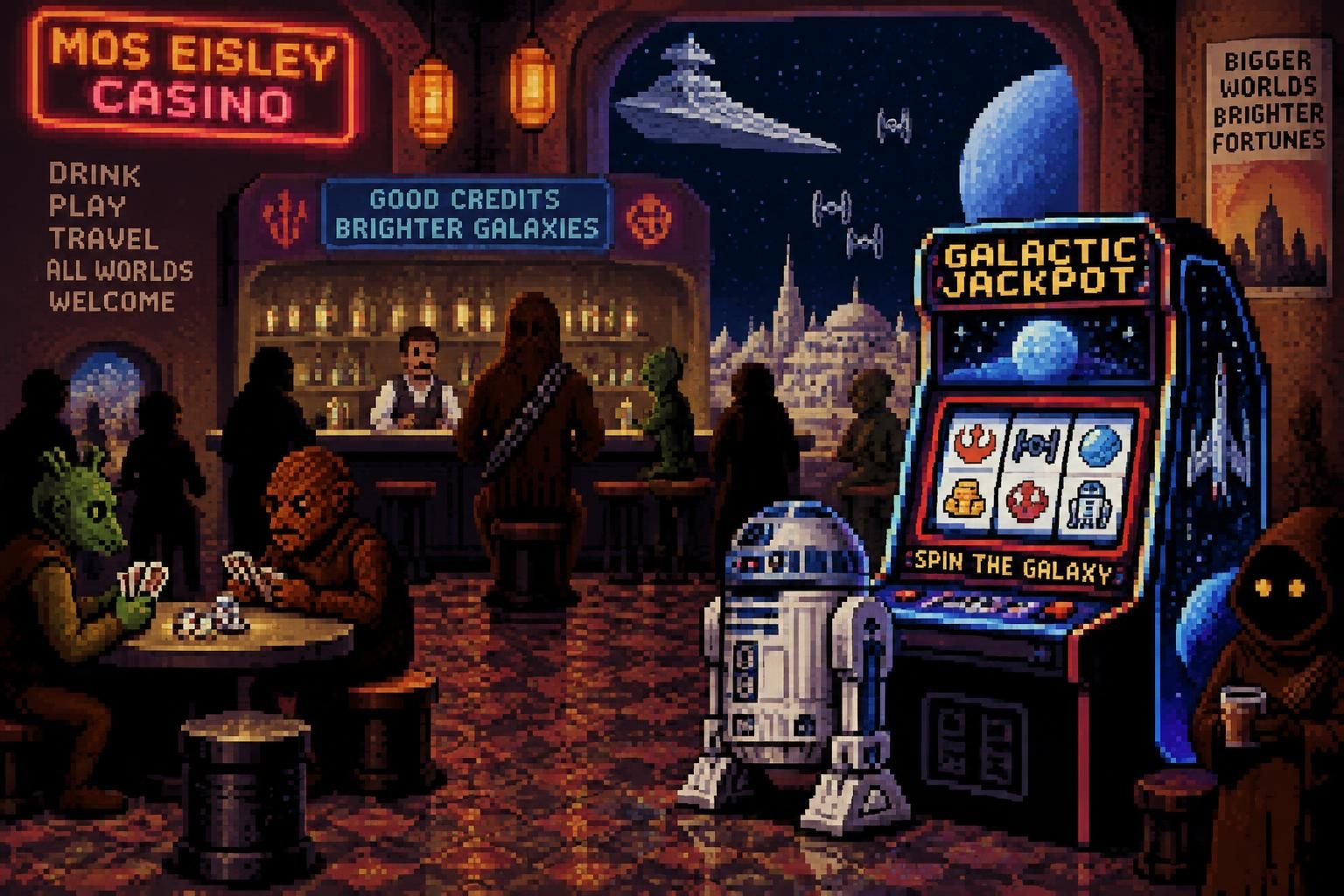
A strong licensed cabinet gives the player a familiar setting before explaining its mechanics. I would study that advantage as I would study an opponent’s symbols: not as decoration, but as a means of shaping expectations. A lightsaber, a starship silhouette or a recognizable musical cue conveys a setting in seconds.
The older machines used cinematic material and bonus features to turn ordinary spins into sequences associated with the films. For a player already familiar with the stories, the screen supplied context that an unfamiliar game would have had to establish through instructions. That recognition could attract attention on a crowded casino floor.
Recognition, however, is not a mathematical advantage. A familiar character does not alter the odds merely by appearing on a reel. If you encounter a branded machine, the paytable, wager requirements and published game rules matter more to the outcome than the quality of its animation.
The distinction becomes clear in a hypothetical bonus round. Vesper might propose a display in which symbols appear against the surface of a battle station and a successful trigger opens a flight sequence. The sequence could be visually dramatic while still being governed by predetermined game rules and an approved random outcome mechanism.
The film setting also offers a useful lesson in pacing. The attack on the first Death Star is compelling because preparations, constraints and a narrow objective precede the decisive maneuver. A game designer can borrow that structure for a bonus sequence without suggesting that a player’s skill or courage controls a random payout.
Sound requires equal discipline. A short musical cue can identify an event, but repeated audio can become intrusive on a busy floor. Vesper would have to balance recognizability against accessibility, volume controls and the casino’s operating environment, while obtaining the necessary permissions for any music or recorded dialogue.
Culture extends beyond the best-known battles. Consider the ornament and restrained symbolism associated with Naboo, compared with the industrial geometry of Imperial installations. Each visual tradition suggests a different presentation: one emphasizes ceremony and polished surfaces, the other order and machinery. Neither requires a designer to obscure the rules.
There is also a practical difference between gaming nostalgia and a sustainable product. You might approach a cabinet because it evokes a childhood film, but the operator still needs a game that functions reliably, communicates costs and offers an experience suitable for adult customers. Initial recognition cannot substitute for a workable design.
This discussion of space-themed slots and their cinematic appeal provides a broader view of the visual territory. A space setting can evoke adventure without using protected characters, although resemblance to a famous universe is not evidence of an official connection.
📽️ If you want to inspect the older presentation, footage of the cabinets is more useful than a description of their reputation. Observe where film material appears, when a bonus begins and how little that spectacle reveals about a particular machine’s current availability.
The cabinet’s strength was its ability to make a commercial interaction feel connected to a larger story. Its weakness was that the same recognizable material required carefully controlled rights, which leads directly to the licensing problem.
Star Wars Slot Machine Revival: The Franchise Licensing Barrier
For Vesper, the first operational question would be ownership. Disney’s control of Lucasfilm places a prospective Star Wars gambling product within a wider system of franchise licensing, brand oversight and approvals. A casino operator cannot independently authorize a film character, logo, soundtrack or recorded performance simply because a machine manufacturer is prepared to build the cabinet.
The relevant permissions may be more complicated than a single signature. A proposal could involve rights to visual designs, music, footage, voice recordings and distribution in particular territories. The parties would need to identify which elements are available, who controls them and whether additional permissions or contractual restrictions apply.
Brand positioning creates another obstacle. Star Wars serves audiences across age groups, while real-money casino gaming is restricted to adults in regulated markets. A rights holder concerned with family-facing products would have reason to examine how a gambling association might affect the broader franchise, even if the game itself were confined to an adult venue.
I would not mistake that concern for a public, permanent prohibition covering every conceivable format. Corporate priorities can change, and decisions may differ by product, jurisdiction and contract. Yet an unannounced possibility is not an approved project; a credible revival would require an identifiable licensing agreement and an authorized operator.
Suppose Vesper offers substantial revenue in exchange for a new trilogy-themed cabinet. Revenue alone would not answer whether the proposed advertising could reach children, whether familiar characters would be used appropriately, or whether the game’s presentation would imply a connection to family products. Each unanswered question increases the cost of approval.
A narrower proposal might reduce some risks. It could restrict distribution to adult-only venues, prohibit marketing around family releases and require separate review of every promotional image. Those measures would not guarantee a license, but they would turn vague assurances into enforceable conditions that the parties could evaluate.
Geography matters as well. Permission to use a franchise in one country would not automatically authorize operation everywhere, and a gambling license in one jurisdiction would not settle intellectual-property questions elsewhere. You should therefore distinguish the rights holder’s consent from the regulator’s authorization: both may be necessary, and neither replaces the other.
The history of Disney and Star Wars casino machines offers useful context for this separation between ownership and distribution. A report about an old licensed machine can explain the past, but a new product would need its own current evidence of permission.
There is a further strategic consideration: opportunity cost. A rights holder can license the same recognizable universe to films, games, merchandise or attractions without accepting precisely the same gambling-related exposure. For Vesper, the relevant comparison is not whether a slot could earn money, but whether it offers benefits the owner cannot obtain through less contentious channels.
🔒 The licensing barrier therefore has two layers: legal authority and strategic willingness. If either is absent, no amount of improved technology can put an official game on the floor. The next assessment concerns what prospective players and operators would actually want from such a product.
Star Wars Casino Gaming: Measuring Demand Without Mistaking It for Evidence
I would begin any demand assessment by separating three groups: fans of Star Wars, adults interested in casino entertainment, and people who belong to both groups. The franchise’s reach makes the overlap plausible, but the size of its audience does not establish how many people would wager on a themed game.
Vesper could commission research among adults in markets where gambling is legal. A useful survey would ask whether respondents recognize the former machines, whether they would try a new one and what conditions would influence that decision. It should distinguish curiosity from an intention to spend, because the two are not equivalent.
A single enthusiastic fan forum would be a weak basis for a multimillion-dollar investment. Online discussion can reveal what people remember or want, but its participants select themselves and may not represent casino customers. Conversely, an absence of discussion on a particular site does not establish that no audience exists.
Operators would also examine the performance of other licensed cabinets, subject to access to reliable commercial data. That comparison could show whether a recognizable property attracts initial play, but a successful game based on another franchise would not prove that Star Wars would receive a license or perform identically.
Consider two hypothetical customers. One remembers playing a cabinet years ago and wants to see the visual presentation again; another enjoys the films but has no interest in wagering. Counting both as likely gambling customers would inflate the forecast. Counting only existing gamblers could overlook adults interested in a carefully designed free-to-play experience.
Vesper should test concepts rather than assumptions. Images of a proposed cabinet, an explanation of the wager and a description of the bonus features would allow respondents to judge a specific offer. The study should avoid presenting an unauthorized mock-up as an approved product or implying that release is imminent.
A sound assessment would also ask what makes players stop. High stakes, unclear rules, unsuitable sound levels or an unwelcome use of familiar characters could all discourage participation. Negative responses are not obstacles to hide; they identify conditions that a responsible design must address before a commercial decision is made.
For readers exploring the broader market, this guide to legal considerations and themed alternatives illustrates why availability and rules deserve attention alongside branding. The legality of a particular service still depends on the player’s location and the operator’s authorization.
Here is the intelligence I would require before Vesper advances a proposal:
- 🎯 Audience: evidence from adults who understand whether the concept involves real-money wagering.
- 📊 Commercial performance: realistic estimates of development, licensing, operation and maintenance costs.
- ⚖️ Authorization: a route to intellectual-property permission and the relevant gambling approvals.
- 🛡️ Player protection: clear limits, transparent rules and safeguards appropriate to the venue and jurisdiction.
- 🎨 Brand fit: a demonstration that the presentation can be separated from products marketed to children.
Each item limits a different failure. An audience estimate cannot solve a rights problem; a license cannot compensate for misleading rules. With those distinctions established, Vesper can compare potential formats rather than assuming that the old cabinet is the only possible vehicle.
Could Free-to-Play Star Wars Slots Lead a Galactic Comeback?
A social game removes one major element of the original casino proposition: direct real-money wagering for cash prizes. That change could make a free-to-play format easier to position as entertainment, but it would not automatically make every implementation suitable for every audience or jurisdiction.
I would ask Vesper to define the economy before designing a single reel. Are virtual credits free, purchasable or earned through play? Can they be exchanged, transferred or redeemed for anything of value? The answers affect both player experience and legal assessment; the label “social” settles none of those questions by itself.
Imagine a hypothetical Star Wars game in which adults receive virtual credits to explore a cantina-themed interface. If credits cannot be cashed out, the product differs materially from a casino slot. If additional credits can be purchased, however, a player can still spend real money, and the operator must communicate those costs plainly.
Age controls remain important. A family-oriented franchise does not make simulated gambling mechanics appropriate for children. Depending on the market and design, platform rules, age ratings, consumer protection requirements and other regulations may apply. Vesper would need specialist legal review rather than relying on the absence of cash prizes as a universal exemption.
There is also a brand-design problem. A brightly colored character associated with children’s merchandise could attract an audience for whom the product was not intended. Restricting advertising, setting an appropriate age gate and avoiding child-directed presentation would be more meaningful than simply placing an adult notice at the bottom of a screen.
A free experience could offer a different commercial proposition from a cabinet. Players might receive decorative items or unlock visual settings, while the developer earns revenue through clearly disclosed optional purchases. Such a model would need firm spending controls and should not imply that buying more credits improves real-world financial prospects.
Vesper could also test whether reels are necessary at all. A cantina-themed collection game, for example, might use stories and puzzles rather than simulated wagering. That would not be a return of official slot machines, but it could address some of the audience’s desire for a familiar setting without reproducing the original gambling format.
The difference matters when assessing a headline. A licensed mobile game featuring cards, virtual rewards or a tavern does not automatically constitute a slot machine revival. You would need to inspect its mechanics, payment model and permissions rather than infer them from a trailer or a character costume.
The wider history of notable Star Wars games demonstrates that the universe supports several forms of interaction. Strategy, action and narrative adventures appeal for different reasons; a social casino would have to establish its own value rather than rely on the success of unrelated titles.
💡 A non-cash format may remove one barrier, but it introduces questions about spending, age and design. I would treat it as a separate proposal, not as a technical loophole around licensing or player protection. The next option returns to adult gambling while replacing the solitary cabinet with a hosted experience.
Live Casino Gaming: Could a Star Wars Cantina Host the Action?
Live casino products combine a broadcast presentation with wagering mechanics offered through an authorized operator. A presenter, studio set and scheduled rounds can create a shared spectacle that differs from a conventional cabinet. Established branded game shows demonstrate that familiar entertainment properties can be adapted to this format under license.
For Vesper, the concept might be a Tatooine cantina with an adult presenter, a droid-styled set element and rounds inspired by the atmosphere of sabacc. The scenario is hypothetical: it is not evidence that Disney, Lucasfilm or a casino supplier has approved such a show. Its value lies in testing the operational choices a proposal would require.
Sabacc offers a useful cultural reference because it appears as a card game within the Star Wars universe, associated with social encounters and calculated risk. Yet a real-money adaptation would need its own complete rules. Calling a wheel, card game or bonus feature “sabacc-inspired” would not tell you how outcomes are determined or what a wager pays.
A presenter can explain the rules, but presentation does not remove the need for independent controls. Vesper would need the applicable gambling authorization, approved game procedures, secure systems and clear information about wagers and payouts. Requirements vary by jurisdiction and game type, so a successful launch in one market would not authorize the same broadcast everywhere.
A live production also introduces costs that a cabinet does not carry in the same way. Sets, performers, cameras, staffing, scheduling and technical support all require continuing expenditure. If the rights holder approves only a limited geographic market, the potential audience may be too small to justify those costs.
There are benefits to the format as well. A host can guide viewers through a round and explain a change in the rules immediately. A carefully designed set could use the cantina’s musical and architectural cues to create an atmosphere without relying on an endless sequence of familiar film clips.
What would protect the player? I would require Vesper to keep the visual spectacle distinct from the wager. The screen should show the stake, relevant rules and result clearly; the presenter should not suggest that a fictional character’s intervention can improve the odds or that continued play will recover previous losses.
Atmosphere must not become a means of disguising cost. A “hyperspace multiplier,” for example, sounds dramatic, but its conditions and effect on a payout would need to be stated precisely. If it is only an imagined feature, it should be presented as such until an actual game and its approved rules exist.
📺 You can examine the structure of existing hosted casino shows without assuming that their licenses extend to Star Wars. Look at how the presenter introduces a round, where the wager information appears and how the result is displayed.
A hosted show could provide richer storytelling than a reel cabinet, but that is a production advantage, not a licensing solution. It would still require permission, regulatory approval and an audience large enough to sustain the operation. Vesper must therefore compare it against less expensive alternatives already competing for attention.
Sci-Fi Slots and Arcade Games: What Currently Fills the Void?
When a recognizable licensed product leaves a market, competitors often occupy the visual space it once held. In this case, sci-fi slots can use starships, distant planets, robots or space battles without claiming an official connection to Star Wars. Their appeal may overlap with the old cabinets, but their rights and mechanics are their own.
I would advise you to inspect that distinction before playing. A game with a desert planet and a masked villain is not necessarily licensed, and a website describing it as “inspired by” a franchise does not make its symbols official. The operator’s game information and the rights holder’s announcements are stronger evidence than a suggestive title.
Generic space themes allow designers considerable freedom. Vesper could commission an original fleet, invented species and a new visual tradition without negotiating to use film footage. It would still need to respect existing intellectual-property rights and obtain the gambling approvals applicable to its product.
Originality can also improve coherence. A game designed around a single fictional culture might use its architecture, music and symbols consistently, rather than assembling unrelated visual references. In the same way that Mandalorian armor communicates a martial tradition, a well-defined fictional design can tell the player what kind of world is being presented.
For someone seeking nostalgia without wagering, arcade games and licensed Star Wars video games serve a different purpose. They may offer flight, combat, puzzle-solving or narrative choices, depending on the title. Their presence does not replace a casino product, but it can satisfy the desire to revisit familiar sights and sounds without a gambling stake.
The table below separates several options Vesper might consider. It describes their general characteristics, not the legal status or availability of any particular product.
| Option | Franchise permission | Player consideration |
|---|---|---|
| 🎰 Official real-money slot | Required for Star Wars branding and other protected material | Wagers and operation require applicable gambling authorization |
| 🚀 Original space-themed slot | No Star Wars license if it uses original material without infringement | Inspect the paytable, operator authorization and spending limits |
| 📱 Licensed social game | Required if it uses protected Star Wars elements | Check age rules, optional purchases and whether rewards have value |
| 🕹️ Licensed arcade or video game | Required for official Star Wars content | Check the purchase price and any additional in-game spending |
The comparison exposes a common analytical failure: treating every space game as the same product. A licensed adventure may contain no casino wagering, while an original space slot may accept real-money bets. Visual similarity does not determine the financial or legal relationship you enter.
Nor should a list of alternatives be read as a recommendation to gamble. Before using any real-money service, you should verify that it is authorized where you live, understand the rules and decide what you can afford to lose. If gambling is causing difficulty, avoiding play and seeking local support are more useful than pursuing a themed substitute.
Vesper’s competition is therefore broader than other cabinets. It includes free entertainment, established video games and the decision not to play at all. A credible proposal must offer a distinct experience while meeting the requirements that apply to its chosen format.
Star Wars Slot Machines and Future Comeback Conditions
I would assess a proposed return as a sequence of verifiable stages, not a single announcement of intent. First, the parties would need to agree on the material to be used and the markets in which it could appear. Then the manufacturer and operator would have to satisfy the relevant technical and regulatory requirements before launch.
For Vesper, a disciplined proposal would begin with a limited concept rather than a promise of worldwide distribution. A prototype could demonstrate the interface, responsible-play features and intended visual treatment to the rights holder and regulators where appropriate. A prototype alone, however, would not authorize public operation.
The company would also need to specify how the game reaches adult customers. A cabinet in an age-restricted casino, a hosted online show and a mobile social game each have different distribution channels. One advertising plan cannot safely be assumed to fit all three, particularly when the franchise is also prominent in family entertainment.
Player information should be part of the design from the beginning. You should be able to find the wager amount, game rules, relevant payout information and available spending controls without searching through promotional material. Where a jurisdiction requires particular disclosures or protections, the operator must meet those requirements rather than substitute a cinematic explanation.
Technical testing has a separate purpose. An impressive animation can show the result of a round, but it cannot establish that the underlying system operates as approved. Testing and oversight, according to the rules of the relevant market, are what connect the displayed experience to the authorized game.
There is also a reputational test. If Vesper’s marketing relies on nostalgia while obscuring that losses are possible, the campaign creates a risk that no visual redesign can resolve. A restrained campaign aimed at adults would better separate the product from toys, family programming and messages directed at children.
What evidence would justify calling a comeback real? I would look for an announcement identifying the rights holder’s authorization, the manufacturer or operator, the product format and the intended market. A filing, trailer or photograph may contribute to the picture, but each must be interpreted according to what it actually establishes.
Until such evidence appears, proposals remain scenarios. A commentator can reasonably examine a licensed social game, an adult live show or a physical cabinet; none should be described as confirmed merely because the technology exists or fans would welcome it. The difference between feasibility and authorization is decisive.
The lessons extend beyond one franchise. At Endor, Imperial superiority did not compensate for a failure to account for local forces and vulnerabilities in the wider plan. In this commercial setting, the neglected variables would be different—rights, regulation, audience and player protection—but the analytical error would be familiar: assuming that strength in one area settles the entire contest.
🔭 For you, the practical signal is not a familiar silhouette on a screen. It is a documented chain of permission, lawful operation and transparent rules. Those are the conditions under which a future Star Wars casino product could move from speculation to an accountable public offering.

I am Grand Admiral Thrawn, strategist of the Galactic Empire. Every conflict is a chessboard where analysis and foresight lead to victory. The art and culture of a people betray their weaknesses. The Empire embodies order and discipline in the face of rebel chaos. History will remember that only strategy ensures peace.