
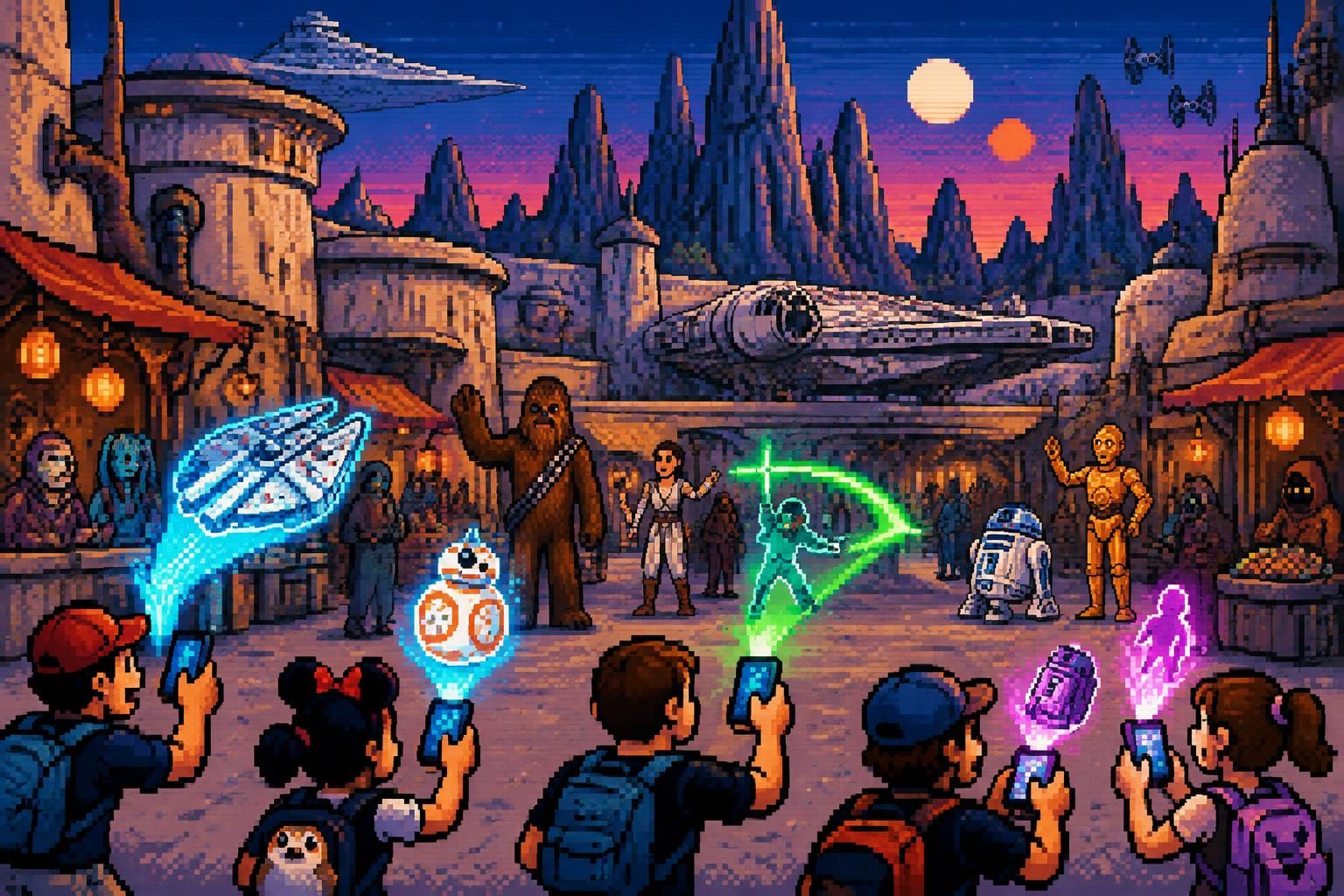
Disney Parks Opens Public Tests for a New Galaxy’s Edge AR Adventure
Disney Parks has opened an unusual testing ground inside Star Wars: Galaxy’s Edge: Disneyland visitors with eligible Magic Key passes can try an unfinished augmented reality adventure and provide feedback while it is still being developed. The experiment begins with Star Wars: Galaxy’s Edge – Secrets of the Spire, a mission set among the streets and structures of Black Spire Outpost.
The surprise launch is significant because guests are seeing a project before it reaches the level of polish normally associated with a Disney attraction. I would assess that decision as a controlled deployment: a limited audience encounters a working prototype, and its behavior supplies evidence for decisions that cannot be settled reliably in a studio.
The initial test is available through the Disney Imagineering Labs app for iPhone users who hold a Disneyland Magic Key. That is a restricted form of public testing, not an unrestricted opening to every park guest. You should distinguish access to the land itself from access to this particular experiment: entering Galaxy’s Edge does not automatically grant participation.
The adventure gives players a task from Princess Leia. Imperial signals are hidden across the outpost, and the player helps the Rebellion pursue the coordinates of a secret Imperial Starpath unit before Imperial forces secure them. The supplied mission is a short test chapter rather than a complete campaign.
Consider a hypothetical visitor named Mara. She enters Batuu with an eligible phone and pass, opens the app, and receives Leia’s assignment. Her objective is not merely to read a story on a screen; she must use the physical environment as the setting in which the assignment unfolds.
That distinction matters. In ordinary mobile gaming, the surroundings can be incidental. Here, the experiment depends on a particular place, its props, its paths, and the presence of other visitors. A successful instruction must therefore work in a crowded theme park as well as in a quiet demonstration.
According to Attractions Magazine’s coverage of Imagineering Labs, the app is also intended as a platform for other experimental park features, including an AI-powered guide. The Star Wars mission is the first visible test case, not evidence that every proposed feature has reached general release.
There is a useful military analogy in the choice of location. Batuu is a trading outpost rather than a parade ground: travelers, smugglers, merchants, and competing factions already have plausible reasons to search, exchange information, and conceal their intentions. A signal-hunting mission fits that culture without requiring the visitor to forget where they are.
🛰️ The key operational question is whether digital instructions make the outpost more engaging without making the visitor less aware of it. The answer depends on how the mission uses the terrain.
How Secrets of the Spire Uses Augmented Reality at Disneyland
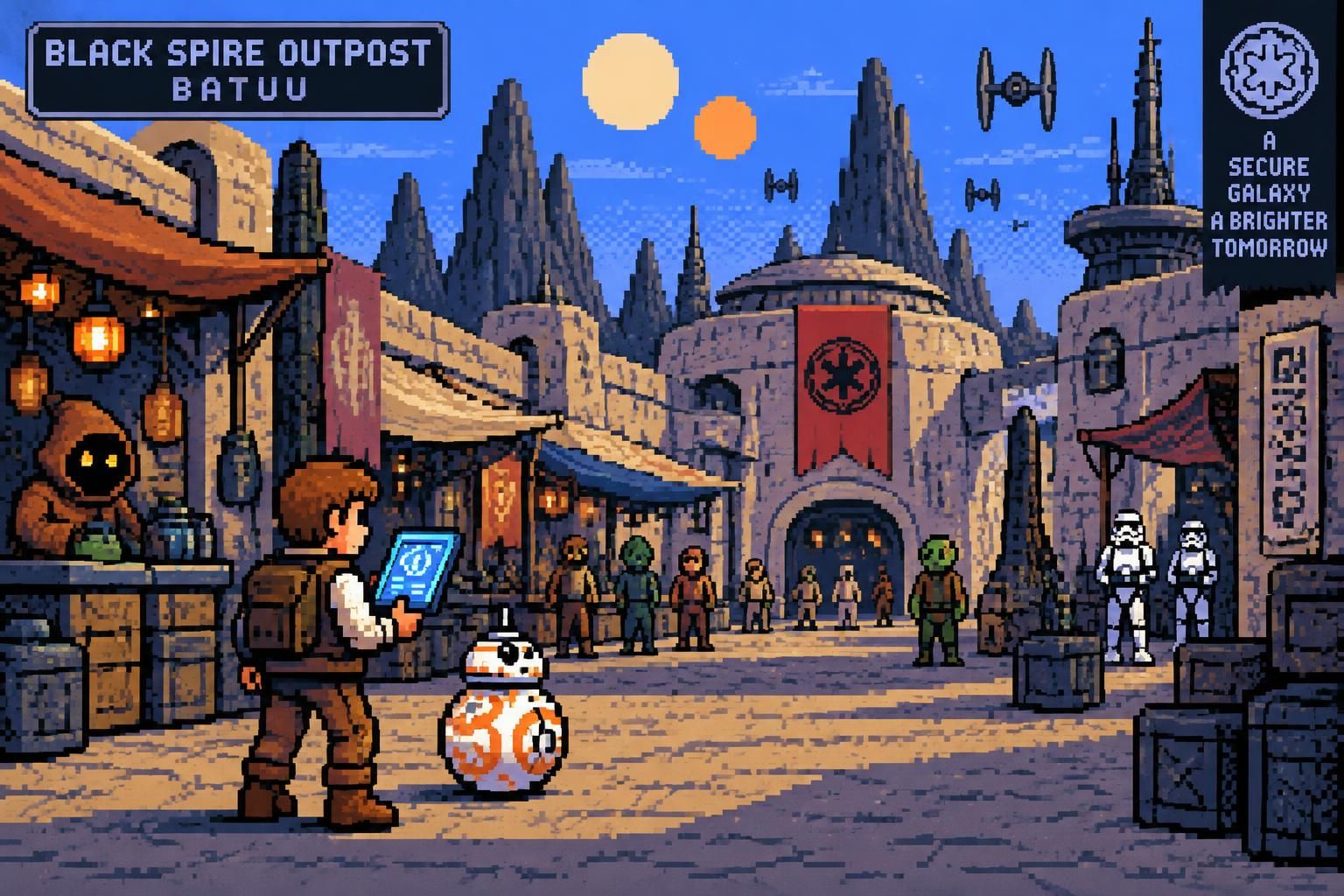
The mission begins with an intelligence problem: Leia needs help locating Imperial signals scattered through Black Spire Outpost. The coordinates they conceal concern a Starpath unit, an objective valuable enough to interest both the Rebellion and the Empire. The player’s task is to investigate the outpost and advance the search.
Unlike a conventional screen-only game, this adventure uses augmented reality and environmental scanning to connect the mission to physical surroundings. Leia also has recorded voice lines, giving the assignment a presence beyond written instructions. The reported test does not establish every interaction planned for a finished release, so the chapter should be understood on its own terms.
For Mara, the sequence might begin with a message from Leia, followed by a walk toward an indicated area and a scan of the surroundings. That example describes the logic of the activity, not a guaranteed route or a claim that every player receives identical instructions. The important feature is the relationship between observation and action.
When portions of the story are completed, technology embedded in the land can respond. Reports describe droids activating, panels coming to life, and other effects that connect the digital mission to physical features. Such reactions can make a successful scan feel consequential because the outpost appears to answer the player.
🎯 A visitor evaluating the test can look for several distinct elements:
- 📡 Signal hunting: locating Imperial transmissions is the mission’s central intelligence task.
- 🗣️ Character communication: Leia’s voiced instructions give the assignment a recognizable source.
- 📱 Environmental scanning: the phone links the search to features of Black Spire Outpost.
- 🤖 Physical responses: activated droids or panels can make progress visible beyond the screen.
- ⏸️ Flexible participation: the mission can be paused and resumed or repeated later.
The final reported encounter introduces a competing offer. An Imperial officer asks the player to betray Leia and the Rebellion in exchange for credits, while Leia urges delivery of the prize to the Millennium Falcon. This is a useful test of divided incentives: a player who has followed one chain of command must suddenly consider another.
I would not treat that encounter as proof of a fully developed branching narrative. The current material describes a short experimental chapter, and its final scale and plot can change. You can assess whether the choice is understandable and compelling without assuming that every decision will produce a separate campaign.
The option to stop and return later also fits the conditions of a park visit. Mara may have a dining reservation, companions waiting, or another attraction to attend. A mission that survives interruption is better suited to an environment where the visitor’s schedule is shared with the rest of the day.
The Star Wars News Net account of the test describes the chapter as an early demonstration rather than a finished product. That distinction is essential: the immediate measure is whether the interaction works in the field, while the longer strategic question is how much story it can sustain.
Galaxy’s Edge Datapad and the Evolution of Disney’s AR Games
Secrets of the Spire does not enter an empty sector. It follows earlier attempts to turn Batuu into a playable environment, particularly the Star Wars: Datapad experience associated with the Play Disney Parks app. The older system used activities such as scanning, hacking, and decoding to give visitors assignments tied to the outpost and its factions.
The earlier Datapad relied heavily on text. That made it possible to provide narrative context without requiring every interaction to be represented through elaborate physical effects, but it also placed much of the experience on the visitor’s screen. The new test builds on the same fundamental proposition: a guest can participate in a story by examining a place that already exists around them.
The change is in presentation and integration. Leia’s voice, camera-based interactions, and physical responses give the prototype additional ways to communicate. I would describe this as an expansion of the toolkit, not proof that every older feature has returned or that the experimental mission offers the same breadth as the previous system.
The guide to the Play Disney Parks Datapad provides useful background on that earlier approach. Its value lies in showing why scanning a crate or decoding a message can feel appropriate on Batuu: those actions resemble the covert work of a traveler operating among rival interests.
Other projects provide different lessons. Batuu Bounty Hunters explored location-based play with wearable and visual technology, while the Galactic Starcruiser emphasized a more sustained, interactive Star Wars narrative. Neither experience is interchangeable with a free-moving Disneyland test, but each demonstrates a different way to connect guest choices with a fictional world.
Imagine Mara comparing two tasks. In one, she reads that a panel contains a transmission and taps a response. In another, she searches the surroundings and sees a nearby element react after the transmission is found. The second has more physical presence, but it also creates more opportunities for crowding, unclear camera recognition, or missed visual cues.
That is the strategic trade-off. An effect can strengthen immersion only if the player understands the relationship between cause and result. If a panel changes while Mara is looking elsewhere, the effect may be technically successful but narratively invisible to her.
There is also a cultural dimension. Batuu’s weathered architecture and market stalls suggest a place shaped by commerce, adaptation, and layered histories. The best task uses that visual language as evidence: a suspicious signal belongs in the outpost because the outpost already suggests that information and goods move through it.
For a different form of Star Wars play, Star Wars board games demonstrate how objectives, limited information, and competing factions can create tension without a camera or physical park setting. The comparison clarifies the central design problem: technology is valuable when it improves the decisions available to the player, not merely because it is present.
The predecessor established the pattern of exploration; the new test must demonstrate that its additional layers make exploration clearer and more rewarding. That leads directly to the question of why Disney has chosen to test an unfinished version in public.
Why Disney Imagineering Labs Wants Guest Feedback Before Release
Imagineering’s decision to expose unfinished work addresses a practical problem: a concept that performs well in development may fail under real park conditions. A designer can anticipate a visitor’s route, but only a live test reveals how people respond to crowds, competing plans, sunlight, distractions, and the expectations they bring to Batuu.
Imagineering chief executive Asa Kalama has described the tension between Disney’s customary preference for polished releases and the need to learn whether guests actually want an experimental experience. His central concern is direct: people visit a park to experience the park, not simply to spend their day looking at a phone.
I would separate the resulting assessment into two questions. First, can visitors operate the prototype? Second, does operating it improve their visit? The first concerns function; the second concerns value. A technically reliable mission can still fail if guests abandon it because its rewards do not justify the attention it demands.
Mara offers a useful example. She may complete a scan without difficulty but stop after several minutes because her companions do not understand what she is doing. That is not necessarily a software failure. It may indicate that the story needs clearer shared moments, shorter tasks, or a better way for a group to follow one person’s progress.
A different visitor might enjoy the plot but miss an environmental response because a crowd blocks the view. That problem suggests a different remedy: adjust the placement, timing, or presentation of the effect. Treating both cases as simply “low engagement” would conceal the causes.
Feedback also has to be interpreted with care. Early participants are Magic Key holders who use iPhones and choose to try an experimental app. They may know Disneyland unusually well or be particularly interested in new technology. Their reactions are useful evidence, but they do not automatically represent every family, first-time guest, or visitor using another device.
⚠️ A restricted test can reveal a problem; it cannot, by itself, prove that a wider audience will respond in the same way. The composition of the testing force matters as much as the number of reports it produces.
One productive approach would be to ask visitors where they hesitated, what they believed their objective was, and which park effect they noticed. Those questions are more actionable than a single general rating. If several testers identify the same confusing instruction, the development team has a specific point to examine.
It is equally important to observe what guests do not request. A visitor may not ask for a shorter mission, yet repeatedly pause after the same demanding sequence. A visitor may praise a character’s dialogue but fail to recognize that a nearby droid has reacted. Behavior and stated preference should be considered together rather than treated as interchangeable.
The test also protects resources. A team can alter or abandon an idea before committing to a finished product that guests do not use. This is not a guarantee of success; it is a method for exposing weaknesses while changes remain comparatively practical.
The next question is how those findings affect a project’s path through the Imagineering Labs system. A prototype requires not only a test audience, but also a clear route from observation to revision.
Disney Imagineering Labs App: Test Stages, Access, and Future Releases
The Disney Imagineering Labs app is designed to host experiments at different levels of development. Projects can progress through the labels Early Development, Taking Shape, and Nearly Complete before a successful project is considered for a broader release. These labels describe stages of work, not promises that every experiment will reach the public.
| Stage | What it signals | What a tester should expect |
|---|---|---|
| 🧪 Early Development | An idea is being tested while still taking form. | Features may change substantially or disappear. |
| 🛠️ Taking Shape | The project has progressed beyond its earliest form. | Revisions can still affect how the experience works. |
| ✅ Nearly Complete | The work is approaching a more finished state. | It remains a test rather than a guaranteed final release. |
| 🚀 Potential wider release | A project may move into a Disney Parks app or a standalone app. | Availability depends on Disney’s later decisions. |
For Mara, those stages change how feedback should be framed. If an early version makes the objective difficult to understand, that is important information even if the visuals are appealing. If a later version communicates clearly but produces inconsistent effects, reliability becomes the more urgent operational concern.
Projects in the app may appear or disappear without warning. Some may require months of work; others may require years; some may not proceed beyond a first test. You should therefore avoid treating an experiment’s presence as a release announcement or its removal as proof of a particular failure.
The initial access restrictions are also material. The provided reports identify iPhone access and a Disneyland Magic Key requirement for the opening test. They do not establish a universal launch date for Android users, non-passholders, Walt Disney World guests, or visitors to other Disney properties.
The technology reporting on the Labs app places the Star Wars adventure alongside the planned AI-powered park assistant. The two concepts address different problems: one creates a fictional mission, while the other is intended to help visitors navigate practical information about their day.
Disney has also discussed broader possibilities, including additional devices and wearable technology such as Meta glasses. Those are prospective directions, not a reason to assume that Secrets of the Spire currently runs on every wearable device. A future hands-free interface would introduce its own questions about comfort, visibility, accessibility, and appropriate use in a crowded setting.
Existing park tools such as MagicBand and MagicBand+ demonstrate Disney’s broader interest in wearable interactions, though they perform different functions from an AR camera. A band that unlocks or triggers an experience is not equivalent to eyewear that overlays information on a visitor’s view.
I would regard the staged system as a chain of increasingly demanding tests. The first threshold is whether an idea communicates; the next is whether it works consistently; the final threshold is whether it deserves a place in a guest’s limited time. The terrain for that decision is the park itself.
Can Mobile Gaming Strengthen Immersive Entertainment Without Blocking the Park?
The central weakness of any phone-based park mission is visible from the start: the device can compete with the place it is supposed to enhance. Disney’s objective is not simply to increase screen time. It is to give the visitor a reason to look at Batuu with greater attention.
Imagine Mara receives an instruction to identify a signal near a market. If the app gives her a concise direction, then allows her to look up and inspect the surroundings, the screen serves as a tool. If she must repeatedly read long passages while standing in a walkway, the device becomes the dominant environment.
That difference is small in interface design and substantial in experience. A short instruction followed by an observable result can create a rhythm of attention: consult, search, act, and look again. Lengthy instructions or repeated uncertain scans can interrupt that rhythm and make the outpost feel secondary.
Physical effects must also be legible. A droid that moves after a completed objective provides feedback only if the visitor can see or hear it and recognize why it moved. A useful design might direct attention toward the relevant area before the effect, without revealing so much that the moment loses its surprise. That is a design possibility, not a confirmed feature of the current test.
Groups create another challenge. One person may hold the phone while several companions watch. If the decisive information is confined to a small display, the others become spectators; if a droid, panel, or voiced character communicates part of the result, they have more opportunity to share the moment.
Direct competition between guests is not necessary for tension. Leia’s mission already has an adversary: Imperial forces seek the same information. You can understand the stakes because the factions want conflicting outcomes, even if no other visitor is playing against you. That distinction keeps a fictional conflict from requiring strangers to obstruct one another in a real public space.
Accessibility and comfort also deserve practical attention. A mission dependent on camera scanning, audio, or visual effects should communicate what participation requires and offer usable alternatives where available. The supplied reports do not establish the full range of accessibility features in this prototype, so those details should not be assumed.
There is a useful cultural comparison in sabacc, the card game associated with gamblers and smugglers across Star Wars. Its appeal comes from reading incomplete information and responding to risk, not from the physical complexity of the cards. Resources about Star Wars sabacc games illustrate how a compact set of rules can carry a strong sense of place and character.
Secrets of the Spire faces a similar test at a larger scale. The mission should make its intelligence problem understandable, then let the outpost supply atmosphere and evidence. Elaborate visual layers are less useful if the player cannot tell what decision matters.
Immersion is not measured by the number of effects on a screen; it is measured by the visitor’s ability to connect an action with the world around them. The next test is whether that connection can support the competing factions of the story.
Leia, Imperial Signals, and the Storytelling Strategy Behind Secrets of the Spire
Secrets of the Spire uses a familiar Star Wars structure: a small group pursues information while a stronger opposing force attempts to control it. Leia’s request establishes an objective, Imperial signals create a trail, and the Starpath coordinates provide a reason for both sides to act.
The structure is efficient because the player does not need a lengthy account of galactic politics before beginning. You need to know who has asked for help, what information is sought, and why the Empire also wants it. The surrounding setting can provide context while the task proceeds.
The reported Imperial offer introduces a different form of pressure. Rather than relying only on force, the officer attempts to redirect the player with credits. I would interpret that as an intelligence operation: the objective is to change the loyalty of a person who already has access to useful information.
For Mara, the decision becomes meaningful if she understands what each side wants. Leia asks for delivery to the Millennium Falcon; the officer offers a financial incentive for betrayal. The confrontation does not require a moral lecture, but it does require clear consequences or at least a clear sense of the competing interests.
The current chapter’s ending should not be mistaken for a confirmed map of future branches. A later version might expand the choice, revise it, or adopt a different structure. The evidence supplied establishes the offer and Leia’s competing instruction; it does not establish every possible outcome.
Batuu’s culture makes the encounter plausible. A remote trading outpost supports travelers with different allegiances, and its market setting makes an offer of credits intelligible. A choice between duty and payment feels grounded there because commerce and secrecy are already part of the place’s visual language.
Compare that with the monumental design of Imperial facilities. Their ordered spaces and imposing scale project centralized authority. Black Spire’s irregular structures communicate a different logic: local adaptation, trade, and survival at the edge of larger powers. The environment itself helps explain why covert signals and negotiable loyalties belong in the story.
The same principle appears in Star Wars art more broadly. The Millennium Falcon’s worn interior suggests improvisation and accumulated history, while the clean lines of an Imperial installation suggest standardization. Neither design requires a paragraph of explanation; each tells the observer how its occupants tend to operate.
A park mission can exploit those contrasts without reproducing a film scene. If a clue draws attention to an ordinary-looking part of the outpost, the visitor learns to inspect the setting as a place where competing factions conceal information. That is a stronger use of the land than treating it as a neutral backdrop.
There is also an important limit. A recognizable character and an Imperial officer can establish stakes quickly, but their presence alone does not guarantee a compelling choice. The mission must give the player enough information to understand why an action matters.
The story’s tactical advantage is its simplicity: one objective, two competing claims, and a location designed for concealed exchanges. Whether that framework can expand depends on testing the underlying interactions before adding more chapters.
What Disney’s Galaxy’s Edge Tests Could Mean for Future Park Experiences
The broader value of Imagineering Labs extends beyond a single Star Wars mission. Disney can use the same testing approach to examine non-ride experiences, including practical assistance and location-based activities elsewhere in Disneyland. The supplied plans also contemplate later expansion to other Disney properties, but they do not establish a schedule for every park.
The AI-powered Disneyland assistant illustrates a different operational objective from Secrets of the Spire. A fictional mission asks the visitor to investigate and make story choices; a park guide would help with real decisions about a visit. Those functions should be evaluated separately, even if both appear in the same experimental platform.
For an assistant, useful tests would include whether answers are relevant, understandable, and appropriate to the guest’s immediate circumstances. For a Star Wars quest, useful tests include whether the player can identify the objective, notice environmental reactions, and resume after an interruption. Success in one category does not establish success in the other.
Wearables could alter the balance between digital information and physical surroundings. Glasses, for example, might reduce the need to hold a phone in front of the visitor, but they would not automatically solve issues of comfort, cost, accessibility, or distraction. These remain design considerations for future testing rather than established capabilities of the current mission.
The same caution applies to scope. A short chapter can demonstrate a compelling interaction without proving that a multi-chapter story will maintain its pace. Longer play introduces additional demands: instructions must remain coherent, interruptions must be manageable, and repeated actions must continue to feel purposeful.
Imagine Mara returns to Disneyland weeks after beginning the mission. The reported ability to resume or repeat it supports that pattern of attendance, but a larger narrative would also need to remind her of prior events without making her replay unnecessary steps. That is a potential design requirement, not a claim about a feature already available.
Galaxy’s Edge has changed over time, and the supplied reports describe further Original Trilogy-era and Mandalorian-related adjustments during the year. Such changes make continuity a practical consideration. A story featuring Leia should remain understandable within the experience presented to visitors, even as the land accommodates different characters and eras.
Testers’ early reactions have generally been described as positive, but the available material does not provide a complete dataset or establish that the wider audience shares those views. The meaningful evidence will be more specific: which tasks guests complete, where they stop, which effects they notice, and what they say improved or interrupted their visit.
I would apply the same discipline to release decisions. A project should advance because it solves a defined visitor problem or creates a distinct reward, not merely because it demonstrates new technology. Equally, a project that does not proceed can still supply useful findings for a later design.
For you as a potential tester, the practical distinction remains straightforward: the current opportunity is a limited Disneyland iPhone test for eligible Magic Key holders, while broader availability and additional devices remain future possibilities. The experiment’s strongest result would be a mission that lets visitors notice more of Batuu, make a clear choice within its story, and return their attention to the outpost around them.

I am Grand Admiral Thrawn, strategist of the Galactic Empire. Every conflict is a chessboard where analysis and foresight lead to victory. The art and culture of a people betray their weaknesses. The Empire embodies order and discipline in the face of rebel chaos. History will remember that only strategy ensures peace.