
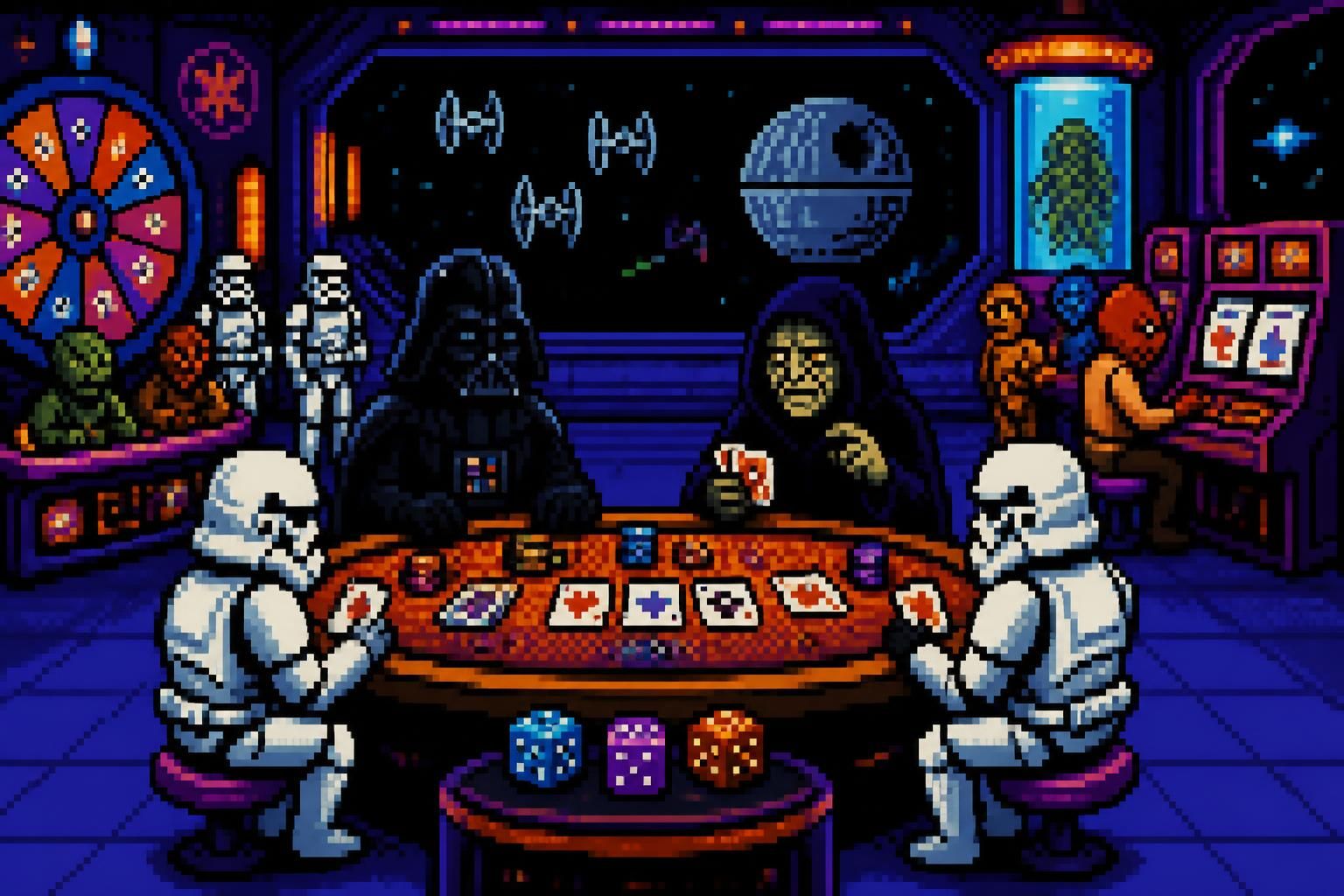
Star Wars Games of Chance: Why Risk Shapes the Galaxy
Across the Star Wars galaxy, games of chance are not decorative distractions. I have observed that they operate as compressed tests of judgment, patience, deception, and social power. A sabacc table in a frontier cantina, a podracing circuit on Tatooine, or a private casino floor on Cantonica all expose the same principle: participants reveal their priorities when outcomes cannot be fully controlled.
You should not interpret gambling merely as a pastime for smugglers and criminals. It is a cultural mechanism shared by merchants, pilots, aristocrats, mechanics, aliens, and soldiers on leave. A wager can settle a debt, establish a hierarchy, finance an escape, or create an obligation that will later become strategically significant. In a galaxy where hyperspace routes, political alliances, and military deployments change rapidly, certainty is a scarce commodity. Games of chance provide a ritualized method for confronting uncertainty.
Han Solo represents the most visible example. His decisions often appear impulsive because he acts before all variables are known. Yet his behavior is not identical to recklessness. He calculates what can be gained by moving quickly while opponents are still analyzing. His familiar refusal to accept unfavorable odds is therefore not a rejection of mathematics. It is an effort to change the conditions under which the calculation occurs. A capable pilot, a modified freighter, and an unexpected route may alter the risk faster than a cautious adversary can respond.
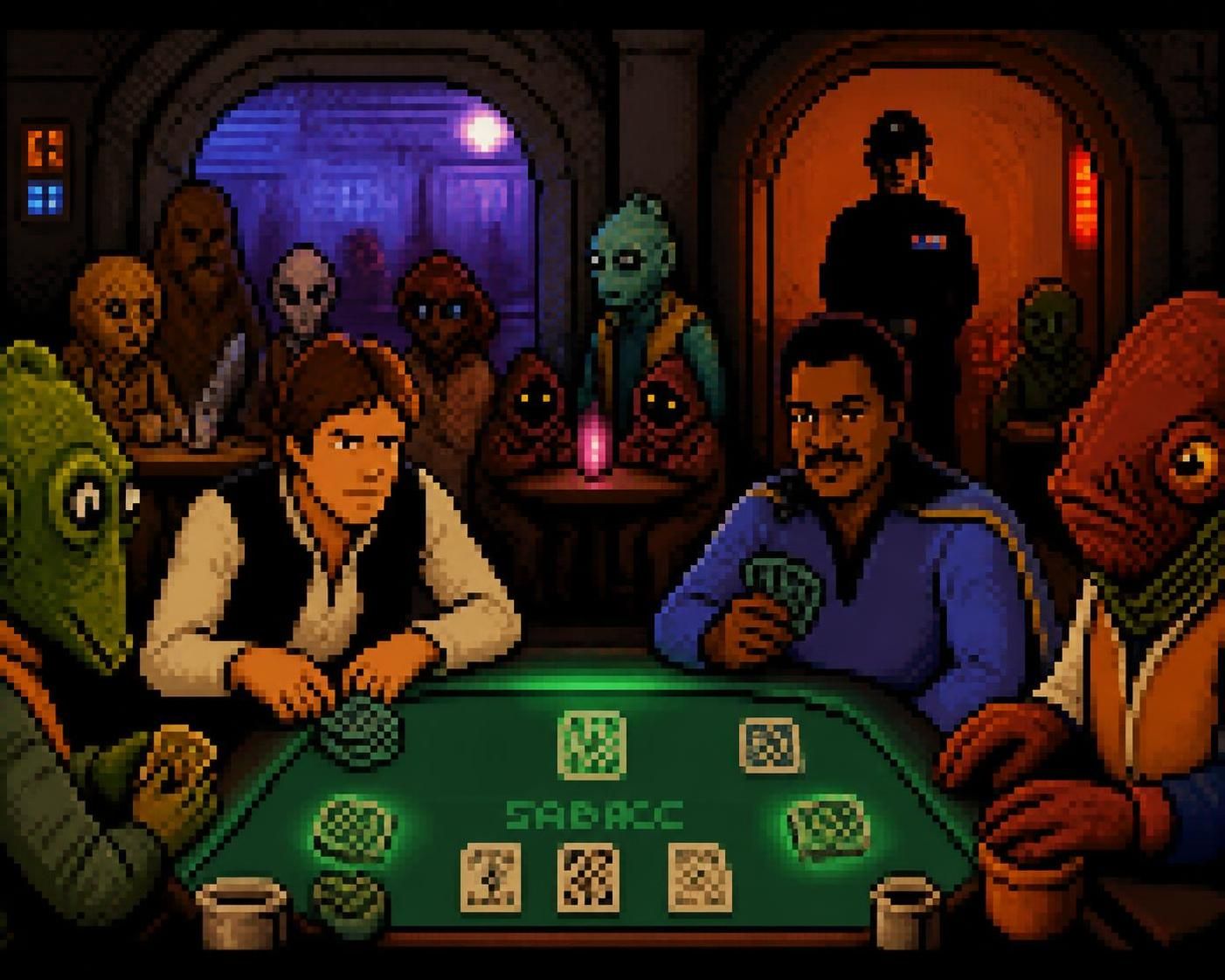
Lando Calrissian applies an opposing method. He studies the room, measures confidence, identifies weaknesses in etiquette, and places himself where a loss will not destroy future options. The sabacc rivalry between Lando and Han works because it is not simply about luck. Each player interprets posture, timing, voice, and hesitation. Their contest turns a card game into an intelligence operation conducted without uniforms. The Millennium Falcon changing hands through sabacc gives the ship a different significance: it was not acquired through bureaucratic allocation or military procurement, but through an individual contest of nerve and reading ability.
That event demonstrates why the franchise repeatedly returns to gambling. A vessel may be powerful, but ownership is frequently determined by personal decisions rather than technological superiority. The Falcon’s history begins, in part, with cards, confidence, and misdirection. You can explore the game’s changing rules and broader history through this overview of sabacc, but its narrative purpose remains consistent: the game transforms invisible judgment into visible consequence.
Risk is equally important outside formal games. A bounty hunter accepting a contract evaluates payment against danger. A rebel commander commits limited fighters against a larger fleet because delay would make success impossible. A trader chooses an unstable route because the safer corridor is monitored. These decisions resemble betting even when no cards or dice are present. Each actor invests resources under incomplete information and hopes that preparation will compensate for chance.
The arts of individual worlds reinforce this pattern. Core World casinos often display polished architecture, controlled lighting, and ceremonial restraint because their patrons want uncertainty to appear civilized. By contrast, the rough tables of Outer Rim cantinas accept noise, improvised rules, and visible weapons because survival itself is already unstable. Culture determines how a society frames luck, but it does not eliminate the underlying contest between information and uncertainty.
⚠️ The essential lesson is direct: in Star Wars, chance is rarely random in its consequences. The player who understands people, terrain, technology, and timing gains an advantage before the first card is dealt. That advantage becomes clearer when the galaxy’s most famous card game is examined closely.
Sabacc and Strategy: The Millennium Falcon’s Most Valuable Wager
Sabacc is effective because it appears familiar while remaining unstable. Players receive cards, build combinations, bluff opponents, and attempt to hold the strongest hand. Yet the game’s electronic cards may shift value, creating a mechanism that punishes anyone who relies entirely on an early advantage. I consider this an accurate model of galactic conflict. Intelligence can be correct when obtained and still become obsolete before forces arrive.
When Han Solo won the Millennium Falcon from Lando Calrissian, the material result was extraordinary. A highly capable freighter became the property of a pilot whose instincts, technical improvisation, and willingness to defy normal procedures allowed it to become far more influential than its original design suggested. The game did not create the Falcon’s capabilities. It placed those capabilities in the hands of an operator willing to exploit them.
You should examine the difference between possession and use. Lando had access to the ship, but Han developed an operational relationship with it. He learned its weaknesses, altered its systems, and treated its limitations as variables to be managed. A similar distinction exists in military command. An officer may receive superior equipment, yet equipment without familiarity produces only theoretical strength. A lesser asset, understood completely, can be decisive.
The scene in Solo: A Star Wars Story makes this conflict visible. Han projects confidence, but his confidence also conceals inexperience. Lando displays composure because he recognizes that social control is part of the contest. Each man is evaluating the other’s tells while trying to manufacture false ones. You can see why sabacc scenes require little exposition: the viewer understands that every pause might be a signal and every signal might be deliberately false.
Sabacc also illustrates a flaw common among overconfident players. They assume that visible confidence equals control. An experienced opponent uses this assumption. If you face a calm adversary, do not assume calmness proves a strong position. It may indicate a prepared deception, a tolerance for loss, or an alternative objective beyond the immediate hand. Lando’s sophistication lies in recognizing that the game is conducted at several levels simultaneously.
Modern interactive adaptations preserve this logic. Physical decks at themed locations and digital versions of the game allow participants to experience the instability of changing values, limited information, and forced choices. A detailed account of how sabacc functions as a Star Wars game is useful because it distinguishes the recognizable card-game structure from the setting-specific mechanics that make it memorable.
Within the galaxy, sabacc is also a meeting ground. Smugglers, bureaucrats, diplomats, and mercenaries may sit at the same table, even when they would never share a formal negotiation chamber. Such proximity produces intelligence opportunities. A careless player may reveal a destination, a financial shortage, or the identity of an associate. In this respect, the prize money can be less valuable than the conversation surrounding it.
Consider the cultural contrast. A formal Core World match may treat rules as extensions of status. A game in a Hutt-controlled district may treat rules as suggestions enforced only when powerful participants benefit from them. The cards remain similar, but the risk changes because enforcement changes. A rational player studies not only the deck but also the authority governing the room.
🎯 Sabacc therefore rewards preparation without promising safety. That is why it remains a suitable symbol for Han and Lando: both understand that luck matters, but neither survives by trusting luck alone.
The strategic value of card games becomes clearer when contrasted with a contest where the machinery itself can kill the competitor. Podracing turns uncertain judgment into a public spectacle with immediate physical cost.
Podracing, Betting, and the Boonta Eve Risk Calculation
The Boonta Eve Classic on Tatooine demonstrates how a sporting event can become a political and personal instrument. Podracing is not a restrained competition. Engines pull small cockpits across hostile terrain at speeds where mechanical failure, collision, or environmental hazards can be fatal. Spectators do not merely watch athletes compete. They watch individuals convert technical skill into survival.
Qui-Gon Jinn faced a constrained situation. Queen Amidala’s ship required parts, Watto would not accept Republic currency, and normal trade had failed. Under such conditions, the wager on Anakin Skywalker was not entertainment. It was an improvised transaction designed to obtain resources when established institutions could not function. The event’s importance came from the terms attached to victory: repair materials, financial leverage, and ultimately Anakin’s freedom.
Watto’s error was not that he enjoyed gambling. His failure was analytical. He had observed Anakin’s ability, but he interpreted that ability through ownership rather than probability. He assumed a child, even one with exceptional reflexes, could not overcome established rivals such as Sebulba. This assumption ignored a key variable: skill does not become less significant merely because it is held by someone socially underestimated.
| Event Element | Immediate Stake | Strategic Variable | Operational Lesson |
|---|---|---|---|
| 🏁 Boonta Eve race | Ship components and payment | Anakin’s piloting capacity | Skill can offset material disadvantage |
| 🎲 Watto’s wager | Anakin’s freedom | Faulty assessment of competitors | Never confuse ownership with control |
| 🔧 Damaged podracer | Ability to finish | Repair under pressure | Redundancy and adaptation preserve options |
| 👁️ Spectator betting | Credits and reputation | Public perception of form | Markets react to incomplete information |
You can identify familiar patterns in the crowd. Spectators assess form, reputation, machinery, weather, past outcomes, and rivalries before placing bets. This resembles real sporting analysis, where audiences compare matchups and recent performance before committing money. The difference is that podracing magnifies every consequence. An incorrect prediction can cost credits; a mechanical mistake can cost a life.
Watto also manipulated the chance cube that determined whether Anakin or his mother would be included in the agreement. Qui-Gon recognized the dishonesty and influenced the result through the Force. This event complicates the notion of fair chance. A game is only legitimate when participants possess comparable access to rules, equipment, and enforcement. Once one party can secretly alter the system, the contest becomes a controlled extraction mechanism.
That principle applies to gambling throughout the galaxy. A casino game may appear neutral while its proprietor controls surveillance, debt collection, or card supply. A podracing bookmaker may publish odds that encourage vulnerable bettors toward a preferred outcome. A Hutt financier may offer credit designed to create dependence rather than opportunity. You should always ask who sets the terms, who verifies the result, and who profits if everyone else loses.
The official treatment of podracing as a widespread cultural spectacle is important. It gives the galaxy ordinary routines beyond warfare. Families watch races, mechanics build engines, vendors sell food, and gamblers argue over favorites. Such details make the setting credible because societies do not exist solely to produce soldiers or rebels. They also seek diversion, status, and stories.
🏎️ The Boonta Eve wager proves that a race is never only a race when freedom, resources, and power are attached to the finish line. The next environment, however, hides its danger behind elegance rather than exposed engines.
Canto Bight Casino Culture and the Economics of Galactic Gambling
Canto Bight presents gambling in its most polished form. On Cantonica, wealthy patrons move through ornate halls, display elaborate clothing, and treat massive wagers as social performance. The environment resembles a carefully defended cultural institution rather than a frontier cantina. Yet I find the structure more revealing than the decoration. Luxury is used to make unequal power appear natural.
In such spaces, the wealthy do not merely purchase entertainment. They purchase separation from consequence. Their credits insulate them from the labor, conflict, and exploitation that make their comfort possible. The casino’s visual design communicates this message through controlled color, clean lines, decorative creatures, and ritualized behavior. Every artistic detail reassures guests that disorder exists elsewhere.
Finn and Rose enter Canto Bight with a limited mission: locate a master codebreaker. Their experience reveals a basic intelligence failure. They assume that access to a location will lead quickly to access to the right person. The casino contains many wealthy, skilled, and deceptive individuals, but proximity to useful talent is not equivalent to identification. In a dense social environment, a false lead can consume the entire operational window.
The pair’s encounter with the apparent codebreaker also shows how reputation functions as currency. Elegant presentation, confidence, and visible wealth suggest competence. Yet such signs may only prove that an individual understands the local performance of status. A skilled intelligence officer would verify capabilities through behavior, associates, and previous work rather than relying on appearance. The lesson applies equally to a gambler selecting a table and a commander selecting an ally.
Canto Bight’s deeper significance lies in its relationship to arms dealing. Its elite patrons profit from conflict regardless of faction. They treat war as a market because their distance from battle allows them to ignore its human cost. The casino therefore becomes a symbol of strategic parasitism: wealth is accumulated by supporting opposing forces, then converted into social prestige. A useful examination of this relationship appears in this discussion of casino culture in the Star Wars universe.
You should distinguish between risk assumed and risk transferred. A pilot in combat assumes personal danger. A gambler who bets disposable wealth assumes financial danger. A manufacturer who sells weapons to every side while remaining protected transfers danger to those who must operate the weapons. Canto Bight is designed to obscure this distinction through music, etiquette, and spectacle.
The city also reveals why gambling regulations matter. Rules can prevent fraud, restrict predatory lending, and create mechanisms for dispute resolution. They can also be written to protect owners rather than guests. On Cantonica, law and luxury appear to cooperate because the ruling structure benefits from stable entertainment markets. Stability for patrons, however, does not necessarily mean justice for workers, stable hands, or exploited child laborers.
The contrast with Tatooine is deliberate. Tatooine displays danger openly: dust, engines, weapons, and Hutts. Canto Bight conceals danger under ceremony. A strategist should not assume the clean environment is safer. In fact, concealed systems are often more durable because those harmed by them are kept outside the visible frame.
💠 Canto Bight demonstrates that the most expensive game is often not played at the table, but in the system that decides who may enter the room. That system is best understood by comparing the social spaces where gambling occurs across the galaxy.
Behind the polished surfaces of Cantonica lies a wider network of cantinas, racing pits, and private rooms where information travels faster than official reports. These spaces deserve the same attention as military corridors.
Aliens, Cantinas, and the Social Intelligence of Star Wars Gambling
A cantina table is often more informative than a formal briefing chamber. In the Star Wars galaxy, gambling creates temporary contact between groups that may otherwise remain separated by species, class, language, or allegiance. Aliens from distant worlds gather around shared games because rules, gestures, stakes, and visible outcomes can overcome linguistic barriers. This does not create trust. It creates an opportunity to observe how trust is negotiated.
I have found that cultural habits reveal themselves most clearly under small pressure. A Rodian may react to public embarrassment differently from a Corellian smuggler. A Hutt representative may use silence as leverage because others fear the consequences of filling it. A protocol droid may treat a probability calculation as decisive while organic players treat it as merely one input. None of these tendencies should be reduced to crude stereotypes, but every culture establishes patterns that competent observers can study.
Consider the familiar cantina environment on Tatooine. The room combines music, trade, suspicion, and entertainment. The musicians establish a rhythm that makes conversation feel casual, while patrons assess strangers through clothing, weapons, companions, and behavior. A card game in this setting provides cover. Participants can exchange information without appearing to hold a formal meeting. Credits move across the table while loyalties move beneath it.
You should therefore read gambling behavior as social evidence. A player who stakes too much may be rich, desperate, intoxicated, or attempting to project wealth. A player who never risks anything may be disciplined, frightened, or operating with resources too valuable to expose. The visible action is incomplete intelligence. Its value emerges only when compared with timing, relationships, and local customs.
The design of games matters as well. Some worlds favor quick contests because merchants and travelers cannot remain for long. Others value extended games where patience and memory determine prestige. The form of entertainment becomes a cultural artifact, much like architecture, painting, or music. A society that admires elaborate ceremonial play may also prefer formal political negotiation. A society that celebrates improvised street competitions may adapt quickly when conditions change.
These observations have operational use. If you need to understand a region before deploying force, study its leisure activities. Ask what people watch, what they wager, what losses they consider shameful, and what victories they celebrate publicly. Such questions reveal incentives more accurately than slogans. Political speeches describe ideals; games often reveal practical values.
Gambling can also create dangerous misunderstandings. A visitor who assumes every table follows Core World norms may underestimate local enforcement. In Hutt territory, the person collecting debts may be more important than the dealer. In a remote outpost, the individual who controls air, fuel, or docking clearance may hold greater power than the nominal proprietor. Rules are not merely written; they are enforced by whoever can impose consequences.
For this reason, I advise the reader to treat every game as a map of authority. Identify who owns the venue, who watches the exits, who settles disputes, and who is permitted to leave after losing. These details determine whether the contest is recreation, coercion, or recruitment. A game can recruit a pilot, expose a spy, or bind a debtor to a criminal network without any participant naming the larger plan.
👁️ The table is not neutral ground. It is a small territory where culture, information, and power are arranged in visible form. Once that arrangement is understood, the difference between luck and calculated risk becomes easier to measure.
Luck Versus Preparation in a Star Wars Space Adventure
Many participants in a space adventure attribute survival to luck because the full chain of causes is difficult to see. This is understandable but incomplete. Luck describes the variables outside immediate control: an asteroid field shifting unexpectedly, a hidden patrol entering a route, a component failing at the wrong moment, or an ally arriving sooner than predicted. Preparation determines whether those events become fatal.
The Millennium Falcon’s escape maneuvers illustrate this distinction. Flying into an asteroid field is dangerous, but it can be strategically rational when the pursuer’s doctrine discourages close pursuit. Han Solo’s success in such moments does not prove that danger vanished. It proves that he understood the comparative limitations of his ship, his crew, and the forces following him. He chose uncertainty that he could influence over certainty controlled by an enemy.
You can apply the same reasoning to games of chance. A player cannot control every card drawn, but can control how much is staked, when to withdraw, which opponents to challenge, and whether a suspicious table is worth entering. The strongest participant is not the one who wins every hand. That condition is impossible. The strongest participant remains operational after an unfavorable sequence.
Qui-Gon’s conduct on Tatooine provides another useful case. He accepted a wager because conventional bargaining had failed, but he did not enter blindly. He had observed Anakin’s piloting ability and recognized an unusual potential. His use of the Force altered the chance-cube result, raising ethical and strategic questions, yet the broader lesson remains: he selected the available gamble only after identifying an advantage that Watto had underestimated.
Risk becomes destructive when leaders mistake hope for preparation. A commander who launches an attack with no intelligence, no reserve force, and no extraction plan is not brave. That commander is surrendering initiative to chance. Conversely, a commander who establishes fallback routes, distributes responsibility, and defines thresholds for retreat is not avoiding danger. That commander is shaping it.
In gambling, this is called bankroll management in some cultures; in warfare, it is reserve allocation. The terminology changes, but the logic does not. Do not commit every resource to one outcome when future conditions are unknown. Preserve capacity to respond. A player who loses a small wager can analyze and adapt. A player who loses everything becomes dependent on others.
Technology also affects the equation. Navigation computers, sensor arrays, droids, and encrypted communications reduce uncertainty, but they do not eliminate it. Their outputs depend on inputs, maintenance, and interpretation. An outdated map, compromised droid, or manipulated transmission can transform apparent knowledge into a trap. The same is true of a casino’s displayed odds: numbers create confidence, but confidence is only justified if the system producing them is credible.
When studying chance mechanics in Star Wars games, the useful question is not whether fortune exists. It clearly does. The useful question is which decisions remain available after fortune turns against you. That is where strategic competence appears.
🧭 Luck decides some events; preparation decides how many events are allowed to decide you. This distinction becomes essential when wagering leaves private entertainment and enters the realm of political power.
Galactic Politics, Bounties, and the Hidden Markets of Risk
Political systems across the galaxy often resemble high-stakes betting networks. Senators wager influence on legislation. Crime syndicates advance credits to captains and expect repayment through future control. Corporate interests fund security arrangements that protect trade routes favorable to their own operations. The public language may concern order, stability, or prosperity, but the hidden calculation concerns expected return.
Bounty hunting makes this calculation explicit. A hunter reviews a target’s location, reputation, security, affiliations, and posted reward. The payment is not simply income; it is a signal of perceived difficulty. A high bounty can indicate a dangerous target, a wealthy client, a political message, or a trap constructed to draw ambitious hunters into a controlled area. You should never treat the number alone as evidence of value.
The Mandalorian profession demonstrates why reputation matters. A hunter with reliable equipment, verified captures, and disciplined methods may earn contracts that a reckless competitor cannot approach. In this market, consistency is more valuable than dramatic success. Clients want results, discretion, and predictable cost. A hunter who accepts every dangerous assignment may become famous briefly, but fame does not replace operational endurance.
Criminal syndicates employ gambling in a similar fashion. Debt converts entertainment into leverage. A debtor may be pressured into transporting cargo, revealing access codes, betraying an associate, or accepting an impossible job. The original game becomes irrelevant once the debt has been created. What matters is the relationship of dependence that follows. This is why rules governing credit and collection matter as much as the rules of play.
The Empire and the Rebellion also made strategic wagers, though they rarely described them in such terms. The Empire invested heavily in centralized terror weapons, assuming that fear would create compliance more efficiently than distributed control. The Rebel Alliance invested in mobility, local support, and audacious strikes, assuming that political legitimacy could compensate for material inferiority. Each side gambled on a theory of behavior.
At Endor, Imperial strength in conventional firepower was considerable. The failure arose from dependence on a narrow set of assumptions: the shield generator would remain secure, the Death Star would control the engagement, and local resistance would be irrelevant. The Ewoks were not a decisive strategic force at the beginning of the plan. They became decisive because the defense system had not assigned sufficient weight to terrain knowledge, local motivation, and unconventional tactics.
For the reader, the relevant lesson is not that large forces always fail. Large forces fail when their decision-makers treat inconvenient variables as negligible merely because those variables are difficult to quantify. In gambling, this resembles ignoring the possibility of a manipulated deck because acknowledging it would require leaving a profitable table. In politics, it resembles ignoring civilian resentment because the security reports look orderly.
Markets of risk therefore connect private and public life. A sabacc debt can influence a smuggling route. A bounty can alter the balance among criminal groups. A corporate wager can fuel an arms race. A military miscalculation can destabilize entire systems. The scale changes, but the pattern is continuous: resources are committed before results are known.
⚖️ Every major power must ask not only what it may win, but who gains leverage if the wager fails. That question leads directly to practical methods for assessing danger before it becomes irreversible.
Games of Chance in Star Wars: A Field Method for Reading Risk
A disciplined approach to risk begins before a wager is placed. Whether you are examining a sabacc game, a podrace, a bounty contract, or a political alliance, separate visible excitement from the actual structure of incentives. Excitement attracts participants; structure determines outcomes. A noisy room can conceal a simple trap, while a quiet transaction can reshape control of an entire sector.
The following field method is intended for any observer moving through the galaxy. It does not promise perfect prediction. Such promises are usually tools of manipulation. It provides a way to reduce avoidable error by identifying the forces that influence a decision before resources are committed.
- 🔍 Identify the real stake: determine whether the stated prize is credits, access, freedom, reputation, information, or leverage over another person.
- 🎲 Test the rules: ask who created them, who enforces them, and whether any participant has hidden authority to alter the outcome.
- 👁️ Study the players: observe behavior before the contest begins, especially alliances, debt, confidence displays, and responses to small losses.
- 🛠️ Assess the tools: inspect cards, droids, engines, ships, data feeds, and security systems for weaknesses or manipulation.
- 🚪 Preserve an exit: define the point at which withdrawal is preferable to escalation, and ensure that leaving is physically possible.
- 📡 Separate rumor from intelligence: cantina whispers can identify leads, but they require verification before they shape strategy.
- 🧱 Protect reserves: never stake every credit, ship, ally, or military unit on a single uncertain result.
This method applies directly to Han Solo’s habits. His apparent boldness works best when he has a route, a ship capable of exploiting it, and a crew ready to respond. It fails when those elements are missing. The distinction is often ignored by those who imitate the visible act without understanding the preparation beneath it. Imitation without analysis produces casualties.
The same standard applies to Lando Calrissian. His social fluency gives him access to powerful spaces, but access creates obligations. His decisions at Cloud City show the limits of negotiation when an opponent possesses overwhelming coercive power. A deal may appear rational at the moment of agreement and still deteriorate if the stronger party can revise terms without penalty. A player must calculate not only the original rules but the opponent’s capacity to abandon them.
For writers and players, this is why gambling remains useful in Star Wars storytelling. It condenses a character’s philosophy into action. Han commits before certainty arrives. Lando measures the social terrain. Watto relies on ownership and local influence. Qui-Gon selects an unconventional path when official currency has no value. Finn and Rose discover that glamorous wealth can conceal systems of exploitation. Each case uses betting to reveal how people respond when control is limited.
The galaxy also gains texture through these ordinary activities. Citizens watch races, exchange cards, argue over odds, and seek distraction after work or travel. Those details make battles more meaningful because they clarify what ordinary life contains and what conflict threatens to disrupt. A galaxy composed only of fleets and councils would be strategically incomplete. Leisure shows where social pressure accumulates.
One final practical point deserves emphasis. Never mistake probability for destiny. A favorable forecast can fail because of sabotage, weather, betrayal, mechanical damage, or an adversary who understands your assumptions. An unfavorable forecast can be overcome when the opponent is rigid, careless, or dependent on a single point of failure. Probability informs action; it does not excuse the failure to adapt.
♟️ The most reliable player is not the one who claims to defeat chance. It is the one who understands where chance ends and disciplined strategy begins.

I am Grand Admiral Thrawn, strategist of the Galactic Empire. Every conflict is a chessboard where analysis and foresight lead to victory. The art and culture of a people betray their weaknesses. The Empire embodies order and discipline in the face of rebel chaos. History will remember that only strategy ensures peace.