
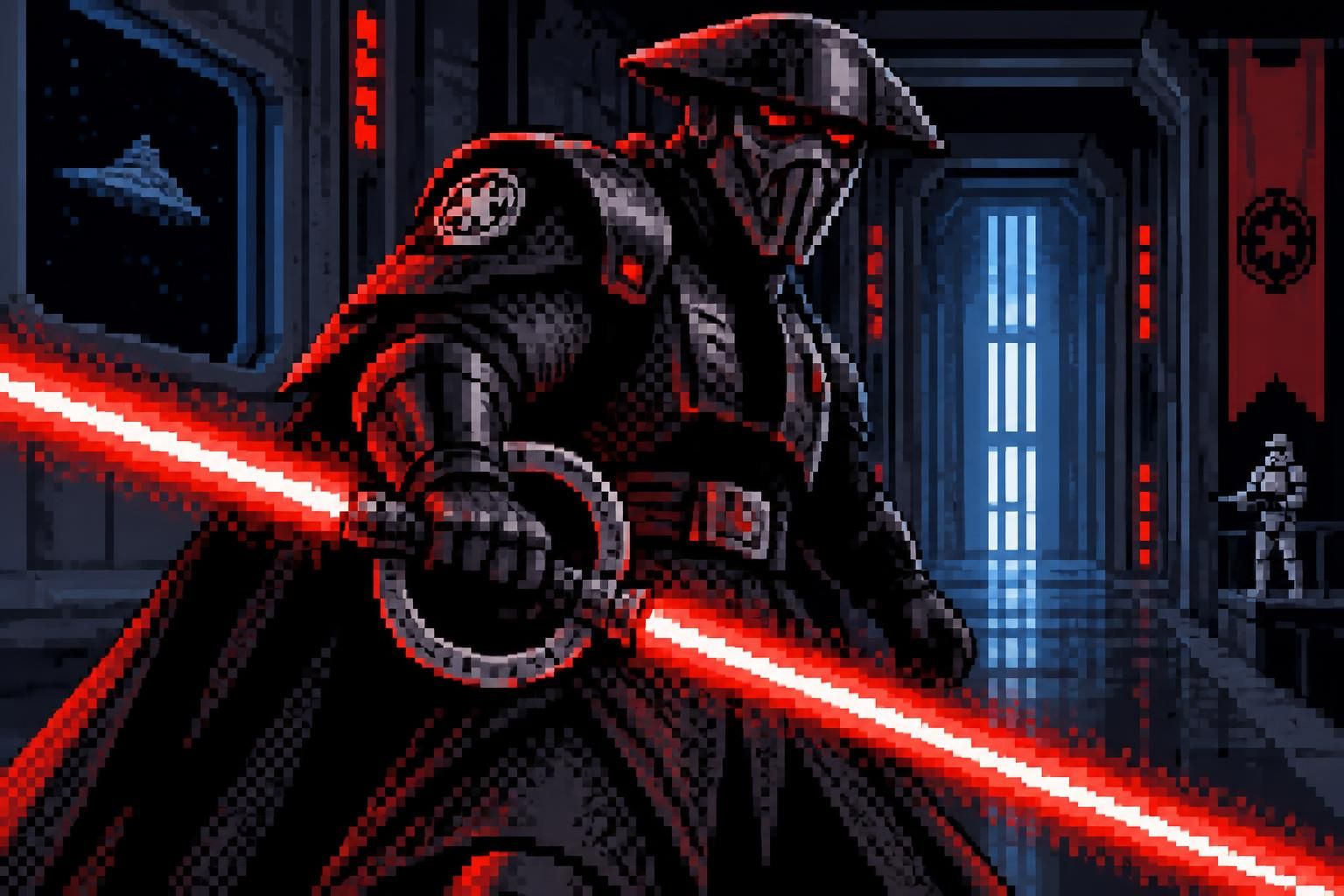
The Sixth Brother’s Identity: Bil Valen and the Imperial Inquisitorius
I assess The Sixth Brother by separating his institutional purpose from the reputation surrounding him. You encounter a dangerous Force-sensitive operative, but his significance lies less in exceptional combat mastery than in what his career reveals about the Empire’s methods of recruitment, intimidation, and control.
Before receiving his numerical designation, he was known as Bil Valen. His passage from the Jedi tradition into the Imperial Inquisitorius placed a former member of the persecuted institution inside the machinery designed to destroy its survivors.
I regard that transition as an operational advantage with an embedded vulnerability. A former Jedi could recognize training habits, defensive instincts, and patterns of concealment, yet those same connections supplied adversaries with knowledge of his origins.
Why the Sixth Brother’s Former Identity Matters
You should not treat the replacement of a personal name with a title as a decorative change. A designation such as Sixth Brother subordinated individual identity to an organization whose members existed under the authority of the Grand Inquisitor and, above him, Darth Vader.
I read the numbering system as evidence of institutional possession, not as a reliable combat ranking. Nothing about the numeral alone establishes that its bearer was stronger than every operative assigned a higher number, or weaker than every operative assigned a lower one.
The distinction matters because readers often convert administrative labels into unsupported power hierarchies. An intelligence assessment requires demonstrated performance: whom an operative located, what resistance he overcame, how he handled unexpected conditions, and whether his actions advanced the assigned objective.
His appearance also requires source discipline. Prose and illustrated depictions emphasize different features, including unusual skin coloration, facial markings, intimidating proportions, and equipment that obscures or frames his eyes; those variations do not justify inventing a confirmed species.
I would therefore record his species as unidentified rather than derive ancestry from pigmentation. You gain nothing by replacing an absent identification with an attractive guess, especially in a galaxy where similar physical traits occur across unrelated populations.
The Inquisitor as an Instrument of Imperial Rule
The Imperial Inquisitorius pursued surviving Jedi and other Force-sensitive individuals after Order 66. Its remit extended beyond winning duels: identifying hidden networks, locating children with unusual abilities, and making civilian assistance to fugitives appear prohibitively dangerous.
I distinguish that mission from ordinary military occupation. A stormtrooper garrison could secure a landing field or enforce a production quota; a specialist trained in the Force could investigate incidents that conventional officers could neither explain nor reliably counter.
You can follow the distinction through a hypothetical district commandant receiving reports of impossible reflexes during an arrest. The useful response would begin with witness separation, physical evidence, and discreet surveillance, rather than an immediate public declaration that a Jedi had appeared.
Bil Valen’s eventual pursuit of Ahsoka Tano demonstrates why this distinction mattered. Reports of extraordinary intervention could identify a valuable target, but the manner of investigation determined whether that target remained exposed or disappeared before the hunter arrived.
I also separate the Dark Side from administrative competence. Access to destructive abilities did not automatically provide patience, accurate threat classification, or sound judgment under pressure; the Sixth Brother’s record repeatedly exposes that gap.
For background comparison, you can consult Wookieepedia’s Sixth Brother entry, while retaining the distinction between a reference compilation and the stories it summarizes. The novels and comics remain essential for evaluating what he actually does.
My working assessment is consequently precise: he was a specialized persecutor whose institutional authority exceeded the reliability of his decisions. That imbalance becomes visible when his training under Vader replaces disciplined development with a permanent demonstration of vulnerability.
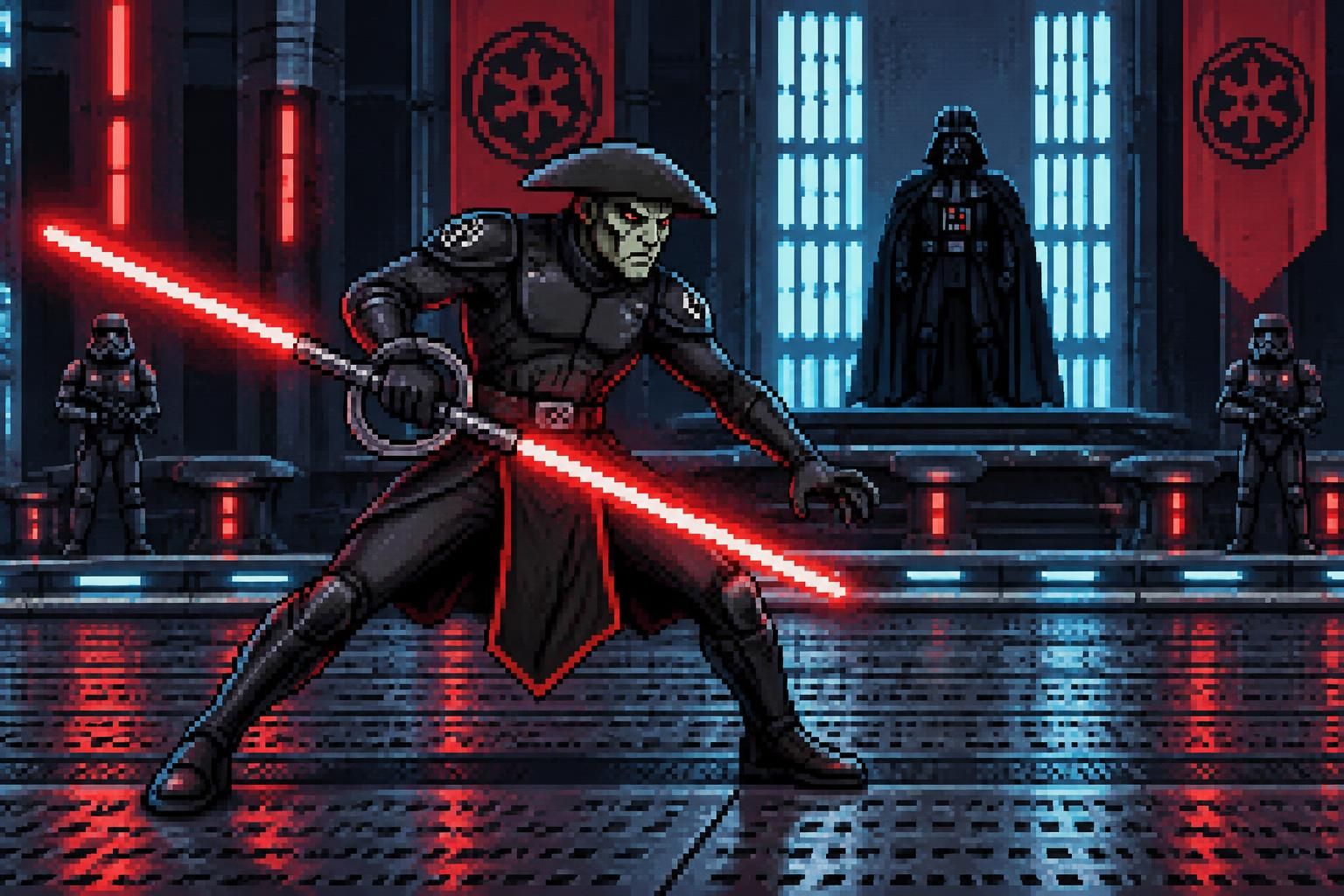
The Sixth Brother and Darth Vader: What the Lost Arm Reveals
I treat the Sixth Brother’s training injury as more than a demonstration of Darth Vader’s superiority. During an early encounter depicted in Darth Vader: Dark Lord of the Sith, the Sith Lord severed his left arm, establishing that membership in the hunting organization offered no protection from its own commander.
You should distinguish the immediate lesson from its institutional consequences. Vader demonstrated overwhelming dominance; the more difficult question is whether that demonstration produced a better operative or merely a more frightened subordinate.
His explanation to the Grand Inquisitor concerned teaching loss. That rationale fits a system intended to sever attachments and cultivate dependence, but an explanation of intent does not prove that the resulting behavior served the Empire effectively.
Vader’s Training Method and Its Operational Cost
I can identify a narrow advantage in the exercise. An agent who had previously relied on familiar Jedi forms now faced an opponent who exploited those habits without restraint, making inherited confidence visibly inadequate.
There was also an unmistakable material cost. A wounded specialist required treatment, recovery, and adaptation to a prosthetic limb before returning to full service; those requirements consumed time and resources that a controlled exercise might have preserved.
You should not assume that a mechanical replacement made the injury irrelevant. Star Wars contains highly capable cybernetic combatants, but replacement and adaptation are separate processes, and the available account does not provide a detailed measure of his rehabilitation.
The relevant issue is therefore not whether a prosthesis could function effectively. It is whether deliberate mutilation taught a transferable combat principle more efficiently than a demanding exercise with clear instruction, correction, and repeated testing.
I would evaluate that claim through subsequent conduct. If the trainee later showed composure, cooperation, and accurate threat assessment, the method might demonstrate operational value; if he instead concealed information and sacrificed allies, its supposed efficiency would require reconsideration.
Bil Valen’s Encounter with Iskat Akaris
Inquisitor: Rise of the Red Blade provides another perspective on the aftermath through Iskat Akaris, who would become the Thirteenth Sister. Her encounter with the injured operative places the consequences of Vader’s instruction inside the organization’s everyday environment.
When questioned about what happened, he responded with hostility rather than a useful explanation. I read that exchange as evidence of guardedness and humiliation, not as proof that he had extracted a clear tactical lesson from the defeat.
You can see the institutional problem without assigning him an undocumented private motive. A newcomer encountered a serious training casualty, yet the response did not supply actionable information about expectations, hazards, or methods of preparation.
In a functioning training establishment, experienced personnel transmit lessons that reduce avoidable losses. Here, knowledge became another means of exclusion: the injured subordinate knew something dangerous, and the new arrival was left to discover it through exposure.
I would have required a structured debrief describing the opening, the failed defense, and the corrective exercise. That recommendation is an analytical alternative, not an event depicted in the story; its value lies in identifying what the recorded encounter lacks.
The cultural contrast is instructive. Jedi instruction traditionally connected martial discipline with restraint, while this encounter transformed instruction into a display of ownership; the familiar language of apprenticeship remained, but its protective obligations had been removed.
You should consequently resist a simple equation between suffering and strength. Pain can expose a weakness, yet only analysis and practice convert that exposure into improved performance; otherwise, the lasting lesson may be that survival requires concealing weakness from everyone nearby.
I identify the lost arm as an early warning of the Sixth Brother’s later conduct. A system that makes vulnerability dangerous to disclose should expect its agents to prioritize individual survival when a mission begins to collapse.
The Sixth Brother on Mon Cala: Environmental Power Against Imperial Force
I consider the Mon Cala operation the clearest test of the Sixth Brother outside a controlled encounter. Accompanying Vader, the Ninth Sister, and the Tenth Brother, he entered a campaign in which political resistance, submerged geography, and a concealed Jedi presence complicated the Empire’s apparent superiority.
The immediate search concerned a surviving Jedi associated with King Lee-Char. You should notice that this created overlapping objectives: locating the fugitive, controlling the sovereign, and imposing Imperial authority were related tasks, but they were not interchangeable.
Confusion between those objectives could produce local successes without resolving the central problem. Capturing a political figure might yield intelligence, yet coercing him in a hostile environment also exposed the pursuing force to intervention from actors outside its immediate field of view.
Why Mon Cala’s Environment Changed the Engagement
I would begin any assessment of Mon Cala with its physical conditions. A maritime civilization possesses routes, refuges, movement practices, and relationships with its environment that an arriving expedition cannot understand merely by controlling the sky.
You can recognize the broader principle in the planet’s shipbuilding culture. Habitats, vessels, and engineering traditions developed around aquatic conditions illustrate a society accustomed to treating water as infrastructure rather than simply an obstacle.
That observation does not establish that every local inhabitant possessed superior tactical knowledge. It establishes a planning requirement: an occupying force had to investigate submerged access, pressure conditions, evacuation routes, and the possibility of intervention from the surrounding sea.
During the confrontation involving Lee-Char, enormous sea creatures generated waves that overwhelmed the immediate position. The Sixth Brother attempted to resist the incoming water through the Force, but his effort did not prevent the group from being swept away.
I classify that moment as a mismatch between individual capability and environmental scale. The same power that can deflect a weapon or move an opponent does not necessarily provide an adequate answer to a vast moving mass of water.
What should you infer from his failure? Not that he lacked all competence, but that an emergency response had become necessary because the position’s exposure had already exceeded what personal combat ability could reliably compensate for.
Intelligence Collection During the Mon Cala Mission
The surviving hunters subsequently used a submarine and continued the operation. The Ninth Sister’s acquisition of information concerning the fugitive’s location demonstrates that the expedition was not wholly ineffective; useful intelligence emerged even amid disruption.
I would preserve that distinction in a campaign report. Calling the entire mission incompetent would obscure a successful collection effort, just as celebrating the discovery would conceal the vulnerabilities exposed during the approach.
For the Sixth Brother, the operational demand now changed. He was no longer merely intimidating a ruler; he was participating in a pursuit where confined approaches, uncertain opposition, and the distribution of command authority would shape the encounter.
Vader’s separate movement to recapture Lee-Char left the subordinate group facing the hidden adversary without his immediate presence. You should regard that separation as a condition requiring contingency planning, not as automatic evidence that splitting the force was inherently wrong.
A sound plan would have established communications, withdrawal criteria, and procedures for unexpected interference with supporting troops. These are recommended safeguards rather than documented preparations, and their relevance becomes apparent in the confrontation that followed.
I also note a political cost in treating local society solely as a collection of pressure points. When an expedition extracts information through fear, it may secure a location while simultaneously increasing the number of inhabitants willing to obstruct its movements.
The lesson is specific: environmental understanding must precede coercive confidence. On Mon Cala, the sea was not background scenery; it was a powerful operational variable that helped determine where Imperial advantages could actually be applied.
Ferren Barr and Order 66: How the Sixth Brother’s Support Force Failed
I identify Ferren Barr’s manipulation of the clone purge troopers as the decisive reversal in the Mon Cala pursuit. The hunters had reached an apparently favorable position, only to discover that their supporting infantry contained a vulnerability their opponent understood better than they did.
Barr, an Iktotchi Jedi survivor, confronted an enemy organization staffed by former Jedi and accompanied by clones conditioned to execute Jedi. You should immediately recognize the contradiction: the attackers’ biographies intersected dangerously with the behavioral programming of their own troops.
The surviving Jedi exploited that relationship through the Force, turning Order 66 against the pursuing group. Instead of providing additional firepower, the accompanying soldiers became an immediate threat to the personnel they had been supporting.
When Superior Numbers Become an Internal Threat
I distinguish this event from an ordinary change of allegiance. The soldiers did not conduct a political reassessment of Imperial authority; Barr activated an existing framework in which the former Jedi before them could be classified as targets.
That distinction explains why the reversal happened so quickly. A prepared behavioral response required less persuasion than a new ideology, and the hunters had entered close proximity to weapons carried by troops they assumed were secure.
You can express the failure as a problem of incompatible authorization. One institution had reclassified former Jedi as Imperial assets, while an older command mechanism could still identify their origins as sufficient grounds for execution.
The Tenth Brother was killed during the attack. The Sixth Brother and Ninth Sister used the Force to resist and create space, but the formation had already lost cohesion, and its primary target gained an opportunity to escape.
I would not attribute the entire outcome to insufficient aggression. More force directed at Barr might not have prevented the reversal once the supporting troops were close enough to engage; the weakness lay in the composition and assumptions of the unit.
The Sixth Brother’s Attack on the Ninth Sister
During the withdrawal, the Sixth Brother severed the Ninth Sister’s leg and escaped while she remained exposed. This was not simply a failure to rescue a comrade; it was an active reduction of an ally’s mobility to improve his own prospects.
I can reconstruct the immediate calculation without endorsing it. A disabled companion could occupy the pursuers’ attention, creating time and distance for the escaping operative, but that short-term benefit came at the expense of organizational reliability.
You should ask what any surviving colleague would learn from such conduct. If an ally might deliberately cripple another during retreat, future cooperation would require additional safeguards, and every shared maneuver would carry an internal security cost.
The Ninth Sister survived, making the attack especially important for understanding the organization rather than merely its casualty count. The incident demonstrates that mutual survival was not a dependable constraint on the Sixth Brother’s decision-making.
- ⚠️ Command vulnerability: incompatible orders turned supporting infantry into hostile firepower.
- 🎯 Adversary advantage: Barr exploited his opponents’ origins instead of matching their numbers.
- 🛡️ Unit-cohesion failure: a deliberate attack on an ally converted retreat into internal predation.
- 📋 Planning requirement: sensitive deployments needed checks on conditioning, identification, and emergency control.
I would have separated the vulnerable troops from this particular engagement until their responses could be assessed. That recommendation does not presume a simple technical cure; it recognizes that an unexamined risk should not be placed inside the formation it might destroy.
Barr’s subsequent death at Vader’s hands did not erase the earlier failure. You must distinguish eventual elimination of an adversary from successful execution of every preceding operation; otherwise, final victory becomes an excuse to ignore preventable losses.
The durable finding is that the Sixth Brother survived by transferring danger to his own side. That behavior preserved an individual asset while weakening the very system that made the asset useful.
The Sixth Brother Hunting Ahsoka: Raada and the Limits of Terror
I examine the Raada pursuit through the account presented in E. K. Johnston’s Ahsoka. In that novel, reports of unusual abilities during resistance to Imperial rule bring the Sixth Brother into the orbit of Ahsoka Tano, who is attempting to survive without openly resuming her former life.
The setting matters because the conflict does not begin as a formal duel between recognized opponents. You encounter farmers, production demands, concealed identities, and improvised resistance before the specialist hunter turns those conditions into a trap.
I regard Raada’s agricultural community as an operational network, not merely a population waiting to be threatened. Shared labor, familiarity with local movement, and personal obligations created channels through which information and assistance could travel outside official control.
Why Hostage Tactics Brought Ahsoka into the Open
The Sixth Brother used violence against civilians to force the concealed defender to respond. His method depended on a sound observation: a survivor shaped by Jedi training might accept personal danger rather than permit others to suffer in her place.
You should separate that accurate psychological observation from the conclusion he drew from it. Predicting that a target would appear did not establish that she would arrive without a plan, accept his preferred engagement, or prove inferior once contact began.
I identify a familiar coercive error here. The hunter treated moral obligation as a restraint on his opponent while failing to account for the initiative it could generate; someone who chooses to intervene may also choose the timing and method of intervention.
The Imperial presence had already given local inhabitants reasons to distrust official authority. Additional brutality could expose a defender, but it also made the threatened community less likely to provide reliable voluntary cooperation after the immediate crisis.
A hypothetical garrison commander following this case would need to distinguish compliance from intelligence. Terrified witnesses can repeat what an interrogator wants to hear, conceal useful details, or flee, leaving an apparently controlled settlement increasingly difficult to understand.
Ahsoka Tano as a Misclassified Opponent
I assess Ahsoka’s experience as the essential variable the hunter underestimated. Her survival through the Clone Wars, extensive combat exposure, and familiarity with unconventional threats made her materially different from an isolated novice whose abilities had only recently emerged.
Although she was no longer formally part of the Jedi Order, her departure had not removed her training. You should not confuse institutional status with capability: leaving an organization does not erase the skills, reflexes, or judgment acquired within it.
Her lack of functioning lightsabers during the confrontation likewise did not make her harmless. The Force remained available, and her ability to perceive the crystals within the opposing weapon created an avenue of attack that conventional fencing did not address.
I would describe the Sixth Brother’s central mistake as equipment-based threat classification. He confronted an apparently unarmed opponent and behaved as though the absence of a familiar weapon had resolved the question of relative danger.
A more disciplined assessment would have examined prior interventions, probable training, escape behavior, and the possibility of a concealed countermeasure. These are analytical alternatives, not additional events in the novel, but they identify the information required before committing to close combat.
The case also exposes the limits of fear as a universal instrument. Intimidation works differently against a dispersed civilian population and an experienced combatant who has already decided that intervention is necessary; applying the same method to both creates predictable miscalculations.
I therefore read Raada as a failure of assessment before it became a defeat in combat. The trap succeeded in producing contact, but contact was not the same as control.
The Sixth Brother’s Lightsaber: Mechanical Failure and Ahsoka’s White Blades
I consider the Sixth Brother’s weapon the most concentrated expression of his operational problem. Its rotating, double-bladed configuration offered intimidation and tactical options, yet he allowed confidence in the device to obscure the possibility that his opponent could attack its essential components.
In the Ahsoka novel’s account, she reaches through the Force toward the kyber crystals inside his lightsaber. The resulting disruption causes the weapon to fail explosively, killing its wielder and ending the immediate threat.
You should preserve the specificity of that sequence. It is not merely an instance of an unarmed fighter being faster than an armed one; it is an attack on the relationship between the operator, the mechanism, and the crystals powering the blade.
Why the Rotating Lightsaber Did Not Guarantee Superiority
I would evaluate the rotating assembly as a tool with situational advantages rather than a universal improvement. Movement can complicate an opponent’s reading of an attack, but additional mechanical behavior also creates timing patterns and points of dependency.
The novel places Ahsoka’s intervention at the moment the weapon’s operation becomes decisive. Her success demonstrates that control of the engagement can shift without either participant first winning a conventional exchange of strikes.
You can compare the principle to a warship whose offensive power depends on a vulnerable targeting system. Superior weapons remain useful only while the supporting architecture functions; an adversary who attacks that architecture may bypass the expected contest entirely.
I would not extend this example into an unsupported claim that every rotating saber is intrinsically defective. The documented result concerns a particular user, opponent, and intervention; sound analysis identifies the exposed dependency without inventing a universal failure rate.
The appropriate training response would include recognizing abnormal feedback, disengaging from a compromised mechanism, and maintaining distance when an opponent demonstrates unexpected influence over equipment. Those procedures follow from the failure mode, even though the narrative does not depict such a corrective program.
The Meaning of Ahsoka’s Purified Kyber Crystals
After the encounter, Ahsoka purifies the crystals taken from the defeated hunter’s weapon. Their transformation into the white crystals associated with her later blades gives the confrontation consequences extending beyond the removal of one Imperial operative.
I distinguish purification from ordinary mechanical repair. Within Star Wars, kyber has a relationship with the Force, and the red coloration associated with dark-side weapons results from an act of domination commonly described as bleeding.
Ahsoka’s intervention reverses that imposed condition. You should not reduce the white blades to a simple factional insignia, but their origin materially connects her later equipment to the rejection of the coercion embodied in the weapon she dismantled.
The contrast also has cultural significance. Imperial intimidation depended on recognizable symbols of danger, while her new blades transformed captured material into an instrument no longer displaying its former allegiance; the same crystals entered a different moral and practical relationship.
I find that distinction more informative than treating weapon color as a numerical measure of strength. Appearance communicates history and affiliation, but the actual confrontation was decided by perception, timing, and the exploitation of a specific vulnerability.
You can consult the Disney Wiki’s profile of Bil Valen for another overview of his role in the novel. Any compressed biography should still be checked against the original sequence when evaluating how the defeat occurred.
The wider military lesson is not that sophisticated equipment should be rejected. It is that an operator must understand the dependencies of his own weapon more thoroughly than an adversary understands them; otherwise, the instrument intended to impose fear can become the quickest route to defeat.
The Sixth Brother in Star Wars Canon: Separating the Novel from Animation
I treat the relationship between Ahsoka and Tales of the Jedi as a source-comparison problem, not an invitation to declare a preferred version victorious. Their overlapping situations require careful description because shared dramatic functions do not make every depicted detail interchangeable.
The animated episode “Resolve” presents a rural community, Ahsoka’s concealed identity, an Imperial threat, and a confrontation with a masked hunter. You can recognize the resemblance to the novel without assuming that the animation reproduces its locations, supporting characters, or combat mechanics exactly.
Most importantly, the animated opponent’s defeat is not the novel’s kyber-extraction explosion. Ahsoka evades his attack, takes control of his weapon, and kills him with it; collapsing those actions into the prose version creates an error before any continuity debate begins.
What the Two Ahsoka Accounts Actually Establish
I separate direct evidence from interpretation. The novel explicitly assigns its confrontation to the Sixth Brother, while the animated episode itself does not identify its masked opponent as Bil Valen through spoken dialogue.
Appearance alone cannot settle the matter. A redesigned character and a separate character can both produce visual differences, so an identity claim requires reliable identification beyond a viewer’s impression that the mask resembles a bird.
You should apply the same discipline to nicknames and numerical designations circulated in commentary. A label attached to the animated hunter in a discussion is not automatically proof that every associated biographical claim has been officially established.
| Evidence point | Ahsoka novel | Tales of the Jedi: “Resolve” |
|---|---|---|
| 📍 Setting | The Raada resistance provides the central context. | A rural settlement provides a compressed setting. |
| 🎭 Opponent identification | The narrative identifies the Sixth Brother. | The episode does not name Bil Valen in dialogue. |
| ⚔️ Defeat mechanism | Interference with the kyber crystals destabilizes the weapon. | Ahsoka seizes the attacker’s blade and strikes him down. |
| 💎 Crystal aftermath | Purification establishes the origin of her white crystals. | The episode does not depict that purification sequence. |
I use this comparison to prevent a common analytical shortcut: importing a detail from one account into the other and then treating the resulting hybrid as a third, authoritative version. That practice manufactures certainty rather than resolving evidence.
Why a Continuity Difference Does Not Prove Survival
Even if a later source identifies the animated opponent as a separate individual, that identification alone would not demonstrate that the Sixth Brother survived every event assigned to him in prose. You would still need evidence explaining the status of the novel’s account.
I therefore reject the unsupported leap from “the adaptation differs” to “Bil Valen is confirmed alive afterward.” A possible opening for a future story is a publishing opportunity, not an event that has already occurred within the fictional chronology.
The reverse shortcut is equally weak. Treating every variation as merely an exaggerated legend requires a framing device or authoritative explanation; without one, the proposal remains an interpretation rather than a documented feature of the narrative.
For a reference assessment in 2026, I would date any claim about newly assigned identities or later appearances to its actual publication. A future-dated article should not be used to certify a development before that development can be examined.
You can still discuss both accounts productively without pretending that all their details fit neatly together. The novel establishes a specific biography and death sequence, while the animation presents a related but materially different confrontation.
My governing rule is straightforward: describe what each source depicts, identify the discrepancy, and do not promote a theory into Star Wars canon. That method preserves the character’s documented history without closing possibilities that only later storytelling can resolve.
The Sixth Brother’s Military Value: How an Imperial Jedi Hunter Should Be Assessed
I assess the Sixth Brother’s military value through mission performance rather than visual menace. You should ask whether he could locate a concealed target, preserve useful intelligence, coordinate supporting forces, and survive without damaging the organization that deployed him.
Measured against those requirements, his record is mixed but intelligible. He possessed abilities that ordinary troops lacked, participated in major operations, and pursued dangerous fugitives; he also demonstrated failures in cooperation, threat assessment, and adaptation.
The useful question is not whether he was formidable in isolation. It is whether his capabilities produced dependable results against the particular adversaries and environments the Empire assigned him to confront.
Where the Sixth Brother Offered a Genuine Advantage
I would employ a specialist of his kind where evidence already indicated an unusual threat and conventional forces required expert support. Recognition of Force-related phenomena, familiarity with former Jedi habits, and the ability to respond to extraordinary resistance represented real operational assets.
You can imagine the district commandant from the earlier assessment receiving corroborated reports rather than rumors. A disciplined deployment would establish the fugitive’s pattern, place civilians outside the likely combat area where possible, and define what information the specialist needed to confirm.
That reconstruction is a planning model, not a missing episode from his biography. It demonstrates how the same capabilities could serve a more coherent mission when the objective is clearly distinguished from the desire to intimidate.
I would also separate investigative authority from unrestricted coercive authority. An operative rewarded primarily for immediate displays of dominance has little incentive to preserve the witnesses, records, and local cooperation required for a longer campaign.
What His Deployment Would Have Required
The Mon Cala incident indicates that supporting-force compatibility needed examination before contact. A commander could not safely assume that troops conditioned to kill Jedi would respond predictably beside former Jedi when an adversary capable of influencing them was present.
His attack on the Ninth Sister required a different safeguard: accountability within the specialist formation. You cannot solve deliberate betrayal merely by issuing improved equipment, because the failure concerns incentives and expectations rather than mechanical capacity.
I would require explicit extraction priorities and independent reporting after joint operations. Such measures would not eliminate disloyal conduct, but they would make it harder for individual survival to be presented automatically as satisfactory mission performance.
Raada supplies the corresponding requirement for adversary assessment. An opponent’s apparent lack of weapons should trigger examination of alternative capabilities, especially when prior evidence already indicates substantial training and unusual control of the Force.
You should also account for cultural behavior without reducing entire populations to fixed traits. The solidarity of agricultural neighbors, Mon Cala’s relationship with its seas, and a former Jedi’s sense of responsibility all affected choices, but each required observation rather than stereotype.
Future Stories About the Sixth Brother Need a Defined Chronology
I see several legitimate areas for further characterization that do not depend on asserting an undocumented survival. His earlier service, adaptation after losing his arm, relationships within the hunting organization, and conduct before Raada could all expose additional dimensions of his operational record.
A story set after the novel’s confrontation would carry a different burden. It would need to establish its chronology and address the existing death account rather than rely on audience familiarity with an unresolved adaptation debate.
The distinction matters because continuity is part of characterization. A survivor returning after a presumed death, an operative shown before that death, and a separate masked hunter are three different propositions with different evidentiary requirements.
I would test any new account against one final question: does it explain how this particular agent makes decisions under pressure? Additional victories or darker armor would add little unless they clarified the relationship between institutional conditioning, personal survival, and mission execution.
For your assessment, retain the measurable standard: a Jedi hunter’s effectiveness depends not on how much fear he creates, but on whether his decisions convert specialized power into reliable results.

I am Grand Admiral Thrawn, strategist of the Galactic Empire. Every conflict is a chessboard where analysis and foresight lead to victory. The art and culture of a people betray their weaknesses. The Empire embodies order and discipline in the face of rebel chaos. History will remember that only strategy ensures peace.