
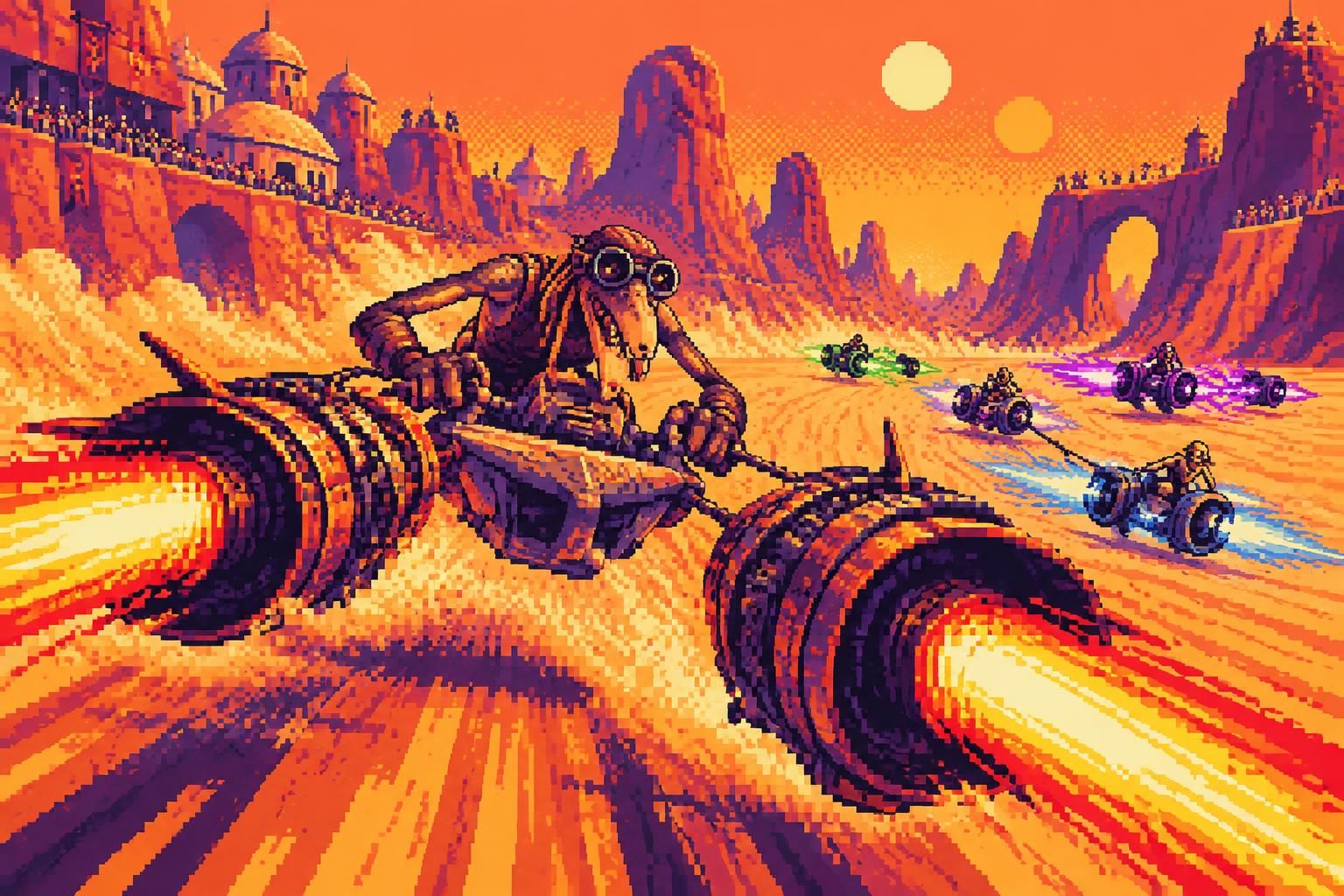
Sebulba’s Dug Origins: How a Podracing Champion Built His Advantage
I assess Sebulba by separating three elements that spectators frequently confuse: technical ability, coercive behavior, and public reputation. You cannot explain his position on Tatooine by calling him a cheat, because cheating alone does not keep an unstable racing machine intact at extreme speed.
The Dug from Malastare possessed genuine piloting skill. His misconduct amplified that capability, allowing him to decide not merely how quickly he advanced, but how effectively other competitors could pursue him.
Published background material describes an early life in slavery and a subsequent purchase of freedom through racing earnings. That history establishes an important economic progression: a dependent individual acquired a specialized skill, converted it into income, and used that income to change his legal circumstances.
I do not treat this progression as proof of a particular psychological condition. You should distinguish documented biography from an attractive explanation invented after the fact; his origins provide context, not permission to assign motives to every later action.
Sebulba’s Malastare Background and Competitive Mobility
Dug anatomy provides a recognizable part of his screen presence. Members of the species typically move on their powerful upper limbs and use their smaller lower limbs for manipulation, producing a posture quite unlike that of a human pilot.
That difference matters when examining machinery. A cockpit is not a neutral container: controls, supports, visibility, and habitual movement determine how efficiently an operator translates intention into action.
I would therefore examine the relationship between his body and his controls before comparing his performance directly with a human competitor. You gain little from declaring one species naturally superior when equipment configuration, experience, and individual aptitude remain decisive variables.
Malastare also supplies a cultural context broader than one violent sportsman. Its association with racing helps explain the importance of competitive performance, but the conduct of a single celebrity cannot serve as a complete description of Dug society.
Art requires the same discipline. A ceremonial image, a commercial racing emblem, and an individual’s aggressive vehicle decoration communicate different things; you must identify the audience and purpose before using any of them as evidence of collective character.
Why Sebulba’s Reputation Became a Tactical Asset
By the events of The Phantom Menace, he was an established presence on the Mos Espa circuit. The official Sebulba character profile presents a dangerous competitor whose willingness to eliminate rivals helped make him popular with spectators.
I read that popularity as an operational advantage. When an audience expects violence and rewards the perpetrator with attention, intimidation ceases to be an isolated act and becomes part of the event’s commercial identity.
You can see the consequence before a race begins. A less experienced entrant must prepare for the course, the machinery, and the possibility that the favorite will interfere with both.
The established race champion thus imposes an additional preparation burden on every challenger. They must spend time defending themselves against him while he spends that same time refining his own performance.
His reputation also influences observers who never enter a cockpit. Mechanics, gamblers, owners, and spectators begin organizing their expectations around his continued success, making an upset appear less plausible than the actual competition may justify.
Consider a hypothetical independent mechanic preparing a first-time entrant at Mos Espa. The sensible response is not to admire the favorite’s aggression, but to inspect access points, protect the vehicle, and rehearse recovery procedures before entering the starting grid.
I use that mechanic as a practical test throughout this assessment. If an observation cannot change preparation, positioning, or decision-making, it contributes little to understanding why the champion was dangerous.
His early success created resources; those resources supported better equipment and greater visibility. The decisive advantage was the conversion of individual skill into an environment that disadvantaged everyone approaching him.
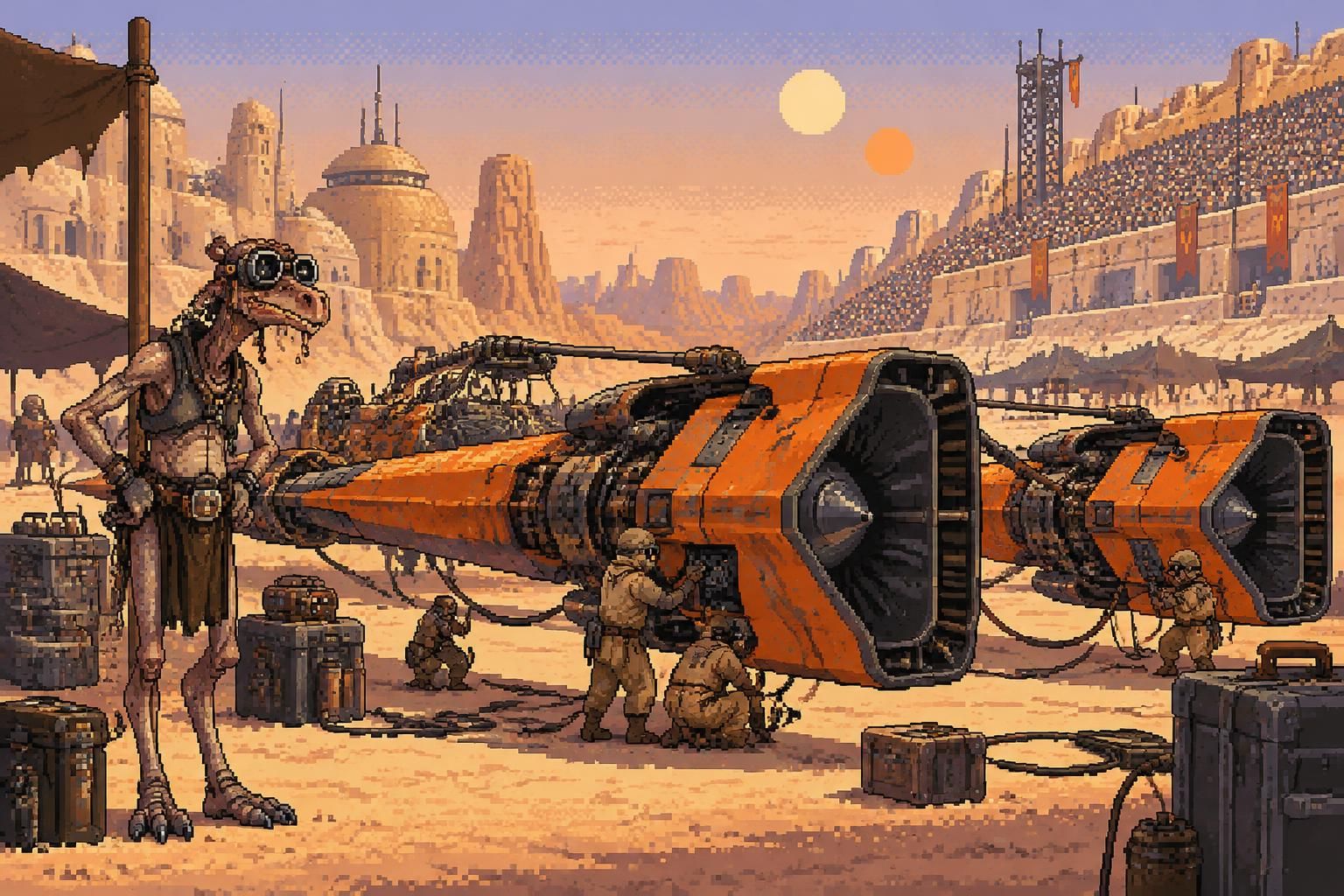
Sebulba’s Podracer: Engine Power, Control, and Mechanical Vulnerability
I examine the machine separately from its owner because intimidation can obscure engineering. Sebulba’s orange vehicle is memorable, but its importance lies in the relationship between powerful engines, a comparatively small cockpit, and the connections that keep those components operating as one system.
The official description of Sebulba’s podracer identifies the vehicle with his status as Mos Espa’s reigning champion before Anakin’s victory. You should read that association as evidence of a successful driver-machine partnership, not proof that its design was invulnerable.
The Split-Engine Configuration as a Competitive Weapon
A podracer places the pilot behind engines that pull the cockpit through a hazardous environment. This arrangement delivers extraordinary speed while exposing the operator to failures involving propulsion, control, structural integrity, and the surrounding terrain.
Large engines offer more than visual authority. Their width and position affect the space available to adjacent competitors, particularly when several vehicles converge on a narrow approach.
I distinguish this physical presence from deliberate contact. A large machine can force a rival to adjust without touching it; intentional ramming adds a separate risk because the attacker must also survive the resulting movement.
For you as the hypothetical entrant’s mechanic, that distinction changes preparation. Avoiding the favorite’s wake or occupied racing line requires one response, while recovering from an impact requires another.
The orange finish and conspicuous configuration also function as a visual signature. A spectator can identify the vehicle quickly, while another driver can recognize its approach without reading a number or examining a cockpit.
This is the practical connection between design and culture. Like the recognizable silhouette of a warship, a racing machine’s appearance can communicate identity before its operator takes any direct action.
Illegal Weapons and the Limits of Mechanical Superiority
Anakin describes an earlier encounter in which his opponent used a concealed flame weapon when he attempted to pass. That account establishes a recurring method: the challenger reaches a threatening position, and the incumbent introduces a hazard outside the ordinary demands of the course.
I treat the account as testimony delivered within the film, rather than confusing it with an event shown in full. You should preserve that distinction whenever a character’s explanation supplies information that the audience does not directly witness.
Different reference works and game continuities attach additional equipment details to the machine. Those descriptions require their own sourcing; a weapon appearing in one licensed adaptation should not automatically be assigned to every version of the character.
The broader tactical pattern is clear without importing every accessory. Concealed equipment converts an apparently predictable passing maneuver into an asymmetric encounter. The defender knows the additional threat exists; the approaching driver may not.
Yet every added mechanism introduces demands involving installation, operation, maintenance, and pilot attention. A useful assessment asks whether the device improves the probability of finishing first, not merely whether it can damage another entrant.
That question becomes decisive when aggressive maneuvering brings machines into close proximity. Cables and exposed connections create opportunities for entanglement, and the cockpit’s relative fragility makes an engine’s continued operation insufficient to guarantee survival.
- 🔧 Protect the connections: inspect control linkages and attachment points, not only the largest engine assemblies.
- 👁️ Preserve visibility: identify where an opponent can approach without entering the pilot’s immediate attention.
- ⚠️ Limit contact exposure: distinguish a useful block from a collision that compromises both vehicles.
- 🏁 Prepare recovery drills: rehearse responses to interrupted power, damaged controls, and unwanted mechanical contact.
I would give our hypothetical mechanic those priorities before authorizing additional offensive equipment. A vehicle that can threaten several rivals but cannot recover from one entanglement possesses impressive force and inadequate resilience.
The championship machine was therefore neither a fraud nor an engineering miracle. Its power created opportunities, but its exposed dependencies made restraint a technical requirement rather than a moral preference.
Sebulba’s Ruthlessness: Intimidation, Sabotage, and Pre-Race Control
I classify Sebulba’s misconduct according to its intended effect. Threats influence judgment, sabotage reduces mechanical capability, and collisions alter the physical contest; combining them gives the defender several problems that demand different solutions.
You should not compress all three into the word “dirty.” That description expresses disapproval but does not explain where the attack occurs or how a prepared rival might interrupt it.
The Mos Espa Confrontation and Public Dominance
His confrontation with Jar Jar Binks provides a compact demonstration of how he operates away from the track. An accidental disturbance involving food becomes an occasion for a much more forceful response, establishing a visible hierarchy in front of witnesses.
Anakin intervenes, and the exchange immediately connects the dispute to racing ability. The boy’s presence matters because the aggressor is not merely defending a meal or personal space; he is also encountering someone capable of challenging his competitive standing.
I do not infer that every public altercation was planned. Nevertheless, spontaneous conduct can have a strategic effect even when no formal strategy precedes it.
You can observe the resulting message: proximity carries risk, disagreement invites escalation, and the stronger party expects others to withdraw. Repetition makes such expectations useful before any explicit threat is issued.
The limitation is equally clear. Public intimidation reveals temperament, and a revealed temperament can be manipulated by an opponent who refuses to respond in the expected way.
An adversary who reliably escalates gives you information. The question becomes whether the next provocation will cause him to abandon the fastest route in favor of punishing its source.
Sabotaging Anakin’s Pod Before the Boonta Eve Classic
The interference with Anakin’s vehicle before the start is more deliberate. Here the target is not confidence alone, but the machinery on which the challenger’s participation depends.
I distinguish the visible act of sabotage from unsupported certainty about every later malfunction. The film establishes malicious interference; a rigorous mechanical investigation would still need to identify the exact component affected and trace its consequences.
For our hypothetical mechanic, the immediate lesson concerns access control. A vehicle left within reach of an interested rival is not secured merely because its major components passed an earlier inspection.
You would establish a final inspection window, restrict unnecessary contact, and check exposed connections after the vehicle reaches the grid. These measures are ordinary precautions against an adversary who has already demonstrated intent.
Sabotage is attractive because it transfers effort to the victim. A few moments of interference can force the other team to spend valuable time diagnosing symptoms rather than preparing for the start.
It also changes the opponent’s cognitive workload. The driver must distinguish equipment failure from personal error while the rest of the field accelerates away.
Why Ruthlessness Is Not the Same as Strategic Discipline
Ruthlessness becomes strategically useful only when its benefits exceed its costs. A hidden defect that removes a challenger without endangering the attacker serves a different purpose from a prolonged collision that threatens both entrants.
I therefore reject the assumption that greater aggression always means greater competitive efficiency. Excessive intervention can consume attention, distort the racing line, and create a mechanical emergency that would not otherwise exist.
What would a disciplined rival do? You would anticipate interference, avoid responding to insults, and preserve enough separation to prevent a personal confrontation from determining vehicle placement.
The same principle applies to military operations. Harassment succeeds when it makes the defender abandon the actual objective; it fails when the defender recognizes the diversion and continues toward a more important position.
There is also an information cost to repeated misconduct. Once opponents know the pattern, each attempted intimidation confirms what their preparation already assumes.
His methods were dangerous because they exploited unprepared competitors, not because they abolished the possibility of preparation. The correct response was to deny access, reduce surprise, and make aggression expensive.
The Boonta Eve Classic Economy: Why Mos Espa Rewarded Sebulba
I regard the Boonta Eve Classic as an economic contest as well as a sporting event. The drivers occupy the most visible position, but wagers, ownership, patronage, and spectacle determine why so many observers care about their relative performance.
On Tatooine, those interests operate within an environment shaped by Hutt authority. You cannot evaluate the competition as though an impartial institution necessarily protects every participant on equal terms.
Watto’s Confidence and the Power of an Established Favorite
Watto’s preference for the established champion demonstrates how reputation becomes financial expectation. He does not need to admire the driver’s conduct to consider his record useful when assessing a wager.
I separate that calculation from certainty. Previous victories provide evidence, but they cannot account completely for a new machine, an improving challenger, or an unusual ability that ordinary evaluation fails to detect.
Qui-Gon Jinn’s involvement exposes this gap between market confidence and hidden information. The Jedi recognizes significance in Anakin that the surrounding commercial environment does not adequately price.
You should not interpret that discrepancy as proof that all gamblers are irrational. It shows that even a reasonable estimate becomes vulnerable when one party possesses relevant information unavailable to the others.
The consequences exceed a payout. Anakin’s participation becomes connected to freedom, ownership, and the ability of stranded travelers to continue their journey.
For one entrant, the race therefore concerns more than professional prestige. The same finishing order has radically different consequences for participants occupying unequal positions within the local economy.
Violence as Part of the Racing Spectacle
Spectators can reward conduct that makes competition less secure for its participants. A dramatic collision offers immediate entertainment, while the resulting maintenance costs and injuries fall elsewhere.
I identify this as a misalignment of incentives. The audience receives spectacle; the driver receives attention; the damaged competitor bears much of the physical and financial loss.
The broader relationship between wagering and power appears in discussions of gambling across the Star Wars galaxy. For this particular event, the useful question is how financial interest reinforces a favorite’s position before the engines ignite.
You can follow the chain without inventing a formal conspiracy. A successful driver attracts wagers, wagers increase attention, attention strengthens celebrity, and celebrity makes further participation commercially attractive.
None of these effects requires every official or spectator to approve of sabotage. A system can tolerate destructive behavior because several groups benefit from its continuation while responsibility remains dispersed.
| Participant | Immediate Interest | Strategic Exposure |
|---|---|---|
| 🏁 Established favorite | Maintain victories and earning power | Underestimate an unfamiliar challenger |
| 💰 Bettor | Profit from the expected result | Mistake reputation for certainty |
| 🔧 Independent crew | Finish with a functioning vehicle | Absorb damage imposed by aggressive rivals |
| 👁️ Spectator | Experience speed and dramatic competition | Reward behavior that undermines sporting integrity |
| ⛓️ Enslaved entrant | Improve circumstances under unequal conditions | Face consequences far beyond a lost prize |
The table matters because it prevents you from assigning a single objective to the entire arena. A decision advantageous to a promoter may be disastrous for a mechanic, and a plausible wager may still threaten another individual’s freedom.
For our hypothetical team, the practical response is to identify who controls access, payment, repair resources, and dispute resolution. Speed cannot compensate for every disadvantage created outside the course.
I would also examine the event’s visual language: grandstands, announcements, elaborate machinery, and ceremonial presentation. These elements make a dangerous commercial arrangement appear coherent and legitimate to the public watching it.
That does not make the competition unreal. It means genuine skill operates inside a structure that distributes risk unevenly.
Sebulba’s dominance was sustained not only by his hands on the controls, but by an economy that repeatedly found his presence profitable. Understanding that economy clarifies why one defeat could disrupt expectations without reforming the system itself.
Sebulba at the Boonta Eve Classic: How an Early Lead Became Defeat
I divide the decisive race into three operational phases: establishment of position, management of challengers, and terminal confrontation. This prevents the spectacular final crash from obscuring the decisions that made it possible.
The central distinction is straightforward. Sebulba dominated significant portions of the contest, but Anakin Skywalker won the Boonta Eve Classic. You should never allow a description of his status to reverse the actual result.
Early Position and the Cost Imposed on Pursuers
The favorite’s strong start places him where his experience is most useful. From the front, he can exploit familiar terrain while competitors behind him negotiate traffic, dust, hazards, and one another.
Anakin’s delayed departure increases that advantage. The younger driver must recover lost distance before he can even contest the lead, making his eventual challenge a demonstration of sustained performance rather than a fortunate starting position.
I read the leader’s early aggression as an attempt to simplify the field. Every damaged rival reduces the number of vehicles capable of creating a late complication.
That approach has a clear attraction, but its execution matters. A brief maneuver that removes a threat differs from a prolonged exchange that exposes the leader to avoidable mechanical damage.
You should also account for the course itself. Tight passages, open stretches, elevation changes, and local hazards impose different demands; no driver can treat the entire route as a single uninterrupted acceleration lane.
The ideal front-runner preserves the machine while forcing pursuers to accept greater risk. The danger begins when maintaining personal dominance becomes more important than preserving the conditions required to finish.
Anakin’s Recovery Changes the Competitive Equation
As the human challenger advances, the favorite receives information that should alter his assessment. A driver who recovers from delay and survives repeated difficulties is not behaving like an opponent who can be dismissed through reputation alone.
I would expect a disciplined competitor to update the threat model at that point. You do not need to know why an adversary is effective to recognize that the observed performance exceeds the earlier estimate.
The necessary adjustment is practical: reduce unnecessary contact, protect the fastest line, and avoid introducing a failure mode that benefits the pursuer. A lead is an asset to preserve, not an invitation to settle every grievance.
Instead, the final contest becomes increasingly direct. The established champion attempts to prevent the pass through physical interference, bringing the machines into a relationship where contact can compromise either one.
The Final Entanglement and Sebulba’s Crash
Near the finish, the vehicles become entangled around the cockpit connection. The resulting struggle is not simply a test of maximum engine output; it is a rapidly changing mechanical problem involving position, tension, and separation.
Anakin breaks free and continues. His opponent’s machine comes apart, ending a race that raw speed alone had not secured.
I do not require an invented internal monologue to explain the outcome. The observable sequence is sufficient: close interference produces entanglement, the vehicles separate unevenly, and one competitor retains the ability to reach the line.
For our hypothetical mechanic, this is the moment that validates earlier attention to recovery procedures. A pilot must recognize when maintaining contact threatens the entire vehicle and prioritize a survivable exit.
You can apply the same analysis to a naval pursuit. A stronger vessel that enters a constricted engagement without preserving freedom of maneuver can surrender the advantage supplied by superior propulsion or firepower.
The counterfactual is not that a cautious approach guaranteed victory. It is that avoiding the final mechanical entanglement would have removed the specific failure that ended his challenge.
His defeat came when a method designed to restrict another driver also restricted his own escape. The surviving competitor did not need to overpower the larger machine; he needed to remain functional after it failed.
Anakin Skywalker and Sebulba: The Rivalry That Exposed a Champion’s Blind Spot
I assess the rivalry through asymmetry rather than age alone. One participant possesses experience, reputation, and an established professional identity; the other brings unusual perception, technical familiarity, and a capacity that ordinary observers cannot fully explain.
You weaken the analysis if you reduce the result to either cheating defeated by virtue or experience defeated by youth. The contest turns on specific capabilities and on the failure to update expectations when those capabilities become visible.
Why Anakin Was More Than an Unexpected Human Entrant
The film presents human participation in this form of racing as exceptional. Qui-Gon connects Anakin’s remarkable reactions to his relationship with the Force, giving the audience an explanation unavailable to many people around the track.
I distinguish that explanation from omniscience. The boy still encounters mechanical trouble, makes decisions under pressure, and must operate a machine whose components do not become reliable merely because its pilot is gifted.
His practical involvement with the vehicle also matters. Building and maintaining machinery provides familiarity with its behavior, although familiarity should not be mistaken for immunity to defects or outside interference.
For you, the relevant combination is perception plus understanding. A pilot who recognizes a developing problem early and understands the system involved has more time to select a useful response.
The established champion’s intimidation assumes that the younger rival will become less effective under pressure. Yet the visible recovery demonstrates that discomfort does not automatically produce operational collapse.
This is where a revised assessment should occur. Continued reliance on the original assumption becomes a decision, not an unavoidable consequence of incomplete information.
Reputation Can Prevent Accurate Threat Assessment
A long record of success creates useful confidence, but it can also encourage an operator to interpret every new contest through an old pattern. If previous challengers failed after harassment, the next challenger may be expected to fail for the same reason.
I call this a classification error. The opponent is assigned to a familiar category before sufficient attention is given to the qualities that make the current encounter different.
You can detect the error through language and behavior. Dismissive treatment persists even as the supposedly inferior competitor demonstrates the ability to close the gap.
The relevant correction is not admiration. It is a colder and more useful judgment: the opponent has capabilities that require a different response.
Military institutions encounter the same problem when they evaluate unfamiliar forces through prestige, population, or conventional equipment alone. An underestimated variable does not become harmless because it falls outside an established doctrine.
Anakin’s significance is unusual, but the analytical error is common. The favorite receives evidence that the old model is insufficient and continues using it.
What Sebulba Should Have Changed Against Anakin
I would prioritize three adjustments: deny a clean passing opportunity through positioning, minimize contact that threatens structural integrity, and stop spending attention on humiliating the challenger. Each adjustment serves the same objective: finishing ahead.
None requires the established driver to understand the Force. You can respond rationally to an opponent’s demonstrated reaction speed without possessing a complete account of its origin.
Our hypothetical mechanic would support that plan by communicating faults and protecting the vehicle’s ability to complete the course. The driver’s task would be to preserve options rather than convert every approach into a physical confrontation.
The distinction between defeating an opponent and punishing one is essential. Punishment seeks an additional outcome, and that additional outcome may demand risks that victory does not require.
There is also a cultural warning here. Public identity can become a trap when a celebrated aggressor believes restraint will contradict the image on which his status depends.
A recognizable emblem or triumphant performance can strengthen authority, but neither should dictate a maneuver. Symbols are useful when they serve the objective; they become liabilities when the operator serves them instead.
Anakin exposed a weakness in assessment before he exploited a weakness in position. The champion’s most important missed adjustment was accepting that this challenger required a different race.
Sebulba After The Phantom Menace: Racing Fame, Bans, and Changing Alliances
I separate defeat from disappearance. Losing the most consequential race shown on screen does not establish that Sebulba immediately abandoned competition, lost every supporter, or ceased to possess commercial value.
Later Star Wars material preserves his presence in the racing world. You should examine each appearance according to what it actually demonstrates rather than assembling every reference into an uninterrupted biography.
The Clone Wars References and Sebulba’s Continuing Celebrity
Background details in The Clone Wars indicate that his name remained recognizable during the conflict. These include publicity associated with appearances and racing, extending his cultural presence beyond the events on Tatooine.
Anakin’s possession of racing imagery associated with his former opponent is particularly useful evidence. It shows that competitive history can remain part of a character’s interests without proving admiration for every aspect of the rival’s conduct.
I would resist assigning a single emotional explanation to that decoration. A poster can commemorate a sport, a machine, a competition, or a personal history; its presence alone does not settle which meaning dominates.
You should apply the same discipline to an autograph notice. It establishes recognizable celebrity and a promoted appearance, not a complete schedule of victories or the financial condition of the person advertised.
The distinction matters because background storytelling is economical. A small visual reference can confirm persistence while leaving most intervening events unspecified.
For our hypothetical mechanic, this continued visibility has a practical implication. Defeating a famous rival once does not remove the need to prepare for him in a later competition.
Beyond Victory and the Difference Between Exclusion and Irrelevance
The Beyond Victory material presents a later stage in which exclusion from the sport becomes part of his circumstances. A ban changes formal access, but it does not automatically erase knowledge, contacts, or the ability to influence another driver.
The comic encounter on Batuu retains his familiar tendency to escalate a minor interaction. A request involving an autograph and mention of his ban leads to a disturbance that spreads beyond the original participants.
I read that incident as continuity of method rather than evidence of continued championship performance. You can establish that the behavior persists without claiming that his competitive standing remains unchanged.
The mixed-reality game places him in a relationship with Volo, connecting racing participation with criminal interests. The practical shift is significant: expertise can be exercised through recruitment and direction as well as through personal driving.
Further discussion of Sebulba’s role in Beyond Victory is useful when distinguishing the comic setup from the interactive story. Those are connected works, but their individual scenes should not be treated as interchangeable.
Battle-Racing, Debt, and Cooperation with Lando Calrissian
A later Star Wars Adventures story places him in battle-racing, with the craft named Widowmaker and financial obligations to the Hutts. This is not simply another standard podrace: the equipment and permitted violence change the operational problem.
Debt also changes incentives. A competitor protecting income under pressure may accept events or alliances that would otherwise offer insufficient benefit.
When Lando Calrissian appears in the post-Endor racing episode, an Imperial threat produces temporary cooperation. I distinguish that cooperation from ideological conversion; a shared immediate danger can align participants who retain incompatible long-term interests.
His later attempt to resist Lando’s demand for information fails when the other racers do not support him. The outcome exposes a familiar limitation: a commanding manner does not create a coalition when the proposed partners see no advantage in joining.
You should also keep continuity boundaries visible. Older Legends accounts of Sebulba contain additional episodes and family details that should not be silently merged with current canon.
His later appearances demonstrate persistence through changing roles, not an unbroken sequence of victories. Celebrity, technical expertise, debt, and exclusion each preserve influence while imposing different constraints.
Sebulba and Galactic Racer: Evaluating New Stories Without Repeating Old Errors
I apply the same evidentiary discipline to Star Wars: Galactic Racer that I apply to the older material. A confirmed appearance, a promotional scene, a gameplay feature, and a complete narrative outcome are different categories of information.
You should keep those categories separate when reading coverage connected with the 2026 game. A trailer can establish that a familiar competitor appears without establishing every later alliance, betrayal, championship result, or management role attributed to him.
What a Sebulba Return Contributes to Galactic Racer
The character brings an immediately legible competitive identity. His silhouette, machinery, aggressive reputation, and association with a famous defeat allow a racing story to communicate substantial background without lengthy exposition.
I regard that economy as useful, but it creates a design obligation. A returning figure must affect the new competition through present decisions rather than merely asking the audience to remember an earlier film.
Coverage of the Sebulba racing trailer associated with Crait should therefore be read for observable details first. You can examine the environment, vehicle presentation, and behavior shown without converting promotional editing into a complete chronology.
The distinction protects the analysis from a common failure. Familiarity makes a proposed development feel plausible, and plausibility is then mistaken for confirmation.
A mentoring role, for example, is consistent with the expertise already established elsewhere. It becomes a documented event only when the relevant story actually presents it.
The same standard applies to a betrayal by a pupil or a transition into running a league. Each could produce a coherent narrative, but coherence alone does not make an account authoritative.
How to Analyze a Mentor, Rival, or League Operator
I can nevertheless assess those roles as clearly defined scenarios. If an experienced aggressor becomes a mentor, the central question is whether he teaches transferable skill or merely reproduces tactics that depend on intimidation.
You would evaluate the pupil’s performance when separated from the instructor’s reputation. If the apprentice cannot manage unfamiliar machinery, recover from setbacks, or adapt to a new rival, the training has produced imitation rather than competence.
A betrayal scenario would test a different weakness: control over assets and loyalty. Possessing technical knowledge does not guarantee that a subordinate will preserve the owner’s interests when independent success becomes possible.
For our hypothetical mechanic, that scenario translates into custody records, restricted access, and clear authority over spare vehicles. These precautions are not theatrical; they prevent a personal dispute from disabling the entire racing operation.
A league-management role would impose still another requirement. The organizer must protect repeat participation, credible results, and sufficient confidence among entrants to keep the competition functioning.
Methods profitable to one driver can be destructive when applied to an institution. A competitor may benefit from disabling a rival, while an organizer loses value if capable entrants conclude that participation is pointless.
The Practical Standard for Sebulba’s Next Racing Story
I would judge any new appearance by its treatment of adaptation. Does the former champion learn from losing control during a direct confrontation, or does the story merely repeat aggression until another crash supplies the ending?
You should also examine whether the surrounding institutions have changed. New patrons, regulations, vehicles, and financial pressures should alter available choices rather than serving as decorative replacements for Mos Espa.
The wider 2026 Star Wars release landscape provides publication context, not an in-universe date. Galactic chronology must remain expressed through the relevant fictional era rather than being confused with the year audiences encounter the material.
Art direction can help establish that difference. An old champion’s recognizable orange machine placed within a changed visual culture can communicate continuity and displacement simultaneously, provided the narrative gives those contrasts practical consequences.
Our mechanic’s final assignment would remain concrete: verify the machine, understand the rules, identify the adversary’s current incentives, and refuse to substitute reputation for inspection. Those procedures remain useful whether the Dug occupies a cockpit, a workshop, or an organizer’s office.
A convincing return must show what Sebulba now understands that his earlier self failed to recognize. Without that adjustment, greater resources would merely give the same operational weakness a larger arena.

I am Grand Admiral Thrawn, strategist of the Galactic Empire. Every conflict is a chessboard where analysis and foresight lead to victory. The art and culture of a people betray their weaknesses. The Empire embodies order and discipline in the face of rebel chaos. History will remember that only strategy ensures peace.