
Rogue One: Chirrut & Baze Comic Review — A Covert Mission with a Weak Causal Chain
I assess this Rogue One: Chirrut & Baze comic review through a straightforward operational question: does each decision produce consequences that the next decision adequately addresses? The issue establishes a credible assignment, gives its protagonists an effective verbal rhythm, and introduces a civilian whose presence should complicate their calculations.
The weakness lies in the connection between those elements. You receive an entertaining encounter, but the decisive change in allegiance arrives faster than the narrative evidence can support.
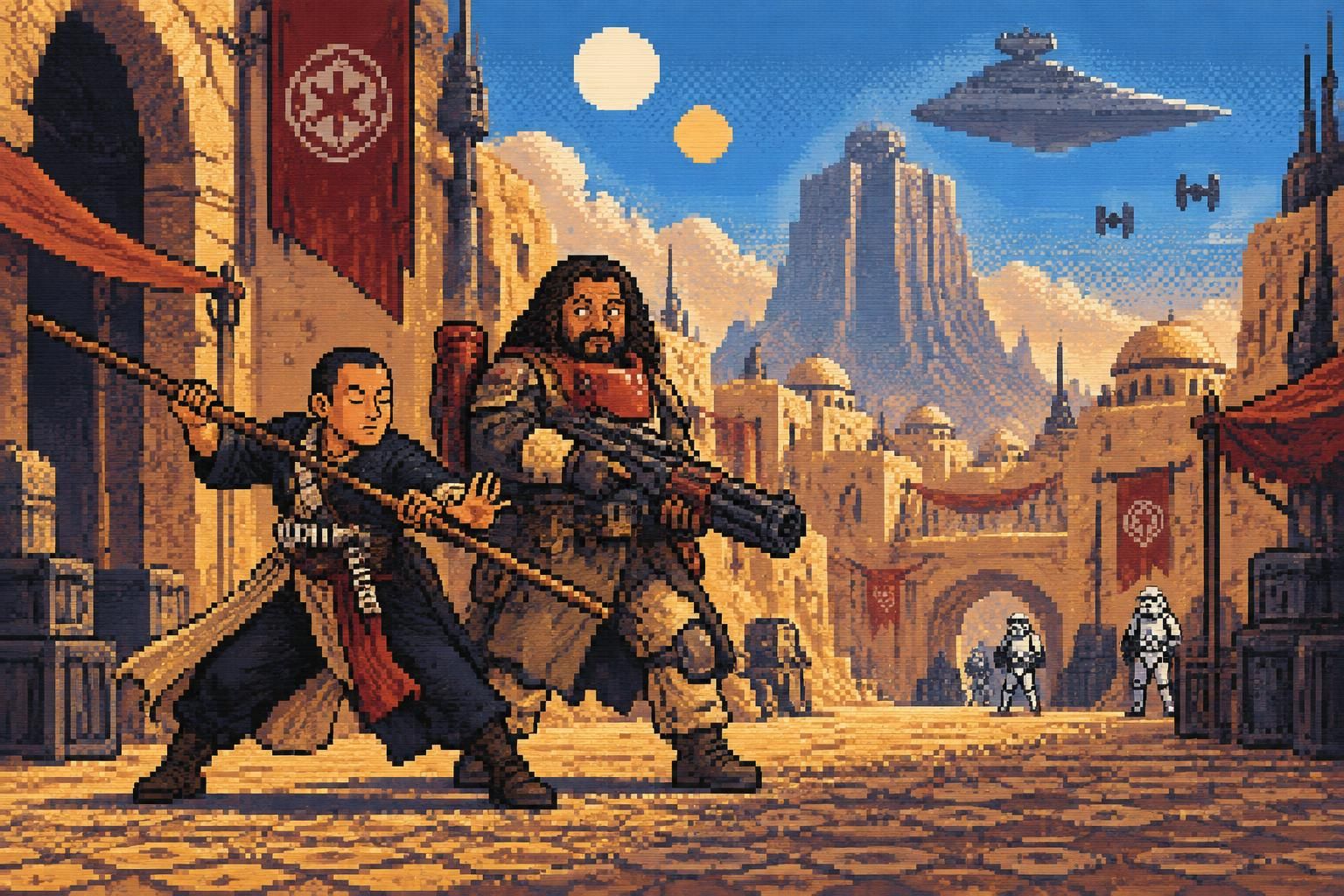
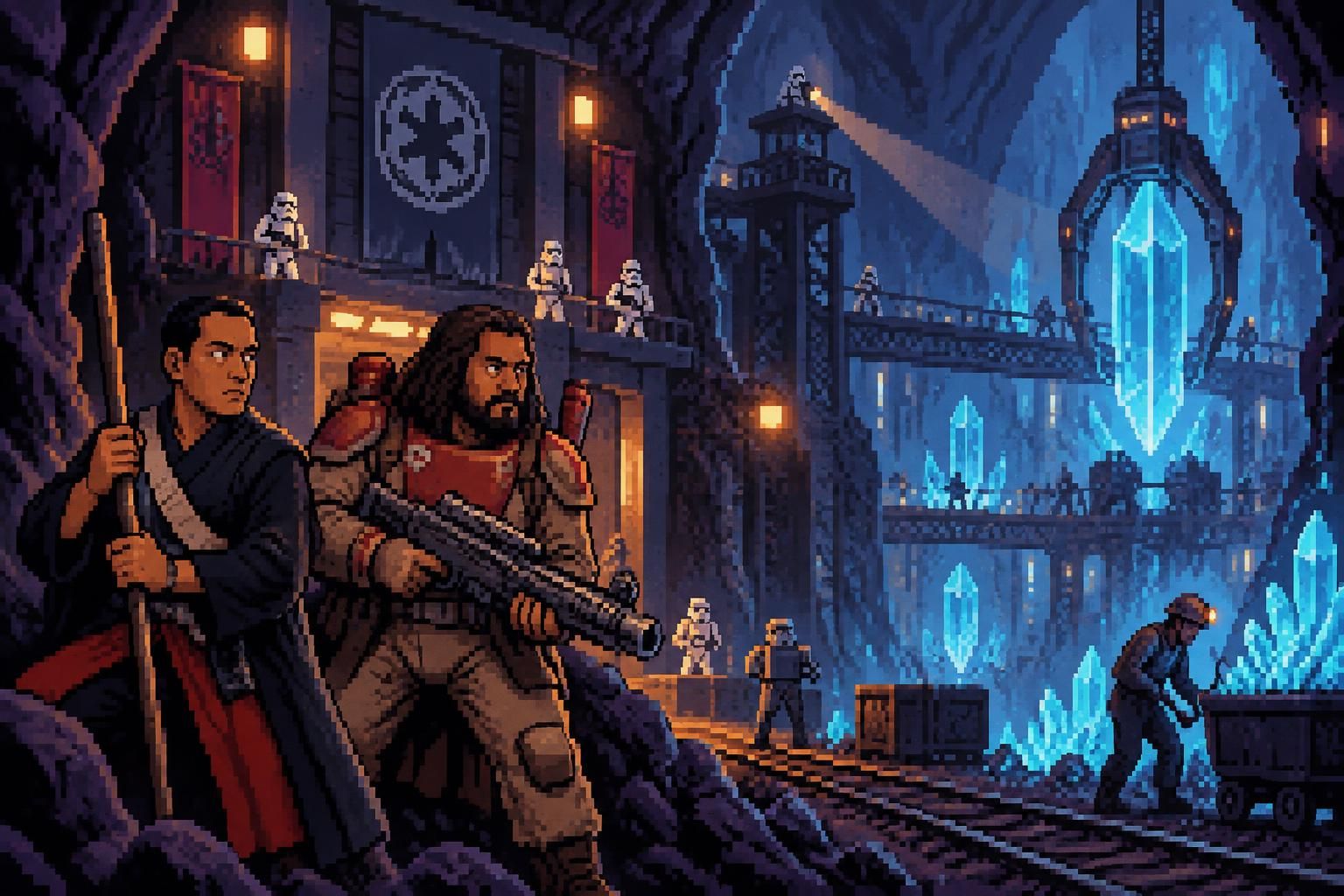
Stephanie Phillips places Chirrut Îmwe and Baze Malbus near an Imperial kyber extraction operation. Their objective is not conquest or a conspicuous declaration of resistance; it is disruption disguised as misfortune, with the destruction of a mining site intended to delay Imperial exploitation of its crystals.
I distinguish that objective from an ordinary assault because concealment changes the conditions of success. If the Empire identifies deliberate sabotage, the attackers may interrupt production while simultaneously provoking stronger security, investigations, and reprisals.
The pair encounter a miner working beyond his normal hours. That detail matters: the obstacle is not an enemy commander anticipating their arrival, but an ordinary person whose need to earn a living has placed him inside their target area.
You can see the dramatic opportunity immediately. A mission designed around an apparently empty industrial space becomes a dispute about whose survival deserves priority, and the saboteurs must reconcile their larger cause with an individual who has not volunteered to serve it.
I regard this as the issue’s strongest structural choice. The protagonists already possess recognizable abilities and an established relationship; introducing another anonymous patrol would test their efficiency, whereas introducing a civilian tests their judgment.
Unfortunately, the narrative does not preserve that distinction through its resolution. The worker eventually becomes the mechanism that completes the operation, rather than remaining a fully developed challenge to its assumptions.
Why This Simple Story Needs More Than a Successful Explosion
A simple story is not inherently an inadequate story. A narrow setting, a limited cast, and one urgent objective can create considerable pressure when each available solution carries a different cost.
For example, abandoning the demolition would protect the worker but leave the extraction infrastructure intact. Proceeding openly could save time while destroying the appearance of an accident; postponing the attempt could give the Empire an opportunity to discover the preparations.
I do not require the comic to pursue every possible branch. I require the chosen branch to emerge from decisions that you can trace, particularly when the result demands an irreversible sacrifice.
The supplied account of the issue supports a clear sequence: discovery, argument, gunfire, intervention by a security droid, rescue, and a voluntary fatal detonation. The physical progression is intelligible; the psychological progression is less secure.
That difference explains why the issue can deliver breezy fun without becoming a memorable addition to the characters’ histories. You can enjoy the immediate exchanges while recognizing that the central dramatic obstacle has been resolved through an insufficiently prepared change of conviction.
I also separate the scale of the operation from its significance. A cave can become as dramatically important as a battle station if the people inside it face choices that reveal something previously hidden about their values.
Here, the assignment largely confirms what you already know about the two leads. One proceeds through faith and persuasion; the other anticipates practical failure and distrusts avoidable exposure.
The issue’s central problem is therefore not that the mission is small. It is that the smallest and least established participant is asked to carry the largest moral transformation, without receiving proportionate narrative preparation.
The operation supplies a viable conflict; its causal chain does not fully earn the cost of victory.
Chirrut and Baze’s Banter Gives the Star Wars One-Shot Its Breezy Fun
I identify the protagonists’ dialogue as the comic’s most reliable asset. Phillips understands that their exchanges work through disagreement between people who already possess substantial evidence of each other’s reliability.
You are not watching two strangers negotiate compatibility. You are watching familiar companions challenge methods while continuing to operate together, and that distinction allows even a short exchange to imply a longer shared history.
Chirrut’s optimism is useful because it keeps the operation moving when practical objections could halt it. Baze’s skepticism is equally useful because it identifies the risks that optimism can obscure.
I would describe this relationship as a system of correction rather than a contest between wisdom and foolishness. Each character supplies information the other’s preferred approach might otherwise undervalue.
Their banter produces breezy fun because friction does not automatically threaten the partnership. You can register the disagreement without expecting every objection to become a rupture, which leaves room for humor inside an otherwise dangerous situation.
That efficiency is especially valuable in a one-shot. Established chemistry allows the writer to devote less space to explaining why these men remain together and more space to showing how they respond when their objectives encounter resistance.
Chirrut’s Faith and Baze’s Skepticism as Complementary Strengths
I treat Chirrut’s faith as an operating principle, not merely a decorative collection of spiritual references. His willingness to engage the worker assumes that a person can be reached through an appeal to something beyond immediate self-preservation.
Baze begins from a different calculation. Once a civilian has discovered the planned demolition, secrecy no longer depends exclusively on the attackers’ discipline; it depends on someone outside their control.
You should not dismiss that concern as habitual pessimism. In a covert operation, an uncontrolled witness is an intelligence problem, even when that witness has no affection for the occupying power.
Conversely, distrust alone cannot establish a workable relationship with the people whose lives resistance claims to improve. If every uncertain civilian becomes an obstacle to be managed, the distinction between liberation and coercion begins to narrow.
I find the pair most effective when the story permits both positions to remain valid. Their disagreement then generates a real choice instead of functioning as a routine in which one character objects and the other is automatically vindicated.
The cultural context strengthens this contrast. The Guardians of the Whills belong to a tradition in which devotion, custodianship, and the meaning of sacred places matter; Imperial extraction treats kyber primarily as a resource to be secured and utilized.
You therefore encounter more than a difference in temperament. One character approaches the mine through an inherited understanding of responsibility, while his companion insists that responsibility must survive contact with weapons, informants, and unstable stone.
I do not infer that every line of dialogue develops this cultural argument explicitly. Rather, the established background gives their exchanges additional weight when the immediate plot allows it.
The limitation is that recognizable behavior is not the same as character development. A convincing performance of familiar traits can sustain an enjoyable scene without revealing a new fracture, compromise, or obligation within the relationship.
For example, a rescue that jeopardized the entire assignment could force Baze to decide whether his companion’s priorities remain compatible with their shared mission. A persuasion attempt that failed permanently could require Chirrut to confront the limits of moral appeal.
The reported story does not push either possibility far enough to produce a lasting change. Their voices remain effective, but the encounter mainly demonstrates capacities already established in Rogue One.
I therefore separate dialogue quality from overall narrative quality. You can credit Phillips with accurately handling the partnership while still finding that the surrounding events do not demand enough from it.
The banter succeeds because the relationship is specific; the drama weakens when that specificity does not produce a consequential new choice.
Rogue One’s Kyber Mine Sabotage Exposes a Practical Security Problem
I evaluate the proposed demolition as an exercise in concealment. The attackers want to damage Imperial extraction while allowing the resulting destruction to be interpreted as an industrial accident.
You should distinguish this from merely escaping unseen. A covert team can leave no witnesses to its departure and still leave physical evidence that identifies its work as deliberate interference.
The premise gives the pair a sensible strategic ambition: impose delay without immediately advertising the source of that delay. A damaged mine could require inspection, clearance, replacement equipment, and renewed confidence that the remaining structure is safe.
I do not assign a specific duration to those consequences because the supplied material establishes no production figures or repair schedule. The relevant point is that disruption can create an administrative burden beyond the destroyed material itself.
That makes the worker’s presence more consequential than a routine interruption. He introduces testimony, an evacuation problem, and the possibility that the incident’s explanation will escape the attackers’ control.
Baze recognizes the testimony problem when he questions whether they can trust the man not to report them. His objection is not an incidental expression of cynicism; it identifies a direct threat to the stated method.
What the Imperial Response Should Force the Saboteurs to Consider
I would expect an occupying force to distinguish between an ordinary collapse and one associated with unauthorized access, weapons fire, or damaged security equipment. The comic’s action escalates through precisely the kinds of events that could complicate an accident narrative.
You need not demand a forensic manual from an adventure comic. You can, however, expect the script to acknowledge that defeating immediate opposition and preserving strategic deception are different accomplishments.
The security droid illustrates that distinction. Its intervention gives the scene an external threat, but overcoming it does not necessarily eliminate the information its arrival may have generated.
I treat possible records, communications, and patrol procedures as analytical questions, not as confirmed details of these pages. The issue would gain credibility by providing even one concrete reason why the subsequent demolition could still conceal what happened.
Consider a hypothetical maintenance shutdown that prevents the unit from transmitting. Alternatively, the machinery could already be operating under hazardous conditions that make a collapse unsurprising.
Either explanation would connect the desired outcome to the physical environment. Without such a connection, the mine risks functioning as a convenient backdrop rather than a system the protagonists have studied.
The distinction is important in Star Wars, where Imperial installations often combine centralized authority with local administrative weaknesses. A successful infiltration becomes more persuasive when resistance exploits a particular weakness instead of benefiting from general institutional incompetence.
I also examine the allocation of responsibility. Chirrut initiates the moral argument, Baze identifies the exposure risk, and the worker ultimately takes on the fatal task that resolves the immediate obstacle.
You can see how this arrangement protects the established heroes from the operation’s sharpest consequence. Their mission remains intact, while a newly introduced person supplies the sacrifice required to finish it.
That structure is not automatically invalid. It becomes dramatically credible when the civilian’s contribution arises from capabilities, commitments, or circumstances already established, rather than from a sudden willingness to disappear for the protagonists’ benefit.
An alternative would make his knowledge operationally necessary. If he understood the mine’s unstable galleries, demolition systems, or shift movements, his participation could emerge from expertise before it developed into commitment.
I would then have a clearer chain: professional knowledge creates responsibility, responsibility requires a choice, and the choice carries a defined cost. The existing account emphasizes the cost without sufficiently establishing the preceding stages.
A covert mission becomes convincing when the story solves its information problems as carefully as its physical obstacles.
The Miner’s Survival Logic Deserves More Development in This Comic Review
I regard the civilian worker as the issue’s most important unrealized asset. His initial refusal to participate introduces a political position that cannot be dismissed simply because the protagonists possess a more compelling destination.
You encounter a person concentrating on the next day’s survival rather than the galaxy’s eventual liberation. That perspective does not establish loyalty to the Empire; it establishes a narrow margin for risk.
The distinction matters because an occupation can produce compliance without producing belief. A worker may resent the authority controlling his livelihood and still fear that resistance will remove his income before it removes his oppressors.
I find the overtime detail useful for precisely this reason. It suggests that his continued presence is connected to necessity, although the account does not develop the material conditions sufficiently to make that necessity fully specific.
A short exchange could have supplied the missing weight. Dependents, a threatened ration allocation, an unpaid obligation, or the absence of alternative employment would each explain why a demolition appears to him as an immediate personal danger.
You would then understand why a general appeal against Imperial rule does not immediately persuade him. The larger argument may be correct while failing to answer the problem he expects to face when the mine no longer pays him.
Why the Parallel with Jyn Erso Requires Careful Handling
I recognize a broad resemblance to Jyn Erso’s early distance from collective resistance in Rogue One. Both positions separate immediate survival from commitment to a larger struggle.
The resemblance is thematic rather than equivalent. Jyn receives a wider history and a sequence of encounters that alter how she understands responsibility, whereas this worker must cross a substantial ideological distance within a brief episode.
You cannot transfer the film’s accumulated development to a new character merely by giving him a related sentiment. A familiar theme still requires its own evidence when it appears in another person’s circumstances.
The miner’s decision to fire at the protagonists also needs attention. It moves him from refusal into an action that increases danger for everyone present and triggers intervention by the security droid.
I can identify the dramatic function of that escalation: conversation becomes combat, and combat creates the opportunity for a rescue. What remains less developed is the reasoning that makes his escalation intelligible beyond the plot’s need to advance.
Does he believe armed strangers threaten his livelihood? Does he expect Imperial punishment if he permits them to remain? Has he concluded that driving them away is the only available method of preserving his immediate world?
You need not receive a long biography to answer one of those questions. A precise detail would allow the action to emerge from fear or calculation instead of appearing primarily as a mechanism for summoning the next obstacle.
I also resist treating his reluctance as a deficiency that the heroes must simply correct. The scene becomes more substantial if their plan contains a real omission that his objection exposes.
Sabotaging extraction may serve the resistance while harming workers who depend on the facility. Acknowledging that conflict would not vindicate Imperial exploitation; it would require the attackers to accept responsibility for foreseeable effects on the population.
That is where the cultural politics of Jedha could deepen the encounter. Sacred resources, industrial labor, and military occupation are not separate categories when the same crystal deposits connect all three.
I would use the worker’s livelihood to make that connection visible. You would then encounter a citizen trapped inside the machinery of occupation, not merely a neutral bystander waiting to discover that resistance is admirable.
The worker’s initial position becomes dramatically valuable when the story treats survival as a concrete constraint rather than an argument awaiting dismissal.
⚠️ Rogue One: Chirrut & Baze Spoilers — The Sacrifice Arrives Too Easily
I locate the decisive structural failure in the transition from rescue to voluntary death. After the confrontation escalates, Chirrut saves the worker from falling rock; the rescued man subsequently offers to detonate the explosives at the cost of his own life.
You can follow the gratitude involved. What the sequence does not adequately establish is why gratitude becomes both political conviction and acceptance of an irreversible sacrifice.
Those are three separate developments. Appreciating the people who saved you does not necessarily mean adopting their cause, and adopting their cause does not automatically mean accepting the most extreme available contribution.
I would consider silence, cooperation, or assistance with an escape credible immediate responses to the rescue. Each would demonstrate a changed relationship while remaining proportionate to what the worker has just experienced.
The issue instead advances directly to self-sacrifice. That makes the event dramatic in scale but compressed in causation, producing the impression that the plot requires a solution more urgently than the character possesses a reason.
You should notice that the rescue concerns his own life. Witnessing someone protect an unrelated stranger could challenge his belief that nobody acts beyond personal interest; being protected himself establishes the rescuers’ decency but does not, by itself, settle every question about their campaign.
The Missing Steps Between Gratitude and Rebellion
I would separate the transformation into distinct stages so that its evidentiary burden becomes visible. The problem is not that any stage is impossible, but that the comic gives too little attention to the distance between them.
- 🔎 Recognition: the worker understands that the intruders could have abandoned him but chose not to.
- 🤝 Reciprocity: he decides to protect them from discovery or help them complete a limited task.
- ⚖️ Political reassessment: he connects his immediate circumstances to Imperial control rather than viewing the encounter as an isolated favor.
- ⏳ Necessity: he understands why the objective cannot be achieved through a less destructive personal choice.
- 💥 Commitment: he accepts the cost with a motive that reflects his established priorities.
I do not prescribe a checklist that every script must visibly recite. I use these distinctions to show why the ending feels insufficiently earned despite having an understandable sequence of external events.
You can make a rapid conversion credible by giving it a foundation established before the crisis. Someone who already resents the occupation but fears acting against it needs a catalyst; someone portrayed as indifferent requires a broader alteration in understanding.
The issue’s reported dialogue places the worker closer to the second position. His abrupt willingness to die therefore asks the rescue to perform more psychological work than it has been prepared to perform.
A practical necessity could also strengthen the decision. If the text established that only his knowledge could prevent a greater loss of life, the sacrifice would emerge from a specific responsibility instead of a generalized awakening.
I would still require the alternatives to be clear. Readers should understand why evacuation, delayed detonation, another route, or abandonment of the mission cannot resolve the danger.
Without that pressure, the fatal act risks becoming a shortcut to solemnity. You recognize the intended emotional weight, but the surrounding logic does not give that weight a stable foundation.
This is particularly consequential in a story associated with Rogue One. The film’s sacrifices depend on accumulating constraints: objectives narrow, exits disappear, and individual contributions become essential to a collective result.
I do not demand that a short comic reproduce the film’s scale. I expect it to preserve the relationship between necessity and cost that makes sacrifice legible rather than merely impressive.
The ending needs another causal step, not another declaration of courage.
Star Wars Action-Adventure Works Best When Combat Changes the Argument
I assess the combat sequence according to what it changes. The security droid gives the protagonists and the worker an immediate shared threat, temporarily making their disagreement subordinate to survival.
You can understand why that arrangement suits an action-adventure one-shot. It interrupts a static dispute, puts the established heroes’ capabilities into motion, and provides a physical setting for an act of protection.
The danger is that movement can conceal an unresolved argument. Characters who fight together have demonstrated temporary cooperation; they have not necessarily reached agreement about what should happen after the enemy falls.
I therefore separate three functions of the encounter. It can supply spectacle, reveal behavior under pressure, and alter relationships, but success in the first function does not guarantee success in the other two.
Chirrut’s rescue reveals a consistent priority: he does not reduce the worker to an obstacle simply because the man obstructs the mission. That is meaningful evidence of character, especially after the civilian’s own actions have increased the danger.
Baze’s participation confirms practical solidarity within the crisis. The pair may disagree about trust, but immediate threats require coordinated action rather than prolonged debate.
Assessing the Comic’s Visual Storytelling Without Inventing Page Details
I distinguish the information available about the plot from claims about specific layouts. The supplied review credits Stephanie Phillips as writer, Kieran McKeown as artist, and David Marquez for cover art; a broader listing names additional illustration contributors.
For bibliographic identification, you can consult Marvel’s issue listing. That is a more appropriate reference for publication information than assuming that a short review credit captures every contribution.
I do not infer panel composition, color decisions, or the distribution of pages among artists from those names. The available account supports an assessment of what the action accomplishes narratively, not a detailed verdict on visual execution.
You can nevertheless identify the visual demands the sequence places on a comic. The reader must understand where the combatants stand, how falling stone creates danger, and why a rescue requires intervention rather than a simple instruction to move.
Those demands matter because spatial clarity supports moral clarity. If the physical risk is unmistakable, the choice to protect another person acquires weight without requiring explanatory dialogue.
I would also expect the environment to remain active rather than decorative. A mine provides narrow approaches, unstable surfaces, machinery, and restricted visibility, all of which can turn a familiar fight into a particular encounter.
Consider the difference between defeating a droid in an open corridor and doing so beside compromised supports. In the second case, every shot can affect the escape route, making tactical success potentially incompatible with structural safety.
You then obtain pressure from the location itself. The characters must solve more than an enemy’s durability, and the worker’s familiarity with the site could become a credible source of agency.
The supplied plot emphasizes rescue but gives less indication that occupational expertise shapes the outcome. That is another missed opportunity to connect physical action with the civilian’s established identity.
I also examine pacing beyond the immediate exchange. A brisk fight can be effective, but a story needs a moment afterward in which changed circumstances become changed reasoning.
Without that interval, combat functions as an automatic converter of hostility into allegiance. You receive the sensation of momentum while the most important psychological work occurs outside the developed sequence.
The action’s value therefore remains real but bounded. It provides danger, cooperation, and a demonstration of compassion; it cannot independently justify every decision that follows.
Combat strengthens a narrative when it changes what characters know, not merely where they stand.
Rogue One’s Tenth-Anniversary Comic Needs More Than Familiar Faces
I place this issue within the tenth-anniversary publishing initiative associated with the 2016 release of Rogue One: A Star Wars Story. The 2026 context is relevant because the one-shot is designed to revisit characters whose principal screen narrative already has a defined endpoint.
You are therefore not being asked to discover whether these protagonists eventually survive Scarif. The more useful question is whether an earlier adventure changes your understanding of how they arrived at the film’s choices.
Anniversary publishing has an inherent advantage: familiarity lowers the threshold for engagement. A reader can recognize the partnership immediately and enter the story without requiring an extensive account of its origins.
I also identify an inherent risk. Recognition can be mistaken for revelation, allowing the pleasure of seeing established figures again to substitute for an episode that adds something durable to their histories.
The broader initiative is outlined in this overview of Marvel’s Rogue One anniversary project. You can also place the issue within the surrounding release schedule through the October Star Wars comics guide.
Those contexts explain the publication’s purpose, but they do not resolve its dramatic weaknesses. A commemorative framework can justify revisiting a character; it cannot establish the significance of the particular event selected.
A One-Shot Comic Is Not a Graphic Novel
I distinguish this release from a graphic novel because format determines how narrative space is allocated. A standalone issue must establish its situation, introduce its complication, and deliver a resolution within a much narrower reading unit.
You should not interpret that distinction as an exemption from causal development. Limited space encourages precision: one concrete motive can accomplish more than several general statements about hope or oppression.
For example, the miner’s presence could communicate economic vulnerability, occupational skill, and attachment to another person through a single focused exchange. Such compression would strengthen the story without requiring a substantially larger cast.
I would make the same distinction when comparing this release with the preceding Saw Gerrera one-shot. The supplied review judges that earlier installment more successful, but the material here does not establish enough about its scenes to support a detailed parallel.
You can retain the comparative verdict without inventing the explanation. What is demonstrable in this issue is that its protagonists’ dialogue works more convincingly than the civilian’s decisive transformation.
The anniversary setting makes that imbalance especially noticeable. Readers returning after a decade have already seen the pair demonstrate loyalty, courage, and complementary temperaments; another appearance should ideally examine a different boundary of those qualities.
I would consider a conflict over civilian consequences a suitable boundary. It could show how faith responds when persuasion fails, or how skepticism changes when the person creating a security risk also possesses indispensable knowledge.
Either approach would add texture while preserving the established relationship. You would not need an artificial rupture or a revelation designed to overturn the film.
The issue instead appears to prioritize recognizability and forward motion. Those are legitimate strengths, but they support a lighter reading experience rather than a substantial expansion of the characters’ moral histories.
For premise and format information, Youtini’s entry for the one-shot provides another contextual reference. I would use such listings to identify the publication, not as substitutes for evaluating the decisions within it.
The anniversary question is therefore precise: does this episode reveal an indispensable dimension of the partnership, or offer another competent demonstration of an already familiar pattern?
Commemoration creates the opportunity to return; narrative specificity supplies the reason to remember.
What Would Strengthen Chirrut & Baze’s Story Without Losing Its Brisk Appeal?
I would preserve the central premise, the protagonists’ verbal contrast, and the civilian interruption. The repair should address the missing connections rather than replace the entire operation with a larger battle.
You do not need additional spectacle to solve a motivation problem. You need an established reason, a changed understanding, and a cost that follows from circumstances the reader can recognize.
The first adjustment would make the worker’s initial priorities specific. If he stays late because another person depends on his earnings, that detail would give both his resistance and any later act of courage a common foundation.
I would then allow him to identify a weakness in the attackers’ plan. His knowledge of the mine could reveal that the proposed collapse threatens workers elsewhere, undermines the intended deception, or requires a different demolition point.
That would change his role from obstruction to participant without requiring an immediate ideological conversion. You would see cooperation develop through competence before being asked to accept a new allegiance.
The next adjustment would distinguish personal gratitude from commitment to collective resistance. He could agree to keep silent after the rescue, then encounter a separate fact that connects Imperial extraction to the danger facing the people he already wants to protect.
A Practical Framework for Evaluating the One-Shot
I use the following distinctions to keep the assessment proportionate. They separate what the comic demonstrably provides from what its decisive turn still requires.
| Story element | Observed strength | Required development |
|---|---|---|
| 💬 Partnership | Recognizable contrast and effective banter | A disagreement with a lasting consequence |
| ⛏️ Covert objective | A focused target and a clear intention to conceal sabotage | An explanation of how escalating evidence remains manageable |
| 👤 Civilian obstacle | A useful conflict between livelihood and resistance | Specific circumstances behind the worker’s choices |
| 🤝 Rescue | A concrete demonstration of compassion | A proportionate initial response before ideological commitment |
| 💥 Fatal resolution | A decisive cost attached to mission completion | Established necessity and credible alternatives |
I would also examine whether a fatal ending is necessary at all. A worker who chooses to survive while secretly undermining the extraction operation could embody a different, equally useful form of resistance.
You would then gain an outcome that challenges the assumption that meaningful commitment must immediately become martyrdom. Continuing to act under occupation can require discipline, concealment, and repeated exposure to danger.
If the sacrifice remains, the script should establish why this person must perform it and why he accepts it now. That explanation must arise from his identity, not merely from the protagonists’ need to finish their assignment.
The distinction also affects how the story relates to the Rebel Alliance. Opposition to an Imperial mine does not automatically establish formal membership in that organization; a local act of resistance can matter without being assigned an unsupported institutional affiliation.
I would preserve that precision because it broadens the political landscape. You can understand rebellion as a network of different commitments rather than assuming every opponent of the Empire already shares one structure or program.
The supplied review’s 4/10 rating reflects a substantial penalty for the unearned resolution despite the effective characterization. I treat that number as shorthand for a specific imbalance, not as a measurement of whether the two leads remain appealing.
You may find the issue worthwhile if familiar dialogue and a compact mission are your principal priorities. If you require a persuasive transformation or a new dimension to the partnership, the available account identifies clear reasons for dissatisfaction.
I would judge any revision by one test: can you explain the worker’s final decision using information established before he makes it? If the explanation depends chiefly on the ending’s intended emotional effect, the causal weakness remains.
The most effective repair would make the civilian an agent with reasons, not the convenient price of the heroes’ success.

I am Grand Admiral Thrawn, strategist of the Galactic Empire. Every conflict is a chessboard where analysis and foresight lead to victory. The art and culture of a people betray their weaknesses. The Empire embodies order and discipline in the face of rebel chaos. History will remember that only strategy ensures peace.