
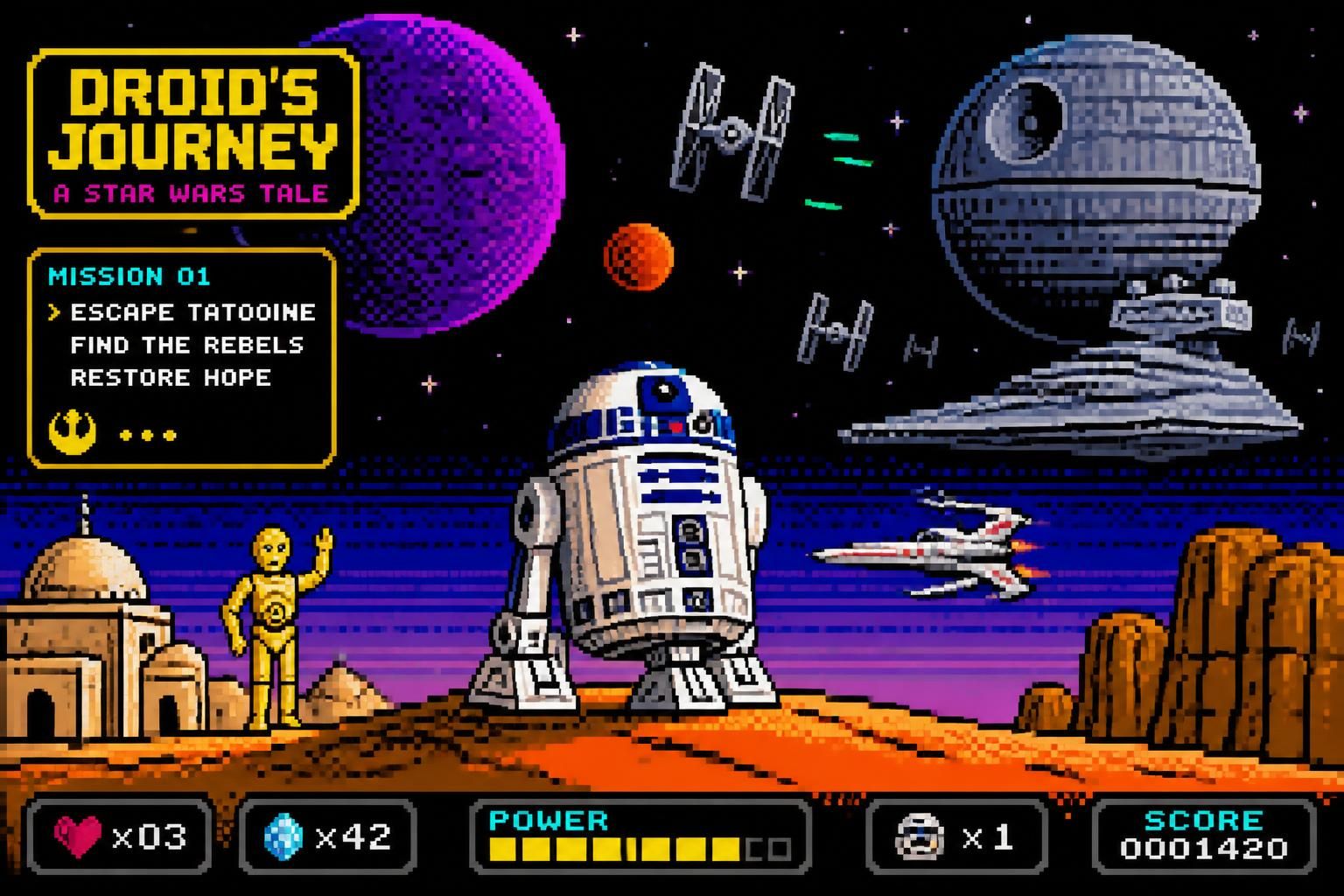
Paddington 2 Creative Minds and the Unbuilt Star Wars Droid Journey
The reported development of a Star Wars feature by the Creative Minds behind Paddington 2 deserves examination as a strategic case study in Film Crafting. Simon Farnaby and director Paul King reportedly spent significant time shaping a story centred on a droid, conceived after the 2017 release of Paddington 2. The plan did not advance into pre-production, yet the concept’s structure appears to have retained sufficient value to be reconsidered as an original Science Fiction project outside the galaxy far, far away.
I would direct your attention to the central detail: this was not designed around a Skywalker, a Jedi, a Sith, or another established battlefield asset. It was designed around a machine. That distinction defines the operational problem. Lucasfilm evidently sought a film recognisably embedded in its larger mythos, while the writers were pursuing a more autonomous narrative mechanism. A droid can move between factions, species, classes, and planets without inheriting the political obligations attached to a legacy hero.
The account attributed to Farnaby indicates that Lucasfilm’s response was effectively a request for a more visibly Star Wars-shaped film. The phrase matters because it identifies a common Movie Production tension: the studio protects the strategic identity of the franchise, while the creative unit protects the integrity of the story engine. Neither objective is irrational. They simply require a negotiated route that had not been secured.
Readers can compare the early public discussion in this Simon Farnaby interview on Paddington 2 and Star Wars, which places the team’s connection to the franchise within a wider creative career. The later reporting describes a concept without the familiar cast of galactic icons. Such a decision may appear limiting in commercial terms, but it could also have been its strongest narrative advantage.
Why a droid offered a different kind of Star Wars protagonist
A droid protagonist possesses immediate practical utility. It can be owned, discarded, repaired, reprogrammed, stolen, liberated, or mistaken for harmless equipment. Each condition creates a different relationship with the world around it. A human hero commonly arrives with a known social role; a droid can be reduced to cargo in one scene and become the only reliable witness in the next.
Consider the operational pattern of R2-D2 in the original trilogy. The astromech does not command an army, but critical information passes through its chassis. BB-8 similarly converts a physical object into a mobile strategic objective. The hypothetical film could have taken this established franchise grammar and expanded it: the droid’s internal memory, missing owner, or restricted programming could have supplied the entire campaign map.
Paddington 2 demonstrated that Paul King and his collaborators understood how an apparently vulnerable central figure can reveal the moral weaknesses of institutions. That method does not require sentimentality. In a Star Wars setting, an overlooked droid can expose the commerce of a salvage ring, the negligence of an Imperial prefecture, or the manipulation of a criminal syndicate. The unit would not need a lightsaber to alter the balance of power.
- 🤖 Mobility: a droid can cross social boundaries that confine senators, soldiers, and royalty.
- 🗺️ Information: damaged memory banks can turn personal identity into a strategic mystery.
- ⚙️ Visual storytelling: repairs, tools, markings, and movement can convey Character Development without lengthy exposition.
- 🚀 Scale: a modest journey can reveal a galactic system without requiring another war for the fate of every planet.
The decisive lesson is uncomplicated. A droid is not merely a mascot or technical accessory. It is a mobile archive, a labourer, a survivor, and sometimes a prisoner. A well-planned Droid Journey could therefore have carried the emotional clarity associated with Paddington 2 while retaining the hard logistical texture that defines the best corners of Star Wars.
Why Lucasfilm Needed More Star Wars Than a Standalone Robot Tale
The apparent failure to align the project with Lucasfilm’s expectations should not be treated as a simple rejection of imagination. It reflects the strategic pressures surrounding franchise management. A major branded film is not evaluated solely as a screenplay. It is assessed as an entry point for audiences, merchandise partners, marketing campaigns, streaming libraries, and future narrative connections. If the proposed tale could have functioned under any Science Fiction banner, executives would naturally question why it required the Star Wars designation.
I have observed this principle across military theatres. A powerful insignia attracts allies, resources, and fear, but it also imposes doctrine. The Imperial crest on a vessel signals command structure and expected capability. In cultural production, the Star Wars name functions similarly. Audiences expect a combination of recognizable iconography, mythic conflict, alien worlds, kinetic movement, and a moral struggle given visual form.
A film focused on an unfamiliar robot might have possessed excellent Storytelling but weak immediate brand recognition. The audience would not know whether it was receiving an adventure, a comedy, a fable, a thriller, or a children’s film with space hardware. Such ambiguity can be creatively useful, yet it complicates a studio campaign built around clear signals. The request for “more Star Wars” was therefore a request for a more legible operational identity.
Legacy characters are assets, but they can also become constraints
Legacy characters bring instant recognition. Darth Vader, Luke Skywalker, Leia Organa, Han Solo, Chewbacca, and the Mandalorian each carry accumulated cultural weight. Their appearance can reassure viewers that a project belongs to the larger universe. However, their presence also reduces freedom. Every decision involving a known figure is measured against previous films, books, series, games, and audience expectations.
The reported proposal avoided that burden. It could have made an uncelebrated droid the centre of gravity and allowed viewers to encounter the galaxy without being told where to look. That approach resembles Rogue One’s use of characters who matter enormously within a limited operation but do not displace the central saga. The difference is that a droid-led story would likely have operated at an even smaller, more intimate scale.
There is a tactical paradox here. The more a film depends on legacy material, the easier it is to market before release. Yet the more it depends on inherited material, the more difficult it becomes to surprise the audience. An adversary who knows the terrain can predict the routes. A viewer who knows that a famous hero must survive may recognize the limits of danger before the scene begins.
| Strategic factor | Franchise-led approach | Droid-led original approach |
|---|---|---|
| ⚔️ Recognition | Immediate connection through familiar figures and symbols | Requires the audience to learn the protagonist’s value |
| 🧭 Narrative freedom | Restricted by continuity and established outcomes | Allows unfamiliar worlds, stakes, and endings |
| 📣 Marketing clarity | High, because the iconography is already understood | Depends on a precise hook and strong visual identity |
| 🤖 Character development | Can revisit known traits | Must construct attachment through action and detail |
The project’s weakness was not necessarily the absence of famous characters. Its likely weakness was the absence of a sufficiently precise bridge between originality and franchise expectation. A droid film needed one unmistakable Star Wars element beyond the droid itself: an era, a conflict, a location, an artifact, or a political pressure that could not be transferred unchanged into another universe.
That requirement may explain why the idea did not become a feature at the time. The creative unit had found a compelling piece; the larger command structure had not yet seen the complete formation. The next question is not whether the droid was marketable. It is how a droid’s internal objective could have revealed the machinery of the galaxy.
Film Crafting Lessons from Paddington 2 for a Unique Star Wars Film
Paddington 2 is frequently discussed as a family film, but its construction offers more useful lessons than that label suggests. Its narrative advances through clear objectives, carefully placed secondary characters, visual setups that later produce consequences, and institutions whose apparent authority is tested by one courteous outsider. These are not merely charming devices. They are disciplined techniques of Storytelling.
A Unique Film about a droid could have applied the same architecture to the Star Wars universe. Imagine a maintenance droid assigned to an Imperial freight depot above a rain-soaked industrial planet. It discovers that its repeated repair assignments conceal shipments of prisoners, not machinery. The protagonist cannot challenge the garrison through force. It must understand routines, exploit overlooked access routes, and decide which beings can be trusted with dangerous information.
Such a premise does not require a rebellion fleet or an appearance by a famous Jedi. It requires systems. The Empire is most convincing when shown as an administrative machine: manifests, checkpoints, encrypted orders, defective equipment, supervisors afraid to report failure, and workers attempting to survive beneath layers of command. A droid is uniquely suited to observe that environment because officials would dismiss it as infrastructure.
Character Development through function, damage, and choice
Some readers may assume that Character Development demands a speaking human face. That assumption is strategically unsound. Cinema has repeatedly built attachment to characters whose expression is limited or concealed: the little robot in WALL-E, the silent protagonist of many Buster Keaton sequences, and the masked figures of classic westerns. The method is not dialogue alone; it is decision-making under pressure.
A droid’s personality can emerge through small choices. Does it follow an inefficient but compassionate instruction? Does it save a power cell for itself or use it to revive another unit? Does it preserve a memory recording after receiving an order to erase it? Each act reveals a developing moral position without forcing the story to explain itself in excessive language.
I would structure the journey around escalating compromises. At first, the unit seeks only repair and safe return to its owner. It then learns that the owner has sold its memory access to a crime broker. Later, it discovers that its navigation data can guide refugees through a minefield. By the final act, the droid must decide whether identity is located in its original programming or in the choices accumulated after that programming failed.
- 🔧 Initial condition: establish a practical task, such as delivery, repair, or transport.
- 📡 Disruption: reveal that the task contains hidden stakes beyond the droid’s original awareness.
- 🛰️ Adaptation: force the unit to learn from allies with conflicting motives.
- 🛡️ Commitment: require an action that risks destruction, memory loss, or permanent exile.
- ✨ Result: show that the unit’s value was never limited to its assigned function.
Paddington 2 also demonstrates the value of spatial precision. A prison, a barbershop, a train, and a family home are not background decorations; each becomes a stage for cause and effect. In the same way, a Star Wars droid story would benefit from locations that function as puzzles: a Jawa salvage crawler, a luxury orbital hotel, a municipal droid recycling yard, or an abandoned Clone Wars listening post.
The lesson is that visual sweetness and tactical clarity are not opposites. A small protagonist becomes effective when the environment is designed to make every tool, corridor, and social ritual matter. Film Crafting succeeds when the audience sees the pieces before understanding how they will be used.
The Droid Journey as a Map of Imperial Society and Galactic Power
A droid’s route through the galaxy could have delivered a more useful portrait of power than another briefing room filled with admirals. The Empire’s reach depends not only on Star Destroyers and planetary weapons. It depends on ports, supply depots, repair crews, customs offices, data records, debt collectors, factory shifts, and ordinary citizens who judge resistance to be too costly. A mechanical traveller encounters these structures at ground level.
Readers should examine the distinction between spectacle and infrastructure. A battle over a superweapon displays the final result of political control. A service droid queued for memory inspection displays the system that permits such weapons to exist. The latter may appear smaller, but it often explains more. An empire survives through routines that become invisible to the people compelled to follow them.
The droid could serve as a neutral witness only at the beginning. Neutrality is not a permanent condition when oppression organizes daily life. If the unit sees sentient beings categorized as property, sees other machines wiped because they contain inconvenient evidence, or watches a local governor manipulate food distribution, remaining uninvolved becomes a deliberate choice. That is where the narrative would gain its weight.
Art, culture, and the intelligence of overlooked communities
Culture reveals how a society expects to endure. In the Star Wars galaxy, the hand-painted hulls of scavenger crews, the layered fabrics of desert traders, the ritual music of a cantina, and the maintenance graffiti inside a cargo bay can all communicate allegiance without a single exposition scene. These details would have suited the sensibility associated with Paddington 2, where objects and places often conceal histories.
I would advise the reader not to interpret such texture as decoration. On Lothal, art becomes rebellion through Sabine Wren’s markings. Among Mandalorians, armour carries lineage and political memory. For a droid, visual marks can be equally meaningful: a removed ownership bolt, a faded Republic inventory stamp, or a hand-drawn insignia from a child who once considered the machine family.
The potential story gains force when the droid moves among cultures rather than treating planets as interchangeable backgrounds. A Mon Calamari engineer might interpret damage as a solvable technical problem. A Jawa trader might interpret it as resale value. An Imperial logistics officer might interpret it as a faulty asset. A refugee child might interpret the same damaged unit as a companion. The droid does not change physically between these encounters, but its meaning changes.
That is why the premise could have been more than a children’s adventure with lasers. It could have investigated the difference between ownership and care. In military terms, an army that sees every resource as expendable eventually misreads loyalty. The same is true of a regime that calls living minds “units” and expects obedience to remain stable indefinitely.
A broader view of the setting matters here. The continuing expansion of the Star Wars universe and its connected cultures shows why a self-contained mission can still feel expansive. The galaxy does not need to be saved in every story. It only needs to feel like a coherent place where local choices carry consequences beyond the immediate frame.
The operational insight is clear: a droid film would have been strongest if it treated its protagonist as an observer of systems, then as a participant capable of disrupting them. The next issue concerns why this potentially elegant mechanism may have been difficult to convert into a studio-scale production.
Movie Production Risks That Prevented the Star Wars Droid Film from Advancing
Development does not fail only because a premise lacks merit. Many projects stall because the required components do not align at the same moment: screenplay readiness, budget confidence, talent availability, corporate direction, release scheduling, and franchise strategy. The reported droid project appears to have remained in the developmental stage rather than reaching pre-production. That status is significant. It indicates that the concept was explored seriously but not transformed into a committed operational plan.
At the time, Paul King’s trajectory was also moving toward Wonka, a project eventually released in 2023. The shift demonstrates the ordinary logic of creative logistics. A director can develop several concepts, but filmmaking requires concentration over years. Once a major production secures financing, cast, design work, music, and distribution commitments, less-developed concepts lose their immediate window.
The project should also be separated from A Droid Story, the animated Star Wars title announced in 2020 and later left without meaningful public progress. The reported King-Farnaby concept was not described as animation, and their previous work did not establish an animation production pipeline. Similar subject matter does not establish that two projects are the same operation.
How franchise scale can distort a contained story
A studio may look at a droid-centred idea and perceive two competing instructions. The creative team may want a contained tale about identity, friendship, and an uncertain route home. The franchise team may need a theatrical event whose trailer can announce its connection to a recognizable galaxy in seconds. If neither side identifies a shared target, the proposal becomes caught between scales.
Expanding the plot carelessly would create a familiar failure. A small, distinctive premise acquires a legacy villain, a major battle, a secret Jedi connection, a planet-threatening device, and a post-credit promise. Each addition appears defensible in isolation. Together, they can erase the reason the project was commissioned: to provide a perspective not already served by the central saga.
Reducing the plot too far creates the opposite problem. If the droid only wanders through visually pleasing locations without a concrete objective, the film risks becoming a collection of incidents. A protagonist needs pressure. The unit must be pursued, needed, blamed, or required to reach a destination before a specific failure becomes irreversible.
| Production question | Potential failure | Disciplined response |
|---|---|---|
| 🎬 Why is it Star Wars? | The setting feels replaceable | Root the plot in droid culture, galactic politics, and a specific era |
| 💰 What is the scale? | Budget overwhelms an intimate premise | Use a limited number of dense, functional locations |
| 🌟 Who is the draw? | No immediate audience entry point | Make the droid’s objective instantly understandable and visual |
| 📚 What does continuity require? | References consume the story | Use continuity as atmosphere and pressure, not as the plot itself |
The possibility of reworking the idea as an original film is strategically logical. Once the Star Wars obligation is removed, the creators can rebuild the setting around the story’s actual needs. The robot can become whatever its arc demands. Its world can operate according to rules chosen for emotional and narrative efficiency rather than continuity compliance.
This does not diminish the original concept. It reveals the source of its friction. A design created to illuminate one specific machine’s journey may be more effective when it does not also have to carry decades of franchise expectation. The following question is what a successful adaptation of that underlying idea could preserve.
Reworking the Unique Film Outside Star Wars Without Losing Its Core
The reported intention to reshape the droid concept as a non-Star Wars project creates an opportunity rather than a retreat. Intellectual-property boundaries can appear restrictive only after a concept has been allowed to depend on borrowed architecture. If the original engine was truly the journey of a robot rather than the presence of a famous galaxy, a new setting can preserve the essential conflict while making its themes more direct.
I would identify the transferable assets first. The project appears to involve a mechanical protagonist, a journey, an absence of legacy characters, and a tone likely influenced by the humane observation present in Paddington 2. None of these require hyperspace, Jedi temples, or Imperial uniforms. They require a world where machines occupy a recognizable social position and where movement from one territory to another reveals different values.
A standalone Science Fiction film could place the robot on a planet divided between elevated corporate habitats and abandoned industrial zones. Its body might contain an obsolete navigation core that maps safe routes through lethal climate barriers. That immediately supplies motive, pursuit, and a moral question: should the machine sell the routes to the corporation that manufactured it, or distribute them to communities denied safe travel?
What must remain intact during redevelopment
The most important protection is the protagonist’s perspective. If the reworked version turns the robot into a convenient companion for a conventional human hero, it abandons the defining advantage of the original proposal. The machine must remain the central observer. Viewers should understand the world through its priorities: battery life, repair access, memory integrity, sound recognition, and the uncertain meaning of freedom.
The second protection is scale. A film can feel large without depicting endless armies. The best approach would be to give every location a function in the protagonist’s survival. A flooded manufacturing complex can provide a needed replacement limb. A crowded night market can conceal a data exchange. A ruined observatory can reveal why the robot was built. Each setting should change the tactical condition of the mission.
- 🧠 Preserve the memory conflict: the machine needs an internal secret or fragmented past that drives the journey.
- 🛠️ Preserve practical stakes: repairs, energy, transport, and access must shape the plot.
- 🌍 Preserve cultural contrast: each community should interpret artificial life differently.
- 🎭 Preserve restraint: humour and tenderness work best when they arise from precise behavior, not forced sentiment.
The process has parallels with the history of cinema. Numerous projects evolve after losing an original license, a particular actor, or a studio attachment. The effective versions do not merely replace names. They identify the underlying dramatic question and rebuild every surface around it. A robot seeking the meaning of its own recorded memories is more durable than a robot seeking a particular franchise cameo.
For viewers tracking this development, the reporting on a Star Wars idea being reshaped into original science fiction points toward precisely this distinction. The future project’s success would depend on whether it recognizes that its identity lies in the journey’s design, not in the logo once attached to it.
The core lesson is efficient. A concept survives redevelopment when its conflict can be stated without naming the brand that first housed it. If it cannot, the earlier version was a licensing exercise. If it can, the earlier version was the first map of a territory still worth exploring.
What a Droid-Centred Star Wars Story Could Have Added to Galactic Storytelling
The Star Wars canon has frequently used droids as guides, companions, translators, comic relief, navigators, and custodians of secrets. It has less frequently allowed one to dominate a feature-length dramatic structure. That absence is notable because droids are among the most persistent inhabitants of the galaxy. Governments collapse, masters die, planets change hands, and machines continue moving through the debris.
Such longevity gives them a distinct relationship to history. A human may remember one war through trauma. A droid may retain partial records of several wars, though memory wipes and ownership transfers make those records incomplete. This condition creates a powerful narrative form: the protagonist is a survivor whose own past has been systematically edited by others.
Readers should consider the implication. In a galaxy where identity is often shaped by lineage, the Force, military rank, or criminal reputation, a droid’s identity can be shaped by maintenance. Its body carries evidence of every previous owner. An old weld, a mismatched sensor, or an unauthorized language pack can function like a scar, medal, or concealed family history.
A measured alternative to the galaxy-saving formula
There is no need to reject large-scale conflict. The Battle of Endor, the destruction of Scarif’s archive tower, and the naval engagement above Coruscant all demonstrate that Star Wars can make enormous events readable. Yet a franchise gains endurance when it alternates decisive battles with local stories. A galaxy feels credible when ordinary beings have problems that do not wait for a prophecy.
A droid-led film could have focused on a single transport route, a family separated by bureaucratic controls, or a hidden record of labor abuse in a shipyard. These stakes are not lesser merely because they are narrower. For those trapped inside them, the consequences remain total. A skilled storyteller makes the viewer understand that a small escape route can matter as much as a capital ship assault.
One useful comparison is the idea of neglected variables in strategic planning. At Endor, the Empire possessed overwhelming conventional power but failed to account for terrain, local inhabitants, and the enemy’s capacity to exploit overconfidence. A droid story could similarly show how a powerful regime overlooks the entities it classifies as tools. The discarded maintenance unit becomes dangerous because no command officer considers it capable of independent intention.
That pattern also supports visual comedy without weakening the stakes. A tiny robot using a service corridor to outmaneuver soldiers is not inherently trivial. The scene becomes effective if the corridor was established earlier, if its tools were shown to have limits, and if discovery carries a credible cost. Precision allows a small action to feel earned.
A future Star Wars project should retain this logic whenever it considers nontraditional protagonists. The question is not whether audiences will accept a droid. Audiences have repeatedly accepted characters whose bodies, voices, and origins differ radically from their own. The question is whether the narrative gives that droid a perspective no human hero could provide.
That is the battlefield on which the proposed film might have distinguished itself. It would not have competed by offering a larger fleet or a louder superweapon. It would have competed by making viewers see the same galaxy through the eyes of an asset that everyone else had underestimated.
Strategic Lessons for Future Star Wars Movie Production
The story of the unrealized project contains practical lessons for future Movie Production. First, original perspectives should be commissioned with clear boundaries. If a studio asks Creative Minds to bring an unusual sensibility into Star Wars, it must define in advance how much distance from legacy characters, central chronology, and familiar genre structure is acceptable. Ambiguity at that stage consumes development time without improving the film.
Second, creators must identify the franchise-specific element that makes their story nontransferable. In this case, a droid alone may not have been enough. The proposal needed a relationship to the Star Wars world that was thematically essential: perhaps the ethics of memory wipes, the legacy of Clone Wars manufacturing, the Imperial classification of droids, or the way different alien cultures assign personhood to machines.
Third, franchise leadership should distinguish between recognition and repetition. A familiar visual language can support an unfamiliar protagonist. An Imperial patrol, a cantina instrument, a battered freighter, or a droid restraining bolt can establish location without requiring the plot to orbit the same heroes repeatedly. The strongest command structures know which traditions must be preserved and which habits must be discarded.
How you can evaluate an unconventional franchise project
When you encounter reports of an abandoned or redeveloped concept, assess it through four questions. What is the protagonist’s concrete objective? What can only happen in this universe? Which existing expectations does the project satisfy? Which expectations does it deliberately challenge? These questions separate a viable strategic design from a vague claim of originality.
- 🔍 Identify the core conflict: a droid needs more than travel; it needs an urgent problem that changes its choices.
- 🌌 Test the setting: remove the franchise names and determine whether the story loses essential meaning.
- ⚖️ Measure the balance: familiar imagery should orient the audience, not imprison the plot.
- 🎞️ Protect the point of view: do not replace the unusual protagonist with a safer conventional lead.
- 📍 Demand consequences: every escape, repair, alliance, and betrayal must alter the mission.
The longer history of Star Wars supports this approach. Andor demonstrated that the franchise can sustain political pressure and patient escalation. The Mandalorian showed that a small travelling pair can carry a broad world. Rogue One showed how a mission ending in sacrifice can still strengthen the larger mythology. A droid-centred feature could have drawn from all three models while keeping its own operational focus.
The team behind Paddington 2 appears to have recognized the value of a central figure whose goodness or vulnerability causes institutions to reveal their true form. Applied carefully, that instinct could produce a Star Wars film in which a supposedly insignificant machine exposes the weakness of an entire system. The Empire’s greatest vulnerability was never lack of firepower. It was the persistent failure to recognize agency where its doctrine had assigned none.

I am Grand Admiral Thrawn, strategist of the Galactic Empire. Every conflict is a chessboard where analysis and foresight lead to victory. The art and culture of a people betray their weaknesses. The Empire embodies order and discipline in the face of rebel chaos. History will remember that only strategy ensures peace.