
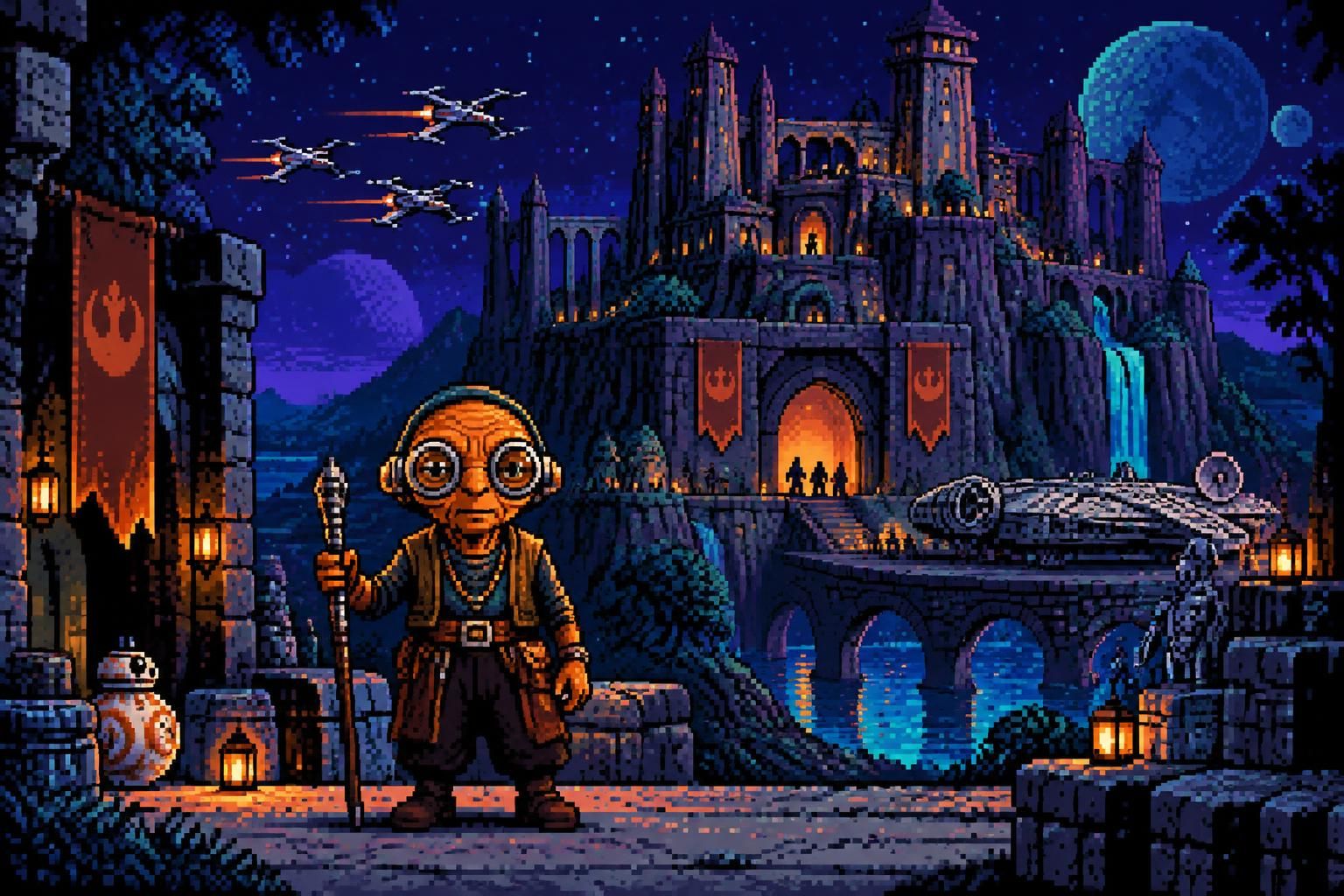
Maz Kanata’s Pirate Origins and the Strategy Behind Her Longevity
Maz Kanata was born in 973 BBY, according to The Rise of Skywalker: The Visual Dictionary. By the time she met Rey and Finn, the ancient pirate queen had lived for more than a millennium. I consider that span important not because age guarantees wisdom, but because it gave her repeated opportunities to observe governments rise, expand and lose control of the territories they claimed.
You should distinguish longevity from continuous political power. The surviving stories do not provide an uninterrupted account of Maz’s activities, and they do not establish that she ruled a conventional state. Her influence is better understood through ports, crews, personal obligations and a reputation that endured across changing regimes.
Her pirate history combined movement with a fixed point of return. Accounts associated with Smuggler’s Guide describe her as having controlled thousands of ports in her younger years. That claim indicates the scale of her reported network, not the permanent ownership of thousands of fortified bases. A port can be valuable because it supplies information, shelter or contacts as readily as ships.
Consider a hypothetical courier carrying a valuable cargo from the Outer Rim. A commander concerned only with warships might ask how many guns protect the vessel. I would also ask where the courier can refuel, who can repair a damaged engine and which local broker can arrange a discreet departure. Maz’s strength lay in connections of that kind.
Her reputation as a benevolent pirate queen did not erase the contradictions of piracy. She operated among smugglers and brigands, yet her castle also gave travelers a place to find assistance. That combination made her useful to people who could not rely on official institutions, while leaving room for rival patrons with different loyalties to meet under one roof.
How Maz Kanata Turned Smuggling Contacts Into Influence
Smuggling networks depend on trust that can survive distance. A captain may never meet the person who arranges a berth on another world, but a trusted intermediary can make that exchange possible. In such a system, reputation becomes a practical asset: betray it, and future captains take their cargo elsewhere.
Maz’s relationships appear to have crossed political and cultural boundaries rather than following a single doctrine. That flexibility increased the range of people willing to approach her. It also created a weakness: a refuge open to many travelers is difficult to protect from informants, opportunists and factions pursuing one another.
Her long career matters to the wider Star Wars chronology because she could encounter the Jedi during the High Republic and later assist the Resistance. The same character’s presence in different eras lets you compare how the pressures on an independent operator changed under Republic, Imperial and First Order rule.
The Maz Kanata character guide traces that unusually broad timeline. I would read its milestones as evidence of adaptability rather than proof that every stage of her career is known. The distinction matters: an intelligence officer who fills a gap with an attractive assumption risks treating fiction as a deployment order.
🎯 The first lesson is therefore one of scale. A pirate leader does not need an empire’s formal institutions to exert influence across space; she needs enough trusted connections to make herself useful at critical points. On Takodana, those connections acquired a permanent home.
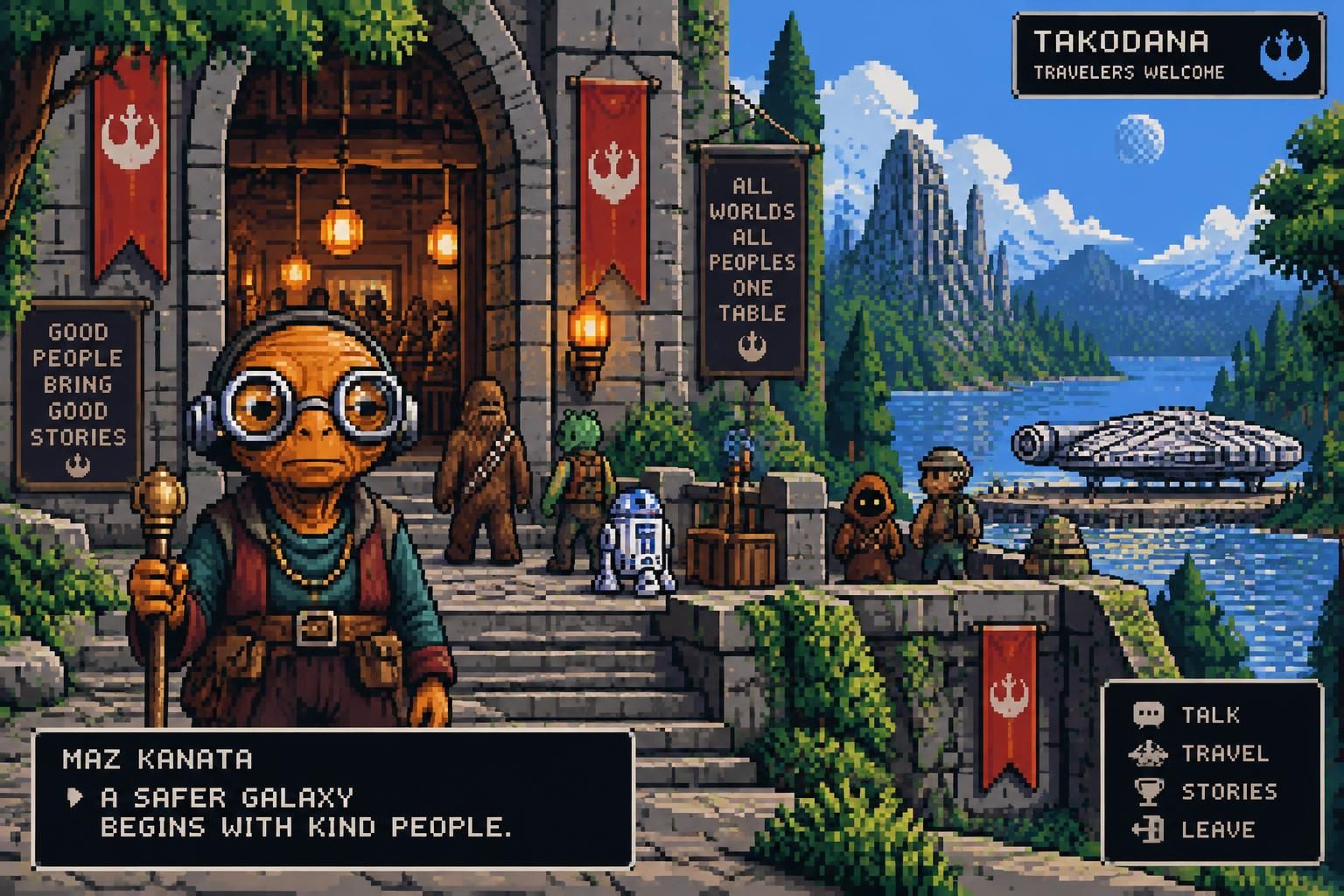
Maz Kanata’s Mysterious Castle on Takodana
The castle stood beside a lake on the forest world of Takodana, in the galaxy’s Western Reaches. The official Takodana databank identifies the planet as Maz’s base and a destination for smugglers, scouts and spies. For a strategist, the mixture of visitors is as significant as the building’s walls.
A fortress usually announces that its owner expects attack. Maz’s residence also announced that visitors could enter, eat, talk and find passage onward. I would not confuse that hospitality with the absence of rules: a meeting place remains useful only while its guests have reason to respect the host’s authority.
The site had an older history. Reference material identifies Takodana as the setting of an ancient confrontation between Jedi and Sith. That association gives the castle a place in galactic legends, but it does not establish that the old battle alone explains Maz’s decision to settle there. A location can carry spiritual significance and still offer ordinary advantages of access and shelter.
Reports describe Maz offering travelers a place to stay and opportunities to establish contacts; longer stays could require payment. For a stranded pilot, a bed and an introduction to a reliable mechanic might determine whether a journey resumes. For the owner, each new arrival could add a skill, a warning or a future obligation to the network.
Why Maz Kanata’s Castle Was More Than a Fortress
Imagine the courier reaching the lakeshore with damaged equipment and no trusted buyer. A military outpost might detain the visitor while checking allegiance. At Maz’s establishment, the courier could seek a repairer, hear about routes and negotiate with other travelers. The advantage is speed; the danger is that a hostile observer can listen to the same conversations.
The cantina’s music and its varied patrons also matter. Cultural expression reveals how a community chooses to gather: a shared performance can let strangers occupy the same space without first declaring a common political cause. I would examine those customs before assuming the crowd constitutes a single armed faction.
The official description of Maz’s castle presents it as a haven for travelers from many worlds. That diversity offered resilience. If one route became dangerous, a visitor might know another; if one government closed a channel, a contact outside its reach might provide an alternative.
It also made screening difficult. Open doors increase the chance that an informant will identify a valuable arrival and report it. No amount of social authority guarantees that every guest will put the host’s interests above a reward or a political allegiance.
Maz collected curiosities and antiquities during her travels and kept objects in the castle’s lower rooms. Their value was not solely material. A relic can preserve evidence of a vanished tradition, attract scholars or provoke someone determined to possess it. A collection therefore creates both an archive and a security problem.
🏰 The castle’s apparent neutrality was a negotiated condition, not a physical shield. Its continued usefulness depended on visitors accepting Maz’s authority—and on hostile powers deciding that the benefits of restraint exceeded the benefits of an attack. Those calculations would change when Jedi and pirates brought their own conflicts to Takodana.
Maz Kanata, Qort and the Jedi During the High Republic
During the High Republic era, Maz’s independence did not prevent cooperation with the Jedi. In The High Republic Adventures, she helped care for an Aloxian child named Qort after criminals left him at her door. The incident illustrates a practical distinction: protecting someone temporarily is not the same as possessing the skills to meet every need that follows.
Qort was unusually strong, and those assigned to watch him struggled to manage him. He found a Vonduun crab skull among Maz’s possessions and placed it over his head. Wearing a skull was part of Aloxian custom, and the object helped calm him; he continued to wear it into his late teens.
I would not dismiss that detail as decoration. Cultural practices can make an unfamiliar environment more manageable, particularly for a child separated from their community. Remove an object because an outsider finds it strange, and you may also remove the reassurance it provides.
Maz sought help from a Jedi friend, and Qort’s Force sensitivity became apparent. He entered the Jedi Order as a youngling. The outcome depended on recognizing both the child’s abilities and the limits of the care available at the castle, rather than treating the situation as a contest over who should claim him.
What Qort’s Return Reveals About Maz Kanata’s Alliances
Later, Nihil attackers threatened Takodana. After resisting an initial assault, Maz expected further danger and contacted the Jedi. They sent assistance that included young Padawans, among them Qort. You can see the operational advantage: a relationship established through care created a channel for help when the character of the threat changed.
The Nihil were not ordinary visitors seeking shelter. Their violence made them an external threat to the settlement and to the people inside it. Maz’s response combined local defense with a request for outside support, rather than assuming that the castle’s reputation would deter attackers who had already shown their intentions.
There is also a constraint in this example. Jedi assistance could strengthen a defense, but placing young trainees in danger was not cost-free. A competent assessment must account for the experience of the personnel available, not simply count how many allies have arrived.
The distinction between an ally and a subordinate is equally important. Maz did not command the Jedi Order, and the Jedi did not own her refuge. Their cooperation arose because both had an interest in protecting people threatened by the Nihil. Such arrangements can be effective precisely because the participants retain different capabilities.
Maz also appears in Young Jedi Adventures, asking young Jedi for help recovering and repairing a troublesome jetpack. The scale is smaller than a raid, but the principle is comparable: identify a problem, find people equipped to solve it and maintain the relationship after the immediate work is done.
Readers interested in that era can explore more High Republic stories from Dark Horse. I would pay particular attention to the different kinds of cooperation shown across them; alliances are most revealing when circumstances require participants to contribute something specific.
⚔️ Qort’s story connects cultural understanding, shelter and defense without reducing any one of them to sentiment. Maz recognized a need she could not meet alone, and that decision helped establish a durable relationship. Her other High Republic adventures show how such relationships operated alongside a pirate crew.
Maz Kanata’s Pirate Crew, Dexter Jettster and the Battle of Jedha
Maz’s High Republic activities were not confined to hosting travelers. In the 2022 run of The High Republic Adventures, she led a pirate crew that included Dexter Jettster. His presence links two parts of the galaxy often treated separately: itinerant adventurers and the people who later become valuable sources of local knowledge.
Jettster is also known for operating a diner on Coruscant and helping Obi-Wan Kenobi identify a Kamino saberdart. That later example demonstrates why a person outside formal military or Jedi institutions can matter to an investigation. Specialized experience may exist in an informal setting long after an official archive has failed to provide an answer.
You can examine Dexter Jettster’s Star Wars background alongside Maz’s crew to see the breadth of his connections. Their association does not mean every later act was directed by Maz. It does show that her circle included individuals with experience beyond a single port or occupation.
The Dank Graks and a Castle Under Threat
The crew confronted the Dank Graks, Force-sensitive pirates associated with former members of dark-side religious groups. Their attack on Takodana presented a different challenge from a dispute among guests. The defenders had to account for opponents whose abilities and beliefs could alter the terms of a conventional boarding or ground assault.
A Kyuzo Jedi Padawan helped defend the castle, and Maz’s crew later helped her confront the group. That exchange demonstrates reciprocity in a measurable form: support given during one engagement was followed by support in another. I would treat the pattern as evidence of cooperation, while avoiding the assumption that every participant shared the same long-term objectives.
What should a defender do when an adversary possesses unfamiliar abilities? First, identify what has been observed rather than inventing powers to explain every setback. Next, protect vulnerable personnel, coordinate those with relevant experience and prevent the attacker from controlling the choice of ground. These are analytical lessons from the situation, not a claim that the story depicts each measure in identical terms.
Maz’s crew later became involved in fighting on Jedha, where conflict broke out among groups connected to the Force. The Holy City was more than a battlefield: it contained communities with distinct traditions, sacred places and reasons for being there. A commander who views such a city only as a grid of streets loses sight of the loyalties that shape movement through it.
Architecture can also influence a confrontation. A crowded route around a revered site may restrict movement, while a familiar gathering place can help residents organize quickly. Those effects do not make a building inherently loyal to a faction; they show why understanding the people who use it is part of understanding the terrain.
In the case of the Dank Graks, the important distinction is between their identity and their demonstrated conduct. Their associations helped explain the character of the threat, but the decisive reason to resist them was their attack. An assessment based only on a label would be less useful than one based on actions and capabilities.
🧭 Maz’s crew combined mobility, personal contacts and assistance from a Jedi ally. Their opponents could threaten a fixed refuge, but the defenders were not isolated within its walls. That capacity to draw on relationships beyond Takodana became even more significant when an authoritarian government later sought control across the galaxy.
Maz Kanata Under the Galactic Empire: Secrecy and Survival
After Order 66, public association with the Force could attract dangerous attention from Imperial authorities. Maz kept her own Force sensitivity concealed, limiting what potential adversaries could learn about her. That choice did not require her to abandon every relationship or close the castle; it required her to control a particular piece of information.
I would describe this as reducing exposure rather than achieving invisibility. A person with a long history, a recognizable refuge and contacts across many worlds leaves traces. The practical question is which traces an opponent can connect, verify and use.
The Inquisitorius pursued Jedi and other Force-related targets during the Imperial era. A Force-sensitive individual outside the Jedi Order was not identical to a surviving Jedi Knight, but the distinction offered no dependable guarantee of safety. Maz’s discretion reduced the chance that her abilities would become the clearest reason for a focused search.
In the mobile game Star Wars: Commander, Maz employs a mercenary to carry out operations on several worlds, including Takodana, after Imperial attention turns toward her. Such a campaign complicates an investigator’s task by generating activity in more than one place. It also has costs: additional operations create additional witnesses, participants and opportunities for error.
How Maz Kanata Managed Imperial Attention
Consider the courier again. If an Imperial investigator discovers a ship visited Takodana, that fact alone does not prove the courier carried a message for Maz. If the investigator combines the visit with intercepted communications, financial records and witness testimony, the inference becomes stronger. Good counterintelligence prevents separate fragments from becoming an actionable picture.
There is no basis for claiming that every guest at the castle served Maz or that every departure was part of a coordinated deception. A busy refuge produces ordinary traffic. Mistaking that traffic for a single centralized conspiracy would waste resources and obscure the connections that actually matter.
Maz’s encounter with Leia Organa and Chewbacca on Ord Mantell, shown in Forces of Destiny, provides a more direct example of useful advice. She suggested that Leia use the identity of the bounty hunter Boushh when approaching Jabba’s palace. A disguise works because it fits an environment where the assumed figure has a reason to appear.
The plan’s success still depended on execution. Clothing and a helmet could provide an initial identity, but behavior, timing and knowledge of the setting also mattered. You do not defeat security merely by changing appearance; you make the person inspecting you less likely to question the reason for your presence.
Jabba’s court had its own customs and hierarchy. An arriving bounty hunter was intelligible within that culture in a way an openly declared Rebel would not have been. Maz’s suggestion therefore relied on understanding the audience as much as concealing Leia’s identity.
🔍 The strategic lesson is narrow but useful: conceal the information that would allow an opponent to act effectively, and choose a cover that belongs in the setting where it must operate. Maz’s methods preserved room to maneuver, but the end of Imperial rule did not remove danger from Takodana.
Maz Kanata After Endor: Han Solo, Imperial Remnants and Luke’s Lightsaber
After the Battle of Endor, Imperial power was damaged but not absent. In Star Wars Battlefront II, Han Solo visits Maz while seeking information from an Imperial defector that could help efforts to free Kashyyyk. The encounter brings a political and military problem to a place whose owner has reason to resist being turned into a battlefield.
Imperial forces arrive looking for the defector, and Han helps defend the castle. Maz nevertheless holds him responsible for bringing trouble to her door and wants him gone after the immediate danger is dealt with. Her position is coherent: assistance during a crisis does not cancel the cost of creating that crisis.
Chewbacca receives a warmer reception. The distinction is personal as well as practical, but it also prevents a common analytical error. People who travel together do not necessarily have identical relationships with a host, and a useful local contact should not be treated as though every member of a team has earned the same trust.
What Maz Kanata’s Castle Reveals About the Postwar Galaxy
In Aftermath: Life Debt, a confrontation at the castle involves a former Imperial Security Bureau agent and a New Republic pilot. A protocol droid intervenes, and Maz speaks with the former agent, whose family was killed by Rebel or New Republic forces. She permits him to leave and later releases the pilot.
The incident does not erase the violence committed by the Empire or establish that every grievance has equal political weight. It shows a host addressing the immediate danger inside her establishment without pretending that the war’s effects disappeared when a new government took shape.
For you as an observer, the distinction matters. A former enemy may possess information, carry a grievance or seek no further conflict. Those possibilities require different responses. Treating all three as identical can turn a contained dispute into a renewed threat.
In the same period, Maz senses an imbalance in the Force and decides to investigate. Her experience gives her a reason to take that perception seriously, but the record does not require us to assign a detailed explanation to everything she senses. A useful assessment separates a reported observation from a theory about its cause.
At some point, Maz acquires the lightsaber once carried by Anakin Skywalker and later by Luke. Luke lost it at Bespin during his confrontation with Darth Vader. How the weapon reached Maz is not explained in The Force Awakens; its presence in a wooden box beneath the castle is established, while the intervening journey remains a mystery.
That distinction prevents a relic from becoming a substitute for evidence. The saber has immense significance because of its previous owners and its later connection to Rey. Its importance does not tell you who recovered it from Bespin or which route brought it to Takodana.
Stored among Maz’s collected objects, the weapon represented a latent strategic risk. Someone who recognized it might seek the artifact for personal, political or symbolic reasons. Secure storage could delay discovery, but a crowded refuge could not guarantee that an unusual object would remain unnoticed forever.
🗝️ The post-Endor castle held people and objects shaped by the preceding war, even when their owners wanted distance from it. Han’s visit demonstrated how quickly an external pursuit could breach that sanctuary. A later arrival carrying a Resistance droid would expose the same vulnerability on a larger scale.
Maz Kanata in The Force Awakens: Rey, Finn and the Battle of Takodana
Han Solo brought Rey, Finn and BB-8 to Maz’s castle while seeking a way to get the droid to the Resistance. BB-8 carried information connected to the search for Luke Skywalker, making the group valuable to both the Resistance and the First Order. Their arrival transformed an ordinary meeting place into a target.
Maz pressed Han to confront his separation from the wider struggle rather than continue avoiding it. She also recognized Finn’s wish to leave and directed him toward travelers who could take him away. I would separate those judgments from a command decision: neither visitor belonged to her crew, and each had to decide how to act.
Rey encountered Luke’s former lightsaber in the castle’s lower rooms and experienced disturbing visions. Maz explained that the weapon had called to her and spoke about the Force, but Rey rejected the encounter and fled into the forest. An invitation to accept an unfamiliar role is not the same as an order that can be enforced.
How the First Order Found Maz Kanata’s Castle
The castle’s openness created competing information flows. A Resistance sympathizer could report the visitors’ presence, while an informant could alert the First Order. Once both sides knew where to look, Maz’s reputation as a host could no longer prevent a military confrontation.
The following sequence is useful because it separates observable events from their consequences:
- 📡 The valuable arrival: BB-8 brought sought-after information into a crowded public setting, increasing the consequences of exposure.
- 🕵️ Conflicting loyalties: people at the castle could pass word to opposing factions; the host did not control every guest’s allegiance.
- ⚔️ The ground assault: First Order troops attacked, damaging the fortress and forcing its defenders into an immediate fight.
- 🚀 Resistance intervention: Resistance fighters arrived to challenge the assault, but Rey was taken by Kylo Ren.
The First Order’s use of force damaged the castle and disrupted the refuge, but the battle did not secure every objective in a single stroke. Rey’s capture and the Resistance response must be assessed separately; a battlefield can produce a tactical gain without eliminating the opposing network.
Maz gave the lightsaber to Finn during the crisis. He used it while fighting First Order forces and later confronted Kylo Ren. Possessing a powerful weapon did not make him an experienced lightsaber duelist, yet it gave him a means to resist when ordinary routes of escape had narrowed.
The destruction also exposed the castle’s central trade-off. A host can reduce the risk of infiltration by restricting access, but a refuge that admits almost nobody loses much of its value to travelers. The problem is not solved by declaring openness a mistake; it requires deciding which risks are acceptable and what protection is available if they materialize.
A more controlled meeting for a high-value droid would have reduced the number of people able to identify it. Such a choice might also have delayed contact with potential allies. The relevant question is not whether secrecy is always superior, but whether the expected benefit of broad access justifies the exposure of the particular mission.
📍 Takodana demonstrates that a neutral venue can be strategically useful and tactically vulnerable at the same time. Maz’s network survived the loss of its familiar setting, but the next phase of her story relied increasingly on information passed across distance rather than protection offered by the castle walls.
Maz Kanata and the Resistance: From Canto Bight to Exegol
In The Last Jedi, Finn contacts Maz while the Resistance is trapped by the First Order. She answers during a firefight she calls a “union dispute” and identifies a codebreaker associated with the casino at Canto Bight. The film does not explain the dispute further, so I would not assign it a cause or an outcome.
Her information gives Finn and Rose a possible route into the First Order flagship, the Supremacy. It does not guarantee that they can reach the recommended specialist, win his cooperation or complete the mission. An intelligence lead is an opportunity to investigate, not a promise of success.
The Canto Bight operation illustrates that distinction. Finn and Rose fail to secure the codebreaker Maz identified and instead work with DJ, whose later actions expose them. The failure cannot be reduced to Maz’s recommendation: the situation changed, the team made a different arrangement, and the substitute’s incentives became decisive.
Maz Kanata’s Role in Leia’s Resistance
In Resistance Reborn, Poe Dameron seeks Maz’s help as the Resistance attempts to rebuild. She does not personally join his immediate effort, but directs him toward information involving an auction on Corellia and a list connected to First Order prisoners and targets. The contribution is specific: she provides a lead when personnel and dependable intelligence are scarce.
By The Rise of Skywalker, Maz is present with the Resistance on Ajan Kloss and advises Leia. Her position has changed from a largely independent host assisting selected visitors to a participant within an organized movement. You can trace that change through what she supplies: first access and advice, then guidance from inside the Resistance’s base.
When the Resistance discusses Palpatine’s return, Maz identifies Exegol as central to confronting him. The story establishes that she knows of the hidden Sith world; it does not establish precisely when or how she learned of it. Her long travels provide context for her knowledge, not proof of a particular source.
| Moment | Maz Kanata’s contribution | Strategic significance |
|---|---|---|
| 🎰 Canto Bight | Identifies a specialist for Finn and Rose. | Creates a lead, but cannot guarantee access or loyalty. |
| 📋 Resistance rebuilding | Points Poe toward information on Corellia. | Helps a weakened organization locate people and opportunities. |
| 🌑 Exegol | Explains the importance of the hidden Sith world. | Connects the threat to a place the Resistance must reach. |
| 🏅 After the battle | Gives Chewbacca a medal associated with Leia. | Recognizes a long-serving ally’s contribution. |
Maz is present when Leia reaches out to Ben Solo through the Force and dies after the effort. The scene shows Maz’s proximity to a consequential personal decision; it does not make her the author of Ben’s subsequent choice. As elsewhere, proximity to an event should not be confused with control over every result.
After the victory at Exegol, Maz presents Chewbacca with a medal. The gesture recognizes his service without requiring the claim that he had never received another honor. Its significance lies in the moment and the relationship, not in an invented absence from earlier ceremonies.
Maz’s later appearances remain open to future storytelling, while large portions of her earlier life are available for further exploration. For now, the demonstrated pattern is clear: when a fortress could no longer protect its guests, relationships and carefully placed information still allowed its owner to influence the conflict. 🎯

I am Grand Admiral Thrawn, strategist of the Galactic Empire. Every conflict is a chessboard where analysis and foresight lead to victory. The art and culture of a people betray their weaknesses. The Empire embodies order and discipline in the face of rebel chaos. History will remember that only strategy ensures peace.