
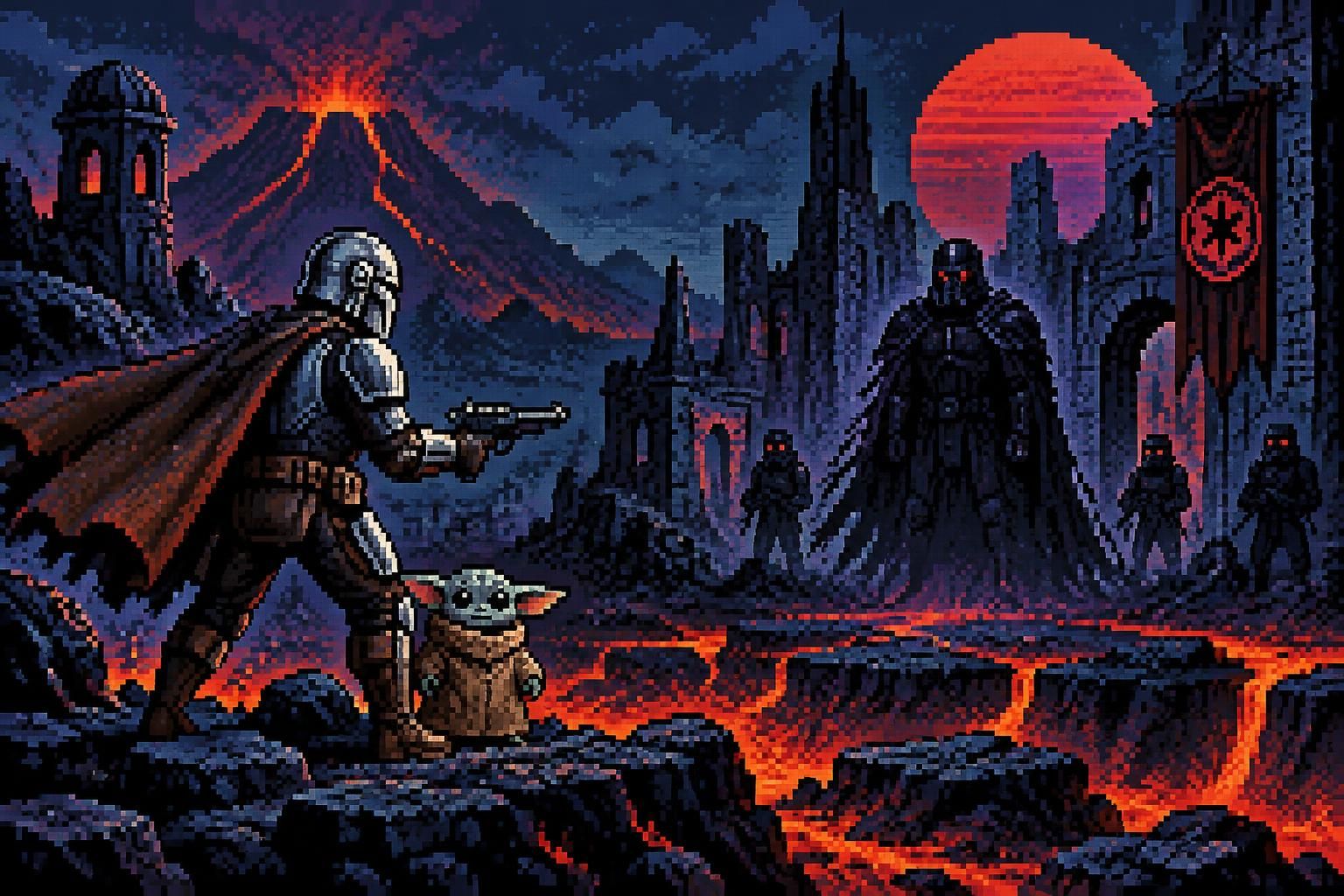
Nightmare on Nevarro Review: A Haunting Built on an Intelligence Problem
I identify the central problem in Nightmare on Nevarro as a failure of classification: the inhabitants recognize a danger before they understand its nature. Creatures with luminous red eyes are frightening the population, and Din Djarin must determine what those sightings mean before he can remove the threat. You should approach this premise as an investigation rather than an invitation to assume that supernatural explanations are correct.
The distinction matters within Star Wars, where the extraordinary is real but appearances remain unreliable. The Force, unfamiliar organisms, abandoned machinery, and deliberate deception can all produce events that witnesses interpret through fear. I therefore assess the haunting by a practical standard: does it make the protagonists gather information, revise assumptions, and act differently, or merely give them something unfamiliar to shoot?
Delilah S. Dawson writes this one-shot for Papercutz, the younger-reader imprint of Mad Cave Studios, with artwork credited to Alessandro Ranaldi, Vincenzo Federici, and Gaia de Bernardini. The publisher’s October release announcement places the project within a seasonal publishing strategy, while the supplied release information identifies October 21, 2026. I treat that as the announced publication date, rather than repeating conflicting promotional claims that the issue has already arrived.
The stated forty-page format establishes a compact operational boundary. Dawson must present a civilian emergency, establish the investigating pair, move them underground, develop the apparent haunting, and provide a resolution without the space available to a continuing series. You can see why recognizable locations and established relationships become useful: they reduce the amount of explanation required before the mission begins.
That economy also creates the principal vulnerability. This adventure follows Danger in the Dark, another Dawson story that sends the same protagonists into dangerous subterranean territory after trouble affects the settlement. I distinguish efficient reuse from narrative duplication by asking whether the second deployment changes the problem, the available information, or the consequences of failure; a different creature design alone cannot accomplish that work.
The reported premise offers an appropriate complication through uncertain identification. A conventional attack invites a defensive response, whereas a supposed ghost story first requires the investigator to decide what kind of incident has occurred. If you imagine a frightened resident refusing to approach a tunnel entrance, the operational consequence becomes clear: fear restricts access and damages confidence before any physical confrontation takes place.
I use that hypothetical resident as a civilian benchmark throughout this review. An effective intervention must do more than keep an armored visitor alive; it must make ordinary movement possible again and replace rumor with a usable explanation. This standard prevents spectacle from concealing a weak resolution, because defeating a visible adversary and restoring public security are related but separate achievements.
The available account supports a modest assessment: an accessible adventure, an effective central partnership, and a setting whose repetition limits surprise. It does not justify inventing the creatures’ identity, revealing an unsupported solution, or assigning specific visual achievements to pages not described in the source material. My assessment begins with the evidence: the haunting provides the question, but the quality of the investigation determines its value.
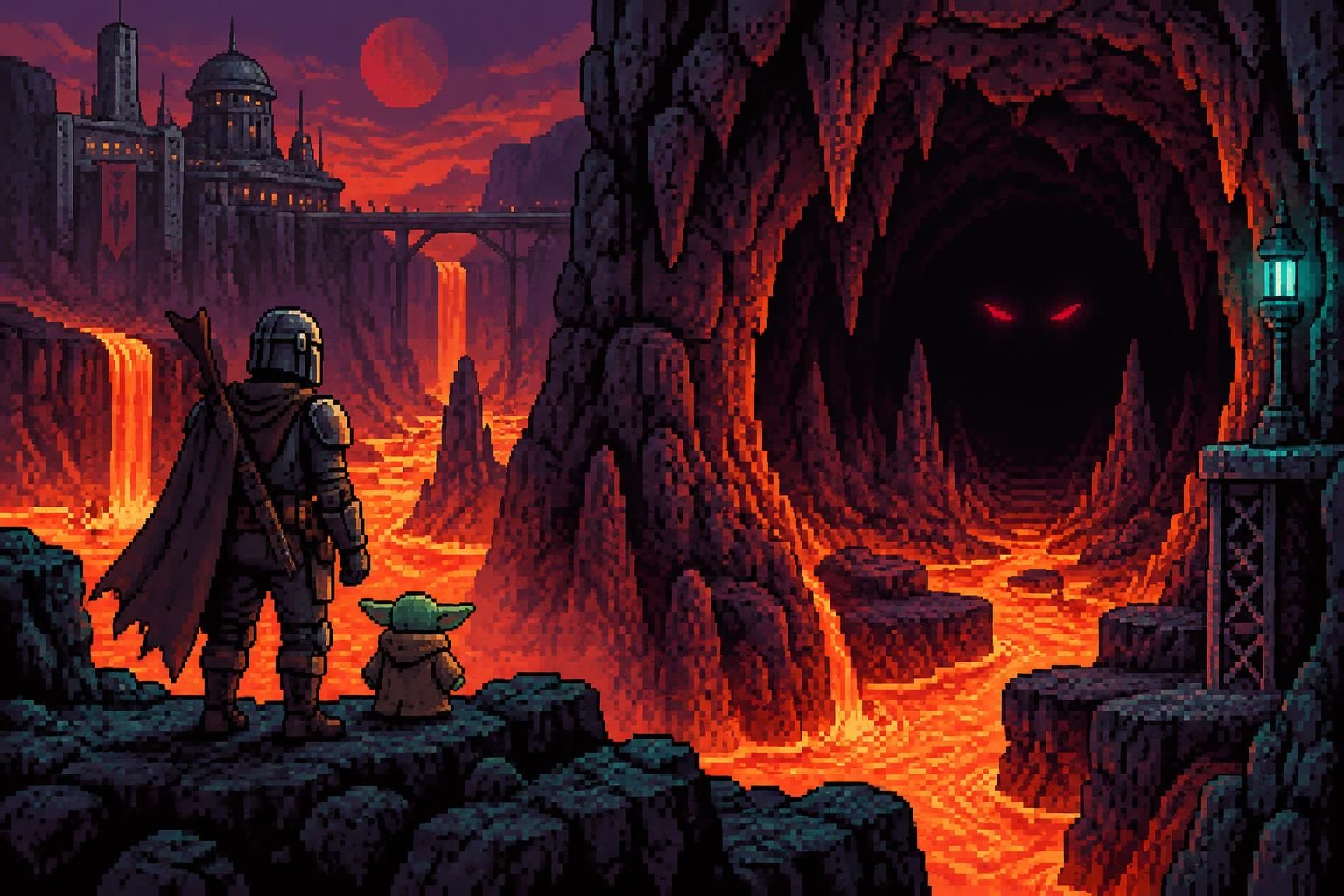
The Mandalorian Returns to Nevarro: Familiar Terrain, Repeated Tactics
I regard the return to the lava tunnels as the comic’s most consequential structural decision. Familiar geography can strengthen a story when prior knowledge becomes an asset, a liability, or a source of false confidence. You should therefore distinguish recognition from development: knowing where the protagonists are does not automatically mean that returning there provides a new dramatic purpose.
The comparison with Danger in the Dark is unusually direct. The supplied account describes a repeated sequence in which residents face danger, Greef Karga dispatches the armored investigator, and the investigation leads into volcanic passages populated by hazardous creatures. I identify the weakness not as continuity itself, but as the reuse of the same relationship between assignment, destination, and obstacle.
Military forces revisit contested ground for legitimate reasons, and serialized adventures can do the same. A second operation becomes informative when an adversary has adapted, intelligence proves obsolete, or the objective changes from destruction to recovery. Apply that principle here: the return would gain force if the earlier expedition caused Din to misread the new disturbance, making familiarity an identifiable disadvantage rather than convenient background.
That example is an analytical test, not a claim about an undisclosed scene. The distinction protects the review from attributing sophistication that the supplied evidence does not establish. What the account does establish is that references to the earlier adventure appear in dialogue, rewarding returning readers without making the preceding issue essential preparation.
For a new reader, this independence is an advantage. You can understand a frightened settlement, a dispatched protector, and an underground investigation without studying a continuity chart or recalling every episode of the TV series. I consider that low entry threshold appropriate for a younger-reader publication, particularly when the central relationship already supplies a clear emotional and practical framework.
For an established reader, however, accessibility cannot erase repetition. The related coverage of the earlier danger-focused adventure provides a useful comparison point: the relevant question is not whether both stories contain peril, but whether they organize that peril differently. A sequel earns its return visit when previous experience alters decisions, not merely when characters acknowledge that they have visited before.
Consider the civilian benchmark again. From a resident’s perspective, another emergency originating beneath the settlement suggests that a previous intervention did not produce comprehensive knowledge of the surrounding environment. That need not indicate incompetence, but it creates an opportunity to examine incomplete surveys, neglected passages, or the difference between ending one incident and establishing lasting security; the source account does not confirm that the comic pursues those possibilities.
The repetition also affects pacing before any individual encounter can establish its own identity. Once you recognize the assignment and destination, you begin predicting the broad route of the story, which places additional pressure on supporting characters and discoveries to supply variation. I find the return defensible as continuity, but insufficiently differentiated as a mission: familiar ground must change the decisions made upon it.
Din Djarin and Grogu: Why Shared Protection Carries the Adventure
I identify the relationship between Din Djarin and Grogu as the strongest element in the supplied assessment. Their usefulness to one another develops beyond the simple arrangement of an armed guardian transporting a vulnerable child. You should evaluate that progression through decisions and consequences: companionship becomes dramatically meaningful when each participant can change the other’s prospects of survival.
Din contributes equipment, combat experience, physical reach, and a practiced response to immediate danger. His foundling contributes a different set of capabilities, including Force sensitivity, together with a perspective that does not follow the adult’s habitual methods. I do not treat these contributions as interchangeable; the partnership works because its members cover different weaknesses rather than perform identical functions at different scales.
The reported story places emphasis on their reliance upon those complementary abilities. That provides a practical reason for both characters to occupy the same hazardous environment, avoiding the problem of a child companion whose only function is to be endangered. For you as a reader, the important shift is from asking whether the Mandalorian can protect his charge to asking how protection moves in both directions.
There is a useful comparison with a small reconnaissance team. One operative may possess superior firepower while another detects a hazard the first cannot recognize, and success depends on transferring initiative at the correct moment. This is an analytical model rather than a description of a particular panel, but it explains why cooperation generates more durable interest than repeated displays of individual strength.
Grogu’s developing protective role also gives the comic a purpose within the wider franchise. A side adventure need not reveal a major political secret or rearrange galactic power to contribute something worthwhile; it can establish a behavioral change that makes later interactions more legible. The supplied review connects this movement toward reciprocity with The Mandalorian and Grogu, although that connection should not be mistaken for proof of an indispensable continuity event.
I would direct readers interested in the broader relationship toward discussion of the pair’s continuing trajectory, while keeping this issue’s requirements separate. A self-contained comic should demonstrate its relationship clearly enough that you do not need future developments to justify present behavior. Franchise relevance is an additional benefit, not a substitute for a functioning scene.
Mandalorian culture makes this exchange more significant than an ordinary partnership adjustment. The importance of foundlings places responsibility within an inherited social framework, while the bond itself tests whether guardianship means control or preparation for independent action. I read the most productive version of that tension as a disciplined transfer of trust: the protector must recognize capability without pretending that vulnerability has disappeared.
The story’s young audience benefits from that distinction. Independence does not require the child figure to become invulnerable, and authority does not require the adult to possess every answer; each remains useful because the other remains different. I assess the father-and-son dynamic as the mission’s principal source of development: the route repeats, but the allocation of responsibility can still advance.
Nightmare on Nevarro’s New Threat: Fear, Terrain, and Incomplete Information
I evaluate the advertised new threat through three separate variables: what the creatures can do, what the witnesses believe they can do, and what the tunnels prevent anyone from observing. Those variables need not align. You can frighten a population with an adversary of limited physical capability if the environment makes its movements difficult to track and its intentions impossible to verify.
The volcanic passages provide a credible foundation for that uncertainty. Restricted routes complicate movement, uneven sightlines conceal distance, and dangerous surroundings punish hurried decisions even before an opponent intervenes. I do not need to assign unreported properties to the creatures to recognize the setting’s tactical value: an unfamiliar sound or a pair of distant eyes becomes more consequential when retreat is awkward.
The crimson eyes perform an immediate communication function. They offer a simple visual signal that younger readers can recognize quickly, while withholding the rest of the body preserves a gap between observation and explanation. For you, the distinction is useful: a story can establish that something is present without establishing what it is, allowing suspense to develop through controlled information rather than graphic injury.
I would organize the investigation around the following questions, each of which converts a fearful impression into something that can be examined. These are evaluative criteria, not a list of confirmed events from the issue.
- 🔎 Identification: Are separate witnesses describing the same phenomenon, or combining different incidents into one apparent haunting?
- 🧭 Movement: Do the sightings follow accessible passages, suggesting a discoverable route rather than unrestricted supernatural travel?
- 🛡️ Intent: Does the disturbance involve pursuit, territorial defense, accidental contact, or deliberate intimidation?
- ⚠️ Civilian exposure: Which ordinary activities place residents near the danger, and can those activities be redirected during the inquiry?
The list matters because apparently supernatural problems often encourage premature certainty in opposite directions. One investigator accepts every frightened description literally; another dismisses every witness because the explanation sounds implausible. I reject both methods: testimony can contain useful observations even when the speaker’s interpretation is wrong, and skepticism becomes ineffective when it refuses to collect evidence.
Within this galaxy, cultural comparison sharpens that reasoning. The Nightsisters demonstrate that unfamiliar traditions cannot be dismissed simply because an outsider lacks their conceptual framework, while other encounters show how technology and performance can manipulate belief. I use those references as cautions against intellectual rigidity, not as claims that either mechanism explains this particular mystery.
The published preview coverage frames the adventure around appearances that may mislead. That promise establishes a fair criterion for the eventual explanation: it should reorganize information the reader has encountered, rather than depend entirely on a fact introduced at the last possible moment. Surprise is stronger when you can reconstruct its logic afterward.
For the hypothetical resident, the most useful result would be a clear distinction between safe and unsafe behavior, supported by an explanation that survives retelling. An investigator who returns with only a victory leaves room for the same rumors to form around the next unexplained sound. I judge the haunting by whether uncertainty is resolved through observation: a frightening shape is an opening move, not a complete adversary.
Anzellans and Niner: Comic Relief as a Control on Suspense
I treat humor in this adventure as a pacing mechanism rather than an interruption that must be tolerated. The supplied account identifies the returning Anzellans as a source of lively dialogue and introduces Niner as a reluctant guide. You should examine both contributions by their effect on the investigation: a useful supporting character changes either the available information, the emotional pressure, or the pace of movement.
The Anzellans have a recognizable advantage because their scale, technical associations, and distinctive speech can establish character rapidly. A younger audience does not require an extensive biography to understand that a small participant can possess knowledge an armored warrior lacks. I regard that contrast as efficient storytelling when competence remains visible beneath the joke, rather than disappearing into a sequence of amusing noises.
The supplied review credits their dialogue with easing the frightening atmosphere for more sensitive children. That is a specific function: a moment of verbal disorder can interrupt an accumulating expectation of danger and allow readers to reassess the scene. You can compare the effect to opening a pressure valve; the mechanism works only if enough pressure remains for the next uncertain passage to matter.
Too much relief creates a different problem. If every threatening image immediately receives a joke that renders it harmless, the narrative teaches its audience not to invest in the danger. I therefore assess comic timing by distribution rather than quantity: humor should provide recovery between escalations, while preserving the possibility that a later decision has consequences the characters cannot simply laugh away.
Niner introduces a separate resource through reluctance. A guide who knows the route but does not welcome the assignment can create resistance without requiring an additional villain, and that resistance gives dialogue an immediate purpose. The supplied account compares the character’s appeal with K-2SO and SM-33; I interpret those comparisons as shorthand for an abrasive, useful presence, not evidence that their histories or exact personalities are reproduced.
The distinction between a companion and a guide also matters operationally. Din may command his own actions, but local knowledge belongs to someone else, forcing him to obtain cooperation rather than assume that superior equipment solves the route. For you, this creates a compact form of negotiation: the mission advances through an exchange of needs, not merely through successive physical obstacles.
Consider a hypothetical junction where the shortest passage is also the least familiar to the visiting investigator. A reluctant local adviser can make that choice interesting by supplying incomplete information, objecting to risk, or revealing a conflicting priority; none of those functions requires betrayal. I offer the example to show why Niner’s role has structural potential beyond amusing commentary, without asserting that this exact encounter occurs.
Culturally, the Anzellans also reinforce a recurring galactic lesson: physical scale is a poor predictor of technical influence. Their effectiveness follows from specialized knowledge, much as a skilled artisan can determine the outcome of an operation without commanding its troops. I find the supporting cast most valuable when humor exposes differences in competence: a joke should reveal who understands the situation, not replace the situation itself.
Star Wars Horror for Younger Readers: What the Visual Premise Must Achieve
I separate the comic’s visual premise from claims about execution that the supplied material cannot establish. The credited artists are Alessandro Ranaldi, Vincenzo Federici, and Gaia de Bernardini, but the available account does not assign their individual responsibilities in sufficient detail to support panel-by-panel attribution. You can still assess the assignment they face: making subterranean danger readable, distinctive, and appropriately unsettling for a younger audience.
The essential contrast is straightforward. Din’s recognizable silhouette and the small figure accompanying him must remain legible against dark passages, volcanic surroundings, and the isolated red signals associated with the creatures. I identify this as an information-design problem before an ornamental one, because suspense depends on knowing what the protagonists can see while remaining aware that something lies beyond it.
Darkness alone does not create useful tension. If a page obscures positions, exits, and direction without intention, the reader spends attention reconstructing geography instead of anticipating danger. An effective sequence gives you a stable enough map to understand a decision, then restricts one important piece of knowledge; uncertainty becomes compelling when its boundaries are clear.
The lava-tube setting supplies a natural vocabulary of constriction, irregular surfaces, and intermittent illumination. Those qualities could differentiate a wide establishing view from a confined reaction shot without requiring constant explanatory dialogue. I describe these as opportunities inherent in the location, rather than verified features of particular pages, because visual criticism loses precision when possible solutions are reported as observed accomplishments.
The wider tradition of science fiction offers a useful comparison. An abandoned station, a damaged vessel, and a volcanic tunnel all become threatening when familiar movement depends on an environment that no longer cooperates. The frightening element is not simply darkness; it is the recognition that ordinary assumptions about access, visibility, and rescue may no longer apply.
For younger readers, that principle allows suspense without relying on explicit bodily harm. A small figure separated by distance, a partly concealed entrance, or a reaction that precedes an explanation can communicate vulnerability through arrangement. You do not need to reduce the seriousness of the situation to make the material suitable for children; you need to control what is shown and how long uncertainty persists.
The art and culture of the galaxy provide another relevant distinction. Mandalorian armor communicates discipline, lineage, and preparedness through form, while the irregular cavern resists the controlled geometry associated with organized power. I read that contrast as potentially productive because it places a visibly equipped warrior in a space where equipment does not guarantee comprehension; the silhouette announces capability, but the surroundings limit its reach.
A fair visual review would therefore examine spatial clarity, expressions, color transitions, and the handling of reveals before praising atmosphere in general terms. The supplied assessment supports the existence of a creepy setting and a child-conscious tonal balance, not a comprehensive technical verdict on every page. I regard visual clarity as the foundation of this kind of horror: you must understand the vulnerable position before you can measure the danger surrounding it.
Nightmare on Nevarro Versus Danger in the Dark: Where the 6/10 Assessment Comes From
I retain the supplied 6/10 assessment as a useful expression of mixed results, not as a mathematical measurement of artistic quality. Its logic is clear: the comic delivers an accessible side adventure and a worthwhile relationship dynamic, but repeats enough of its predecessor’s construction to lose distinction. You should read that score as qualified approval rather than evidence of a failed publication.
A review becomes more useful when its criteria remain visible. The following comparison separates what the supplied account praises from what it identifies as a weakness, while keeping analytical implications distinct from unverified scene descriptions.
| Review criterion | Evidence in the supplied account | Critical implication |
|---|---|---|
| 🧭 Story independence | Earlier dialogue references are present, but prior reading is unnecessary. | The one-shot remains accessible to newcomers. |
| 🔁 Structural originality | Another civilian emergency leads into the same underground environment. | Returning readers have less uncertainty about the story’s broad movement. |
| 🛡️ Central partnership | The protagonists depend on different abilities to escape danger. | Reciprocal protection supplies meaningful character development. |
| ⚙️ Supporting characters | Anzellans provide humor, while Niner serves as a reluctant guide. | The supporting cast varies both tone and access to information. |
| 👁️ Audience calibration | A creepy premise is moderated by comic dialogue. | The adventure targets younger readers without removing every source of tension. |
The table reveals why familiarity cannot be counted only as a defect. Recognizable characters and an understandable mission reduce the cognitive burden on a reader who is still learning how comic sequences work. I would not penalize an all-ages publication for offering a clear objective; the more precise criticism concerns whether clarity has been purchased through unnecessary duplication of the preceding adventure.
Nor does a self-contained format require a minor story to become a major saga event. A successful short mission can test trust, expose a useful limitation, or introduce a memorable collaborator without changing the balance of galactic power. You should resist the assumption that continuity importance and narrative effectiveness are the same quantity, because that assumption undervalues well-constructed smaller encounters.
The reported preference for Danger in the Dark follows from comparative freshness rather than an argument that the later issue contains no worthwhile material. When two adventures deploy a similar structure, the earlier one benefits from establishing the pattern instead of repeating it. The second must compensate with stronger differentiation, and the supplied assessment finds that its new faces and seasonal framing do not fully accomplish that task.
I also distinguish a recommendation from a ranking. A reader seeking a brief encounter with familiar companions may receive exactly what is required, while someone purchasing consecutive issues for new situations may find diminishing returns. The same evidence supports both judgments because the purchasing objectives differ; useful criticism identifies that difference instead of pretending that every reader values novelty and familiarity in equal proportions.
The number therefore carries less information than the balance behind it. Competent delivery, recognizable voices, and cooperative action support the positive side, while repeated terrain and mission architecture constrain the result. I accept the moderate rating because it corresponds to a specific diagnosis: the adventure functions, but its strongest new contribution lies in the partnership rather than the operation.
Reading Nightmare on Nevarro as a Standalone Mandalorian Mission
I would select this comic according to the reader’s immediate objective rather than its position in a franchise checklist. If you want a short, mildly frightening assignment involving a familiar guardian and foundling, the supplied account identifies a clear match. If you want a substantial departure from the previous underground adventure, the same evidence gives you a reason to moderate expectations.
The standalone format is particularly useful for readers moving from the television production into comics. It supplies recognizable protagonists without demanding that a young reader understand the publication order of several ongoing titles. You can explain the mission in a few practical terms—residents are frightened, something underground requires investigation, and the pair must cooperate—while leaving the mystery itself intact.
Reading the predecessor first remains optional rather than compulsory. The returning references may provide recognition, but the account explicitly indicates that they are not necessary to follow the central action. I would therefore avoid describing the earlier issue as required preparation, since doing so would turn a modest continuity benefit into an artificial barrier to entry.
For an adult choosing the comic for a child, the most relevant distinction is between frightening imagery and sustained distress. The supplied review describes eerie creatures and an unsettling environment, balanced by humorous supporting dialogue and a recognizable protective relationship. You should base the choice on the individual reader’s response to darkness and implied pursuit, rather than assuming that an all-ages label guarantees an identical experience for every child.
A shared reading also permits an evidence-focused discussion that fits the story’s apparent design. Ask which details the characters actually observe, which explanations they assume, and what information would change their next decision. I regard those questions as more productive than simply asking whether the creatures are frightening, because they turn passive anticipation into an examination of how a mystery is constructed.
The hypothetical resident provides a further test you can apply without demanding additional lore. After each major development, ask whether that person would now know more about staying safe, or whether only the visiting heroes have gained an advantage. This separates local recovery from personal survival and gives a younger reader a concrete way to examine why the assignment matters beyond its action sequences.
The publication’s seasonal positioning also deserves proportion. A Halloween framework can provide an efficient invitation to explore uncertainty within an established setting, but the issue should remain readable when that calendar association has passed. I would evaluate its lasting usefulness through the same elements that support any compact adventure: clear motivation, differentiated abilities, coherent obstacles, and a resolution proportionate to the problem.
That approach leaves room for both enjoyment and scrutiny without converting either into a command. You can appreciate the cooperative bond, recognize the supporting cast’s function, and still identify the repeated mission pattern as the principal constraint. I would use this one-shot as a contained reading exercise in trust and observation: identify the evidence, examine the response, and determine whether the characters earn the safety they seek.

I am Grand Admiral Thrawn, strategist of the Galactic Empire. Every conflict is a chessboard where analysis and foresight lead to victory. The art and culture of a people betray their weaknesses. The Empire embodies order and discipline in the face of rebel chaos. History will remember that only strategy ensures peace.