
King Lee-Char and the Succession Crisis on Mon Cala
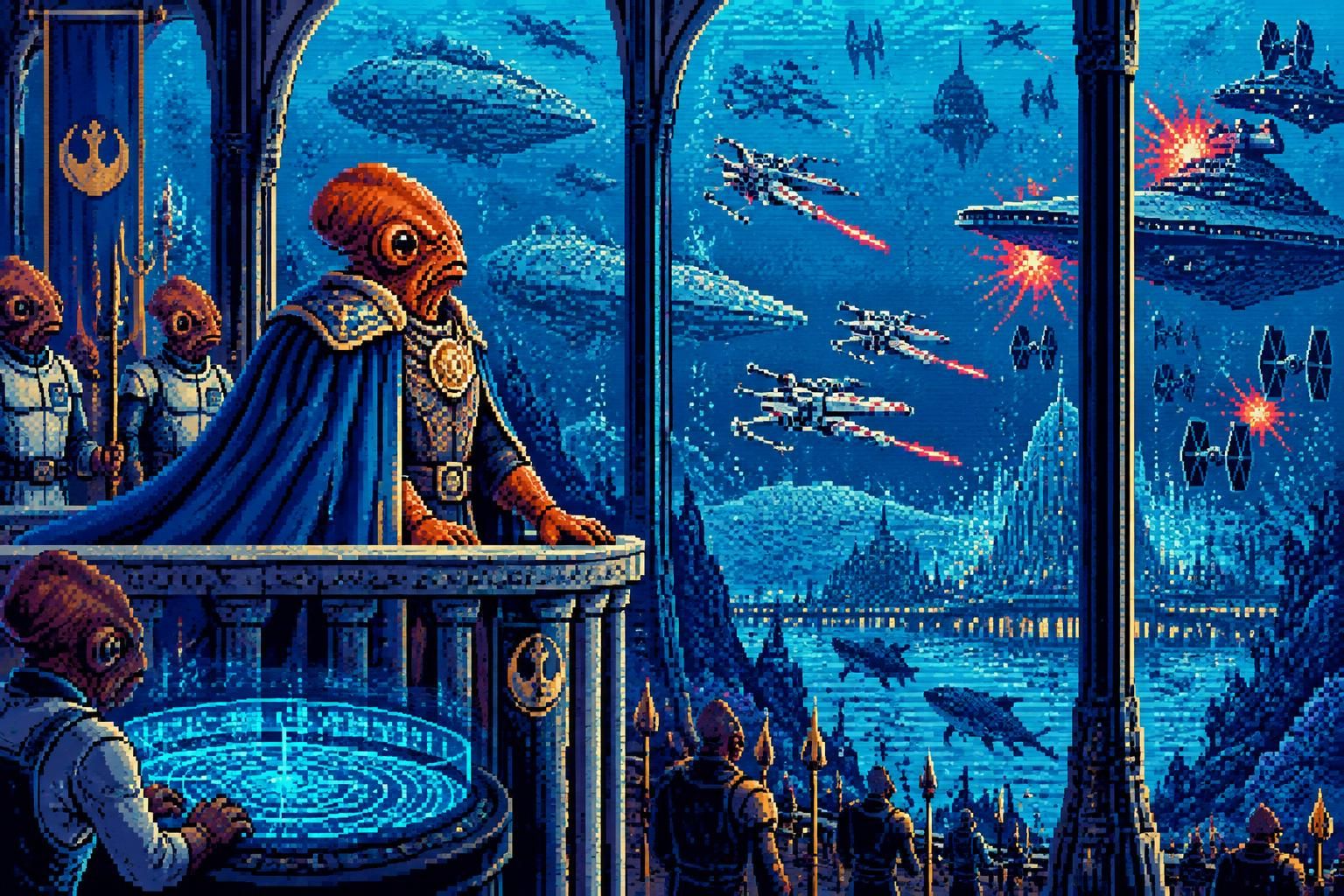
King Lee-Char’s authority began with a problem no fleet could solve for him. His father, King Yos Kolina, was assassinated during the Clone Wars, leaving a young heir to govern an ocean planet shared by the Mon Calamari and the Quarren. I would ask you to examine the timing before examining the battles: the Galactic Republic depended on Mon Cala as an ally, while the Separatists needed only to make that alliance appear incompatible with Quarren interests.
The two peoples did not lack a common home. They lacked confidence that its institutions would protect both of them after the king’s death. Lee-Char inherited a throne associated with Mon Calamari rule, and Quarren leaders questioned whether another member of that royal line would govern impartially. His promise to represent both populations therefore faced a practical test. What would persuade a community with limited control over the throne that the next king would treat it fairly?
Separatist envoy Riff Tamson understood that uncertainty. He demanded a Quarren monarch and presented the dispute as a choice between equal representation and continued Mon Calamari dominance. The argument concealed a separate objective: removing a Republic-aligned government from a strategically valuable world. Political division became a military entry point. Tamson did not need every Quarren citizen to support the Confederacy. He needed enough distrust to prevent negotiations from holding.
Lee-Char invited Anakin Skywalker and Padmé Amidala to assist with those negotiations. Their presence gave the prince access to Republic influence, but it also supplied Tamson with an accusation: outside officials appeared to be helping determine Mon Cala’s succession. I see the difficulty in that arrangement. Lee-Char needed outside support to keep the talks alive, yet he had to demonstrate that neither the Galactic Republic nor a Separatist representative would decide how his people were governed.
Why the Quarren Dispute Became a Star Wars Underwater Conflict
You can follow the crisis in the account of “Water War”: an assassination destabilized the succession, negotiations failed, and forces already preparing for battle moved into the open. The sequence matters because it distinguishes the underlying dispute from its exploitation. Quarren demands for political standing were real. Tamson’s proposed remedy placed their future under Separatist control.
Lee-Char named Gial Ackbar his bodyguard as the threat grew. Ackbar’s assignment protected the heir, but it also connected the prince to commanders who understood the ocean battlefield. That combination of personal security and military advice would remain necessary throughout the Battle of Mon Cala. An inexperienced ruler could not become an expert combatant overnight; he could, however, keep experienced officers close and ensure that their actions served a political purpose.
Mon Calamari civic identity helps explain why succession carried such weight. Their settlements and vessels reflected a culture shaped by water, complex construction, and cooperation across specialized crews. The Quarren possessed their own traditions and claims to the same world. I would not mistake a shared environment for a shared view of government. When one community controls the throne, the other may regard even a capable heir as a continuation of an unequal arrangement.
The prince’s first task was therefore not to defeat Tamson in combat. It was to preserve a basis on which Mon Calamari and Quarren could still govern together after the fighting. If he treated the Quarren solely as enemies, he would validate the envoy’s argument. If he ignored their armed preparations, he would leave his supporters exposed. Lee-Char entered the conflict with two objectives: survive the assault and prevent the alliance Tamson was building from becoming permanent.
The Battle of Mon Cala: Why Lee-Char Stayed with His Forces
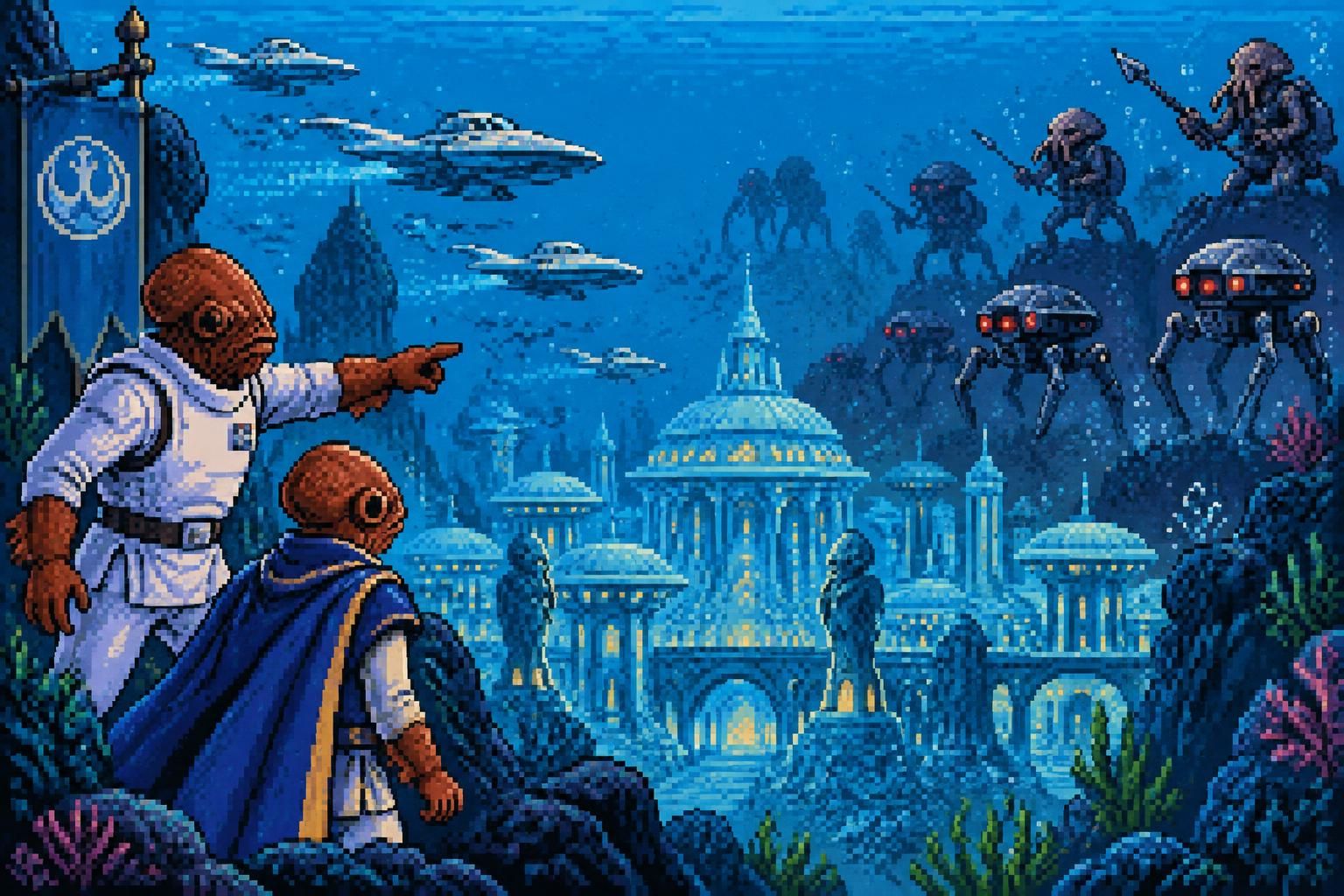
At the opening of the Battle of Mon Cala, Lee-Char watched events with Ackbar and Anakin Skywalker. Anakin wanted to move him to safety. The prince refused to leave his people, a decision that exposed him to immediate danger but answered a question about his fitness to rule. You cannot command loyalty during an invasion through a title alone. Citizens and soldiers needed evidence that their prospective king would share the risks imposed on them.
That choice did not make his safety unimportant. Lee-Char was the clearest remaining source of lawful authority after his father’s death. If he died before the two communities reached an agreement, Tamson could argue that the monarchy had lost its claim to govern. Ackbar’s task was consequently more demanding than guarding one person: he had to keep the prince visible enough to sustain confidence and protected enough to survive the campaign.
Quarren forces received Separatist assistance, including AQ-series battle droids designed for underwater combat. Their deployment changed the scale of the engagement. Local opponents who knew the terrain now had mechanical reinforcements capable of sustaining pressure beneath the surface. The Mon Calamari could not plan as though they were facing only a dispute between neighboring populations; they faced a campaign supported by the Confederacy’s industrial capacity.
Republic SCUBA troops arrived with Kit Fisto and Ahsoka Tano, giving the defenders specialized personnel suited to the environment. Their arrival initially pushed Separatist forces back. I would caution you against equating a favorable exchange in one phase of battle with control of the whole theater. Tamson still possessed reserves, influence over Quarren commanders, and opportunities to strike Republic support beyond the immediate fighting.
Lee-Char, Ackbar, and the Value of a Visible Heir
Under Ackbar’s encouragement, Lee-Char entered the battle himself. The act had a clear political function: his soldiers could see that the heir had not withdrawn while they fought for his succession. It also created a predictable vulnerability. Tamson tried to kill him, and Ahsoka’s intervention saved his life. The episode shows both sides of the decision. Visibility strengthened Lee-Char’s claim; without disciplined protection, it nearly ended it.
I would have separated those requirements more carefully. A ruler can appear at decisive positions without becoming an unguarded target, provided escorts control approach routes and withdrawal remains possible. Lee-Char’s presence should have been coordinated with Ackbar’s defensive plan rather than treated as proof of courage by itself. His value to the defenders lay in what he could still do after the encounter, not in how long he remained exposed during it.
The battle also reveals a weakness in the Republic response. Its troops could reinforce Mon Cala, but their effectiveness depended on maintaining contact with defenders and preserving support from orbit. A commander should assume that an opponent observing those dependencies will strike them. Tamson’s later escalation did precisely that. The Republic’s specialists were useful in the water; they were not a substitute for a secure line of reinforcement.
For Lee-Char, every tactical move carried an audience beyond the battlefield. Mon Calamari fighters judged whether their heir would remain beside them. Quarren observers judged whether he treated their resistance as a grievance to be addressed or a population to be crushed. Separatist commanders sought proof that the prince could be isolated. His greatest immediate advantage was public trust, and his greatest immediate liability was that trust’s dependence on his survival.
The conflict had begun as a succession crisis. Once outside armies entered the water, control of information became nearly as important as control of territory. The next Separatist strike made that distinction unmistakable.
For a visual account of the opening campaign, you can compare these decisions with the animated battle’s movement between political negotiations and underwater combat.
Separatist Escalation and Lee-Char’s Signal to the Mon Calamari
The Separatists introduced another underwater droid threat and destroyed the Republic cruiser above Mon Cala. Republic forces retreated and became separated. Kit Fisto and Ahsoka Tano helped protect Lee-Char, but the larger defensive effort had lost much of its freedom of movement. I would direct your attention to the combined effect of these attacks: the defenders faced pressure below the surface while their support above it was removed.
For civilians, the result was more than a change in the battle line. Many Mon Calamari believed the prince had died. Quarren forces took captives into labor camps, giving the population reason to fear that organized resistance had failed. In that setting, Tamson did not need to defeat every surviving fighter at once. He needed the occupied population to conclude that no legitimate leader remained and that resistance would bring only further punishment.
Lee-Char answered with a horn whose sound carried through the water. It announced that he was alive. I regard this as one of his most efficient actions in the campaign because it used a signal his people could immediately understand. He did not have to circulate a written order through occupied districts or depend on a fragile communications chain. One recognizable sound challenged the Separatists’ most useful claim: that the heir was gone.
The action did not free the prisoners, restore the cruiser, or defeat the battle droids. Its effect was narrower and therefore easier to measure. It restored a point around which dispersed supporters could maintain hope and coordination. You should distinguish that effect from victory. A signal can preserve a resistance movement long enough for reinforcements and planning to matter; it cannot replace either of them.
How an Underwater Signal Disrupted Separatist Control
Mon Cala’s environment gave the horn particular value. Underwater sound could carry a message across areas where movement was restricted and direct contact was dangerous. The prince used a familiar means of expression suited to his people’s surroundings rather than relying solely on Republic equipment. Culture supplied a communications tool at the moment military systems were under strain. An occupying force that studies weapons but neglects local practices leaves openings of this kind.
Republic reinforcements later included the Gungan Grand Army. Gungan soldiers were accustomed to aquatic operations, and their arrival improved the defenders’ capacity to continue fighting. Yet their presence did not settle the political dispute. The Quarren still had to decide whether Separatist sponsorship advanced their interests. Lee-Char’s signal kept the monarchy visible; the next stage required him to prove that Tamson had misled an ally.
I would have treated the period after the cruiser’s destruction as a struggle over three linked resources: safe routes, reliable information, and civilian allegiance. The defenders needed protected paths between surviving units. They needed the public to know that Lee-Char lived. They also needed evidence strong enough to separate Quarren political aims from Tamson’s military program. Concentrating only on destroying droids would have left the envoy’s alliance intact.
The horn illustrates why a ruler’s conduct cannot be assessed solely through combat records. Lee-Char’s physical survival mattered because it kept open the possibility of an agreement after the battle. His signal mattered because others learned of that survival before Tamson could exploit the rumor of his death. The young prince could not reverse every battlefield loss, but he could deny the enemy control over what those losses meant.
That distinction prepared the decisive maneuver. Rather than trying to overpower every Quarren formation, Lee-Char sought to change the reason those formations fought.
How Lee-Char Broke the Quarren–Separatist Alliance
Lee-Char eventually allowed himself to be captured. On its surface, the choice seemed to repeat the danger of his earlier appearance in battle: the ruler entered enemy control while Tamson still wanted him dead. The difference lay in the objective. Lee-Char sought direct access to the Quarren leadership and a setting in which Tamson’s conduct could be exposed. I would describe it as a high-risk political operation supported by a precise understanding of his opponent’s weakness.
The Quarren had aligned with the Separatists because they expected a better position in Mon Cala’s government. Tamson, however, treated their demands as a means to capture the planet for the Confederacy. Lee-Char showed their leader that the envoy had not honored the arrangement on which their cooperation depended. The evidence mattered more than another appeal to unity. A Quarren commander could reject Tamson without abandoning the original demand for fair representation.
Lee-Char also drew out Tamson’s admission that he had assassinated Yos Kolina. That confession changed the meaning of the entire conflict. The king’s death was not merely an opening the Separatists had exploited after the fact; their agent had created the opening. Quarren leaders now had to consider whether they had fought a civil war arising from a genuine succession dispute or one deliberately intensified by an outsider.
I would ask you to notice what Lee-Char did not require. He did not ask the Quarren to deny that they had grievances. He presented a more immediate question: would they continue supplying force to a commander who had deceived them about his aims? Their decision to end the alliance deprived Tamson of local legitimacy and reduced the war from a struggle between Mon Cala’s peoples to a fight against the Separatist operation manipulating them.
Riff Tamson’s Confession and the End of the Battle of Mon Cala
Lee-Char killed Tamson in their final confrontation. The death avenged Yos Kolina, but its strategic meaning was broader than personal retribution. Tamson had connected the assassination, Quarren mobilization, and Separatist intervention. Removing him after exposing those connections prevented him from continuing to speak as a credible partner to either community. The confession broke his coalition before the duel ended his command.
The battle ended with Lee-Char crowned king, and Mon Cala remained at peace through the rest of the Clone Wars. That outcome should not be reduced to a prince becoming a stronger fighter. His decisive contribution was identifying the difference between the Quarren’s goals and Tamson’s. Once that distinction became visible, coexistence again became politically possible. The crown followed a settlement the population could recognize, not simply the defeat of a hostile envoy.
The sequence is set out in the official Prince Lee-Char character record. It also provides a useful check on his later history: the young heir of the Clone Wars and the king who resisted the Empire are the same ruler, shaped by the same concern for his people’s independence. His early success established that an external power could be beaten by revealing how it used Mon Cala’s internal divisions.
Still, the maneuver carried costs that another commander should not ignore. Lee-Char could not guarantee that Tamson would speak plainly or that Quarren leaders would act on what they heard. His capture placed a vital political figure within reach of an assassin. A more secure operation would have sought corroborating evidence and controlled witnesses before risking the king. In this campaign, the opening existed and Lee-Char used it; in another, the same gamble could have failed.
His victory offers a disciplined lesson: when an enemy coalition contains partners with different aims, test those aims against the sponsor’s actions. Lee-Char applied that lesson against the Separatists. Under the Empire, he would face an adviser whose concealed objective was harder for him to detect.
The closing stages of the Clone Wars campaign show why the Quarren decision, rather than the final strike alone, determined Mon Cala’s future.
King Lee-Char, Ferren Barr, and the Empire’s Pressure on Mon Cala
In the early Imperial period, King Lee-Char faced a different form of outside pressure. The Empire approached Mon Cala with trade proposals while backing its diplomacy with Star Destroyers. A government may call such an offer commercial, but warships alter how its terms are received. Lee-Char rejected the approach. I would expect you to recognize the pattern from the Clone Wars: an external power sought influence over the ocean planet while claiming to offer a workable political arrangement.
This time, the most dangerous deception came from someone Lee-Char trusted. Ferren Barr, a Jedi survivor, told the king that he had foreseen Mon Calamari ships helping to defeat the Empire. Lee-Char had reason to listen. Jedi had helped save his world during the previous war, and the Empire had destroyed the Jedi Order. He accepted Barr as a secret adviser without knowing how far the survivor would go to pursue revenge.
Barr’s vision concerned a possible future use of Mon Cala’s vessels. His immediate conduct put Mon Cala’s people at risk. He secretly destroyed an Imperial ambassador’s shuttle, giving the Empire a pretext for force. Lee-Char did not authorize the act and did not know his adviser had committed it. The king opposed Imperial control; Barr engineered an escalation in the king’s name. Confusing those two positions would obscure the cause of the ensuing disaster.
Darth Vader arrived with Inquisitors to investigate reports that a Jedi was advising the monarch. Among them was the Ninth Sister, part of the Imperial effort to find surviving Jedi. Barr then used a mind trick to push Lee-Char toward aggressive retaliation. Fighting erupted in Dac City, and Imperial forces captured the king. The Empire gained the confrontation it wanted, while Barr gained the open conflict he believed necessary.
Why Ferren Barr’s Plan Undermined Lee-Char’s Authority
During interrogation, Lee-Char revealed Barr’s location shortly before sea creatures struck the chamber window and the room flooded. The chaos injured the king, and Quarren rescuers moved him to a medical facility beyond immediate Imperial reach. That detail deserves attention. Quarren action helped preserve a Mon Calamari monarch years after the civil war Tamson had fostered. The political settlement of the Clone Wars had left room for cooperation under a new threat.
When Lee-Char recovered, he warned Barr that the Empire was coming for him. He still did not know the survivor had caused the shuttle explosion. Vader found the king again and killed his guards. Barr arrived to confront Vader and revealed during their encounter that he had destroyed the ambassador’s craft. Lee-Char ordered a cease-fire once the truth was clear. He understood that continuing a fight built on Barr’s deception would surrender still more authority over his world’s decisions.
I would identify two failures in the king’s position. First, he had no effective means to verify the acts of a secret adviser with independent goals. Second, his refusal of Imperial demands was not supported by enough control over the events that could trigger invasion. Those weaknesses do not make the Empire’s occupation justified, nor do they make Barr its sole cause. They explain why Lee-Char could not keep his policy separate from an ally’s unauthorized violence.
Barr died in the encounter with Vader. Before his death, he again described his vision of Mon Calamari ships serving a great rebellion. Later events would give that prediction force, but future usefulness did not protect those caught in the present battle. You should assess Barr’s plan at both points in time: it anticipated the fleet’s potential while accepting risks that Lee-Char had not chosen for his people.
The Empire imprisoned the king on Strokill Prime as a “King in Exile.” Mon Cala lost its ruler’s active leadership, while its shipbuilding capacity remained valuable to those seeking power over the galaxy. The same cultural and industrial strengths that had helped define its independence now made Imperial control especially consequential.
The King in Exile and the Strategic Value of Mon Calamari Ships
Lee-Char’s imprisonment removed him from Mon Cala, but it did not remove the planet’s value from the Imperial calculation. Mon Calamari crews and shipbuilders possessed skills developed across generations of work in an ocean environment. Their vessels were products of that tradition: complex, durable craft associated with a people accustomed to designing for difficult conditions. I would not claim that a culture determines every military choice. I would observe that established methods of design and cooperation shape what a population can contribute when war reaches it.
The Empire needed obedience from Mon Cala, not merely possession of its king. An imprisoned monarch could no longer negotiate freely, appoint commanders, or reject demands in public. He could still serve as a symbol around which resentment gathered. Holding Lee-Char alive therefore offered control but also preserved a risk. If his words reached the planet, the authority the Empire had confined could become useful to its opponents.
Time increased the asymmetry. His health deteriorated during years in Imperial custody, while Mon Cala continued to produce and operate ships. By the period after the Battle of Yavin, he depended on life support in his cell. The king could not lead a campaign from that condition. Yet the possibility of connecting his name to the mercantile fleet remained. The Empire controlled Lee-Char’s location; it did not fully control what his people might do on hearing from him.
I would ask you to compare this situation with the underwater horn. During the Clone Wars, Lee-Char had sent a short signal to prove he lived. In captivity, a message would need to do more. It would have to state a purpose, reach trusted recipients, and persuade crews to accept the immediate danger of breaking Imperial control. The principle was familiar, but the available channel and the cost to listeners had changed.
Mon Cala’s Fleet as a Political and Military Asset
The distinction between a mercantile fleet and a combat fleet is important. Commercial vessels do not become effective rebel warships through a speech alone. They require crews willing to depart, routes that allow escape, and an alliance capable of using the ships. Lee-Char could supply neither fuel nor safe passage from his cell. What he could provide was a recognized authority telling those crews that resistance served Mon Cala rather than an outside faction.
That authority had a history. The king had opposed a Separatist envoy who murdered his father. He had also resisted the Empire’s attempt to impose terms under the shadow of Star Destroyers. His people could judge the final message against those earlier actions. A ruler’s words gain force when listeners can connect them to decisions made before the outcome was known; Lee-Char’s record supplied that connection.
The following sequence distinguishes the major contests in his life without treating them as identical campaigns.
| Period | Pressure on Mon Cala | Lee-Char’s response | Strategic result |
|---|---|---|---|
| 🌊 Clone Wars | Separatists exploited the succession dispute | Exposed Tamson’s deception to the Quarren | Alliance against Tamson collapsed |
| ⚔️ Early Empire | Imperial diplomacy arrived with military force | Rejected imposed terms but trusted Barr | Escalation led to captivity |
| 🚀 After Yavin | Imperial control restrained the fleet | Recorded a call for resistance | Ships escaped to the Rebel Alliance |
The table identifies a change in Lee-Char’s means. He first acted in person, then lost control of events around him, and finally influenced them through a recording. In each period, another power tried to make Mon Cala’s resources serve its own campaign. Lee-Char’s final opportunity was to place a choice before the crews who operated those resources.
The problem for the Rebel Alliance was access. A rescue attempt could restore the king himself, or it might recover only his voice. Princess Leia’s mission had to account for both possibilities.
Princess Leia’s Prison Mission and Lee-Char’s Last Message
After the Battle of Yavin, Princess Leia organized an attempt to reach Lee-Char with help from Queen Trios of Shu-Torun. They found him alive in an Imperial facility, confined to a medical pod and dependent on its support. The condition of the prisoner narrowed the operation’s choices. I would tell you to separate the mission’s desired outcome from the one circumstances allowed: freeing the king was the aim, but obtaining a message became the attainable result.
Imperial forces were on alert, and Leia could not safely remove him. Lee-Char used the time available to record a final appeal for his people to resist the Empire. Stormtroopers entered as he finished and killed him. The sequence leaves little room for a comforting account of rescue. The king died in captivity. His message survived because Leia and her allies carried it beyond the prison.
That distinction is essential when evaluating the mission. It failed to extract Lee-Char, but it secured an instruction from a ruler whom Mon Cala still recognized. A voice recording was not an equivalent substitute for a living king. It could not answer questions or adjust to events as they changed. It could, however, cross the distance between an isolated cell and a fleet whose crews had the means to act.
Leia delivered the message to Dors Utrya, the Warden of the King on Mon Cala. Utrya broadcast it across the planet and was killed by Imperial forces. His role shows that transmission depended on more than the courage of a prisoner or the skill of a rescue team. A trusted recipient had to accept the risk of distributing the recording where the intended audience could hear it.
How King Lee-Char’s Recording Reached the Rebel Fleet
The message prompted a mass mutiny within the Mon Calamari Mercantile Fleet. Twelve star cruisers escaped Mon Cala and joined the Rebel Alliance. I would avoid treating that number as an instant measure of battlefield strength. The Alliance still had to integrate crews and vessels into its operations. The escape itself, however, transferred major ships out of Imperial reach and made Mon Cala’s resistance materially useful to the rebellion.
You can see a clear chain of decisions rather than a single miraculous turn. Leia’s team reached the prisoner. Lee-Char recorded the appeal. Utrya broadcast it despite Imperial danger. Crews then chose to take their ships away. If any link had failed, the king’s words would have remained a private act. Their strategic effect depended on people able to relay and implement them.
Lee-Char’s earlier horn provides a close comparison. It told frightened citizens that their prince had survived. The prison recording told armed crews what he wanted them to do after he would no longer be there to lead them. Both messages addressed an Imperial or Separatist effort to isolate him from his people. The later one demanded a greater commitment from its audience: escape with valuable vessels under occupation.
I would also note what the king did not control. He could not determine every crew’s route, guarantee their arrival, or decide how the Rebel Alliance would deploy the ships. His final act created a legitimate basis for resistance; operational decisions belonged to those who heard him. That division of responsibility makes the result more credible, not less. The crews were participants in Mon Cala’s choice, not instruments activated by a speech.
The escape fulfilled the practical part of Barr’s prediction without validating the deception Barr had used years earlier. Mon Calamari ships did aid a wider rebellion. They did so after the king had been imprisoned, after Leia had reached him, and after Mon Cala’s own people acted on his last request.
What King Lee-Char’s Campaigns Reveal About Mon Cala’s Wars
King Lee-Char’s history presents three different problems of command. During the Clone Wars, he had to defeat Separatist intervention without making the Quarren permanent enemies. Under the Empire, he had to resist coercion while an adviser secretly pushed his government toward war. In captivity, he had to move his people to act without being present to lead them. I would not apply one answer to all three. Each required a different use of legitimacy, intelligence, and communication.
The first campaign demonstrates the value of identifying every party’s actual objective. The Quarren wanted greater authority on their homeworld; Tamson wanted Separatist control. Lee-Char succeeded when he made those aims visibly incompatible. The second demonstrates the danger of assuming that an ally’s declared cause governs that ally’s methods. Barr opposed the Empire, as Lee-Char did, but he accepted risks to Mon Cala that the king had not authorized.
The final campaign shows the limits and power of a ruler’s voice. Lee-Char could not fight his way out of an Imperial prison. He could authorize resistance in terms his people understood and leave the practical decision to crews already capable of moving ships. His record gave the message credibility. Leia’s mission and Utrya’s broadcast gave it reach. The fleet’s departure gave it consequence.
I would preserve five operational lessons from those events:
- 🌊 Separate local grievances from outside sponsorship. The Quarren’s demands did not make Tamson a trustworthy partner.
- 🛡️ Protect visible leadership. Lee-Char’s presence encouraged defenders, but each appearance required a means of extraction.
- 📣 Use communications the population recognizes. His horn and later recording worked because their audience knew whose signal it was.
- 🔎 Verify an adviser’s actions, not only an adviser’s stated purpose. Barr’s concealed attack changed the king’s strategic position.
- 🚀 Connect political authority to available resources. The final appeal mattered because Mon Cala’s crews could move substantial ships.
Why Mon Calamari Culture Matters to Lee-Char’s Military Record
Mon Cala’s cultural traditions were not decoration around these wars. An aquatic society shaped the means by which people moved, built, and sent signals. Its shipbuilding and mercantile work later supplied vessels the Rebel Alliance could use. Its shared governance problem also shaped the enemy’s first point of attack. If you examine only droids, cruisers, and troop movements, you miss why the same planet became contested across separate eras.
There is a further distinction between Lee-Char as prince and Lee-Char as king. The prince could stand beside Ackbar, take risks in the water, and confront Tamson directly. The imprisoned king could do none of those things. His influence depended on whether others regarded his appeal as consistent with the rule they remembered. That is why his earlier decisions belong in an assessment of the twelve departing cruisers: they established who was speaking when Leia carried his last words away.
The available record of Lee-Char’s life spans both the underwater campaign and his later resistance. Read as a sequence of strategic problems, it shows a ruler repeatedly confronting powers that wanted Mon Cala’s allegiance or its ships. In the first conflict, he kept an external sponsor from turning a dispute between neighbors into lasting control. In the last, his people moved valuable vessels beyond the reach of an occupying Empire.
Lee-Char’s decisive instrument changed from presence, to evidence, to a recorded order. The constant was his effort to keep Mon Cala’s future in the hands of those who lived and served there. That continuity explains why a king confined far from his ocean planet could still affect a fleet’s course.

I am Grand Admiral Thrawn, strategist of the Galactic Empire. Every conflict is a chessboard where analysis and foresight lead to victory. The art and culture of a people betray their weaknesses. The Empire embodies order and discipline in the face of rebel chaos. History will remember that only strategy ensures peace.