
Who Is Kelleran Beq, the Jedi Hero Who Saved Grogu?
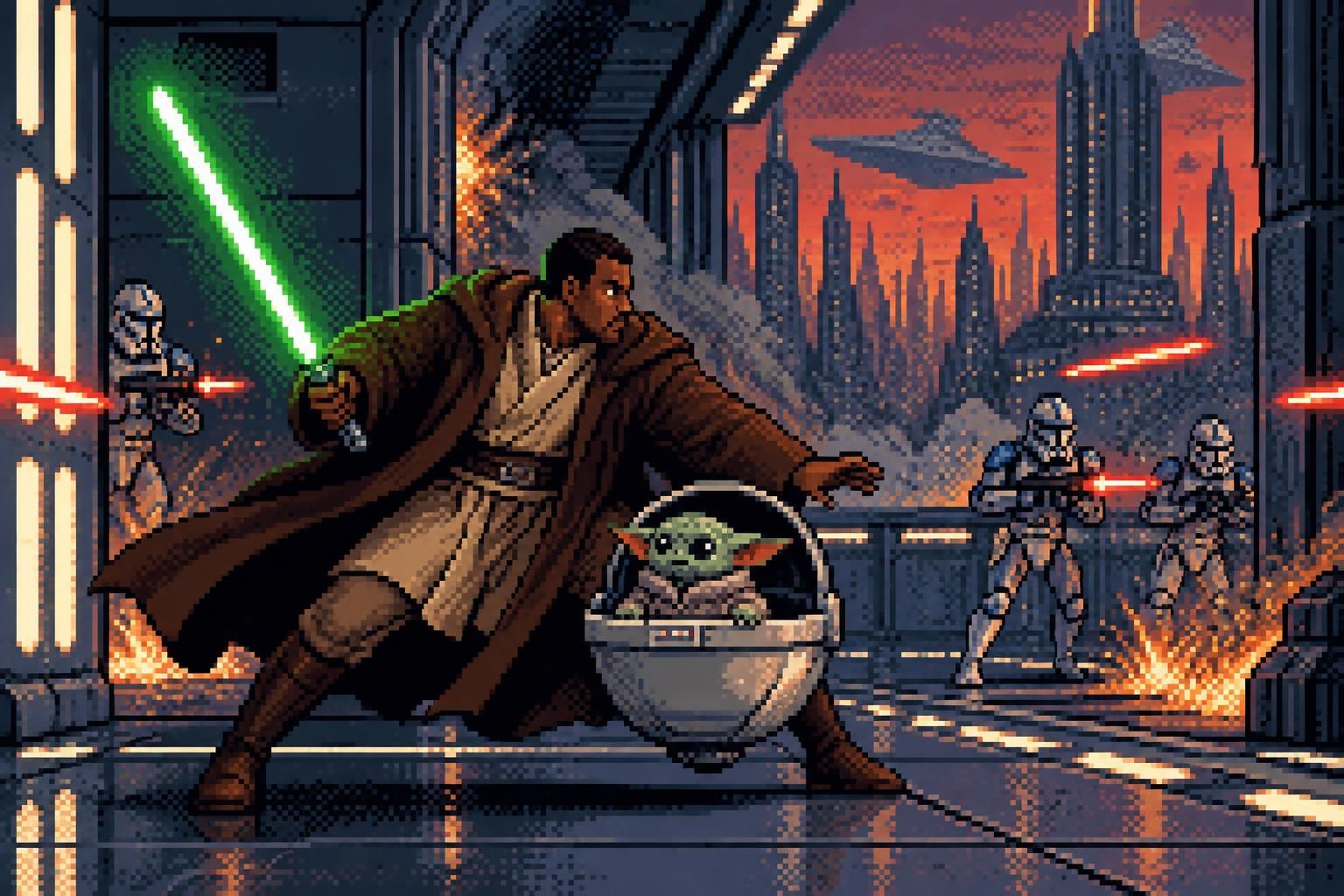
Kelleran Beq is the Jedi who carried Grogu out of the Jedi Temple during Order 66. I regard that distinction as more precise than calling him simply a survivor: his recorded achievement was not merely to escape a lethal assault, but to preserve a vulnerable child while enemy forces controlled the surrounding city.
The official Star Wars character profile identifies him as the “Sabered Hand,” a name associated with his skill as a warrior. His appearance in The Mandalorian gives you the clearest evidence of that skill under pressure, but it reveals only part of his history.
Kelleran Beq’s Star Wars Origins in Jedi Temple Challenge
Ahmed Best first portrayed Beq in Star Wars: Jedi Temple Challenge, a children’s game show released on the Star Wars Kids YouTube channel. As its Jedi host, he guided contestants through physical and mental trials and recognized their progress toward knighthood.
That setting matters because it established Beq as an instructor before viewers saw him fight through Coruscant. I would not treat the game show’s competitions as a literal record of Jedi Temple operations, but the character’s role is consistent with the patience and responsibility later associated with him in fictional stories.
Best also portrayed Jar Jar Binks in the Star Wars prequel films. The connection is a production fact rather than an in-universe relationship between the characters; nevertheless, it makes Beq’s later encounter with Jar Jar in comics a notable piece of casting history. You can examine the actor’s return through this account of Kelleran’s reveal.
I see a useful contrast in those two performances. Jar Jar’s public persona is conspicuous and unpredictable, while Beq’s conduct during the Temple attack is controlled and direct. The distinction concerns how each character operates, not a judgment that one form of behavior is inherently superior.
⚔️ The nickname “Sabered Hand” implies formidable blade work, but a title alone does not establish tactical competence. The more useful evidence is what Beq does with that ability: he clears a path, protects Grogu and leaves before the attackers can close every route.
To follow his mission, consider Grogu’s journey as a chain of custody. At each stage, a different person or group must keep the child moving; if any link fails, individual courage elsewhere may not compensate. The first link is the Temple community that knew how to care for younglings.
That community also gives the character a broader context. The Jedi Order’s customs joined martial discipline with teaching, meditation and service, so an instructor was not necessarily removed from danger or ignorant of it. Beq’s case shows you how those traditions could become operational assets when the Order itself came under attack.
Kelleran Beq and the Jedi Temple: Training Younglings During the Clone Wars
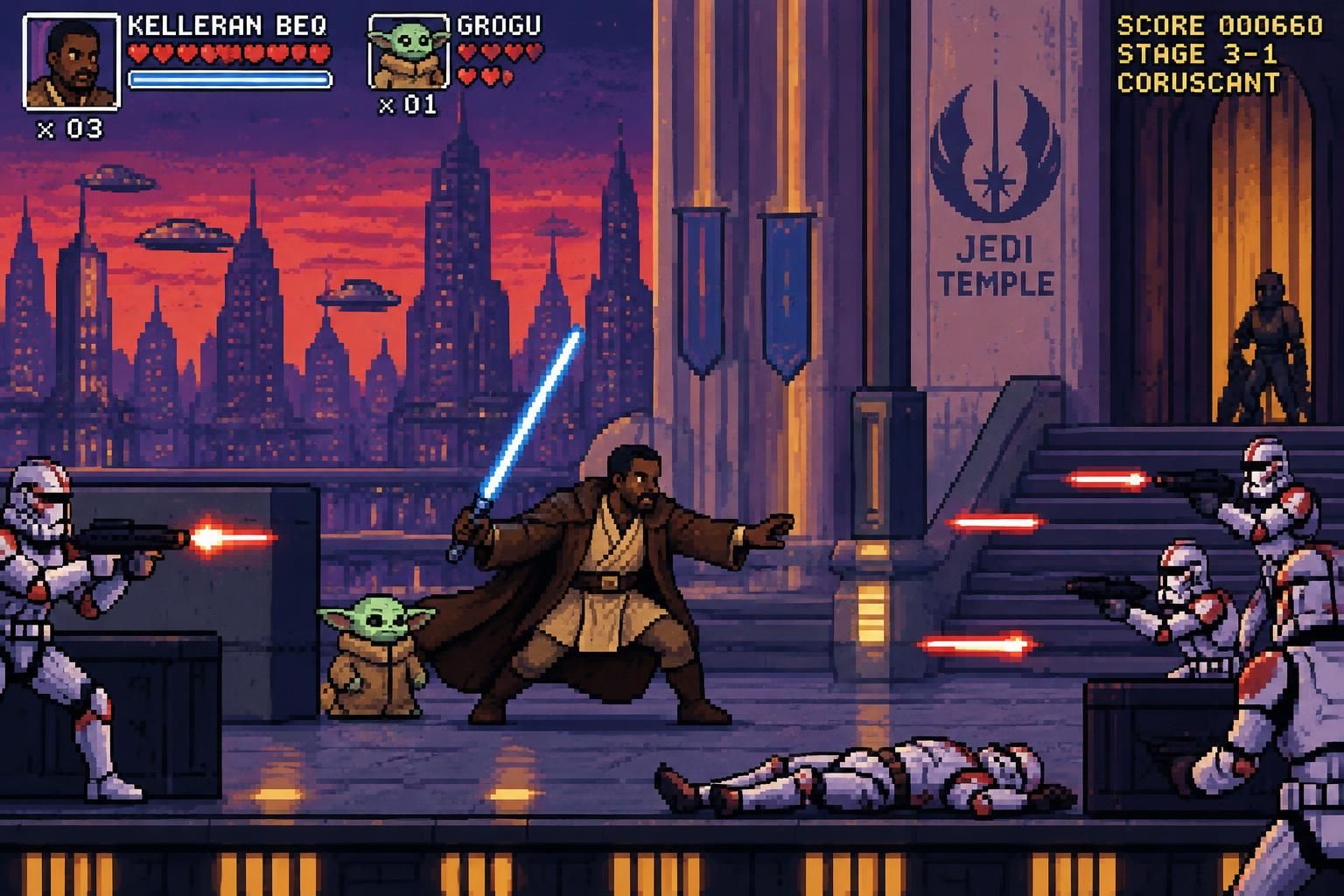
I would begin any assessment of Beq’s wartime role with a distinction: the available stories do not establish a long record of campaigns at the front. They do associate him with younglings and instruction at the Jedi Temple, a responsibility that served the Order even when it did not resemble a battlefield command.
The Clone Wars strained the Jedi’s institutions as well as their armies. Knights and Masters who might otherwise have taught or mediated disputes were drawn into military operations across the Republic. You can infer the administrative pressure on a Temple that still had children to educate while senior personnel were repeatedly sent away.
What Inquisitor: Rise of the Red Blade Reveals About Beq
In the novel Inquisitor: Rise of the Red Blade, set in part after the first Battle of Geonosis, Obi-Wan Kenobi asks Padawan Iskat Akaris to take younglings to the crèche for instruction associated with Beq. When she arrives, Beq is absent, so Iskat begins the session before he comes to take over.
The incident is limited evidence. It places Beq within the Temple’s instructional environment, but it does not explain every duty on his schedule or establish why he was delayed. I would avoid turning a short appearance into an invented biography.
It does, however, show that youngling care depended on more than one person. Iskat can begin the lesson, and Beq can assume responsibility when he arrives. That flexibility is valuable in an institution whose personnel must respond to changing demands; you should distinguish it from a formal evacuation plan, which the scene does not describe.
The Jedi’s educational culture also explains why protecting a child had significance beyond preserving one life. Younglings carried teachings, practices and relationships that could survive only if people did. I do not suggest that Grogu understood the Order’s entire tradition, merely that his survival kept open possibilities that his death would have closed.
Consider a hypothetical Temple coordinator tracing the custody chain. Before an emergency, that coordinator would need to know where children were, who could move them and which adults were authorized to assume care. During an attack, the same information becomes more valuable than a perfect account of ceremonial rank.
Beq’s experience around younglings would have made the presence of a frightened child a familiar responsibility rather than an unexpected burden. The stories do not document his particular relationship with Grogu before the purge, so you should not assume they were close. His conduct during the escape demonstrates a duty accepted in the moment, not a history the screen has confirmed.
The Jedi Temple’s architecture embodied the Order’s culture: a prominent, ceremonial center on Coruscant rather than a concealed military bunker. That visibility helped make the Jedi a public institution, but it also meant an attacker who seized the capital knew where to find many of its members.
Beq’s teaching background and the Temple’s exposed position therefore intersect at a critical point. Instruction created a responsibility to the next generation; the attack made moving that generation the immediate objective. His work beyond Coruscant shows a different expression of the same concern for vulnerable people.
Kelleran Beq and Jar Jar Binks: The Urubai Mission
Beq’s encounter with Jar Jar Binks during the Clone Wars provides a case study outside the Temple. In the Jar Jar comic, the Jedi draws the senator toward Urubai, where local people are being exploited while mining coaxium for the Republic. You can read more about the pairing in this discussion of Jar Jar and Kelleran.
I distinguish the mission’s political problem from its immediate security problem. Exploitation required attention from someone with influence in the Republic; a Jedi with a lightsaber could intervene locally, but a sustained response also depended on oversight beyond the site.
Why Beq Needed a Senator on Urubai
Jar Jar’s position gives him a route to political scrutiny that Beq cannot replace simply by defeating an opponent. Bringing a senator to the planet also makes the conditions harder to dismiss as an isolated report. The important decision is the choice of an ally whose authority fits the problem.
The mission becomes more complicated when engineer Mira Bridger is drawn into danger. Her work uses Urubai crystals to create a secure communications frequency, attracting bounty hunters Aurra Sing and Rum Sleg. Mira is also Ezra Bridger’s mother, connecting the episode to a family whose later story becomes significant in Star Wars Rebels and Ahsoka.
I would not assume the hunters’ arrival explains every aspect of the exploitation on Urubai. The immediate record supports a narrower finding: their pursuit threatens Mira and her invention while Beq and Jar Jar are already dealing with conditions on the planet. Two problems overlap, demanding protection and political action at the same time.
Beq and Binks escape with Mira, and Beq forces Aurra Sing off their ship during the pursuit. That action is a close-quarters response to a specific threat, not proof that he controls the broader situation. You should notice the objective remains the engineer’s survival and removal from danger.
There is a useful parallel with the later rescue of Grogu. In each case, Beq must move a vulnerable person while opponents can still interfere. The comparison has limits: Mira is an adult engineer with knowledge and agency, whereas Grogu is a young child dependent on others for transport and protection.
At the end of the Urubai episode, Jar Jar receives an oversight role intended to address the mistreatment, and Beq promises to check on the people himself. I see two complementary forms of follow-through: public responsibility through the senator and continued attention from the Jedi who raised the problem.
The story also complicates an easy reading of Republic culture during the war. The Republic’s stated values did not automatically prevent exploitation carried out in support of its needs. If you assess a government only by its symbols and declarations, you may miss the conditions under which its resources are obtained.
For the hypothetical coordinator following Beq’s later escape, Urubai offers a relevant lesson: identify both the person who must be protected and the institution capable of addressing the underlying problem. Successful extraction solves an immediate danger; accountable oversight addresses what allowed it to develop. The Temple attack would leave far less time to separate those tasks.
Order 66 at the Jedi Temple: How Grogu Reached Kelleran Beq
Order 66 transformed Clone Troopers from the Jedi’s military partners into attackers. At the Temple on Coruscant, that reversal created a severe problem for defenders: the soldiers approaching them possessed training, weapons and access developed while fighting alongside the Order.
Grogu’s memory of the assault appears in The Mandalorian Season 3, Episode 4, “The Foundling.” I treat the flashback as evidence of the events it depicts, not as a complete operational map of the Temple or a record of every person involved in the evacuation.
The Jedi Defenders’ Final Handoff
Several Jedi escort Grogu toward an elevator while Clone Troopers advance. The child is in his floating pram, which makes him movable without requiring him to keep pace on foot. The defenders send him away as they remain behind to confront the attackers.
That division of labor is decisive. If every defender had remained around the pram without enabling it to move, the group might have been trapped together; by sending Grogu onward, they create a chance for another protector to receive him. The scene does not tell you how much advance planning lay behind the handoff.
When the elevator opens, Beq is there. He fights the troopers near the landing platform and takes responsibility for the child. I would describe this as a transfer of custody under fire: the first group creates the opportunity, and Beq must exploit it before the attackers regain control of the exit.
The scene attributes Grogu’s survival to more than one Jedi. Calling Beq the rescuer is accurate because he takes the child through the next phase, but it should not erase the defenders who brought Grogu to him. Their names and full histories are not established by the flashback.
Why was the elevator so important? It separated the child’s movement from the immediate fight and delivered him to a new position. Yet it was also a confined route with predictable doors, so its value depended on someone being ready to act when it opened.
I would advise the hypothetical coordinator not to confuse that successful transfer with a demonstrated Temple-wide evacuation system. One child reaches one waiting Jedi; the episode does not establish how many comparable routes existed or how many others escaped. The known outcome is substantial without adding unsupported claims.
- 🚨 Threat: Clone Troopers attack the Temple with organized force.
- 🛡️ Initial protection: Jedi defenders bring Grogu to the elevator and hold off attackers.
- ⚔️ Transfer: Beq receives the child at the landing platform while fighting nearby troopers.
- 🏍️ Next objective: The pair must leave the Temple area before the attackers can contain them.
The attackers’ advantage was coordination and surprise; the defenders’ opportunity was a brief interval in which Grogu could still move. The custody chain held because protection and movement occurred together. Once Beq accepted that responsibility, his skill with two blades became a means of opening the next route.
Kelleran Beq’s Lightsabers and Fighting Style During Order 66
When you watch Beq meet Grogu, you see him use two single-bladed lightsabers: one green and one blue. The green blade is associated with him in the available stories; the screen does not establish where he obtained the blue weapon. A fallen Jedi is one possibility, not a confirmed explanation.
I separate the visible technique from claims about formal lightsaber styles. The scene shows Beq handling two weapons against Clone Troopers in a confined approach to a landing platform. It does not provide enough evidence to assign every movement to a named form or to reconstruct his entire training.
The Sabered Hand’s Priority: Create an Exit
Two blades can give a fighter more options for covering attacks and returning pressure, but they also require coordination and awareness. In the flashback, Beq’s actions are effective because they support a defined task: reach Grogu, survive the immediate encounter and move toward transport.
I see no reason to measure his success by the number of troopers defeated. A defender carrying a child into a prolonged engagement would increase exposure to reinforcements. The relevant measure is whether the route remains open long enough for the protected person to leave.
The Force belongs in that assessment as part of Jedi capability, but it should not become an explanation for every favorable outcome. Beq still needs physical access to Grogu, a vehicle and a destination. Extraordinary abilities do not remove the ordinary requirements of distance, timing and transport.
The Jedi’s lightsaber has cultural meaning as well as practical use. Its disciplined association with guardianship contrasts with the troopers’ standardized blasters and armor, symbols of a mass army. You can observe two different institutional traditions meeting at the landing platform: individual Jedi training against soldiers equipped to act collectively.
Neither tradition guarantees victory. Clone Troopers bring numbers, shared procedures and support; a Jedi brings mobility, close-combat skill and access to the Force. The local result depends on how those capabilities interact with the platform, the elevator and the need to protect a child.
Consider the coordinator’s immediate decisions after the elevator opens. First, identify Grogu’s location; second, prevent the nearest attackers from taking him; third, place him on transport. The screen shows Beq accomplishing those tasks, though it does not reveal every decision he made before the encounter.
A hypothetical alternative would be to prepare several protected exits before an assault, with independent transport available at each. That is a planning principle, not evidence that such a system existed at the Temple. Once Beq is on screen, the available choice is narrower: use the opening he has.
The “Sabered Hand” title is therefore best understood alongside the mission rather than apart from it. His blade work matters because it buys time and space for Grogu’s escape. The next test is whether that opening can survive pursuit through a city already under hostile control.
How Kelleran Beq Escaped Coruscant With Grogu
After leaving the platform, Beq takes Grogu onto a speeder and moves through Coruscant. Clone forces pursue them, including troops in Republic gunships. The change of environment matters: a fight at a fixed doorway becomes a chase through a densely built capital, where speed and route selection replace the elevator as immediate concerns.
I would not present the chase as evidence that Coruscant’s traffic alone guarantees concealment. The city offers obstacles, levels and possible approaches, but it also gives pursuing forces airspace from which to follow. You should assess the terrain as a mixture of opportunities and constraints.
Speeder Pursuit and the Cost of a Fixed Route
The speeder gives Beq a means of carrying Grogu quickly away from the Temple. Its advantage is mobility; its weakness is exposure. Neither rider has the protection of a fortified position, and the child remains dependent on Beq’s ability to keep the vehicle moving.
The gunships bring a different set of strengths. They carry armed personnel and can pursue through the air, but their presence does not automatically solve the problem of locating and stopping a smaller target among Coruscant’s structures. The scene shows a pursuit, not a detailed comparison of every vehicle’s performance.
I consider the intended destination as important as the maneuvers. Speed without a receiving point could merely delay capture. Beq is moving toward allies and a ship, turning a temporary escape from the Temple into a chance to leave the planet.
The sequence suggests preparation or coordination beyond a spontaneous sprint, because friendly personnel and transport are waiting. It does not reveal when the arrangement was made, who organized it or what communications preceded it. You can recognize the value of the network without inventing its history.
The hypothetical coordinator would monitor three changing conditions: whether Grogu remains secured on the vehicle, whether the pursuers can close the distance and whether the departure point is still accessible. Failure in any one category could cancel the benefit of success in the others.
A stronger defensive plan for future evacuations would avoid reliance on a single visible rendezvous and would protect the receiving team as carefully as the passenger. That recommendation follows from the observed danger; it is not a claim that Beq personally controlled all available resources during the purge.
Coruscant’s culture also shaped the chase. Its architecture concentrates political power, commerce and vast populations on one world, making the city a hub of movement and a place where control of infrastructure has strategic value. During the Republic’s collapse, those same connections could help fugitives move or help pursuers intercept them.
Beq and Grogu reach the next link in their custody chain: personnel associated with Naboo and a waiting vessel. The speeder succeeds as a bridge between two protected positions, not as a complete evacuation plan. At the landing site, the reliability of Beq’s allies becomes the decisive factor.
Naboo Allies and Kelleran Beq’s Escape Ship
Beq brings Grogu to a waiting Naboo vessel protected by friendly personnel. Their presence demonstrates that his rescue was not a solitary achievement. I distinguish their visible contribution from motives the episode does not explain: they assist the departure, but the flashback does not establish the complete political chain behind their involvement.
The ship’s design recalls the polished Naboo vessels associated with the prequel era. That visual connection is culturally useful: Naboo’s royal institutions and distinctive craft are recognizable across Star Wars. You should not, however, infer that Padmé Amidala personally arranged this particular extraction merely because the vessel resembles ships connected with her world.
What the Naboo Landing Site Contributed
A spacecraft changes the scale of the operation. The speeder can move Grogu across Coruscant, but a ship capable of hyperspace travel offers a route beyond the capital. The plan therefore depends on a transfer between vehicles and on enough time to board before hostile forces close in.
Clone Troopers attack the landing area, and the Naboo personnel resist while Beq moves Grogu toward the vessel. The defenders’ contribution is measured in time and access: they help keep the boarding point usable during the most vulnerable part of the transfer.
I would not describe the landing site as safe. It is a contested position that remains useful only while the defenders and passengers can act. For you as an observer, the difference matters: a rendezvous can be essential without being secure.
The comparison below separates what the sequence shows from what remains outside it. ⚠️ A clear boundary between evidence and interpretation prevents a successful escape from becoming an invented account of a larger conspiracy.
| Part of the escape | What is shown | What it establishes |
|---|---|---|
| 🛡️ Landing-site defenders | Friendly Naboo personnel resist the attackers. | Beq receives assistance beyond the Temple. |
| 🚀 Waiting vessel | Grogu and Beq board a Naboo ship. | They gain transport away from Coruscant. |
| ✨ Departure | The ship escapes and enters hyperspace. | The immediate extraction succeeds. |
| 📍 Later destination | The flashback does not identify it. | The next stage remains undisclosed. |
The ship’s departure does not tell you who survived at the landing site beyond those seen aboard, nor does it reveal the full price paid by the defenders. I would not turn their willingness to resist into proof of a wider Naboo policy. Their observable action is significant on its own.
For the coordinator tracing Grogu’s movement, the critical change is jurisdiction as well as distance. Once the ship leaves Coruscant, the immediate Temple assault can no longer determine the child’s fate by itself. Pursuit remains possible, but the flashback moves no further into that problem.
A future evacuation plan should protect its departure assets, provide alternatives and define who assumes responsibility after launch. Those are analytical lessons, not missing scenes. The visible network carried Grogu from a Temple elevator to hyperspace; the destination and subsequent custody are separate questions.
The episode’s reveal also gave audiences a new reason to revisit Beq’s earlier appearances. Coverage of Ahmed Best’s return places that reveal in the context of the actor’s Star Wars career.
What Happened to Kelleran Beq and Grogu After Order 66?
The flashback ends after Beq and Grogu escape Coruscant. It does not show where they land, how long they remain together or what ultimately happens to Beq. I would keep those questions separate from the confirmed fact that he survives long enough to leave the planet with the child.
Grogu appears decades later in The Mandalorian, where his protection becomes a central concern for Din Djarin. The period between the Temple escape and that later story contains substantial gaps. You should not fill them by assuming that Beq remained Grogu’s guardian throughout, or that he died soon after departure.
The Difference Between Evidence and a Plausible Future Story
Several routes are possible within the unexplained interval. Beq might have brought Grogu to another protector; the pair might have hidden together for a time; circumstances might have separated them. These are narrative possibilities, not events established by the escape sequence.
I use that distinction because an intelligence assessment becomes less useful when speculation is recorded as fact. The same discipline applies to the blue lightsaber, the Naboo allies’ orders and the destination of the ship. Each unknown has a boundary, and none needs to be resolved to understand the rescue shown on screen.
The Kelleran Beq character record can help readers trace appearances across different works. Individual entries should still be read alongside their sources, especially when a game show, a novel, a comic and a television flashback provide different kinds of information.
Beq’s earlier mission with Jar Jar offers one avenue for further storytelling because it places him in a wider wartime network. The discussion of the Jar Jar comic provides context for that partnership. It does not establish that Jar Jar took part in Grogu’s later escape.
The character’s teaching role offers another avenue. A story could examine how the Temple cared for younglings during the Clone Wars or how an instructor prepared children for a galaxy increasingly shaped by conflict. Such a story would need to distinguish what training could reasonably accomplish from the exceptional threat posed by Order 66.
For a military planner, the unanswered interval raises practical questions: where could a Jedi and child find shelter, which allies could be trusted, and how could communications avoid exposing them? The existing flashback does not answer those questions, so I present them as problems a later account might address.
There is also a cultural consequence to consider. Grogu survives the destruction of the institution that trained him, then grows up across a period in which Jedi practices and Mandalorian traditions both become relevant to his life. His survival preserves the possibility of those encounters; it does not make their eventual outcome predictable from Beq’s escape alone.
If you return to the custody chain, the last confirmed link in this episode is straightforward: Beq leaves Coruscant with Grogu aboard a Naboo vessel. Where that responsibility passed next remains a question for a future story.

I am Grand Admiral Thrawn, strategist of the Galactic Empire. Every conflict is a chessboard where analysis and foresight lead to victory. The art and culture of a people betray their weaknesses. The Empire embodies order and discipline in the face of rebel chaos. History will remember that only strategy ensures peace.