
Best Star Wars-Inspired CS2 Skins: Reading the Visual Language
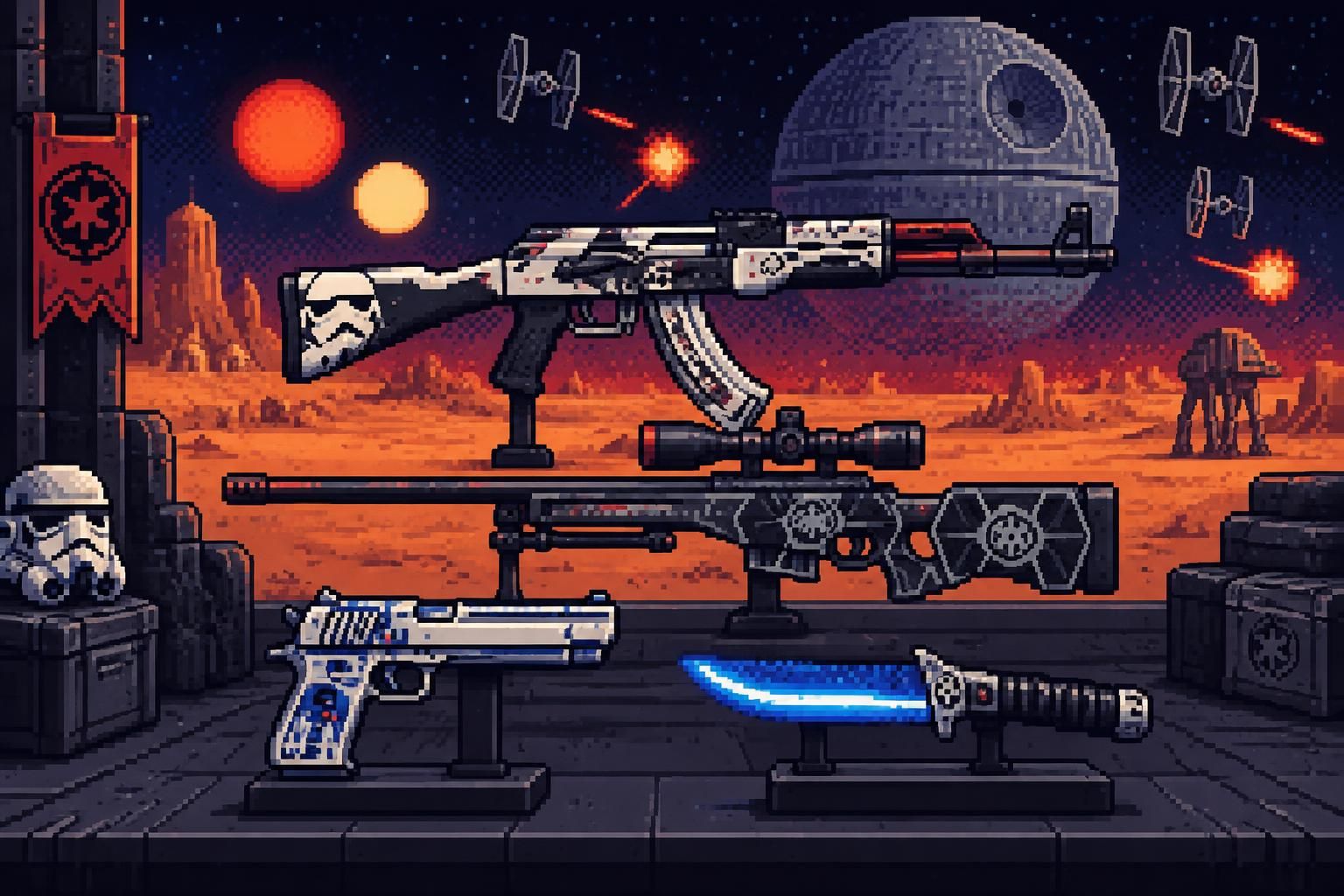
A weapon does not need a lightsaber blade or stormtrooper insignia to suggest a galaxy far, far away. I would begin your selection with a more useful question: does its design communicate the equipment, culture, or environment of a believable galactic civilization?
In Counter-Strike 2, the answer depends on visual evidence. Black-and-white finishes, disciplined geometry, weathered surfaces, cosmic colors, and controlled energy accents can suggest different corners of Star Wars without claiming an official connection.
Consider a fictional pilot named Veya, assembling an inventory before a series of matches. Veya’s first mistake would be to purchase every skin containing stars or bright colors. A collection built on that criterion alone might resemble an assortment of unrelated worlds rather than equipment chosen by one character.
I would ask Veya to identify a role first: Imperial officer, rebel operative, independent pilot, or explorer of forgotten systems. Each role implies different materials and priorities. Imperial equipment favors repeatable forms and visual order; an independent crew can plausibly combine repaired hardware, personal markings, and salvaged components.
These distinctions are not merely decorative. In Star Wars, a faction’s art and architecture reveal its approach to power. The Empire’s monumental structures emphasize hierarchy and uniformity, while Rebel Alliance equipment often reflects adaptation under material constraints. You can use that same distinction to decide whether a polished finish or an irregular, expressive design belongs in your inventory.
How to Evaluate a Galactic CS2 Loadout
I assess each candidate on four axes: palette, surface, silhouette, and narrative. Palette establishes allegiance; surface suggests whether the weapon is issued, maintained, or improvised; silhouette determines whether its identity remains legible; narrative explains why the object would belong to its imagined owner.
- ⚪ Imperial order: white, black, and restrained highlights suggest standardized equipment.
- 🛰️ Deep-space exploration: dark blues, cosmic imagery, and isolated figures suggest missions beyond familiar routes.
- 🟢 Rebel improvisation: vivid accents and irregular expression fit a less uniform force.
- 🔴 Dark-side mystery: severe contrast and unsettling motifs evoke secrecy rather than conventional military polish.
These categories are analytical tools, not rules imposed by the game. A finish may serve several roles if its surrounding equipment establishes the intended context. The same dark pistol, for example, can suggest an Imperial specialist beside white armor-like rifles or a clandestine operative beside more ominous designs.
Your choices also remain cosmetic. A skin does not change a weapon’s damage, accuracy, recoil, or team restrictions. I would therefore select guns you already use, then apply the theme to those choices rather than allowing an attractive finish to dictate your tactics.
For a wider view of the available imagery, compare this approach with the space-themed skins selected by CS.MONEY. Their cosmic emphasis is useful, but a Star Wars-inspired inventory can also draw on military restraint and the appearance of lived-in technology.
Key observation: the strongest theme begins with a coherent visual doctrine, not with the greatest number of stars. That doctrine becomes especially clear when the first test is a pair of disciplined Imperial-style weapons.
Printstream CS2 Skins: Imperial Precision in Black and White
When Veya needs a disciplined military identity, I would place USP-S | Printstream and M4A1-S | Printstream at the center of the assessment. Their black-and-white contrast recalls the visual order associated with Imperial armor and spacecraft interiors, while their pearlescent treatment adds a refined technological quality.
The comparison is aesthetic, not literal. These are Counter-Strike finishes, not licensed Imperial weapons. Their value for your theme lies in how consistently their surfaces communicate a cold, manufactured appearance.
Observe the difference between a weapon that is merely white and one that uses contrast deliberately. Printstream separates light panels from darker areas, preserving the recognizable form of the firearm while making its finish feel engineered. That balance matters: if every surface competes for attention, the equipment can look ornamental rather than issued.
The USP-S suits Veya’s imagined officer particularly well. Its compact silhouette suggests a sidearm carried as part of a formal assignment rather than assembled from scavenged parts. The M4A1-S extends that same visual language to a rifle, allowing the pistol and primary weapon to appear related without requiring identical detailing.
Building an Imperial CS2 Inventory Around Printstream
I would establish a hierarchy before selecting anything else. The rifle and pistol form the visual core; supporting equipment should reinforce their contrast instead of introducing a competing palette. A black or restrained neutral finish can frame the brighter pieces without demanding equal attention.
You should also inspect the specific item before purchasing it. Wear can change the visible finish, and lighting can affect how pearlescent highlights appear. Two listings with the same skin name and wear category may not present identically enough for a collector seeking a precise look.
Veya’s second mistake would be to assume that every expensive-looking object improves the unit. If one accessory introduces a saturated, unrelated color, it may pull attention away from the controlled black-and-white scheme. In a disciplined loadout, the visual relationship between pieces matters more than the prominence of any single item.
There is a practical constraint as well. The M4A1-S is a Counter-Terrorist rifle, and the USP-S is a Counter-Terrorist sidearm choice. If you want the same identity across both teams, you will need separate Terrorist-side weapons that complement the scheme rather than expecting those two guns to cover every round.
That limitation resembles a logistical problem: equipment must match the assignment, not just the parade ground. You can preserve the palette on the opposite side with suitable black, white, or understated finishes, even if their exact surface treatment differs.
For another perspective on assembling matching equipment, examine the space inventory ideas from BitSkins. I would use such examples as references rather than instructions: your preferred weapons and visual priorities remain the controlling factors.
⚪ Key observation: Printstream succeeds because its contrast feels systematic. Once your military core is established, a darker deep-space rifle can add a story without confusing the chain of visual command.
M4A4 Desolate Space: A CS2 Skin for the Aftermath of Interstellar War
M4A4 | Desolate Space addresses a different problem from Printstream. It does not present equipment as a polished emblem of authority; it presents an image of isolation. Its astronaut imagery and dark space palette suggest a story taking place after communication, rescue, or command has failed.
I would assign this rifle to Veya after a failed reconnaissance mission rather than during a formal Imperial inspection. That distinction gives the skin a role. It is not simply a weapon with stars painted on it; it is a visual record of exposure to a hostile environment.
Star Wars frequently contrasts enormous military machines with the vulnerability of individuals inside them. A damaged spacecraft or abandoned outpost can reveal more about a conflict than a pristine fleet formation. Desolate Space draws on a similar contrast: the human figure matters precisely because the surrounding darkness offers so little protection.
For your inventory, that narrative has consequences. Pairing the M4A4 with several equally busy illustrations may weaken its effect, because each finish competes to tell a separate story. A quieter pistol or a dark supporting weapon can give the rifle room to function as the central image.
Comparing Desolate Space With Imperial Hardware
Printstream and Desolate Space can coexist, but they do not communicate the same assignment. One suggests a controlled manufacturing system; the other suggests the uncertainty of an expedition. If you combine them, the relationship needs an explanation in your chosen character: perhaps Veya carries a standard-issue sidearm but uses a rifle marked by a distant mission.
There is also a concrete loadout decision. The M4A4 and M4A1-S occupy different rifle choices for the Counter-Terrorist side. You can include both in a broader collection, but your in-game equipment choices determine which are available to buy during a match. I would not confuse visual ownership with tactical availability.
Before buying, inspect the astronaut and surrounding artwork at the condition you intend to use. Wear can change how much of the image remains prominent. If the figure is the reason you selected the skin, its visibility matters more than a condition label considered in isolation.
What does an opponent gain from seeing the design? Nothing mechanical: the finish does not improve the rifle. What do you gain? A coherent identity that can make a familiar weapon feel connected to a larger fictional setting.
I would also distinguish deep-space imagery from a literal Star Wars replica. Desolate Space works because its isolation and exploration themes are compatible with that universe, not because it depicts a named ship or established battle. You preserve the interpretation by keeping that distinction clear.
The cosmic skin selections at SIH offer other ways to study space imagery. Compare their colors and subjects against your central rifle before adding them; shared stars alone do not guarantee a shared story.
🛰️ Key observation: a convincing space theme can depict the consequences of a mission rather than the machinery that began it. For a more unsettling expedition, the next choice turns from the void toward the unknown.
AWP Acheron: A Dark Cosmic CS2 Skin for Forgotten Worlds
AWP | Acheron belongs in an inventory that treats the galaxy as dangerous and partially understood. Its name draws on a river associated with the Greek underworld, while its unsettling visual character gives Veya an alternative to the clean order of Imperial equipment.
I would not describe it as an official Sith artifact or claim that its pattern depicts a specific Star Wars location. Its usefulness is interpretive: the finish can suggest a weapon carried into a ruined temple, an isolated research facility, or a region where ordinary navigation has failed.
That distinction matters because the fictional galaxy contains more than armies and spacecraft. Ancient architecture, ritual objects, and the art of distinct peoples often indicate beliefs that outlast individual governments. A skin with an eerie appearance can represent that older cultural layer without needing a recognizable symbol.
For Veya, the operational question is whether the AWP should be the centerpiece or an accent. As a centerpiece, it can justify a darker inventory with restrained supporting finishes. As an accent, it can introduce one unfamiliar element into an otherwise orderly collection, suggesting an artifact recovered during an expedition.
Using Contrast Without Losing Loadout Cohesion
I would limit the number of competing motifs around Acheron. If every weapon suggests a different temple, planet, or creature, the result becomes difficult to read. Choose one dominant idea—an expedition into unknown territory—and let the remaining pieces support it through compatible colors or subdued surfaces.
The AWP also creates a different tactical consideration from a sidearm or rifle. Both teams can use it, subject to the game’s economy and the player’s loadout choices, but its cost and role make it a situational purchase. You should not build an entire visual identity around a weapon you rarely choose unless collecting is the primary objective.
Suppose Veya plays several rounds without enough credits for an AWP. A matching pistol and a suitable alternative primary weapon keep the theme visible while preserving the team’s economic plan. The design strategy therefore supports actual play instead of requiring an expensive purchase every round.
Condition remains worth examining. Inspect the exact item under representative lighting and look for the details that attracted you to it. A listing image is an initial report, not a substitute for evaluating the finish you will see in play.
There is a further advantage to a darker visual scheme: it can accommodate different fictional affiliations. Veya might be an Imperial intelligence officer, an independent scout, or a researcher seeking a lost archive. The common factor is not allegiance but the decision to approach uncertainty with preparation.
I would resist adding bright effects merely to make the theme more obvious. Star Wars also uses shadow, negative space, and restrained design to establish danger. A weapon can suggest the dark side through atmosphere without displaying a red lightsaber or claiming supernatural properties.
🔴 Key observation: mystery is most effective when the surrounding equipment supplies context. A single unsettling rifle can broaden your galactic narrative; a carefully selected sidearm can then define who is carrying it.
USP-S Ticket to Hell: A Stealthy Sidearm for a Dark-Side CS2 Loadout
USP-S | Ticket to Hell offers Veya a compact alternative to the pristine appearance of Printstream. Its dark body and pale graphic markings create a stark, severe contrast. I would use it to suggest a clandestine operative or a character associated with forbidden knowledge, not as a literal reproduction of Sith equipment.
The choice demonstrates an important distinction. A dark-side theme does not require every surface to be red and black. In Star Wars, authority and menace can be communicated through controlled form, masks, symbols, and architecture as effectively as through color alone.
Ticket to Hell’s graphic character gives the sidearm a more confrontational identity than the orderly finish of Printstream. Beside Acheron, it supports an expedition into dangerous territory. Beside a clean military rifle, it suggests an operative whose personal equipment differs from standard issue.
Matching a Dark CS2 Pistol to Your Character
I would begin by deciding whether Veya’s equipment is institutional or personal. If the character serves a disciplined organization, the pistol can be the single unusual detail in an otherwise restrained kit. If Veya is an independent investigator, the same finish can anchor a collection of darker, more individual pieces.
That decision prevents a common failure: adding ominous designs solely because each one looks dramatic. Different motifs can undermine one another if they imply unrelated stories. A controlled selection makes the sidearm’s markings more meaningful because the rest of the inventory gives them a setting.
You should also account for the USP-S’s place in the game. It is a Counter-Terrorist sidearm option, so a cross-team theme requires a separate choice for the Terrorist side. Veya’s identity can remain consistent without demanding that both pistols carry the same finish.
Compare the specific skin’s appearance at the condition you intend to buy. A darker finish may respond differently to wear and lighting than a bright, clean surface. If the contrast between its body and markings is the feature you value, inspect that contrast directly rather than relying on the item name.
A useful test is to view the pistol beside your preferred primary weapon. Does it reinforce the same character, or does it introduce an unrelated visual language? The answer is more valuable than any claim that one finish is universally the best.
I would also separate atmosphere from performance. A sinister appearance cannot make the USP-S quieter than its standard behavior, improve its accuracy, or alter its ammunition. Your tactical decisions still depend on the weapon’s established characteristics and the circumstances of the round.
Veya can therefore carry a dark sidearm without abandoning discipline. The fictional narrative supplies an identity; the game supplies the constraints. A good inventory respects both rather than treating the theme as an excuse to ignore the match.
⚫ Key observation: a compact weapon can communicate allegiance through contrast and markings alone. The next set of choices moves in the opposite direction, using vivid technological color to suggest a less regulated society.
ZX Spectron and Neon Revolution: Futuristic CS2 Skins for Rebels and Smugglers
FAMAS | ZX Spectron and AK-47 | Neon Revolution give Veya a route away from Imperial uniformity. Their brighter treatments suggest technology and personal expression rather than standardized military issue, making them useful for a rebel, pilot, or independent operator.
ZX Spectron draws on the appearance of older gaming computers, with a dark base and multicolored accents. That origin is not Star Wars lore, but the result can still evoke a stylized futuristic device: a machine whose interface and casing are designed to be noticed rather than hidden.
Neon Revolution takes a more unruly approach, using conspicuous pink and green elements. I would associate that energy with a character who modifies equipment to declare independence. It is not an official Rebel Alliance design, and its exact contemporary aesthetic differs from much of the original trilogy’s worn hardware.
Why include it, then? Because Star Wars encompasses crowded city districts, distinctive alien cultures, and individual operators as well as military formations. A vivid finish can suggest life outside the Empire’s controlled visual system, provided the surrounding loadout gives it an appropriate setting.
Controlling Color in a Rebel-Style Inventory
I would give Veya one dominant bright weapon and quieter supporting pieces. If the AK-47 supplies the neon statement, a restrained sidearm can keep the result readable. If ZX Spectron is the focus, choose companions that echo one accent or its dark base rather than reproducing every color available.
Team restrictions make these two skins useful examples of planning across a match. The FAMAS is a Counter-Terrorist rifle, while the AK-47 is a Terrorist rifle. You can connect both sides through a shared character concept, but you will not buy either weapon interchangeably on the same side.
Their in-game roles also differ. A coherent theme does not eliminate differences in price, handling, or team economy. Veya should choose a weapon because it suits the round, then enjoy the finish as part of the character’s presentation.
For a fictional case, imagine Veya as a courier moving through an industrial port. The FAMAS might represent equipment acquired through a security contract; the AK-47 might represent a more conspicuous personal weapon. Their shared technological character links them, while the difference in color tells you that the courier does not belong to a single uniformed force.
That narrative remains plausible only if every other choice does not compete for attention. A holographic-looking accent may work, but several unrelated bright finishes can turn a focused theme into visual noise. I would add color in measured steps and inspect the full loadout after each addition.
The futuristic CS2 skin choices discussed by Starburst provide a useful comparison between cinematic technology and simple brightness. You can use that distinction to decide whether an item looks like equipment from a world or merely a decorative effect.
🟢 Key observation: rebellion is not the absence of design discipline. A vivid centerpiece is most persuasive when the rest of the inventory gives it a purpose; a more mythic finish can supply an entirely different kind of energy.
MP9 Starlight Protector: A Mythic CS2 Skin Beyond Military Science Fiction
MP9 | Starlight Protector expands Veya’s options beyond soldiers, spacecraft, and industrial machinery. Its bright, ornate presentation and unicorn imagery create a celestial, mythic impression rather than the appearance of standard military hardware.
I would not mistake that imagery for an established Star Wars creature or artifact. Its relevance is broader: the galaxy contains cultures whose art expresses spiritual belief, ceremonial status, and relationships with extraordinary natural forces. Starlight Protector can represent that mythic layer in a CS2 inventory.
The distinction matters when you choose supporting finishes. A clean white weapon may connect with its luminous appearance, while a heavily industrial or aggressively graphic piece may create a different story. Neither pairing is automatically wrong, but each changes the character you are presenting.
Suppose Veya is no longer imagined as a military pilot but as a traveler carrying an object associated with a distant culture. The MP9 becomes a ceremonial or symbolic centerpiece. A restrained companion weapon then lets its ornamentation stand apart, rather than forcing every item to make the same statement.
Where a Celestial MP9 Fits in a CS2 Loadout
The MP9 is a Counter-Terrorist submachine gun, so its presence in a themed collection should correspond to your actual equipment choices. It may appear in rounds where a lighter purchase supports the team’s economy. It will not replace a rifle’s role simply because its artwork suits your preferred narrative.
I would inspect how the bright areas and detailed imagery appear at the item’s condition before committing to a purchase. A ceremonial concept depends on visible decoration; if the specific finish no longer communicates the detail you wanted, the narrative loses its main evidence.
There is also a useful contrast with Acheron. Both can suggest something beyond ordinary military equipment, but they do so through different visual arguments. Acheron implies danger or the unknown; Starlight Protector suggests a more luminous, fantastical tradition. Your supporting pieces should reflect which story you intend to tell.
Can both appear in the same collection? Yes, if Veya’s story accommodates them: an explorer might encounter both a revered cultural object and a threatening ruin. I would nevertheless avoid presenting them as a uniform set. Their contrast is the point, and a neutral supporting palette can preserve it.
Consider also how cultural reference can enrich a theme without becoming a direct copy. Star Wars often establishes a place through shapes, clothing, architecture, and ceremonial objects before explaining its history. You can use a similar method: select finishes that imply a culture through consistent visual choices rather than relying on faction names.
The result remains an interpretation created by the player. The MP9 does not carry magical properties, and its finish does not alter its statistics. Its contribution is to make Veya’s equipment suggest a wider world than the match itself depicts.
✨ Key observation: a galactic inventory can include myth as well as machinery. Once each candidate has a defined role, the remaining task is to compare the complete selection under practical constraints.
Build a Star Wars-Style CS2 Loadout: Comparison, Wear, and Buying Discipline
I would give Veya a final equipment report before any purchase. The objective is not to acquire every recommended finish; it is to identify which pieces serve the chosen character, fit the weapons used in play, and remain coherent when viewed together.
| CS2 skin | Galactic interpretation | Practical consideration |
|---|---|---|
| ⚪ USP-S | Printstream | Disciplined Imperial-style sidearm | Counter-Terrorist pistol choice |
| ⚪ M4A1-S | Printstream | Clean, standardized sci-fi rifle | Counter-Terrorist rifle choice |
| 🛰️ M4A4 | Desolate Space | Evidence of an isolated space mission | Alternative Counter-Terrorist rifle |
| 🌑 AWP | Acheron | Unsettling expedition into unknown territory | Available to both teams; costly in a match |
| 🖥️ FAMAS | ZX Spectron | Retro-futuristic independent technology | Counter-Terrorist rifle |
| ⚫ USP-S | Ticket to Hell | Severe, clandestine sidearm | Counter-Terrorist pistol choice |
| 🟢 AK-47 | Neon Revolution | Expressive rebel or outlaw equipment | Terrorist rifle |
| ✨ MP9 | Starlight Protector | Celestial, mythic focal point | Counter-Terrorist submachine gun |
The table identifies roles, not rankings. Veya might select both Printstream weapons for an orderly Counter-Terrorist identity, then choose a complementary Terrorist-side rifle. Another player might instead make Desolate Space the centerpiece and use a darker sidearm to support an exploration narrative.
Inspecting and Comparing Your Sci-Fi CS2 Skins
I would inspect each actual listing for condition, appearance, and total cost before deciding. Wear categories provide useful labels, but the visible result is what matters to your design. Compare the specific items you can obtain, particularly when a skin’s artwork or clean surface is central to your choice.
Prices and availability change, so a fixed claim about the cheapest marketplace would be poor intelligence. Compare current listings, fees, payment options, and the platform’s relevant trading terms. If you examine LIS-SKINS or another marketplace, apply the same checks rather than assuming that popularity guarantees the best outcome.
Veya’s purchasing sequence should also follow use. First, identify the weapons selected most often. Second, set a budget for those slots. Third, add occasional weapons only if the remaining funds and the intended theme justify them. This prevents a collection of attractive items from leaving the most frequently used equipment visually disconnected.
When comparing external ideas, the space and galaxy skin guide from SellYourSkins offers a broader range of celestial approaches. Treat it as reconnaissance: useful for finding candidates, but not a substitute for inspecting individual items or defining your own character.
Finally, consider the distinction between visual cohesion and exact duplication. A pilot’s equipment can contain one unexpected artifact; an Imperial-style collection can include a subdued expedition rifle. What matters is that you can explain why each piece belongs to Veya and how it relates to the others.
🎯 Key observation: the soundest acquisition is the one that serves both your imagined galactic role and the weapons you actually use. A deliberate loadout makes every purchase part of the same operational plan.

I am Grand Admiral Thrawn, strategist of the Galactic Empire. Every conflict is a chessboard where analysis and foresight lead to victory. The art and culture of a people betray their weaknesses. The Empire embodies order and discipline in the face of rebel chaos. History will remember that only strategy ensures peace.