
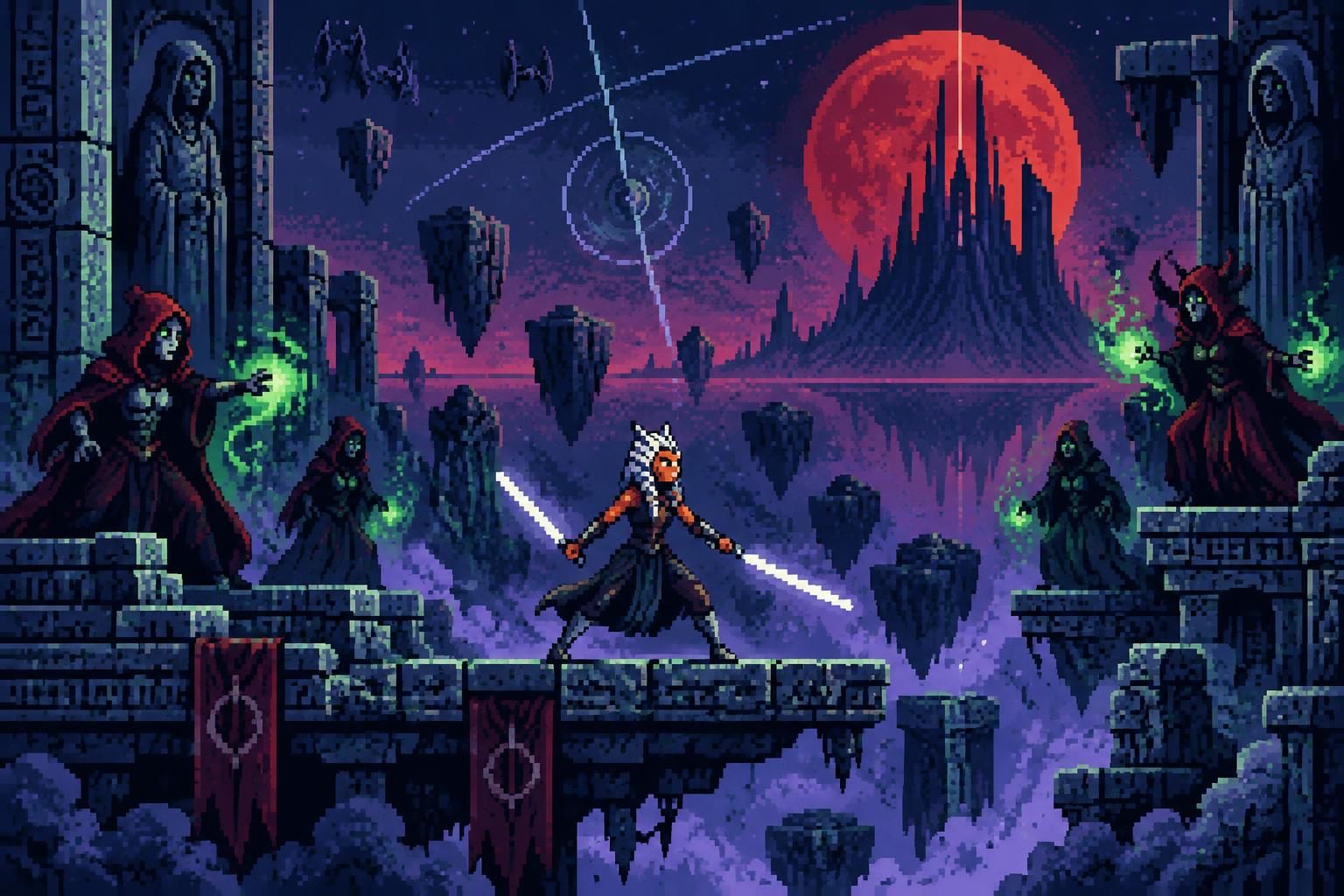
Ahsoka Season 2: Dave Filoni’s Nightsister Tease Changes the Strategic Picture
I read the reported comments from Dave Filoni as a change in the threat assessment, not merely a promise of stranger scenery. For you, the important distinction is that Ahsoka Season 2 appears positioned to connect supernatural capability with military consequence: the occult is no longer confined to an isolated encounter beyond the familiar galaxy.
The first season established the practical foundations. The Great Mothers assisted an Imperial commander stranded on Peridea, their powers helped locate an infiltrator, and reanimated soldiers complicated an otherwise recognizable extraction operation.
I separate those demonstrated abilities from the larger possibilities now circulating around the next chapter. A dangerous alliance already exists on screen; its full reach, command arrangements, and long-term objectives remain matters the continuing story must establish.
That distinction matters because promotional discussion can collapse three different categories into one: what happened, what a creator has suggested, and what an audience has inferred. You gain a more reliable understanding when each category retains its own evidentiary weight.
Dave Filoni’s Force Mythology Tease Requires a Revised Threat Assessment
The supplied account of Filoni’s Empire interview describes an intention to balance conventional conflict with more unusual supernatural material. I interpret that division as a structural decision: one theater can examine fleets, institutions, and contested authority while another investigates phenomena that ordinary military doctrine cannot adequately explain.
You can follow the reported remarks through coverage of Filoni’s discussion of Nightsisters and stranger mythology. The useful question is not whether the series will become less recognizably Star Wars, but whether its competing modes will produce consequences for one another.
I also reject a contradiction in the supplied synopsis: an Imperial restoration campaign would not ordinarily employ these allies “against the Empire.” The coherent strategic reading is that their abilities could support an Imperial resurgence against its opponents, unless the story explicitly establishes betrayal or a separate conflict.
This correction changes your assessment of the danger. The principal risk is not an isolated coven threatening a battlefield; it is an existing military apparatus acquiring methods its adversaries have neither classified nor countered.
Consider the difference between a transport carrying conventional reinforcements and one carrying personnel who can restore fallen defenders to movement. The hull may be identical, but boarding procedures, casualty assumptions, and containment requirements become substantially different.
I would therefore place identification ahead of engagement. A captain who recognizes an unfamiliar green manifestation as a repeatable enemy capability has already made a more useful observation than an officer who dismisses the same event as superstition.
For a continuing example, I will use Mira Lanes, a hypothetical New Republic intelligence analyst, rather than present an invented character as established canon. Her assignment is straightforward: convert Ezra Bridger’s extraordinary testimony into recommendations a skeptical command can actually execute.
Her first report should not announce that every legend has become operational fact. It should identify observed effects, distinguish firsthand testimony from interpretation, and state which assumptions would place personnel at avoidable risk.
I would ask you to apply the same discipline to entertainment reporting. A photograph can establish that a prop exists; an interview can establish a creative intention; neither alone establishes the complete plot or the exact mechanics of an unseen power.
The strategic opening is therefore precise: an opponent becomes more dangerous when familiar resources conceal unfamiliar capabilities. Before examining the temples and symbols behind those capabilities, the analysis must establish how the alliance itself distributes power.
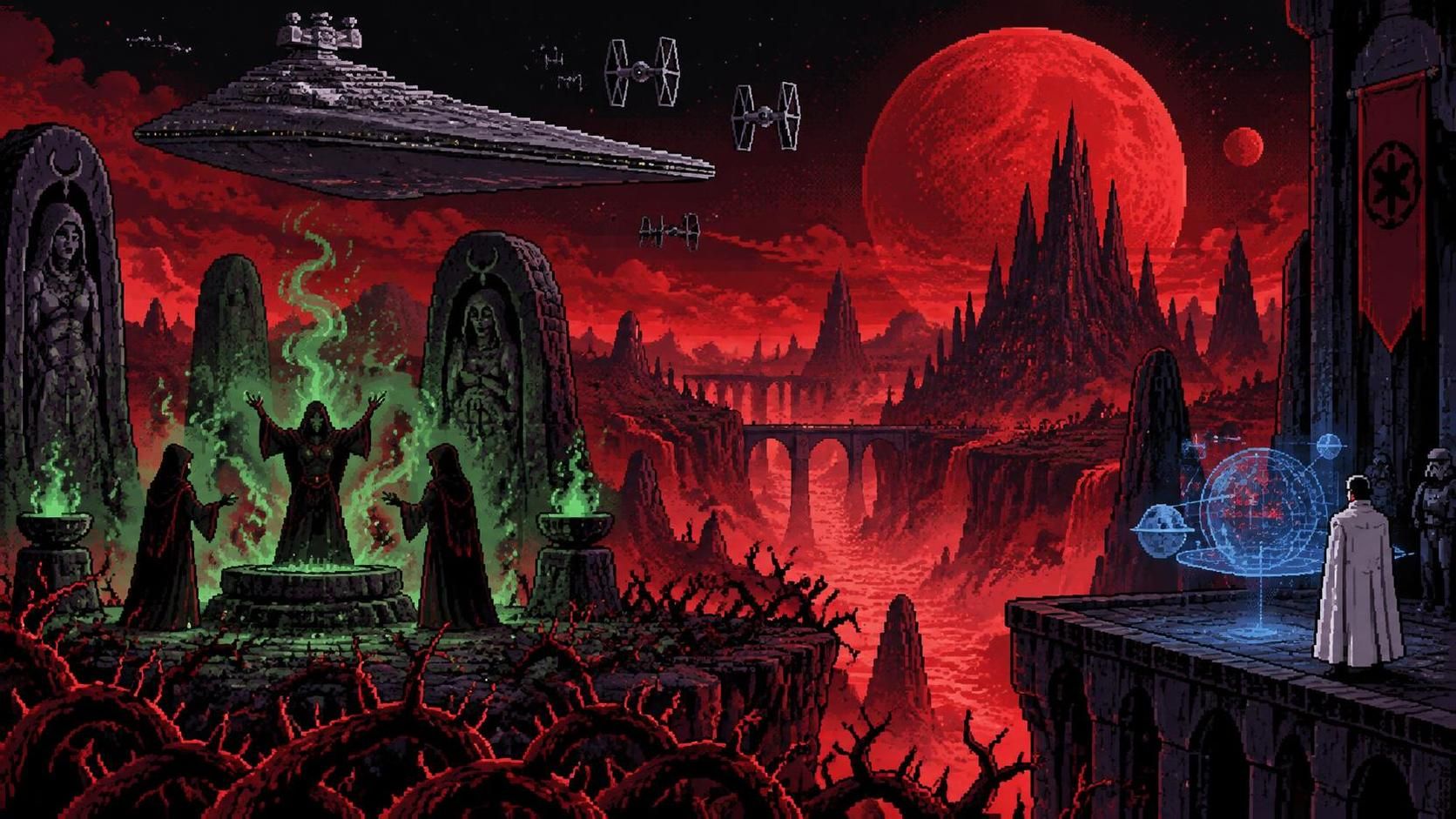
Ahsoka Season 2 and the Nightsisters: An Alliance Built on Unequal Knowledge
I assess the Nightsisters as allies whose value derives partly from the difficulty of replacing them. A starship commander can requisition additional ammunition; obtaining another practitioner with comparable knowledge, loyalties, and ritual competence is a different problem.
That asymmetry gives the relationship strategic depth. Imperial forces provide transportation, protection, industrial capacity, and access to contested territory, while the Great Mothers contribute abilities that conventional officers cannot independently reproduce.
You should not confuse mutual usefulness with shared purpose. The first season showed cooperation, but cooperation alone does not prove that every participant seeks the same political settlement or intends the relationship to remain permanent.
I would examine what each party can withhold. A military commander controls deployment and logistical priorities; an occult specialist may control information about a ritual, its prerequisites, or the true significance of a location.
Why Nightsister Dark Magic Creates Command Vulnerabilities
The practical difficulty with dark magic is not simply that it violates an opponent’s expectations. It can also create uncertainty inside the force employing it, particularly when the chain of command depends on expertise concentrated in a small, autonomous group.
In the extraction from Peridea, reanimation gave defenders additional utility after apparent defeat. I read that as a temporary tactical advantage, not evidence that casualties, physical damage, or resource limits have ceased to matter.
You still need to know what sustains the effect. Does it require proximity, preparation, a specific practitioner, or some other condition? The series has not supplied a universal technical manual, and analysis should not manufacture one.
For Mira Lanes, this becomes a collection problem. Rather than writing “the enemy cannot die,” she should record the sequence of events, the visible ritual intervention, and the circumstances under which the reanimated troops were finally neutralized.
I would build her assessment around four questions, each tied to a decision rather than an abstract curiosity:
- 🔎 Dependency: Which observable conditions accompany the ability, and what happens when those conditions change?
- ⚔️ Battlefield effect: Does the phenomenon improve detection, endurance, mobility, deception, or some combination of these?
- 🛡️ Countermeasure: Which response has actually worked, rather than merely sounding plausible?
- 🎯 Political objective: What does the allied group receive that explains its continued cooperation?
Those questions prevent a common intelligence failure: treating an unfamiliar adversary as either omnipotent or irrelevant. Both errors remove the need for investigation, and both leave commanders dependent on assumptions.
I also examine cultural evidence. Ritual arrangements, funerary practices, and the treatment of ancestral spaces can reveal what an organization preserves, fears losing, or considers negotiable, although none of those observations justifies reducing every member to a single predictable response.
A mural, for example, may identify a sacred relationship without providing a battle plan. Its operational value emerges only when the interpretation is tested against movement, resource allocation, and repeated behavior.
The alliance also creates a bargaining problem after success. Once transportation has delivered one partner to a desired destination, the original balance of dependence may weaken; an agreement useful during exile may require new incentives after arrival.
I would therefore watch negotiations as closely as combat. A withheld explanation, an independent deployment, or a disputed destination could reveal more about the arrangement’s durability than another display of supernatural force.
For you, this makes the partnership more interesting than a simple escalation in enemy strength. The decisive vulnerability may lie between the allies, where military authority meets knowledge it cannot command outright.
Dathomir in Ahsoka Season 2: Terrain, Culture, and the Architecture of Fear
I treat Dathomir as more than a location associated with witches. Its landscapes, ruins, and ritual spaces can communicate how a society organizes danger, memory, and belonging before a character explains any of those subjects aloud.
In the supplied account, Filoni describes a live-action environment crowded with thorns and fog. His comparisons to mythic forests and hostile fairy-tale landscapes indicate a visual intention: the setting should resist the visitor rather than function as a neutral backdrop.
You can understand that intention without mistaking production design for a confirmed plot mechanism. A threatening branch establishes physical obstruction; it does not, by itself, prove that the forest possesses awareness or that every patch of mist carries enchantment.
I distinguish these levels because effective fantasy benefits from material credibility. If characters must slow down, lose visibility, and negotiate narrow approaches, the environment already generates pressure before any supernatural intervention occurs.
How Dathomir’s Landscape Can Shape Star Wars Warfare
On an open plain, reconnaissance can establish distances and probable lines of movement. In tangled terrain, those same measurements become less useful because the shortest route may be impassable, the safest route predictable, and the available sightlines dangerously incomplete.
I would instruct a patrol to mark its route, maintain separation appropriate to visibility, and avoid assuming that electronic contact guarantees physical access. You cannot reinforce a position efficiently if every approach funnels personnel through the same narrow opening.
Fog adds another complication. It reduces the value of visual confirmation, increases the chance of misidentification, and encourages nervous personnel to interpret incomplete signals as immediate threats.
This does not require a magical explanation to be effective. A defender familiar with the ground can exploit an attacker’s uncertainty with ordinary movement, noise discipline, and carefully selected observation points.
Now add a population whose ceremonies and inherited knowledge are bound to that ground. The result is an intelligence imbalance: the visitor sees obstacles, while the resident may recognize routes, boundaries, memorial sites, or indications of earlier activity.
I would have Mira Lanes annotate an environmental survey alongside the political dossier. Her map should distinguish confirmed hazards from symbolic markers, then record whether hostile behavior clusters around either category.
Suppose a reconnaissance team discovers repeated carvings near otherwise concealed entrances. The sensible response is to investigate the association, not immediately declare the carvings an alarm system or dismiss them as decoration.
That is where artistic analysis becomes useful. Repetition, placement, and orientation may reveal intended audiences: an image facing an approach can address outsiders, while one hidden inside a chamber may serve a more restricted community.
You should also distinguish the planet’s traditions from the people encountered on Peridea. Shared affiliations or related practices do not erase differences of history, geography, and authority, particularly when migration and exile have intervened.
The production challenge parallels the narrative challenge. A set can appear dangerous while remaining visually readable; if every surface carries equal emphasis, the audience loses the ability to identify a route, a threat, or a meaningful object.
I would expect the strongest sequences to make geography understandable before disrupting the viewer’s expectations. A clear passage that later becomes unsafe produces a measurable reversal; an incomprehensible maze merely produces confusion.
For your assessment of the coming season, the important question is therefore not whether the environment looks sufficiently ominous. It is whether the landscape changes what characters can know, choose, and survive. That same question applies to the ancient imagery attracting attention around Mortis.
Ahsoka Season 2 Mortis Gods Imagery: Evidence, Symbolism, and False Certainty
I approach the reported Mortis imagery as evidence of thematic attention, not as a complete disclosure of the coming story. A depiction of the Father, Daughter, and Son can establish an artistic connection without establishing physical presence, resurrection, or a specific relationship to every nearby symbol.
The supplied reporting places those figures alongside Nightsister-associated imagery. You can examine the discussion of the mural’s possible connections, but the analytical distinction remains essential: visual proximity invites a question; it does not automatically answer it.
I give greater weight to a creator explicitly acknowledging the subject than to a theory built from an isolated photograph. Even then, acknowledging that Mortis matters does not specify how literally its associated beings will enter the narrative.
The relevant background comes from The Clone Wars. Its Mortis story places Anakin Skywalker, Obi-Wan Kenobi, and Ahsoka Tano in contact with powerful beings whose relationships dramatize competing aspects of the Force.
What the Father, Daughter, and Son Contribute to Force Lore
I would not reduce those episodes to a diagram in which every symbol has one permanent meaning. Their value lies partly in the tension between family conflict, cosmic responsibility, temptation, and the limits of control.
For you, the most immediately relevant connection is Ahsoka’s experience there, including the Daughter’s role in restoring her life. That history gives later visual associations personal significance without proving that the former Jedi has simply inherited another being’s identity.
Morai, the convor associated with that history, supplies another recurring visual thread. I regard such continuity as a reason to pay attention, not permission to convert every appearance into a definitive statement about metaphysical rank.
Baylan Skoll’s final position on Peridea provides a more concrete narrative junction. The monumental likenesses connect his search to an older symbolic landscape, while his stated dissatisfaction with recurring destruction supplies a motive for seeking something beyond another military victory.
What, precisely, has he found? The available ending establishes direction and intention more clearly than it establishes an answer, and any assessment should preserve that distinction.
I would assign Mira Lanes three separate records: the image itself, the known history of its subjects, and the claims made about it by witnesses. Combining those records too early would conceal where observation ends and interpretation begins.
A comparable error would occur if an analyst found a Republic emblem on an ancient wall and inferred the presence of a functioning Senate. Symbols can outlive institutions, move between cultures, or acquire meanings their original makers never intended.
The same caution applies to damaged sculpture. A missing face may carry deliberate significance, but the existence of damage does not alone establish who caused it, when it happened, or whether the damage predicts a future event.
For additional context, the discussion of Filoni’s Mortis comments helps frame the subject as an active creative concern. I would still measure any proposed explanation against the finished episodes rather than allow anticipation to become evidence.
This restraint does not diminish the mystery. It preserves competing explanations long enough for the narrative to distinguish among them, which is more productive than defending a premature answer.
The useful principle is simple: Force lore becomes richer when symbols accumulate consequences, not when every symbol is immediately translated into a fact sheet. The separation between the two galaxies gives the series room to perform that work without abandoning the military conflict.
Dave Filoni’s Two-Galaxy Strategy Balances War with Stranger Force Mythology
I interpret the division between galaxies as an allocation of narrative resources. The familiar theater contains institutions, shipping routes, political resistance, and the possibility of Imperial reconstruction; Peridea isolates characters among ancient structures and phenomena whose governing rules remain less familiar.
This arrangement allows Force mythology and military conflict to develop at different speeds. You can follow an immediate security problem in one location while another storyline examines the deeper assumptions behind the galaxy’s spiritual traditions.
The advantage is separation without total disconnection. Ezra’s return carries knowledge from the remote theater into the political one, while the alliance aboard the Chimaera transports more than personnel and cargo back toward established space.
I would describe this as the movement of consequences across theaters. A discovery matters strategically when it changes decisions elsewhere, even if the people making those decisions never visit the original site.
Why Ahsoka Season 2 Needs Consequences Across Both Galaxies
The supplied interview account invokes mythic adventure as one creative reference and the skeptical-believing partnership from The X-Files as another. Those comparisons describe audience approaches rather than a requirement that one character always be correct.
You may accept spirits while demanding evidence for a particular prophecy. You may also doubt a witness’s explanation while accepting that the witness encountered a genuine, dangerous phenomenon.
I regard this distinction as essential to credible conflict. Skepticism becomes useful when it tests explanations; it becomes a liability when it refuses to update after repeatable evidence appears.
Belief has an equivalent failure mode. A character who accepts every supernatural claim without discrimination becomes easy to manipulate, particularly when ancient authority, selective visions, or ritual spectacle can influence judgment.
For Mira Lanes, the correct response is a layered assessment. She can accept Ezra’s encounter as credible, reserve judgment on his interpretation, and still recommend precautions against the observable capabilities he describes.
The narrative faces a similar burden. If the remote adventure introduces an exceptional power, the audience needs some basis for understanding why it cannot immediately solve every conventional problem in the other galaxy.
Distance may provide one boundary, but distance alone is insufficient if the story later supplies effortless travel. Other constraints could involve knowledge, access, preparation, competing objectives, or consequences attached to use; the episodes must establish whichever limits actually apply.
I would not prescribe those mechanics in advance. Their value depends on consistency, because a restriction introduced only when convenient resembles an administrative excuse rather than a property of the fictional world.
Consider a fleet facing a supply shortage while another storyline explores an ancient sanctuary. The two plots need not converge physically, but they should illuminate a shared problem such as dependence, sacrifice, or the cost of controlling forces beyond one’s understanding.
This is also where galactic mysteries can strengthen rather than interrupt warfare. An unexplained signal may alter reconnaissance priorities; an inherited belief may shape an alliance; a disputed sacred location may determine where an opponent concentrates protection.
You should therefore watch transitions between theaters closely. The strongest transition will not simply alternate spectacle with exposition; it will place one storyline’s assumptions under pressure from the other’s discoveries.
I find the proposed structure most promising when neither register receives automatic supremacy. A vision does not unload a transport, and superior tonnage does not explain a vision. Each problem requires its own discipline, and the characters must recognize when to change instruments.
Ezra Bridger’s Warning in Ahsoka Season 2 Tests New Republic Intelligence
I identify Ezra Bridger’s reported warning as an institutional problem rather than simply a dramatic exchange. He returns with direct experience of an adversary whose capabilities have changed, while the receiving government must decide how much confidence to place in information that challenges established categories.
The first season already depicted resistance to Hera Syndulla’s concerns about an Imperial threat. That precedent makes renewed skepticism plausible, but it should not be treated as proof that every official is incompetent or that every disputed request deserves immediate approval.
You need institutions capable of questioning extraordinary claims. You also need those institutions to distinguish between responsible scrutiny and procedures that make timely action impossible.
I would expect a returning witness to encounter several legitimate questions: what was personally observed, what can be corroborated, which details are time-sensitive, and which defensive measures remain useful even if the broader interpretation proves incomplete.
Turning Ezra’s Testimony into Actionable Star Wars Intelligence
Mira Lanes provides a practical model here. Her task is not to persuade a committee to accept every implication of ancient sorcery; it is to identify decisions that become dangerous if the testimony is substantially correct.
She might begin with the extraction route, the identity of key personnel, and the behavior of troops after apparent incapacitation. Each detail can be compared against independent observations without requiring immediate agreement on the metaphysics involved.
I would then separate confidence from urgency. A claim can remain incompletely verified while still justifying a low-cost precaution, particularly when ignoring it could expose a vulnerable installation.
The following distinctions would keep her briefing useful rather than theatrical:
| Reported issue | Analytical treatment | Operational response |
|---|---|---|
| 🔎 Unfamiliar ritual activity | Record effects separately from explanations. | Preserve sensor data and obtain independent testimony. |
| ⚠️ Troops moving after apparent defeat | Revise assumptions about incapacitation. | Use containment and confirmed threat neutralization. |
| 🧭 Cooperation between distinct factions | Identify shared benefits and separate objectives. | Monitor transfers, destinations, and command disputes. |
| 🛡️ Possible return to established territory | Assess exposure before claiming certainty. | Increase observation around plausible approaches. |
I would also protect the witness from a subtler failure: being treated as an all-purpose authority. Ezra can provide valuable firsthand evidence without possessing complete knowledge of the Great Mothers’ history, internal divisions, or ultimate intentions.
You weaken a report when you demand certainty its source cannot reasonably supply. The resulting pressure encourages either exaggerated confidence or the rejection of useful testimony because it does not answer every question.
A sound institution distributes the work. Navigators assess routes, medical personnel examine unusual physical effects, historians compare symbols, and operational officers determine which installations face immediate exposure.
That distribution prevents the entire assessment from depending on whether one senior official finds the supernatural explanation personally persuasive. Decisions become anchored in observable risk rather than temperament.
The human obstacle remains understandable. A government emerging from war has reasons to resist unlimited emergency spending, renewed mobilization, and military claims that bypass civilian oversight.
I would not solve that tension by portraying oversight as inherently foolish. The stronger conflict arises when sensible safeguards are applied too rigidly to a threat that has changed, forcing characters to improve the process rather than merely evade it.
For further character context, coverage of Ezra’s continuing journey places his return alongside the broader questions facing the next season. My operational standard remains narrower: a warning succeeds when it changes a necessary decision before the opportunity to act disappears.
Ahsoka, Sabine, and Baylan: Different Responses to the Force’s Unknowns
I distinguish the principal travelers by the questions they bring to the same unfamiliar environment. Ahsoka Tano carries experience and unfinished responsibilities; Sabine Wren must translate commitment into discipline; Baylan Skoll has pursued a more fundamental escape from recurring conflict.
Those positions create different vulnerabilities. Experience can become an assumption that an old pattern will repeat, determination can outrun preparation, and the search for a final solution can justify increasingly dangerous shortcuts.
You do not need every traveler to misunderstand the same mystery. A stronger narrative allows each to notice something another overlooks while retaining a specific blind spot that experience alone cannot remove.
I would examine decisions rather than declarations. A character’s approach to the Force becomes legible when it determines whom they trust, which risks they accept, and what they refuse to sacrifice.
Ahsoka Season 2 Can Make Force Training a Test of Judgment
Sabine’s development presents a particularly useful case. The question is not merely whether she can produce a larger visible effect; it is whether she can recognize the circumstances in which using that ability would worsen the situation.
A successful rescue may demand patience rather than greater force. A dangerous artifact may require observation rather than contact, and a vision may need interpretation before it becomes a reason to abandon a defensible position.
I would consider those choices evidence of advancement because they demonstrate control under uncertainty. Spectacle can show increased capacity, but judgment shows whether that capacity has become dependable.
For Ahsoka, mentorship creates a different test. Knowing more than an apprentice does not mean knowing everything, and a teacher who conceals every uncertainty can leave the student unable to distinguish principle from provisional judgment.
You can see how the military analogy applies without reducing their relationship to a command chart. An experienced officer prepares a subordinate to act when instructions are incomplete; a capable mentor likewise develops interpretation rather than obedience alone.
Baylan’s trajectory supplies the counterpressure. His dissatisfaction with repeated destruction gives his search intellectual coherence, but coherence of motive does not establish the safety of the means he seeks.
I would ask what evidence supports his expectation that the hidden power can break the cycle he rejects. If the answer rests mainly on conviction, then his analytical posture may conceal a profound dependence on belief.
That contradiction can produce meaningful drama without requiring him to become irrational. Intelligent people can organize accurate observations around a defective central premise, particularly when the proposed outcome promises relief from a longstanding problem.
Mira Lanes, observing only the consequences from the other galaxy, would face a related limitation. She could detect changed behavior without knowing which private experience caused it, reminding you that audiences and institutions rarely possess identical information.
The story should preserve that difference. If every character immediately understands the full significance of every discovery, distance and secrecy cease to matter, and the two-theater structure loses much of its force.
I also distinguish spiritual authority from moral reliability. An ancient being may possess extensive knowledge while pursuing objectives incompatible with the protagonists’ welfare; age and power do not constitute an endorsement.
This allows the stranger material to test character rather than replace it. A revelation becomes consequential when it creates a difficult choice, not simply when it adds another name to an expanding mythology.
The practical measure for these journeys is therefore clear: growth occurs when a character changes the method of deciding, not merely the scale of the power available. That standard also provides a disciplined way to evaluate the promotional evidence surrounding the season.
Ahsoka Season 2 Release Reporting: What the Evidence Actually Establishes
I separate anticipation from scheduling because production claims are unusually vulnerable to repetition. A date printed in a supplied caption may be accurate, provisional, or detached from its original context; repeating it without qualification does not strengthen the underlying evidence.
The material provided names January 20, 2027 as a Disney+ debut date. It also contains a relative countdown of slightly more than three months, wording that would fit an October 2026 publication context rather than every point in the year.
You should therefore read that countdown as date-dependent language, not as a durable fact about how long remains. A reliable release reference should identify its source and distinguish an official announcement from secondary reporting.
I treat the supplied date as a reported schedule rather than independently verified platform confirmation. The strategic lesson is familiar: information loses usefulness when its timestamp disappears.
How to Evaluate Ahsoka Season 2 Photos, Interviews, and Production Claims
The same discipline applies to reports about filming, episode counts, and directing assignments. Such details can help explain the production’s scale, but they do not establish the quality, pacing, or final narrative function of an unseen sequence.
A photograph of an elaborate object demonstrates investment in that object’s physical presentation. It does not tell you whether the object appears for several episodes, remains in the background, or acquires a meaning different from the one viewers initially expect.
I would assess an interview by separating intent from outcome. A creator can accurately describe a desire to serve both military adventure and mythic exploration while the eventual balance remains something only the completed episodes can demonstrate.
That distinction is especially important when headlines compress a nuanced statement into a promise of radical change. The phrase “a stranger Empire,” for example, may describe altered capabilities rather than an entirely new political institution or a wholesale replacement of established command structures.
You can test an interpretation by asking what would falsify it. If every future image, denial, and silence is treated as support for the same theory, the theory has become insulated from evidence.
Mira Lanes would recognize the problem immediately. An intelligence estimate that explains every possible enemy movement predicts nothing useful, because it never requires its author to revise the original assumption.
I would keep a promotional evidence ledger with three columns in practice: the direct statement, the reasonable inference, and the unresolved question. Its purpose would be to preserve distinctions that enthusiastic discussion tends to erase.
For example, the direct statement might concern Filoni’s interest in unexplored spiritual material. A reasonable inference is that unfamiliar phenomena will receive greater narrative attention; the unresolved question is which characters encounter them and what limits those phenomena possess.
The same method prevents fan theories from becoming counterfeit announcements. An artistic resemblance can justify comparison, while a confirmed identity requires stronger evidence than resemblance alone.
There is also an accessibility test for the finished story. Earlier animated episodes can enrich recognition, but the live-action narrative should still establish the immediate stakes, relevant relationships, and consequences for viewers encountering these ideas for the first time.
I would not demand that every mystery receive an exhaustive explanation. I would demand that you understand what a character risks when acting on incomplete knowledge, because uncertainty becomes dramatic only when the cost of error is legible.
As further material appears, the next useful evidence will concern demonstrated limits, contested loyalties, and the movement of consequences between galaxies. Watch for what changes a decision: that is where mythology stops being decoration and becomes strategy.

I am Grand Admiral Thrawn, strategist of the Galactic Empire. Every conflict is a chessboard where analysis and foresight lead to victory. The art and culture of a people betray their weaknesses. The Empire embodies order and discipline in the face of rebel chaos. History will remember that only strategy ensures peace.