
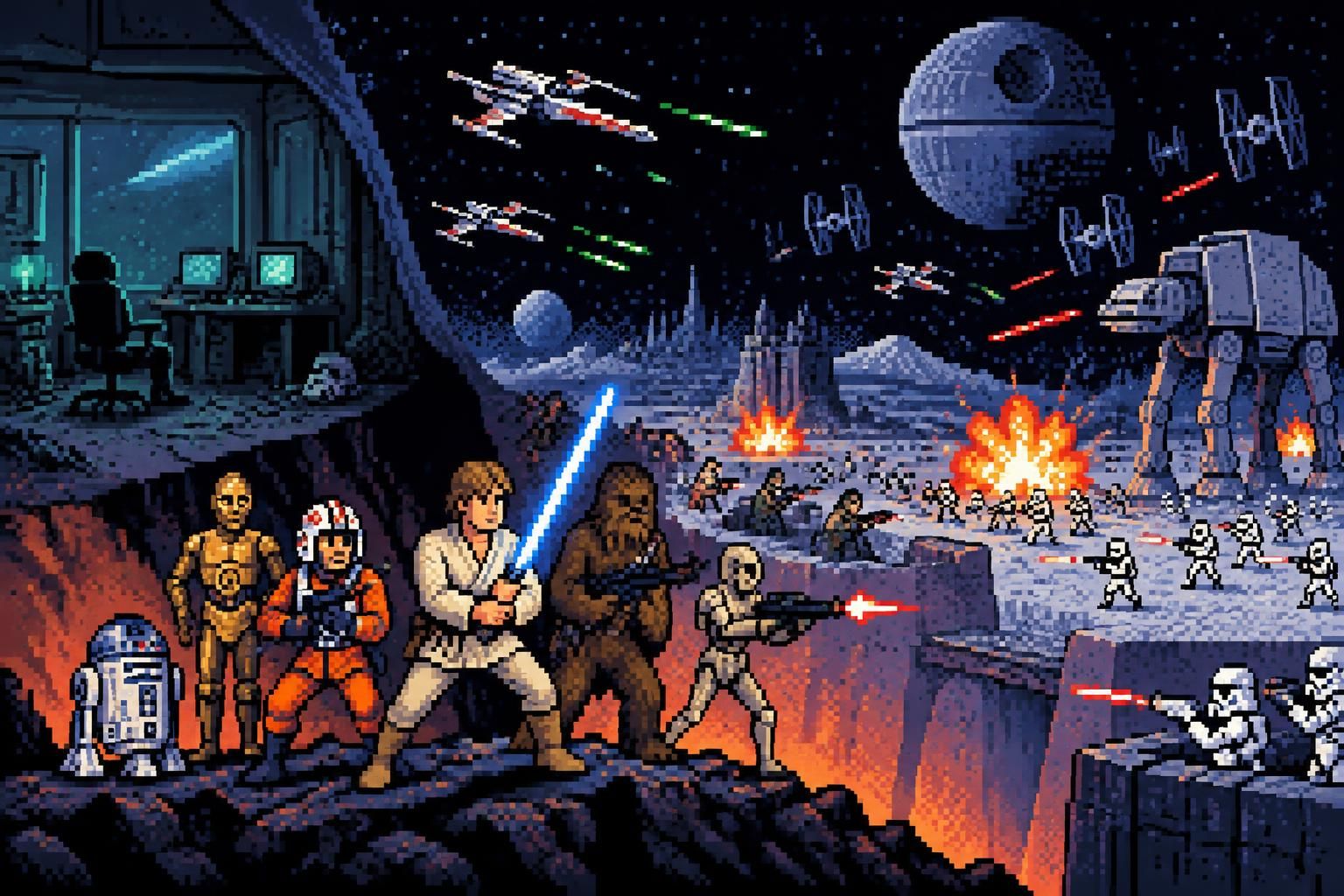
Star Wars: Battlefront 3 Reports Require a Clear Separation Between Evidence and Inference
I separate the reported collaboration between Respawn Entertainment and DICE from the proposed identity of their project. You should apply the same distinction: an unnamed production, even when described in a corporate communication, does not establish that Star Wars: Battlefront 3 has been officially announced. The supplied reporting connects those propositions, but they remain different categories of evidence.
The material provided for this analysis attributes the account to Variety and an internal Electronic Arts memorandum. It describes a joint shooter initiative, approximately 400 job losses, and the closure of BioWare. Those claims are treated here as attributed reporting, not independently verified corporate announcements. This distinction matters particularly when a claim concerns employees, an entire studio, or the cancellation of an unannounced release.
I would classify the intelligence before allocating confidence. A publisher’s authenticated statement can establish that two teams are collaborating; anonymous sources can identify the suspected license; neither automatically establishes a release window, supported platforms, or the scale of production. You lose analytical precision when these separate claims are compressed into one confident headline.
The supplied ScreenRant report on the proposed development partnership and IGN coverage linking the collaboration to Battlefront speculation represent useful points for examining that distinction. Their presence in a source list, however, is not a substitute for inspecting the underlying statement. Several publications repeating one originating account do not necessarily constitute several independent confirmations.
Consider an intercepted Imperial transmission that orders two shipyards to coordinate construction. I can infer that a substantial vessel may be planned, but I cannot identify its class merely because several intelligence officers repeat the same interpretation. You should demand the equivalent of a hull designation: an authenticated title announcement, identifiable production leadership, or a publisher statement explicitly naming the property.
| Reported element | What it could establish | What remains unresolved |
|---|---|---|
| 🔎 Joint studio project | A collaboration, if the attributed memorandum is authenticated | Its name, license, scope, and production stage |
| 🎮 Battlefront identification | A claim attributed to unnamed sources | Official confirmation of the sequel |
| ⚠️ Approximately 400 job losses | A reported company-wide reduction | Verified totals, locations, and affected disciplines |
| 🏛️ BioWare shutdown | A reported studio closure decision | Formal confirmation and the disposition of staff and projects |
The chronology also requires discipline. The 2017 release of Battlefront II would place a hypothetical successor roughly nine years later in 2026. That interval supports the description of a long wait; it does not prove that a sequel has spent nine years in production, nor that an old prototype has survived into a current development pipeline.
I also distinguish commercial intent from operational readiness. A statement about growth in shooters describes a business objective, not a playable build. You cannot infer stable servers, approved combat systems, or sufficient staffing from language about portfolio expansion, however confidently that language is delivered.
Artwork offers a useful parallel. An Imperial recruitment mural communicates purpose through scale, symmetry, and selective omission; it does not document the maintenance condition of the fleet depicted. Corporate messaging likewise deserves examination for what it establishes and what it leaves outside the frame.
The working position is therefore narrow: the supplied material describes a potentially significant partnership and a severe restructuring, while the sequel’s identity remains reported rather than formally established here. I would judge the next disclosure by the uncertainty it removes, not by the enthusiasm it generates.
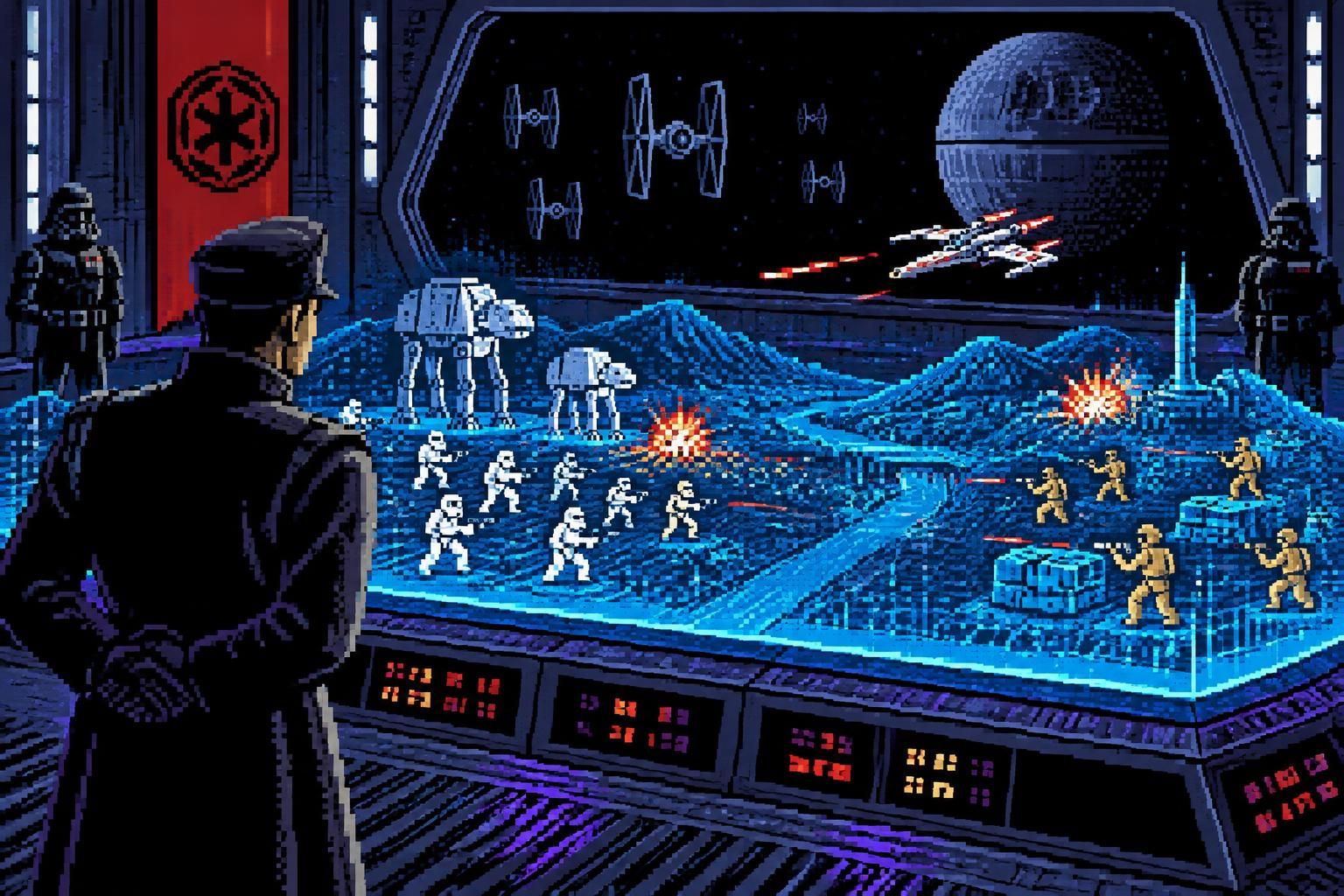
Why a Respawn Entertainment and DICE Partnership Could Fit Battlefront 3
I assess a proposed alliance by the capabilities it combines, not by the prestige of its participants. DICE carries a substantial association with Battlefield and the modern Battlefront releases, while Respawn Entertainment brings experience from Titanfall, Apex Legends, and the Star Wars Jedi games. You can identify complementary experience without assuming that combining two accomplished organizations produces an accomplished game automatically.
The strongest theoretical division of labor would place large-scale battlefield systems, environmental readability, and multiplayer infrastructure alongside expertise in responsive combat and character movement. That arrangement remains an analytical proposal, not a disclosed staffing chart. Its value depends on whether each team owns a defined problem and whether one leadership group can resolve competing priorities.
Imagine a fictional player named Commander Varo defending a hangar on Hoth. He needs clear objective markers, predictable weapon response, and reliable information about approaching armor. A developer focused on animation spectacle may improve one part of that encounter, while a networking specialist protects another; the experience succeeds only when those contributions obey the same combat rules.
I would begin by assigning authority over the central combat model. Who decides movement speed, time to defeat an opponent, camera behavior, and the relationship between infantry and heroes? If those decisions remain distributed without a final arbiter, the collaboration risks becoming a negotiation between incompatible prototypes rather than a coherent production.
The technological question deserves equal attention. Teams with different established tools cannot necessarily exchange maps, animation systems, or gameplay code without substantial integration work. You should treat any claim that existing technology will make development faster as a hypothesis requiring evidence about tools, licensing, platform support, and the cost of adapting established workflows.
At Scarif, coordinated action depended on different units understanding how their tasks contributed to a single operational objective. A production partnership needs comparable clarity: an environment group cannot optimize sightlines effectively if the intended engagement distance changes every month. Efficient cooperation comes from stable interfaces between responsibilities, not from a presentation slide placing two logos beside each other.
Existing obligations complicate the calculation. The supplied account says Respawn would continue work on the next Jedi installment, while DICE remains associated with Battlefield responsibilities. That makes resource allocation a central question: which specialists are dedicated to the proposed project, which are shared, and which are merely available for occasional consultation?
I would not interpret a two-studio announcement as proof of two complete workforces being assigned to one release. A small incubation team, shared technology group, or limited co-development agreement can all produce that public description. You need staffing detail before estimating how much production capacity the arrangement actually represents.
The cultural challenge is less visible but equally consequential. One team may favor rapid experimentation, another formal milestone reviews, and another a toolchain built around a different release cadence. Like the contrasting visual traditions of Naboo and the Empire, these approaches encode priorities; neither becomes effective simply by imposing its outward appearance on the other.
A useful test would be a shared playable encounter that both teams can modify without breaking one another’s work. If an infantry balance change reaches the test build promptly, survives automated checks, and produces interpretable results, the partnership has begun to function operationally. If every adjustment requires prolonged manual reconciliation, the project is accumulating hidden cost.
I would therefore look for named creative accountability, an agreed technical foundation, and evidence that the participating teams can deliver together before accepting claims of an ideal match. You should regard famous studio names as indicators of available experience, not guarantees of execution. The decisive asset is coordinated authority over a coherent product.
Battlefront 3 Gameplay Must Resolve the Conflict Between Spectacle and Readability
I would evaluate a new Battlefront through a practical question: can you understand why an encounter was won or lost? Star Wars supplies powerful silhouettes, distinctive sounds, and recognizable vehicles, but recognition alone does not create tactical clarity. A battlefield can resemble a film convincingly while leaving its participants unable to interpret threats or contribute meaningfully.
Commander Varo provides a useful test case. Place him beneath an AT-AT while starfighters cross overhead and a lightsaber wielder advances through the snow. If he cannot determine whether to damage the walker, protect an emplacement, or withdraw toward an objective, the encounter offers spectacle without an intelligible decision structure.
I would establish three layers of information: immediate danger, local team purpose, and the wider battle state. Weapon effects and directional audio communicate the first; objective indicators communicate the second; reinforcement counts or phase progress communicate the third. You should not need to read a dense interface while simultaneously interpreting several overlapping particle effects.
The Imperial visual language demonstrates why restraint matters. Repeated geometry and a controlled palette make departures from the pattern conspicuous. A designer can apply that principle by limiting decorative interface noise, reserving strong colors for actionable information, and ensuring that an enemy silhouette remains distinguishable against snow, jungle foliage, or a crowded hangar.
Large player counts are not a substitute for encounter design. Adding participants can increase waiting times, crossfire, and unpredictable deaths without increasing useful cooperation. I would judge scale by the number of meaningful roles available at a given moment, not by the largest number that can be printed on promotional material.
Heroes introduce a separate balancing problem. Darth Vader should feel powerful, but ordinary soldiers must still possess useful responses: concentrated fire, defensible routes, temporary suppression, or objectives that reward coordinated diversion. You preserve the fantasy by making a hero influential; you damage it when every non-hero participant becomes disposable scenery.
Vehicle combat needs similar reciprocity. An armored unit should control open ground more effectively than a lone trooper, yet it should face terrain constraints, maintenance pressure, or credible anti-vehicle threats. If armor dominates every distance and environment, the optimal strategy stops being a choice and becomes a repeated purchase of the same advantage.
The broader Battlefront discussion at TIEvaders offers a relevant context for examining those expectations. The central design issue remains independent of any particular wish list: combined arms works when infantry, vehicles, and specialist characters create interdependent opportunities. Parallel activities sharing one map are not automatically a combined-arms system.
I would test map design through repeated journeys rather than isolated screenshots. Can Varo reach the contested control room by a protected route, a faster exposed route, and a specialist route that requires equipment? If every approach passes through one corridor watched by superior firepower, visual authenticity has concealed a structural failure.
Historical battles within the saga supply useful models without dictating literal mechanics. Hoth emphasizes withdrawal under pressure; Scarif combines infiltration with a larger assault; Endor exposes the danger of neglecting local terrain and irregular forces. Each offers a different relationship between information, mobility, and objectives, which is more valuable than merely reproducing its scenery.
The prototype should therefore demonstrate one complete, readable battle before expanding into a catalogue of planets and eras. You should be able to identify what your squad accomplished, which countermeasure defeated it, and what adjustment might work next time. A convincing battlefield teaches through consequences rather than compensating for confusion with additional explosions.
Battlefront 3 Progression Must Avoid Repeating Battlefront II’s Launch Problems
I regard progression as a system of incentives, not a decorative reward track. The 2017 launch controversy surrounding Battlefront II demonstrated how monetization and gameplay progression can become inseparable in players’ assessment of fairness. You do not repair that perception merely by promising that a later release has learned from the past; you demonstrate a different architecture.
The historical distinction matters. Battlefront II changed after its launch, and its later progression structure should not be collapsed into a description of its original commercial model. I would examine both periods: the initial failure reveals the danger, while subsequent revisions show that systems can be rebuilt at a considerable cost in trust, attention, and development effort.
Commander Varo should understand whether he lost because of positioning, coordination, equipment choice, or execution. If a paid transaction can materially improve an opponent’s combat effectiveness, that explanation becomes harder to establish. Even a modest numerical advantage can distort the interpretation of a close encounter and weaken confidence in competitive outcomes.
I would therefore separate combat access from commercial spending. New participants need a credible baseline loadout, and specialist alternatives should involve understandable trade-offs rather than a ladder from inadequate equipment to superior equipment. You can reward mastery through expression, convenience within fair limits, or expanded tactical variety without selling a stronger version of the same weapon.
Cosmetic purchases present fewer direct balance risks, but they still require constraints. A silhouette that obscures faction identification, an effect that masks incoming fire, or an animation that alters apparent timing can affect play despite being labeled cosmetic. The classification must follow the effect on the encounter, not the wording on a storefront.
The franchise’s visual cultures provide a practical design boundary. Clone markings, Rebel field equipment, and Imperial unit distinctions offer recognizable variations without requiring every soldier to become an unrelated spectacle. I would protect that visual grammar because you use it to identify role, allegiance, and threat before consciously processing the details.
The discussion of Battlefront II crate rewards and progression is relevant because reward structures shape behavior long after the initial purchase. A task that requires players to ignore objectives in pursuit of a narrow weapon challenge can undermine the battle even when no money changes hands. Incentives must reinforce the stated purpose of the mode.
- 🎯 Reward useful participation: objective defense, support actions, and coordinated advances should contribute to advancement, rather than leaving eliminations as the only efficient route.
- ⚖️ Publish competitive rules: players should understand equipment access, matchmaking principles, and any restrictions applied to ranked or organized play.
- 🛒 Separate purchases from power: spending should not determine damage output, survivability, or access to an indispensable battlefield counter.
- 🧭 Make commitments legible: season length, reward availability, and purchase conditions should be visible before a player commits time or money.
I would also examine the burden placed on late arrivals. A veteran can possess extensive knowledge without receiving a statistical advantage that makes the newcomer’s first hours strategically hopeless. Training modes, readable defaults, and sensible matchmaking protect the future population by allowing inexperienced participants to learn from recognizable mistakes.
Commercial sustainability remains necessary; servers, support, and content production require resources. The relevant question is not whether the publisher earns revenue, but whether its incentives remain aligned with a healthy battlefield. If frustration becomes the mechanism that drives spending, the business model is drawing resources from the trust required to sustain the community.
You should demand disclosure of the economy before launch, when changes remain possible and purchase decisions remain voluntary. A durable progression system rewards returning to the battle, not paying to escape an artificial disadvantage.
The Reported BioWare Closure Demands Separate Scrutiny From Battlefront 3 Rumors
I would not treat the reported BioWare studio closure as a dramatic footnote to a possible shooter announcement. The two stories concern different decisions, different workers, and different forms of institutional knowledge. You should resist a presentation in which enthusiasm for one potential product automatically offsets the destruction of another production organization.
The supplied account says Electronic Arts would end early work on the next Mass Effect installment and close BioWare’s Edmonton workspace. Without independently authenticated confirmation, those remain attributed claims rather than established outcomes here. Their seriousness nevertheless justifies examining what such a decision would mean if the account is accurate.
A studio is not merely a trademark and a collection of computers. It contains shared methods for reviewing scenes, resolving technical disputes, estimating production risk, and teaching new staff how existing tools behave. When experienced teams disperse, those informal systems are difficult to reconstruct from archived documents, even when the intellectual property remains under the same corporate ownership.
BioWare’s association with Knights of the Old Republic is especially relevant within Star Wars. Its contribution was not simply a familiar setting rendered interactively; it helped demonstrate the commercial and creative power of dialogue, party relationships, and consequential choices in that setting. You can preserve the license while still losing some of the expertise that shaped its expression.
I would distinguish the closure of a development operation from the disappearance of its published works. Existing games, characters, and technologies can remain available under separate arrangements. That distinction prevents exaggerated claims, but it does not erase the practical consequence: an organization capable of making new work may cease to exist even while its catalogue continues generating attention.
The reported figure of approximately 400 layoffs also requires careful handling. The supplied material describes a wider company reduction, not a verified count of BioWare employees alone. You should not assign all affected positions to one studio, infer the distribution across countries, or calculate the supposed savings without reliable supporting detail.
The operational losses would depend on which roles were affected. Removing quality assurance capacity can increase escaped defects; losing technical artists can interrupt asset production; dismissing experienced producers can weaken scheduling and risk management. A headline total cannot tell you whether a particular project has become smaller, slower, less resilient, or all three.
There is an analogy in the destruction of archives during galactic conflict. Capturing a library’s contents does not necessarily preserve the living tradition of interpreting them. The relevant industrial question is therefore whether expertise is retained, transferred through an orderly process, or simply assumed to remain available after the people who carried it have departed.
I would also reject an unsupported causal shortcut: a new multiplayer initiative does not, by itself, prove that its budget was taken directly from a canceled role-playing game. Corporate portfolios contain separate forecasts, licensing obligations, and investment decisions. You need financial or organizational evidence before describing one project as having consumed another.
That caution does not prevent scrutiny of priorities. If leadership concentrates resources in recurring multiplayer revenue while reducing capacity for narrative-driven releases, the resulting portfolio becomes more exposed to the performance of those remaining categories. Diversification is not sentimental; it can reduce dependence on a small number of operating models and audience behaviors.
The human consequences also have operational weight: relocation, interrupted careers, and the dispersal of collaborators affect how quickly experienced teams can form again. I would examine any official disclosure for staffing provisions and project continuity, not merely its tribute to past achievements. A studio’s legacy is best measured against what happens to its people and capabilities.
What BioWare’s Reported Shutdown Would Mean for the Old Republic
I separate ownership, development responsibility, and creative lineage when examining the Old Republic. BioWare’s historical connection to Knights of the Old Republic does not mean every later project in that era depends on the same studio remaining operational. You need to identify the developer and commercial arrangements for each production before predicting which games would stop.
The supplied material presents Star Wars: Fate of the Old Republic as remaining in development and describes Star Wars: The Old Republic as continuing to operate. Those statements should be assessed through the respective projects’ own official communications. A reassuring sentence in coverage of another company event cannot establish their staffing, schedule, or long-term funding.
There is, however, a concrete historical distinction worth preserving: operational development of The Old Republic moved from BioWare to Broadsword in 2023. That separation matters when interpreting a later claim about BioWare’s future. You should not infer the immediate end of an independently operated service solely from the reported closure of its original creator.
I would apply a chain-of-dependency test. Which organization maintains the servers, who controls the publishing relationship, where does the engineering team sit, and what agreements govern ongoing support? Those questions reveal exposure more reliably than a shared association with the Old Republic name.
For a hypothetical Commander Varo, the concern is straightforward: can he still access his characters, play with his guild, and receive meaningful maintenance? The relevant evidence would include service notices, account-system changes, published updates, and statements from the current operator. A corporate restructuring elsewhere might matter indirectly, but the connection must be demonstrated rather than presumed.
Narrative inheritance is a different matter. A future role-playing game can adopt branching dialogue and companion relationships without reproducing the conditions that made an earlier work effective. The value lies in the relationship between authored choices and player understanding, not in the presence of a dialogue wheel or a familiar period in galactic history.
The discussion of narrative-rich Star Wars experiences provides a relevant thematic framework. I would ask whether a proposed successor gives you understandable stakes, characters with coherent motives, and consequences that persist beyond a single exchange. Those are production commitments requiring writing, scripting, performance, testing, and sustained editorial judgment.
Old Republic settings also offer a strategic advantage: distance from the film timeline can create room for unfamiliar conflicts and institutions. That freedom is useful only if the world remains legible. A new faction needs recognizable objectives, material constraints, and cultural habits; otherwise, ancient names and ornate architecture become a substitute for causal explanation.
The contrast between Jedi and Sith traditions illustrates the point. Their art, spaces, and rituals communicate different relationships to discipline, authority, and individual ambition. A well-designed role-playing system can turn those differences into decisions about alliances, sacrifice, and power, rather than reducing them to opposing colors on an alignment meter.
I would therefore evaluate continuity on two tracks. Operational continuity asks whether a specific service or production remains staffed and funded; creative continuity asks whether the next work preserves useful expertise while developing its own identity. You can retain the first without securing the second, or achieve the second through a different team.
The reported fate of one studio should neither erase unrelated projects nor become an excuse to declare the entire era secure. Each production has its own dependencies and failure points. The Old Republic’s future must be assessed project by project, not inferred from the survival or disappearance of a single logo.
Battlefront 3 Development Would Need Production Gates, Not an Assumed Release Date
I would place an unannounced sequel within a production sequence before discussing its arrival. Concept development, pre-production, full production, content completion, certification, and live operations represent different commitments and risks. You cannot determine which stage a project has reached merely because a report uses the phrase “in development.”
A small team can test a viable combat concept while most of the eventual workforce remains assigned elsewhere. That is legitimate game development, but it is not equivalent to building a complete commercial release. I would look for evidence of repeatable production: tools that work, content pipelines that scale, and a stable design that additional teams can execute.
The first meaningful gate would be a representative encounter. Commander Varo should be able to enter a match, understand the objective, encounter infantry and vehicles, complete the round, and return to the interface without special developer intervention. The purpose is not visual polish alone; it is proof that the essential systems function together.
A second gate would examine content cost. How long does a qualified team need to build, test, optimize, and revise one map under realistic conditions? If the answer changes sharply whenever a new environment is attempted, the production schedule rests on assumptions rather than measured throughput.
The third gate concerns online reliability. Matchmaking, party formation, server allocation, reconnect behavior, and regional latency all affect whether you can use the game you purchased. These systems are less suitable for dramatic trailers than lightsaber combat, but failures here can invalidate the entire experience before the first tactical decision occurs.
I would require load testing that reflects actual behavior rather than idealized clients performing identical actions. Players disconnect, join friends across regions, leave losing rounds, and return after updates. A service must tolerate those patterns without corrupting progression or producing matchmaking failures that only appear under sustained demand.
Anti-cheat and moderation belong within that architecture from the beginning. Retrofitting them after widespread abuse can impose design restrictions and operational costs that early planning would have reduced. You should ask how suspicious activity is detected, how reports are reviewed, and how appeals distinguish genuine errors from deliberate manipulation.
Accessibility is another production dependency, not a final decoration. Remappable controls, subtitle readability, color-independent cues, and adjustable visual effects can influence interface layout and combat feedback. If those requirements arrive only after content is complete, the necessary revisions become more expensive and less consistent.
The proposed partnership also needs contingency planning for its other obligations. A major update to Apex Legends, work on the next Jedi release, or Battlefield support could compete for scarce specialists if staffing is shared. I would expect documented ownership and backup capacity for critical systems rather than an assumption that exceptional effort will resolve every collision.
A Star Destroyer is not ready for deployment because its exterior plating has been photographed. It needs functioning propulsion, trained crews, supply arrangements, and tested coordination between compartments. The same logic applies to a large multiplayer release: a convincing demonstration can conceal unfinished support systems unless the production gates examine them directly.
No supplied detail establishes a release date, platform list, player count, or complete feature set for Battlefront 3. You should treat specific claims in those categories as requiring their own evidence, not as natural extensions of a collaboration report. A credible schedule follows demonstrated capacity; it does not create that capacity by being announced.
What Players Should Examine in the Next Battlefront 3 or BioWare Announcement
I would approach the next announcement as an inspection of claims, not a referendum on loyalty to the franchise. You can want another Battlefront and still require a named project, a clear description of its production status, and a credible account of who is responsible. Enthusiasm and scrutiny are compatible because they answer different questions.
The first document to inspect would be the original publisher or studio statement. Does it explicitly name the sequel, or does it announce an unnamed collaboration? I would compare that wording with the headline and opening paragraphs of secondary coverage, looking for the point at which a documented statement becomes an interpretation.
The second question concerns source independence. Five articles may all derive their central claim from one publication, one memorandum, or one unnamed individual. You should trace the attribution chain before treating repetition as corroboration; otherwise, the apparent strength of the evidence increases while the actual evidence remains unchanged.
A trailer would answer some questions while leaving others open. It could establish branding, tone, and the publisher’s willingness to present the project publicly, but a cinematic sequence would not demonstrate multiplayer stability or the fairness of progression. I would identify what the footage actually shows before accepting what its presentation encourages you to imagine.
Gameplay requires its own inspection. Is the sequence continuous, does it show a complete objective cycle, and can you distinguish player actions from scripted events? Commander Varo’s test remains useful: if the footage cannot explain what an ordinary soldier contributes, it may reveal the setting more clearly than it reveals the game.
Any public test would provide stronger practical evidence, although its scope would still matter. A limited technical session might evaluate servers rather than balance, while a polished demonstration could exclude unfinished systems. You should read the stated purpose of the test and judge the result against that purpose, not against assumptions about a finished release.
I would inspect commercial details before any purchase decision. Editions, cosmetic bundles, season structures, premium currencies, and equipment access can alter the practical meaning of the advertised price. A transparent offer allows you to calculate what is included without interpreting several overlapping reward tracks and temporary promotions.
For BioWare, the verification priorities differ. An official studio statement, corporate filing where applicable, employee communication, or credible independently corroborated reporting would carry more weight than a repeated farewell post. I would also distinguish a workspace shutdown, a workforce reduction, and the dissolution of a studio operation, because those terms describe different organizational outcomes.
The fate of a project requires a separate statement again. Ending one development effort does not automatically cancel every related property, while retaining a franchise name does not prove that its previous team remains intact. You should look for the responsible organization, the status of active work, and any explicit transfer of duties.
Community discussion can help identify unanswered questions, but volume is a poor substitute for evidence. Imperial propaganda and Rebel recruitment both exploit symbols because familiar imagery can accelerate commitment before analysis. In the gaming industry, recognizable helmets, musical cues, and studio logos can produce a similar shortcut without resolving technical or organizational uncertainty.
I would keep a simple record beside the next disclosure: the exact claim, its originating source, the evidence offered, and the decision it should affect. A title reveal may justify attention; demonstrated systems may justify confidence; clear commercial terms may justify a purchase. You retain the strongest position when each new commitment follows a specific, verifiable improvement in the evidence.

I am Grand Admiral Thrawn, strategist of the Galactic Empire. Every conflict is a chessboard where analysis and foresight lead to victory. The art and culture of a people betray their weaknesses. The Empire embodies order and discipline in the face of rebel chaos. History will remember that only strategy ensures peace.