
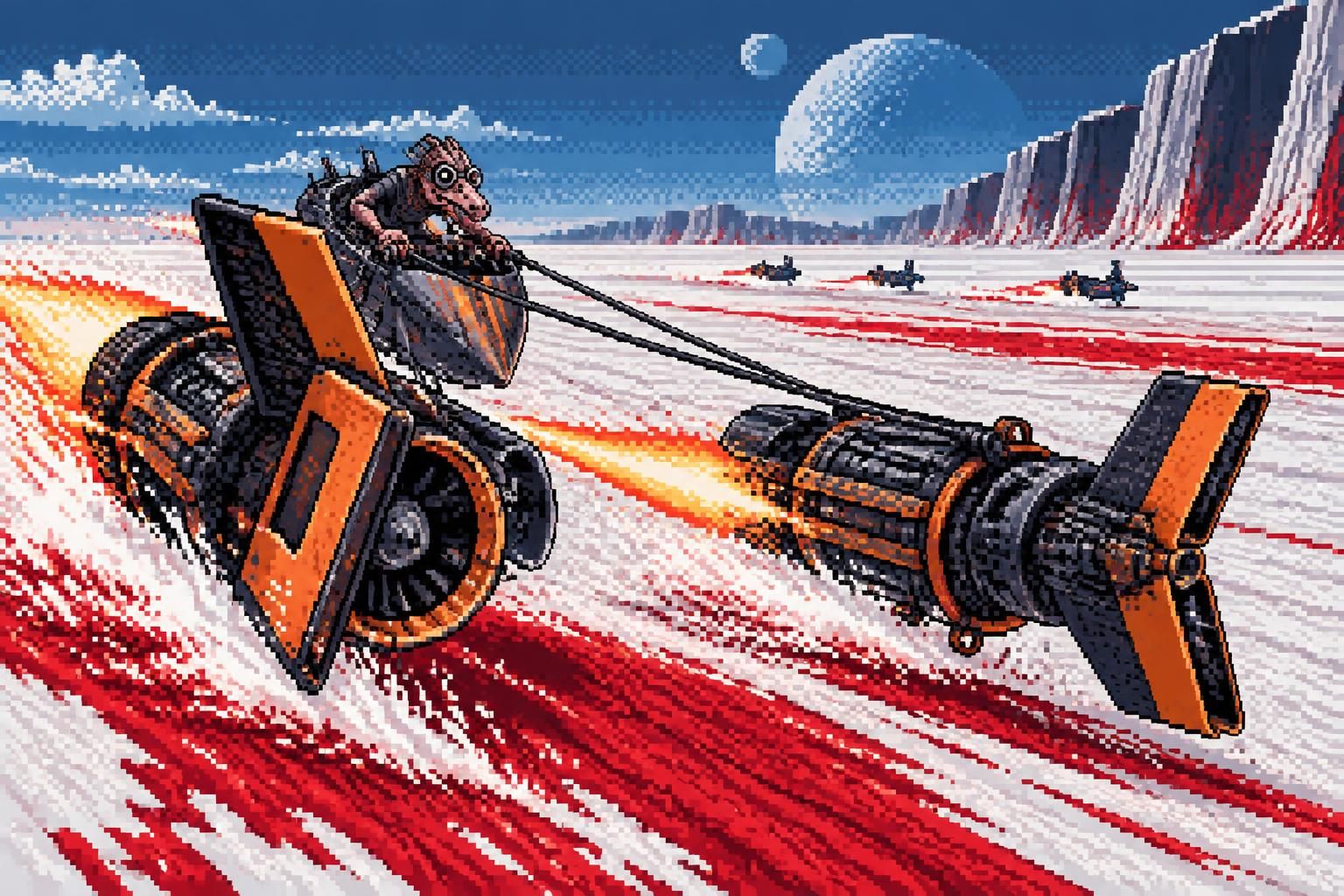
Sebulba and Crait Define the Galactic Racer Launch Trailer
I read the Star Wars: Galactic Racer launch trailer as a demonstration of three connected pressures: hostile terrain, competitive hierarchy, and dependence on unreliable allies. You see accelerated movement and spectacular machinery, but the more useful information concerns the conditions under which Shade must compete.
The promotional sequence places Crait beside familiar competitors and previously revealed destinations. That arrangement matters because a racing game cannot establish its identity through speed alone; it must show why one course demands a different response from another, and why defeating one opponent changes the significance of the next encounter.
I separate what the footage establishes from what its editing encourages you to infer. The salt-covered world appears as a playable destination, Sebulba receives substantial narrative attention, and Shade faces a progression involving podracing. Those observations do not, by themselves, establish every handling system, progression rule, or consequence of defeat.
What the Galactic Racer Launch Trailer Actually Establishes
The opening appearance of Crait’s native vulptices supplies environmental recognition before the machinery arrives. These crystalline creatures connect the location to its appearance in The Last Jedi, while their presence also changes the visual rhythm: the landscape exists before the competitors disturb it.
I consider that ordering effective because it gives you a baseline against which acceleration becomes legible. An undisturbed surface, a narrow passage, and a moving vehicle communicate scale more efficiently than an uninterrupted sequence of explosions. High-octane action becomes meaningful when the viewer can identify what the pilot risks striking.
Shade then moves through salt flats, excavated-looking cavern spaces, and a constricted gorge. Each setting presents a distinct problem of visibility and available space. The footage therefore advertises not merely another recognizable planet, but a route whose changing geometry can support different kinds of competitive pressure.
You can examine the sequence through IGN’s official launch-trailer presentation. I would watch it once for the broad narrative, then again for transitions between open ground and confined passages, because those transitions reveal more about the course’s demands than isolated shots of maximum acceleration.
The distinction between a gameplay observation and a promotional implication remains essential. A cinematic exchange may establish a character’s motive without demonstrating an interactive choice. Likewise, a dramatic collision can communicate danger without proving a specific damage model or explaining whether the same outcome occurs during ordinary play.
How the Launch Trailer Positions Shade
I identify Shade as the organizing variable across the footage. The environments, returning personalities, and workshop conversations acquire practical meaning because they either obstruct the player character or provide a means of advancing. You are not simply watching famous racers assemble; you are being shown a network of conditions surrounding a newcomer’s ascent.
Sebulba’s demand that Shade demonstrate competence before approaching Kestar Bool turns that ascent into a test of credibility. Hibi’s encouragement after a loss establishes a different relationship: support persists when immediate results fail. Together, those scenes distinguish conditional sponsorship from technical and personal investment.
The supplied launch coverage also describes favorable reviews accompanying the release. I treat that reception as context rather than a substitute for evidence: praise can explain why a publisher emphasizes a confident launch campaign, but it cannot tell you whether the handling, structure, or difficulty will suit your preferences.
The earlier announcement phase and the later launch material should not be collapsed into one event. The game was presented publicly before its release campaign, with subsequent footage expanding its locations and cast. The launch sequence belongs to the stage at which prospective players need a coherent account of what those separate reveals amount to.
For you, the useful question is therefore not whether the video looks fast. It is whether its characters, routes, and competitive stakes explain why each race deserves your attention. The trailer’s strongest argument is that movement serves a rivalry, rather than replacing one.
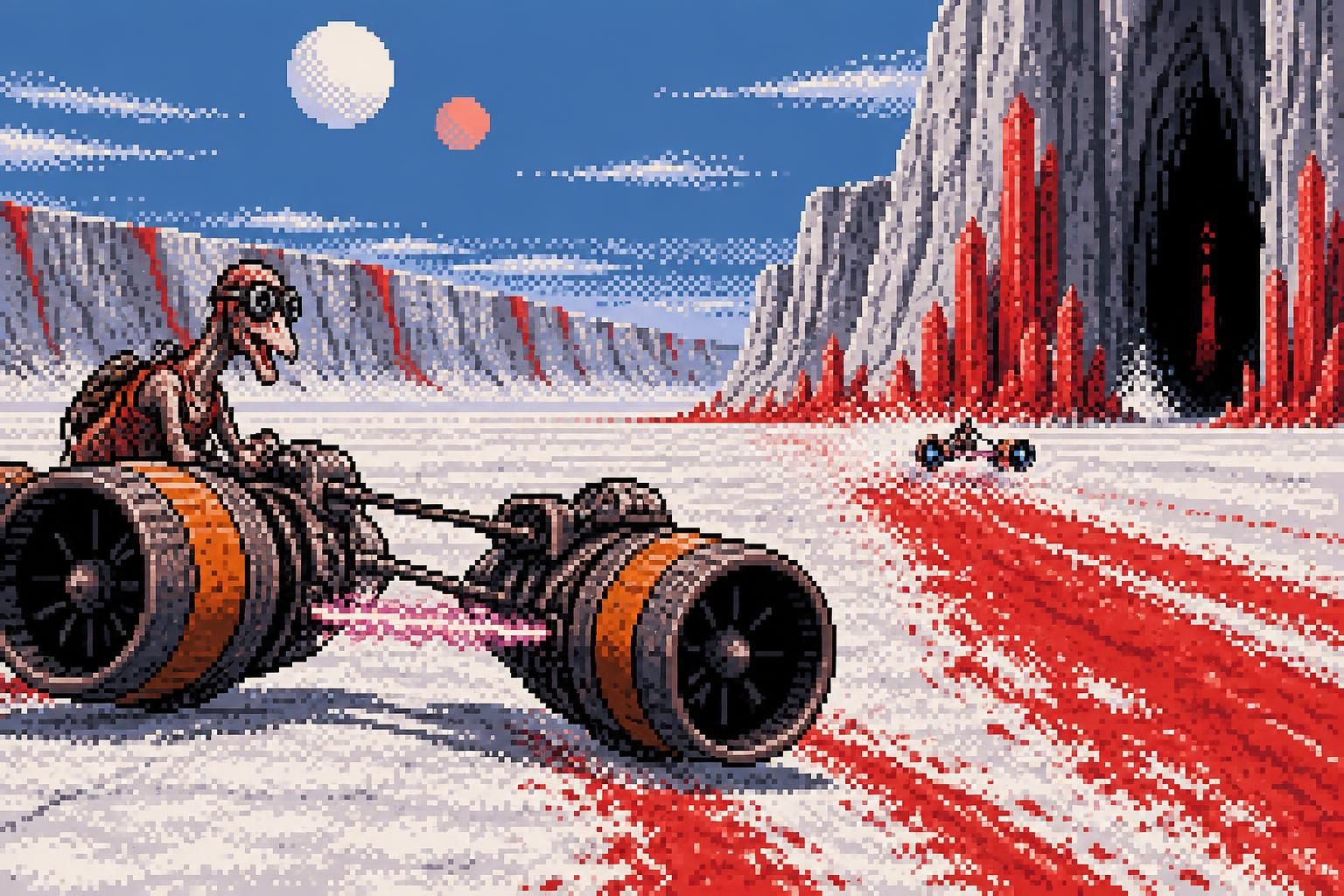
Crait Turns Galactic Racing Into a Terrain Problem
I approach Crait as a sequence of spatial constraints, not merely a striking white-and-red backdrop. You are shown exposed ground, enclosed passages, and a gorge that sharply reduces maneuvering room. The practical challenge is the change between those conditions, because a line that works in one area may become untenable in the next.
On an open salt flat, a pilot can assess the broader field and prepare a route through traffic. Within a cavern, the surrounding structure restricts both movement and visual information. A narrow gorge reduces the number of workable responses still further, making earlier positioning more consequential than a last-moment correction.
Crait’s Salt Flats Reward Preparation Before Speed
I would use the exposed stretches to identify the next restriction rather than spend every available moment pursuing a pass. Consider Shade approaching two competitors before a confined entrance: overtaking the first may be possible, but entering alongside the second could remove the space needed to negotiate the following bend.
That is an illustrative tactical problem, not a claim about a particular scripted event. Its value lies in the relationship between timing and geometry. You gain little from briefly holding a better position if that position obliges you to brake harder, abandon your intended line, or accept contact immediately afterward.
The planet’s red mineral layer beneath its pale surface provides a distinctive visual signature familiar from its cinematic appearance. In racing footage, that contrast helps communicate disturbance and motion. I do not infer an interactive tracking system from it; the visible effect alone already helps you understand where vehicles have passed.
The vulptices also deserve a precise reading. Their crystalline bodies and movement establish the world’s identity, but their appearance does not prove that wildlife functions as a race hazard. You should distinguish environmental staging from mechanics unless the footage clearly demonstrates an interaction between the creatures and the competitors.
Why Crait’s Caves and Gorge Change the Racing Line
I regard the comparison with Mos Espa’s confined course as useful at the level of spatial memory. Viewers familiar with The Phantom Menace already understand that a narrow passage can convert mechanical aggression into risk. The resemblance concerns restricted room, not a verified duplication of that film’s route or obstacles.
Inside a constrained section, the question changes from “How quickly can you advance?” to “Which movements remain available?” A rival occupying the center may prevent a safe pass even when your craft has superior acceleration. The important resource is then usable space, and usable space cannot be generated by engine output alone.
| Crait terrain | Visible characteristic | Practical reading |
|---|---|---|
| ⚪ Salt flats | Broad, exposed stretches | Assess traffic before the route contracts |
| 💎 Cavern passages | Enclosed surroundings | Prioritize a stable line and clear sightlines |
| ⚠️ Narrow gorge | Limited lateral room | Complete positioning decisions before entry |
| 🦊 Vulptix habitat | Recognizable native wildlife | Separate environmental identity from confirmed hazards |
I use these distinctions to avoid a common analytical failure: assigning one universal driving method to every part of a course. You may carry momentum across open ground, then deliberately sacrifice an overtaking opportunity to secure a clean entrance. Those decisions are compatible because they serve the same objective under different constraints.
A military column approaching a defile faces a comparable problem. Numerical strength matters less when the ground prevents that strength from being deployed simultaneously. In galactic racing, a faster machine can encounter the same limitation when the track removes its room to exploit an advantage.
You should also examine what lies beyond a bend rather than treating the bend as an isolated obstacle. A modest entry speed may yield a stronger exit if it preserves alignment for the following section. Conversely, an aggressive entrance can produce a correction that compromises several seconds of subsequent movement.
The planet’s aesthetic therefore supports a functional distinction rather than mere decoration. Its pale expanses make movement readable, while its confined interiors change the relationship between visibility and commitment. On this course, the decisive maneuver may occur before the narrow section begins.
Sebulba’s Alliance With Shade Is a Transaction, Not a Transformation
I interpret Sebulba’s role through the terms he places on cooperation. He does not simply welcome Shade into elite competition; he insists that the newcomer prove capable of defeating him before approaching Kestar Bool in a podracer. You are shown an alliance whose value depends on demonstrated performance.
That condition fits the competitive culture associated with the veteran from The Phantom Menace. His reputation rests on intimidation, technical competence, and a willingness to exploit rivals. Cooperation with the player character does not erase that history; it changes the immediate direction in which his interests operate.
Why Sebulba Tests Shade Before Kestar Bool
I regard the proposed contest as a screening mechanism. If Shade cannot overcome an experienced opponent under a direct test, committing resources to a confrontation with the dominant rival offers poor expected returns. The challenge protects the sponsor from investing in a pilot whose ambition exceeds demonstrated capacity.
You should notice that this arrangement gives the veteran two benefits at once. He evaluates a potential instrument against his own established benchmark, and he reinforces his authority over access to the next confrontation. His gatekeeping therefore has both a practical purpose and a place within the story’s hierarchy.
Consider a hypothetical result in which Shade wins through uncontrolled collisions and favorable circumstances. The victory would establish an outcome, but not necessarily repeatable competence. A strategist would examine how it was achieved, because the same method might fail against a rival with different machinery, positioning, or tolerance for risk.
The trailer does not explain whether the game evaluates such distinctions mechanically. I use the example to clarify the narrative logic of the test rather than invent a hidden scoring system. You can understand why a demanding mentor might seek evidence of control even when the available footage shows only the challenge itself.
The Lost Podracer Gives the Partnership a Material Objective
Sebulba later reveals that he has lost his machine and is relying on Shade to recover it through victory. That admission gives the relationship a concrete objective beyond prestige. The relevant asset is not interchangeable equipment: for an established competitor, a signature craft can embody livelihood, status, and public identity.
The supplied account associates the loss with Bool, but the exact transfer should not be treated as settled merely because it is strongly suggested. The reliable narrative point is that the older pilot lacks his vehicle and expects the newcomer’s success to restore it. The precise circumstances remain a separate question.
I would therefore describe the arrangement as aligned interests rather than loyalty. Shade gains a route toward stronger opposition; the displaced veteran gains a candidate capable of retrieving something valuable. You should expect cooperation to remain durable only while those objectives continue to support one another.
This distinction prevents the familiar error of equating shared enemies with shared values. Two actors can coordinate effectively while retaining incompatible long-term ambitions. In the Outer Rim’s commercial culture, a temporary bargain often produces more dependable behavior than an unsupported declaration of friendship, because each participant can identify the cost of abandonment.
His invitation to Ben Quadinaros extends that pattern. Bringing another recognizable competitor into the event suggests that the veteran can shape the field as well as participate in it. The footage establishes the invitation; it does not establish whether the intention is instruction, spectacle, competitive pressure, or some combination of those purposes.
The account in Star Wars News Net’s examination of Crait and the returning racers provides a useful companion to those character exchanges. I would compare its description with the actual dialogue rather than allow a compressed plot summary to erase distinctions between explicit statements and implications.
For you, the practical reading is straightforward: assistance can carry obligations, and a gatekeeper’s test can serve his interests while still advancing yours. The alliance matters because its conditions are visible, not because its participants have become trustworthy.
Kestar Bool, Ben Quadinaros, and the Competitive Field
I evaluate Kestar Bool as the central competitive obstacle presented by the story footage. His dialogue communicates entitlement and dominance, but neither characteristic establishes weakness by itself. You should resist the temptation to assume that an unpleasant rival must also be tactically careless; personality and performance require separate assessment.
A secure position can produce overconfidence, yet it can also reflect superior machinery, experience, or influence. The trailer does not quantify those advantages. What it does establish is that Shade’s progression is organized around reaching a competitor whom others treat as consequential, and whose defeat carries meaning beyond a single finishing position.
Reading Bool’s Authority Without Mistaking Dialogue for Performance
I distinguish a statement of superiority from evidence of how superiority is maintained. A rival may dominate through clean execution, through control over resources, or through the pressure his reputation exerts on challengers. Each explanation would demand a different response, so none should be selected solely because it fits a familiar villain archetype.
You can apply that distinction while watching race footage. Does the opponent preserve a stable line under pressure? Does he force another pilot into a compromised entrance? Does the edit actually show a sustained advantage, or merely place an assertive line of dialogue beside an unrelated burst of motion?
Those questions prevent cinematic authority from becoming a substitute for analysis. A trailer has limited time and therefore compresses relationships through voice, framing, and contrast. I accept those techniques as narrative signals while reserving judgments about competitive behavior for scenes that show the relevant actions.
If Bool’s standing rests partly on reputation, Shade’s challenge threatens more than one result. Public defeat could undermine the expectations that make other competitors defer to him. That is a conditional interpretation of the rivalry’s stakes, not confirmation of a reputation mechanic or a branching consequence within the game.
Ben Quadinaros Expands the Returning Podracer Cast
Ben Quadinaros appears moving past the player and states that Sebulba invited him personally. His inclusion creates a recognizable connection to the Boonta Eve race without requiring the story to reproduce that event. You are seeing an established participant placed in a different competitive context, with a different immediate relationship to the protagonist.
I would not reduce him to the equipment trouble associated with his cinematic appearance. A prior failure describes an incident, not the complete limits of a pilot’s ability. Treating a returning competitor as permanently incompetent because of one memorable malfunction would repeat the analytical mistake of confusing visibility with representative evidence.
His presence also changes the meaning of the veteran’s challenge. Shade is not confronting a solitary instructor in an empty arena; the developing field includes figures with recognizable histories. That broader cast can make progression feel like entry into an existing competitive culture rather than movement through anonymous opponents.
The reported appearance of Dud Bolt requires narrower wording. A racer in one shot appears to resemble the character from The Phantom Menace, but that visual identification should remain distinct from an explicit character reveal. I would label it an apparent appearance, not convert resemblance into a confirmed narrative role.
For you, this is an opportunity to watch the field systematically rather than collect cameos. Track who appears in direct competition, who speaks, who influences entry into events, and who is merely visible. Those categories help separate meaningful participation from background recognition, especially when the edit changes rapidly.
- 🎯 Central rival: assess the actions supporting Bool’s status, not only his threatening dialogue.
- 🏁 Returning competitor: read Quadinaros through his current appearance rather than one earlier malfunction.
- 🔎 Apparent cameo: distinguish the possible Dud Bolt sighting from a confirmed story assignment.
- 🤝 Field organizer: consider how the invitation reveals Sebulba’s influence beyond his own driving.
I apply the same method to an opposing fleet: identity matters, but disposition and behavior matter more. A celebrated commander can occupy an irrelevant position, while an overlooked unit controls the decisive corridor. The competitive field becomes intelligible when you examine roles rather than reputations alone.
Podracing Gives Galactic Racer a Distinct Mechanical Identity
I regard podracing as more than a nostalgic vehicle category. Its recognizable arrangement places a relatively small cockpit behind large forward engines, creating an immediate visual separation between the source of power and the pilot. You can understand the implied tension between acceleration, mass, and control before the interface explains any numerical attributes.
That visual language helps distinguish the game from a generic sci-fi circuit racer. Star Wars machinery frequently appears assembled, maintained, modified, and exposed rather than sealed behind an immaculate shell. The resulting identity depends on visible mechanical relationships, and the trailer benefits when it allows you to read those relationships at racing pace.
How Podracer Design Communicates Risk and Control
I would inspect a vehicle silhouette before interpreting its behavior. A wide engine arrangement suggests a different apparent footprint from a compact craft, while a long separation between engines and cockpit changes how the machine occupies a confined shot. Those are visual observations; they do not prove a specific collision model or handling statistic.
The distinction matters on a location such as the newly shown gorge. You may see an opening large enough for the cockpit but still feel the threat posed by the forward machinery. Good presentation makes the whole vehicle relevant, rather than allowing the viewer to treat the driver’s position as its only meaningful point.
A hypothetical overtaking attempt illustrates the consequence. Shade begins a pass in open ground, then reaches a passage where two broad machines cannot comfortably appear side by side. The sensible question is not which pilot is more courageous, but whether the maneuver can be completed before the geometry removes its margin.
That example does not depend on a confirmed vehicle-width simulation. It explains why the imagery produces tension and what you should examine during actual play. If handling and collision behavior reinforce the silhouette’s apparent demands, the design becomes functional; if they contradict it, the visual warning loses practical value.
Runs-Based Racing Should Be Read Through Decisions
The game’s promotional description presents a high-stakes, runs-based structure rooted in the lawless Outer Rim. I take that wording as a statement of format and tone, not permission to assign unannounced systems. It does not automatically establish random track generation, permanent vehicle loss, a specific upgrade economy, or any other familiar genre feature.
You should instead ask how a sequence of attempts changes the value of decisions. A format built around runs can make recovery, consistency, and learning more important than a single spectacular result. The exact implementation must determine whether that pressure comes from event structure, opponent difficulty, available machinery, or another confirmed element.
Earlier gameplay coverage also emphasizes customizable repulsorcraft. That broad feature is relevant because vehicle preparation can connect the workshop to the track. However, I would not supply imagined component lists, tuning ranges, or performance trade-offs when the launch material provided here does not specify them.
For broader vehicle context, the discussion of Galactic Racer’s speeder bikes offers a separate avenue of investigation. I would use it to distinguish craft categories, then return to direct gameplay evidence before deciding how strongly their apparent differences affect acceleration, cornering, or survivability.
The strategic issue is matching a machine to a task rather than worshipping maximum output. A craft that sustains control through repeated confined sections could be more effective than one whose advantage appears only on an exposed straight. You need the full course profile before a performance preference becomes a reasoned selection.
Military procurement offers the same lesson. A weapon optimized for one favorable engagement can impose costs across the rest of a campaign. In a racing environment, an extreme setup would deserve scrutiny whenever its strengths demand conditions the route supplies only briefly.
I therefore see mechanical variety as valuable when it changes your decisions, not merely your garage’s appearance. Distinct silhouettes, preparation options, and course geometries should form an intelligible relationship. The useful machine is the one whose advantages can be deployed where the competition actually occurs.
Hibi’s Workshop Makes Defeat Useful in Galactic Racer
I find the scene with Hibi, the Ardennian mechanic, important because it gives a loss somewhere to go. After Shade fails to win, she offers reassurance rather than allowing the result to terminate the narrative. You are shown a support relationship that survives an unfavorable outcome and directs attention toward renewed preparation.
Her later enthusiasm about working on a podracer develops that relationship through a specific task. She calls the prospective work her “masterpiece,” connecting personal investment to machinery the player will use. The workshop therefore functions as a point where competitive ambition becomes material effort, rather than remaining a sequence of confrontations.
Why Hibi’s Response to Shade’s Loss Matters
I distinguish reassurance from analysis. Encouragement can preserve willingness to continue, but it does not identify the cause of a defeat. The scene demonstrates support; your subsequent decisions must still determine whether the problem was route knowledge, poor positioning, excessive risk, unfamiliar handling, or simply a stronger opposing performance.
Consider Shade losing ground near a cavern entrance. If the pilot entered from an unsuitable angle, changing equipment might leave the underlying error untouched. If the approach was controlled but the craft repeatedly struggled under the same conditions, preparation would deserve closer examination. The order of diagnosis matters because different causes require different remedies.
This is a practical example, not an assertion that the game contains a telemetry screen or scripted workshop diagnosis. You can perform the distinction yourself by watching repeated attempts. A consistent problem at the same location provides more useful evidence than a general impression that the entire machine feels inadequate.
I would ask you to identify the earliest point at which the unsuccessful sequence became difficult to recover. The visible collision may be the final symptom rather than the original mistake. An unnecessary pass several moments earlier could have created the poor alignment that made the later impact likely.
The Podracer “Masterpiece” Connects Craftsmanship and Competition
Hibi’s excitement presents machinery as something authored, not merely acquired. That idea is culturally appropriate within a galaxy where pilots, crews, and mechanics frequently depend on equipment whose individuality reflects repeated repair and modification. You are invited to regard the vehicle as the product of skilled attention rather than an interchangeable statistical package.
I do not read her line as proof of a particular crafting system. Its established function is characterization: it tells you that this project matters to her. The possible mechanical implications remain subordinate to what actual interfaces and gameplay demonstrate.
The artistic comparison is nevertheless useful. A crafted object reveals the maker’s priorities through its proportions, materials, and treatment of constraints. In the workshop, those priorities concern function as well as appearance; on the track, the pilot discovers whether the resulting arrangement solves the problem it was intended to address.
You can approach preparation through the same sequence. First identify the task, then determine the constraint, then evaluate whether a change addresses it. Reversing that order encourages you to choose the most impressive-looking option and invent a justification afterward, which is an inefficient method in either competition or procurement.
Hibi also provides a contrast with the conditional mentor outside the workshop. One relationship demands proof before access; the other continues through disappointment and anticipates future work. The story gains texture because Shade’s progress depends on people whose incentives and forms of support are not identical.
That contrast should not be exaggerated into a moral binary. A demanding test may be useful, and sympathetic assistance may still need accurate diagnosis. I assess both relationships by what they enable: access to meaningful competition in one case, and the capacity to return better prepared in the other.
The workshop’s value is therefore not that it removes failure from the experience. It gives failure a productive place within it, linking the next attempt to a reason for improvement. A defeated pilot benefits from support only when support becomes preparation rather than repetition without adjustment.
Ando Prime and Crait Give Star Wars Racing Different Cultural Signals
I compare Ando Prime and Crait because the launch footage uses both to establish a wider competitive environment. The former contributes an icy setting already revealed for the game; the latter supplies pale salt expanses, red mineral contrast, and crystalline wildlife. You receive distinct planetary identities rather than a single course dressed in interchangeable scenery.
That distinction is central to effective Star Wars world-building. A recognizable destination carries memories of architecture, ecology, conflict, and travel. Those associations can deepen a race, but they must remain subordinate to what the route actually asks you to do; recognition cannot compensate for indistinguishable course design.
Ando Prime’s Ice Should Not Be Confused With Confirmed Handling Rules
I treat the visible icy environment as established and any specific friction behavior as a separate matter. A frozen-looking surface does not automatically prove sliding mechanics, reduced traction, or a particular weather effect. You should examine how the vehicle responds rather than importing assumptions from another racing game.
Even without a confirmed surface simulation, the setting changes visual expectations. Cold tones, frozen terrain, and surrounding formations can alter how distance and movement read on screen. The practical task is to determine whether those cues help you identify the route or encourage misjudgment at moments when decisions must be made quickly.
A useful comparison would involve approaching similar-looking bends in both environments. Does one provide a clearer view of the exit? Does the surrounding contrast make a competitor easier to track? Those questions concern readable information and can be answered without inventing an unannounced physics distinction.
I would also look for variation within each location. A planet should not be reduced to one descriptive adjective if its route moves through several spatial conditions. The Crait footage already demonstrates the value of that approach by moving from broad exposure to enclosed spaces and restricted passages.
Why Outer Rim Racing Resembles a Contest of Local Knowledge
The lawless Outer Rim premise positions competition within a setting where formal protection and orderly institutions cannot be assumed. The trailer’s bargains, rivalries, and mechanical dependencies fit that premise. You are shown advancement negotiated through personalities and demonstrated ability rather than a purely impersonal sporting ladder.
I connect that structure to local knowledge. A pilot familiar with the route may know which apparent opportunity produces a poor exit, while an outsider sees only open space. A mechanic may understand a machine’s recurrent weakness before the driver can describe it. Expertise therefore becomes a resource distributed among several participants.
That is why cultural observation has practical value. Competitive rituals, workshop language, and the status attached to a signature vehicle tell you what the participants consider worth defending. The lost craft, the invitation to another racer, and the promise of a major build all reveal priorities through action.
You need not invent the customs of an entire species to make that analysis. One scene cannot establish that all Dugs compete in the same manner or that every Ardennian shares Hibi’s motivations. I confine conclusions to the characters and behaviors presented, because cultural analysis becomes unreliable when a single example is mistaken for a universal rule.
The artistic side of the environments is equally specific. Crystalline wildlife, exposed mineral colors, and frozen forms produce different patterns of texture and contrast. Those patterns shape how the world is perceived, while the route’s geometry determines how that perception must be translated into movement.
For you, this creates two parallel tasks: learn the visual language of the destination and test its practical demands. Familiarity with the films can accelerate recognition, but only repeated observation establishes which features matter to the current event. A remembered battlefield is not automatically a mastered racetrack.
The broader galactic setting succeeds when these layers reinforce one another. A world’s ecology establishes identity, its route imposes constraints, and its participants attach social meaning to victory. Local knowledge becomes an advantage when recognition develops into an accurate prediction of what comes next.
Galactic Racer’s Soundtrack and Launch Availability Complete the Player Briefing
I regard the released soundtrack as part of the game’s launch presentation rather than an incidental extra. The supplied coverage states that it is available on Spotify and other music-streaming services. You can therefore examine its musical identity separately from the compressed sound mix of the promotional video.
That separation matters because a trailer combines music, dialogue, machinery, and effects for immediate impact. A standalone listening session reveals pacing and recurring musical ideas more clearly, while gameplay determines whether those ideas support attention during competition. Neither setting alone supplies the complete picture of how the audio functions.
What the Galactic Racer Soundtrack Adds to High-Octane Action
I would first listen for the relationship between propulsion and interruption. A racing score can sustain forward momentum, but contrast is necessary if major transitions are to register. A quieter or more restrained passage may make the next surge more effective than an arrangement that remains at maximum intensity throughout.
That is a criterion for evaluation, not a claim about particular tracks. The information provided establishes the soundtrack’s release, not its complete instrumentation, composer credits, running time, or cue list. You should obtain those details from the release itself rather than allow the trailer’s brief excerpts to stand in for the album.
For further context, coverage of the Galactic Racer soundtrack provides a relevant companion to the launch discussion. I would compare any described musical themes with your own listening, especially where the score shifts between the competitive spectacle and the story’s quieter relationships.
The cultural function of sound is also worth examining. Star Wars often gives machinery an acoustic identity strong enough to make a vehicle recognizable before it is fully visible. In a racing setting, engine character can reinforce differences between competitors, although the trailer alone cannot establish how reliably such sounds communicate position during play.
You should ask whether audio adds information or merely volume. A distinctive mechanical note could help identify a nearby rival; an overwhelming mix could obscure the same cue. The relevant question is not how forceful the sound appears in isolation, but whether it supports your decisions while several demands compete for attention.
Platforms, Release Timing, and Review Evidence
The supplied release reporting identifies PC, PlayStation 5, and Xbox Series X|S as the available platforms. It also places the launch on October 6, 2026. Using that explicit date is more durable than repeating “out today,” which becomes misleading as soon as the article is read outside its publication window.
I separate that release status from earlier announcements. Reveal footage, subsequent gameplay presentations, story promotion, and the launch trailer belong to different stages of the campaign. A page describing an upcoming release can remain online after launch without contradicting a later report that the game has become available.
The reported positive reception is useful as a signal to examine reviews, not a reason to bypass them. You should look for discussion of handling clarity, event variety, progression, technical performance, and the role of repeated attempts. A broad recommendation carries less practical value when it does not explain which features produced the judgment.
A review also needs to be read against your intended platform. An assessment of design may transfer across versions more readily than an observation about performance. I would not infer frame rates, resolution targets, accessibility options, or hardware requirements from the platform list or from a polished promotional sequence.
Before purchase, identify the few matters that would materially change your decision: whether you enjoy the runs-based structure, whether the vehicles communicate control clearly, and whether the narrative framework adds sufficient purpose to repeated competition. Then seek evidence addressing those matters directly instead of accumulating undifferentiated praise.
The launch package gives you several complementary sources: footage for presentation, reviews for sustained play, platform information for access, and the soundtrack for musical identity. Use each source for the question it can answer; promotional confidence becomes useful only when matched to concrete evidence.

I am Grand Admiral Thrawn, strategist of the Galactic Empire. Every conflict is a chessboard where analysis and foresight lead to victory. The art and culture of a people betray their weaknesses. The Empire embodies order and discipline in the face of rebel chaos. History will remember that only strategy ensures peace.