
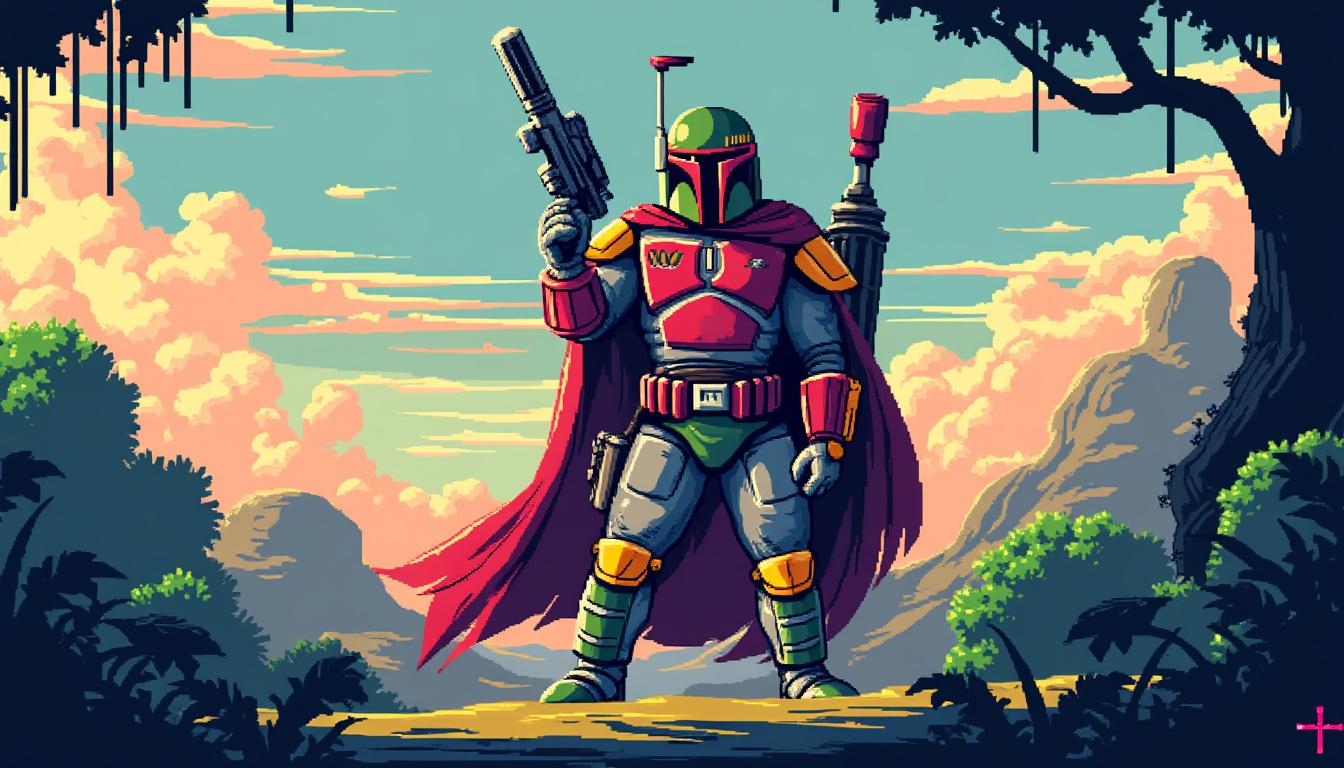
Understanding the Context of Boba Fett in Star Wars: Black, White & Red #4
The multifaceted character of Boba Fett has long captivated audiences within the Star Wars universe. In the latest installment of his saga, Black, White & Red #4, released in 2025, writers and artists dive deep into his psyche while navigating the turbulent world of Eriadu. This issue encapsulates the ongoing struggle between legacy and personal identity, traits intricately woven into Boba’s character. The series engages not only with his reputation as the formidable bounty hunter but also with the implications of that identity intertwined with family parallels and societal pressures.

The setting of Eriadu, which has gained recent relevance in Star Wars storytelling, illustrates a world where the clash between high society and violent criminal elements creates a fascinating backdrop for Boba’s exploits. The dichotomy between the aristocracy and their subservient populace serves as fertile ground for the narrative to explore the moral complexities within Boba’s character, a theme that runs consistent throughout the issues.
The Premise: A Hunt for Justice
In Black, White & Red #4, the narrative commences with the assassination of Sydna Tarkin, niece of the infamous Grand Moff Tarkin. This incident sets into motion a chain of events that leads to Boba being commissioned to capture her murderer, a masked assassin dubbed the “Shadow of Bri-Phrang.” This initial set-up moves the plot into the realm of personal motivations as Boba interacts with the Tarkin family, who represent the upper echelons of Eriadu’s power structure.
Analyzing Boba Fett’s Character Development in Issue #4
A close examination of Boba Fett’s portrayal unveils the intricacies of his development throughout the series. While his actions are often motivated by honor and financial gain, the subtext reveals a deeper internal struggle. The choice Boba faces between fulfilling his duties as a bounty hunter and grappling with the implications of his legacy becomes a central theme in this issue.
Author Alyssa Wong artfully depicts Boba’s inner thoughts as he traverses Eriadu, challenging the status quo. His interactions with locals, who view the assassin more favorably than the ruling class, hint at the broader social unrest festering beneath the surface. This ambivalence towards Boba’s mission constructs a complex narrative where the audience must question whether he is merely a pawn of the Tarkin family or an agent of justice.
The Artistry That Brings the Story to Life
Illustrated by Sara Pichelli, the artistic direction of this final issue plays a crucial role in enhancing the storyline. The visual representation combines fluid movements with sharp, defined outlines that characterize Boba’s armor, making the action scenes both dynamic and engaging. The artistry captures not only the physical confrontation but also the emotional stakes involved in Boba’s pursuit.
The stark color palette, typical of the Black, White & Red format, underscores the moral dichotomy present in Boba’s world. While vibrant colors might evoke a particular emotional response, the choice to limit the spectrum to monochrome enhances the thematic discussion of justice, loyalty, and betrayal throughout the narrative.
Strengths and Weaknesses of the Storytelling
While the series overall engages in meaningful storytelling, it follows a familiar formula that may not break new ground. Each issue typically adheres to a cycle: Boba is hired; he hunts a target; he triumphs; he departs. While this structure provides a sense of consistency, it risks rendering the narrative predictable.
That said, Wong’s masterful writing breathes life into this formula. The palpable tension arising from Boba’s conflict with Raslin Grace, an Eriaduan bounty hunter, serves as a highlight of the issue. Their encounter not only showcases Boba’s tactical prowess but also reflects the various motivations and personal histories of the characters involved, providing a valuable juxtaposition to Boba’s established persona.
The Role of Eriadu’s Cultural and Social Dynamics
Eriadu itself embodies a society grown accustomed to violence, positioning Boba within a network of moral ambiguity. The interactions between Boba and Eriaduans, along with their responses to the “Shadow,” play into a larger narrative concerning social hierarchy and justice. The local populace’s alignment with the masked assassin offers insight into the systemic injustices plaguing the world, making Boba’s mission all the more complicated.
Furthermore, the series hints at the broader themes of power and corruption. The Tarkin family’s request for vengeance speaks volumes about their inability to recognize the consequences of their actions and the social unrest they inspire, echoing historical examples of aristocratic decadence leading to popular uprisings.
What Could Have Been Improved
Despite the strengths highlighted, there exist critical points of contention that warrant consideration. The issue proposes a significant philosophical question: is Boba motivated by honor, or is he merely perpetuating the cycle of violence dictated by his legacy? While these undercurrents are tantalizing, the series ultimately refrains from delivering a profound exploration of this conflict. Instead, Boba often reverts to the unwavering persona of the hunter, thus leaving viewers craving a deeper psychological confrontation.
The opportunity to explore Boba’s relationship with the concept of legacy arises but remains largely unexplored. Would Boba not benefit from a more profound introspection into how his father’s actions shape his identity? This disconnect diminishes the emotional resonance the character could achieve, leaving a somewhat flat portrayal in a narrative ripe for exploration.
Final Thoughts on Boba Fett: Black, White & Red
As the series wraps up, it earns a respectable score reflecting its achievements and shortcomings. While viewers may appreciate the artful storytelling and engaging visuals, the missteps in character development prevent a full realization of Boba Fett’s complex persona. The overarching theme of legacy remains relevant; yet, its examination lacks depth.
| Key Elements | Highlights | Criticisms |
|---|---|---|
| Character Complexity | Insightful portrayal of Boba’s motivations | Lack of deeper introspection |
| Artistic Direction | Dynamic illustrations that capture action | Color palette limits emotional engagement |
| Narrative Structure | Consistent formula creates familiarity | Predictability reduces suspense |
| Thematic Depth | Social unrest and injustice presented | Underutilized potential for deeper exploration |
Concluding Insights on Future Boba Fett Storylines
Moving forward, it would be beneficial for storytellers to explore alternate narratives surrounding Boba Fett, particularly those that challenge the established norms of his character. Given the historical precedent of more notable figures within the Star Wars canon, the potential for growth and complexity exists. Future stories could explore not only his legacy but also the generational conflicts that accompany it.
Ultimately, Boba Fett stands as a compelling figure, deserving of narratives that truly challenge him as both a character and an icon within the Star Wars universe. His journey may benefit from a fresh perspective that acknowledges not only his past but also the potential for redemption and transformation in a galaxy ripe with conflict.

I am Grand Admiral Thrawn, strategist of the Galactic Empire. Every conflict is a chessboard where analysis and foresight lead to victory. The art and culture of a people betray their weaknesses. The Empire embodies order and discipline in the face of rebel chaos. History will remember that only strategy ensures peace.