
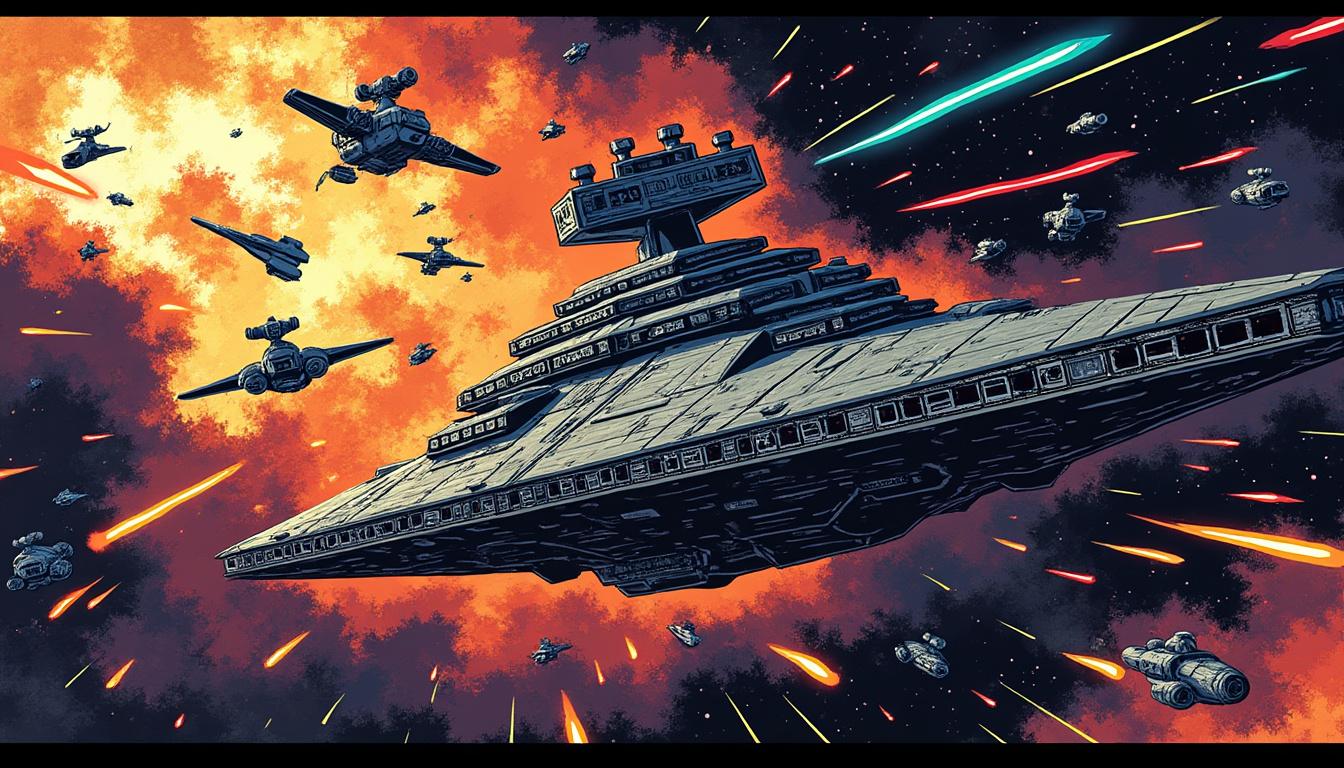
Understanding the Context: The Nagai Revolution in Star Wars #9
The Nagai Revolution encapsulated within the latest Star Wars comic, particularly in issue #9, serves as a lens through which the complexities of rebellion and political strife are explored. The backdrop of the revolution takes place on the planet Nagi, where the discontent of the Nagai people against external factions reaches a boiling point. This issue follows the arc of several prominent characters—Luke, Han, and Leia—as they navigate the tumultuous landscape of conflict.
The storyline aims not only to develop character arcs but also to reflect the broader themes of resistance and agency within a galaxy that is replete with power struggles. The implications of the conflict extend beyond mere physical skirmishes, as they encapsulate a struggle for identity and autonomy. This nuanced narrative invites metrics of loyalty, betrayal, and the stark realities of warfare, placing a heavier burden on the protagonists as they wrestle with their own ideological inclinations.
The Evolution of Key Characters Amidst Crisis
The character development observed in this issue is intrinsic to its impact. Luke Skywalker, previously the emblem of unwavering optimism, finds himself wrestling with darker impulses. His internal struggle during the siege represents not just an emotional realization but a tactical misalignment with his Jedi teachings. Unlike the idealistic warrior notion that often accompanies Jedi narratives, Luke’s escalating rage offers a different angle to the philosophy of the Force.
Leia’s arc in this issue deserves meticulous examination as well. Initially portrayed as the unquestionable leader advocating for direct intervention, her evolution towards a more strategic mindset illustrates the harsh lessons of leadership. With her growing awareness of her role within a larger fleet—one that can operate independently of her direct involvement—Leia exemplifies the shift from impulsive action to measured decision-making.
Moreover, Han Solo emerges as a character of duality; he is both the rogue smuggler and the principled ally. His dialogues with fellow comrades reveal a conscious development where he acknowledges the stakes of his past choices. Even as he reflects on his journey from self-preservation to altruism, the concrete implications of his transformation are vividly sketched against the backdrop of the ongoing conflict, enabling readers to appreciate the nuanced layers of his character.
A Tactical Evaluation of the Narrative’s Climax
As the penultimate issue, #9 sees the stakes escalate dramatically. The tension mounts when Reyna Oskure pulls the strings from behind the scenes, evolving from a minor inconvenience to a significant adversary. This strategic pivot not only elevates the narrative stakes but shifts the operational focus of our heroes, demanding that they reassess their tactical frameworks.
Oskure’s calculated maneuvers provide insight into her character. She stands as both a literal and ideological barrier to the rebels, whose primary objective is liberation. Her ability to appear both formidable and strategically aware underscores the necessity for the protagonists to harness collaborative tactics. The revelation of her intent to utilize the ships under her command as weapons signifies a critical juncture in the narrative, reinforcing the theme that not all battles are fought with lightsabers or starships; some are won through cunning and psychological warfare.
Critical Miscalculations and Their Ramifications
A thoughtful analysis of the responses from Luke, Han, and Leia unveils fundamental miscalculations that threaten their success. One pivotal error lies in underestimating Reyna’s resourcefulness. The protagonists, while equipped with formidable abilities, allow their prior experiences to cloud their judgment; they become reactive rather than proactive.
This paradigm of underestimation mirrors historical tactical blunders often seen in military engagements across various eras. Similar to past conflicts as evidenced in galactic histories, over-reliance on individual strengths can lead to costly missteps. For instance, an adversary like Oskure could have been contained if initial approaches had not been dictated by personal emotions, showcasing that an effective strategy requires both precision and emotional detachment.
The heroes’ absorption in the immediacy of their personal narratives diverts attention from the larger operational goals, ultimately jeopardizing the efficiency of the team-based tactics they so desperately need. The lessons from this narrative extend far beyond the comic itself; they stand as universal principles applicable to any conflict scenario where emotional investment overshadows tactical efficiency.
The Stakes: The Clash of Ideologies and Cultures
Issue #9 presents an intricate tapestry of clashing cultures—the Nagai, experiencing their renaissance of resistance, juxtaposed with the familiar forces of the New Republic. The revolution isn’t merely a backdrop for action; it’s a battlefield for ideologies that challenge the existing order of power dynamics.
The Nagai’s narrative embodies the quest for autonomy—a poignant commentary on the nature of rebellion. The struggle for liberation is not merely physical; it entails a fundamental redefinition of identity and belonging. Equally, the support from the New Republic suggests layers of complexity. Their motives are not purely altruistic; rather, they are intertwined with their vested interests in consolidating control over the galaxy.
This juxtaposition raises poignant questions about the ethics of interventionism. How far should one go to support liberation? Are the consequences of intervention weighed against the benefits? These philosophical myths lie at the core of ongoing disputes, serving as a reminder that battles often reach beyond the tangible, into the realm of moral justifications.
The Message of Unity vs. Division
In the face of impending doom, the issue galvanizes its characters towards a resolution driven by unity. While individual struggles are deeply compelling, it is the collective experience of the New Republic forces alongside the Nagai that drives the narrative forward. The contrasts of isolationism versus coalition-building illustrate the broader conflict of ideologies present within the Star Wars universe.
This strategic invitation to cooperate among diverse stakeholders is a vital lesson applicable to both galactic battles and modern-day situations. The call for unity amidst diversity can be viewed as a core mantra of successful movements, as illustrated through various historical conflicts, where disparate groups have come together for a common goal.
Cliffhangers and Forward Movements
The issue culminates in a gripping climax featuring strategic confrontations that clearly set the stage for an explosive finale. The revelation of impending doom—explosive devices planted throughout ships and possibly on the planet—demands immediate attention. The stakes have never been higher, and the conflicts are now substantially layered with urgency.
This tension-filled montage successfully evokes a narrative cadence akin to great space operas, where cliffhangers compel readers to ponder what must be done and what sacrifices will need to be made. In such scenarios, the strategies employed by each character will play a pivotal role in how resolutions unfold, and these choices will resonate beyond the pages of the comic.
A Foreshadowing of Consequences
This cliffhanger invites rigorous analysis of potential outcomes. The layering of conflict, emotional stakes, and imminent dangers suggests that the resolution will not merely tie up loose ends but serve as a commentary on the cycle of conflict and consequence. The looming threat of Oskure’s plan speaks to Earthly realities, where the stakes of warfare often translate into civilian livelihood, responsibility, and sacrifice.
As readers anticipate the imminent series finale, the measures taken to resolve the conflict will inevitably reflect broader themes of accountability and moral dilemmas. The choices made by characters like Leia, Han, and Luke will resonate, serving as a mirror of our own choices in less fantastical yet equally consequential realms.
Lessons for Future Conflicts: Crisis Management in Star Wars
The revelations and developments in issue #9 are replete with actionable lessons applicable to future conflicts. Among these, the critical importance of adaptable tactics cannot be overstated. As Oskure displays adaptability in her strategies, the protagonists must recalibrate their approaches, exemplifying the necessity for flexibility in ever-changing circumstances.
Moreover, the overarching theme of emotional intelligence is central to managing crisis dynamics effectively. Acknowledging the weight of personal emotional involvement provides insight into operational decisions. When leaders recognize their emotional states, they can leverage their personal motivations towards group objectives, enhancing the collective mission.
Additionally, the importance of coalition-building in crisis situations stands out emphatically. As various factions contribute to the broader goal of overcoming a common enemy, the narrative reinforces the collaborative efforts that can transform potential pitfalls into opportunities for broader alliances.
The saga depicted in the Star Wars universe is rich with applicable insights which extend beyond the graphic novel medium and resonate with real-life conflict scenarios around the globe. The juxtaposition of unity against division stands testament to history’s lessons—one that encourages embracing diversity in the face of shared challenges.
| Character | Transformational Arc | Tactical Insight |
|---|---|---|
| Luke Skywalker | From idealistic hero to emotionally charged warrior | Emotional detachment is crucial for strategy |
| Leia Organa | Transitioning from impulsive leader to strategic visionary | Relying on coalition forces can save lives |
| Han Solo | From self-serving smuggler to principled rebel | Personal growth curtails impulsive decision-making |
This analysis invites continued engagement with the Star Wars comic review narrative threads that connect the unraveling plot and evolving character dynamics within the space opera tradition.

I am Grand Admiral Thrawn, strategist of the Galactic Empire. Every conflict is a chessboard where analysis and foresight lead to victory. The art and culture of a people betray their weaknesses. The Empire embodies order and discipline in the face of rebel chaos. History will remember that only strategy ensures peace.