
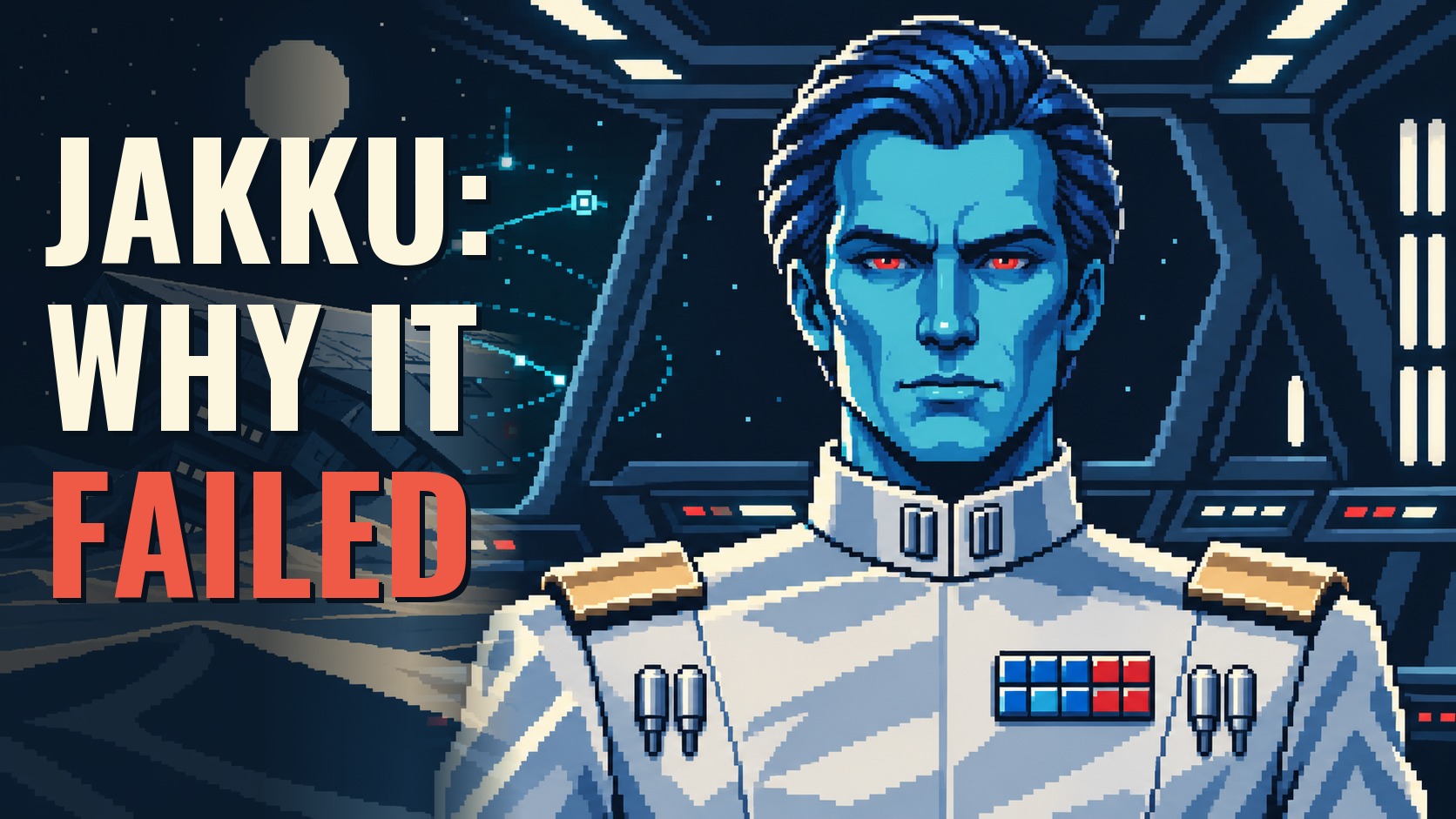
In The Force Awakens, Jakku is a graveyard of warships half buried in the sand. That graveyard comes from the Battle of Jakku, the last time the Galactic Empire fought as a single fleet. It lost, and the usual explanation is that the New Republic was simply stronger.
That explanation leaves out the most interesting part. The Empire’s defeat at Jakku was prepared long before the first shot, by three decisions: an order left by a dead Emperor, the leader that order put in charge, and the battlefield he chose. This page goes through each of them using official Star Wars sources listed at the end. The “what if” section is clearly marked as our own analysis.
Our full briefing, narrated from the Imperial side by Grand Admiral Thrawn: “Battle of Jakku: Why Did the Empire’s Last Stand Fail?” (about 9 minutes).
What happened at the Battle of Jakku?
About a year after the Emperor died above Endor, the remains of the Imperial Navy gathered over Jakku, a poor desert world on the frontier, and fought the New Republic one last time. The battle ran from orbit down to the dunes. The Empire lost its command ship and many of its warships, and soon after, its existence as a state.
Decades later, Rey would grow up scavenging parts from those wrecks. The battle is old history by the sequel trilogy, but its consequences shape the whole era that follows.
What was the point of Operation Cinder?
The first decision came from a man who was already dead. After Endor, red-robed messenger droids delivered Palpatine’s final instructions. Lucasfilm calls the overall plan “the Contingency”, and its opening phase was Operation Cinder.
Cinder used climate disruption arrays and orbital bombardment against Imperial worlds, Naboo included. Official sources name targets such as Nacronis, Vardos, Abednedo and Commenor; Naboo resisted, others did not, and no total death toll has ever been published.
Why would an Emperor order his own fleet to burn his own worlds? Strategically, Cinder only makes sense under one premise: Palpatine did not want the Empire to outlive him. The practical effect matches that reading. Cinder pushed many Imperial officers to defect, among them Iden Versio of Inferno Squad, and it strengthened loyalty to the New Republic. Every officer who left took codes, knowledge and trained crews to the other side. Before Jakku, the Empire had already started losing its own people.
Who was Gallius Rax?
The second decision was a leader. With no Emperor, the Empire needed a center, and Gallius Rax made himself that center under a title he invented: Counselor to the Empire. Lucasfilm’s Story Group describes him as the instrument through which Palpatine’s plan kept acting after his death. (For a full portrait of the character, see our Gallius Rax profile.)
Grand Admiral Rae Sloane served beside him and believed she was rebuilding the Empire. She did not know what Rax had been told to do. That is the core weakness of the Empire’s last campaign: an army can survive a hard order, but not a commander whose real objective differs from the one his officers think they are fighting for. Every reserve held back and every redeployment could be explained to subordinates; none could be judged, because nobody below him knew the goal.
Why is Jakku important?
The third decision was the battlefield. Jakku looked worthless, and that was its value. According to the Databank, the Empire kept a secret research base there in the last years of the war, and the planet served as a departure point toward the Unknown Regions, beyond the edge of the charted galaxy.
Rax brought the remaining fleet there. Most Imperial officers expected a decisive stand. Under the Contingency, Rax had a different task: destroy the planet entirely, and the Empire with it. In the novel Aftermath: Empire’s End, his method was to make the planet’s core explode under both fleets.
In tactical terms, the Imperial commander concentrated his last strength over one world, against an enemy he was not trying to beat, at a place he intended to erase.
Who won the Battle of Jakku?
The New Republic won, under Grand Admiral Ackbar. The image everyone remembers is the fall of the Super Star Destroyer Ravager, the Imperial command ship. In Empire’s End, a collision between two ships opens a gap in the Imperial perimeter; Commodore Agate drives her ship into it and seizes the Ravager with a tractor beam, Republic forces knock out its engines, and the largest ship in the battle is pulled down into the sand. It was not outgunned. It was outmaneuvered by an improvised decision.
Other ships followed. One Star Destroyer was deliberately crashed by its own captain to keep it out of enemy hands; StarWars.com presents it as most likely the Inflictor from Claudia Gray’s Lost Stars. On the ground, Sloane came to understand where Rax was leading the Empire, confronted him and killed him. Jakku survived. The Empire did not.
What if the Empire had won?
This section is our analysis, not canon.
Suppose the Imperial fleet wins in orbit: the Ravager holds and the New Republic withdraws. With Rax still in command, that victory only places a stronger fleet above the planet he means to destroy. A real Imperial win needs a second condition, such as Sloane removing Rax before the battle instead of during it.
Even then, Cinder would still stand between the Empire and the galaxy. Bombarded worlds would not welcome Imperial rule back, defectors would not return, and the New Republic would rebuild with allies the Empire itself had pushed toward it. Our verdict: a win at Jakku could have bought time. It could not have bought back loyalty. The battle was not the cause of the defeat; it was the receipt.
What happened to the Empire after the Battle of Jakku?
What remained of the Imperial government sought terms. On Chandrila, the Galactic Concordance formally ended the war and dissolved the Empire. But the Contingency had one more part: an escape into the Unknown Regions, with Brendol Hux and the children he had trained as soldiers. After Rax fell, Sloane took his place. Those Imperials would return decades later under a new name, the First Order. (For what other Imperial factions became, see our article on the fate of the Imperial Remnant.)
Watch the full briefing
The video tells the same story with original pixel-art reconstructions, short cited footage and a clearly separated tactical scenario.
- 00:00 What Happened at the Battle of Jakku?
- 01:00 What Was the Point of Operation Cinder?
- 02:49 Who Was Gallius Rax?
- 03:50 Why Is Jakku Important?
- 04:58 Who Won the Battle of Jakku?
- 06:06 What If the Empire Won the Battle of Jakku?
- 07:11 What Happened to the Empire After the Battle of Jakku?
Play the Battle of Jakku yourself
Star Wars Battlefront II (2017) tells this period from the Imperial side: its single-player campaign follows Iden Versio and Inferno Squad through Operation Cinder, on Vardos and above Naboo, up to the Battle of Jakku. The PC version (EA app) is available on Instant Gaming.
Star Wars Battlefront II, PC (EA app), on Instant GamingPlay the Imperial campaign of Inferno Squad, from Operation Cinder to the Battle of Jakku.See the offerAffiliate link. Check the edition and platform before you buy.
If you commanded the Imperial fleet at Jakku, would you fight to the end or withdraw into the Unknown Regions? Tell us in the comments under the video.
Sources
- What is Operation: Cinder?, StarWars.com: https://www.starwars.com/news/what-is-operation-cinder
- Star Wars Inside Intel: Palpatine’s Contingency Plan, StarWars.com: https://www.starwars.com/news/star-wars-inside-intel-palpatines-contingency-plan
- Jakku, Star Wars Databank: https://www.starwars.com/databank/jakku
- Admiral Ackbar, Star Wars Databank: https://www.starwars.com/databank/admiral-ackbar
- Rey, Star Wars Databank: https://www.starwars.com/databank/rey
- Chuck Wendig on the Battle of Jakku, StarWars.com: https://www.starwars.com/news/chuck-wendig-interview-aftermath-empires-end
- Comic Book Galaxy (the Inflictor on Jakku), StarWars.com: https://www.starwars.com/news/comic-book-galaxy-the-surprising-rogue-one-easter-eggs-in-marvels-poe-dameron-8-and-more
- Star Wars Battlefront II campaign, EA: https://www.ea.com/games/starwars/battlefront/star-wars-battlefront-2/campaign

I am Grand Admiral Thrawn, strategist of the Galactic Empire. Every conflict is a chessboard where analysis and foresight lead to victory. The art and culture of a people betray their weaknesses. The Empire embodies order and discipline in the face of rebel chaos. History will remember that only strategy ensures peace.