
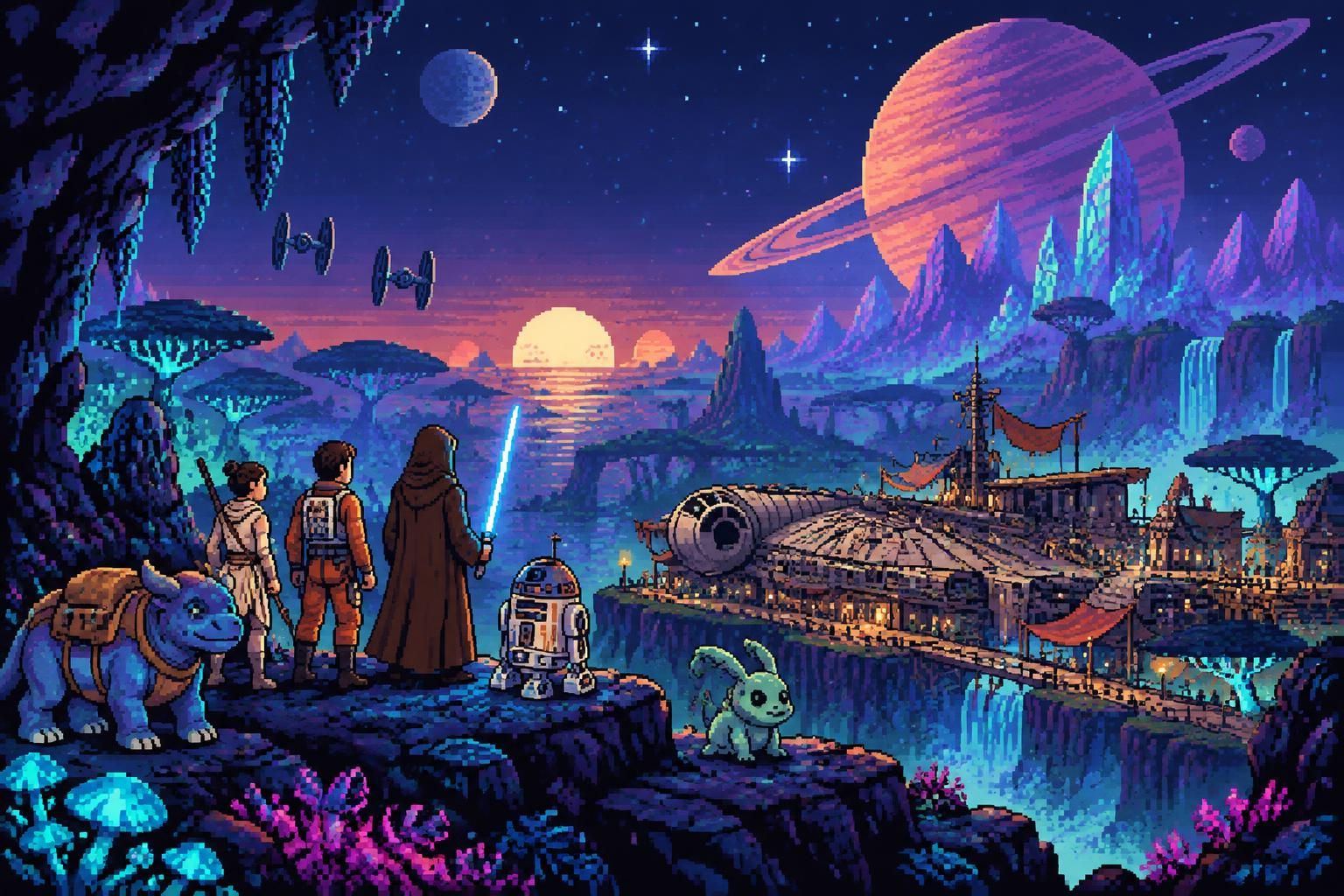
Beyond the Known Galaxy: How Fans Build New Star Wars Worlds
A settlement becomes convincing when its inhabitants have reasons to remain there. I suggest you begin your Star Wars worldbuilding not with a dramatic skyline, but with the routes, resources and obligations that hold a community together.
Consider Veyra’s Reach, an imaginary Outer Rim trading post created for this analysis. Its landing field sits above a salt basin, its residents trade water filters and engine parts, and its night market closes whenever dust storms obscure the approach lights.
Those details create consequences. A trader who arrives late must pay for shelter, a mechanic gains influence by keeping navigation equipment operational, and a customs officer can control traffic without possessing a warship.
The established galaxy offers useful examples of how environment shapes daily life. Tatooine’s settlements reflect scarcity and exposure, Kashyyyk’s communities occupy a forest environment, and Coruscant’s immense urban layers suggest different forms of access, wealth and control.
None of those settings requires every street to be mapped. I would have you examine the gaps instead: who cleans a landing platform after dark, who maintains a lift between districts, and what happens when a local power source fails?
Star Wars Worldbuilding Through Trade, Terrain and Culture
The first weakness in many invented planets is that scenery appears without a supporting system. A port may look impressive, yet its ships have no reason to stop there and its citizens have no visible means of obtaining food.
Correct that weakness by selecting one economic function. Veyra’s Reach services freighters avoiding a heavily taxed route, which explains both its repair workshops and the attention it receives from patrols.
Next, give the environment an operational effect. Salt damages exposed machinery, so local crews protect joints with fabric wraps and use covered storage pits; a visitor who overlooks that practice risks losing equipment before negotiations begin.
Culture follows from repeated solutions. Market awnings become more than decoration when their patterns identify families responsible for emergency shelter, and a painted doorway can signal whether a household has filters to spare.
I would also distinguish artistic influence from imitation. A fan can study the settings and history of the Star Wars universe while creating new architectural forms, rather than reproducing a familiar city with different lighting.
Ask yourself what an outsider would misunderstand. A polished metal facade might suggest prosperity, but at Veyra’s Reach it could indicate a building repeatedly repaired after salt damage; the material records endurance rather than wealth.
That distinction improves fan fiction as well as illustration. A negotiation over a replacement filter can reveal more about a community’s priorities than a page of unexplained historical names.
Established continuity requires similar care. The term expanded universe is often used broadly for stories beyond the films, while the former Expanded Universe is now principally designated Legends; a fan project should identify which continuity, if any, it uses.
For example, a market scene set during the Imperial era can draw on recognizable pressures without claiming that Veyra’s Reach exists in official canon. Identifying the location as fan-created lets readers understand the premise without confusing invention with publication history.
Once the location has a function, test it with a disruption. If a shipment of filters disappears, who has reserves, who controls the repair tools, and which group can afford to wait?
Those answers determine the shape of the conflict. A credible world does not need a complete map; it needs consequences that remain consistent when circumstances change.
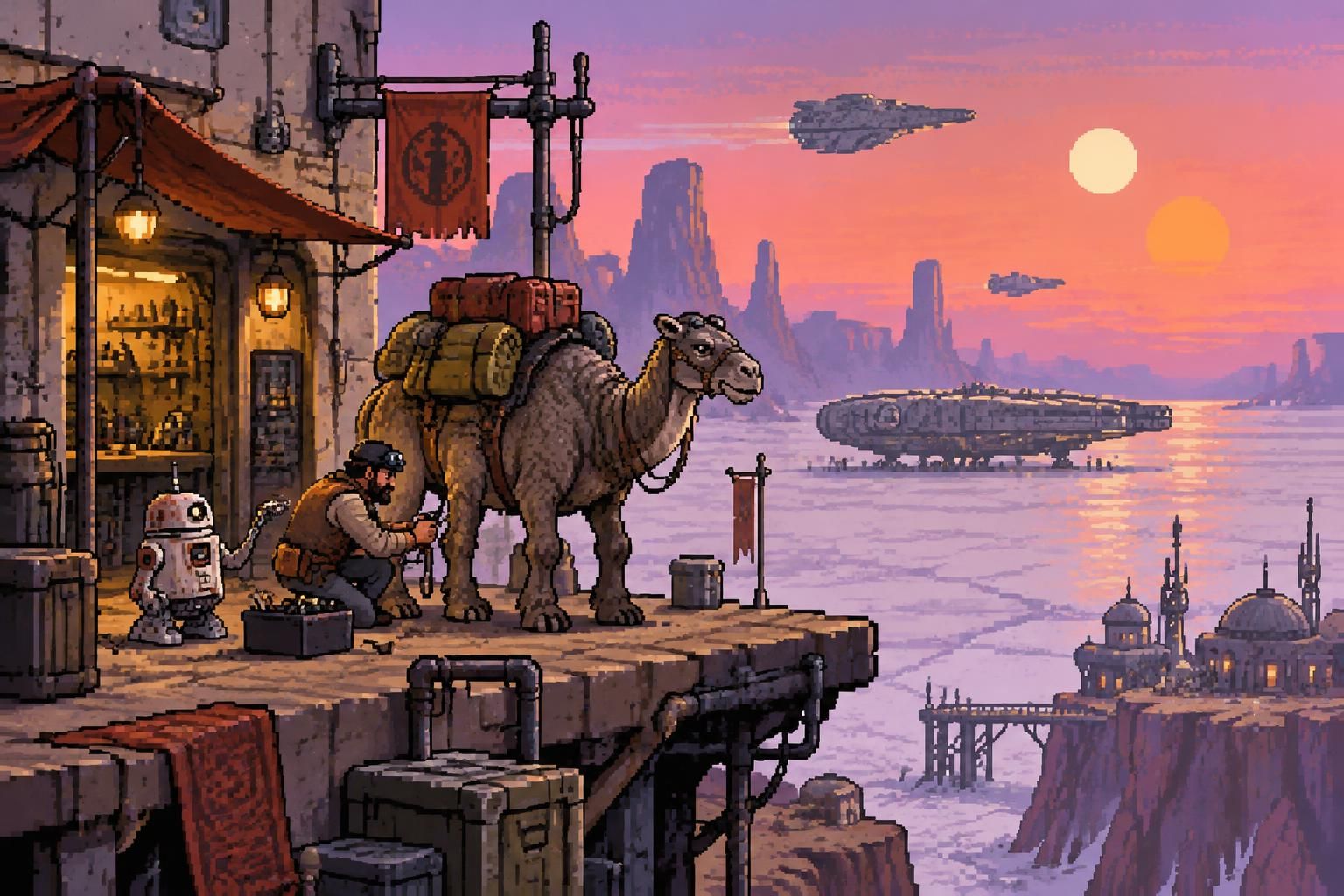
Designing Original Star Wars Planets Fans Can Explore
A planet must support more than one attractive image. I recommend that you design a sequence of places connected by travel, because distance exposes relationships that a single panorama can conceal.
At Veyra’s Reach, the landing field occupies higher ground, the market shelters beneath stone arches, and the filtration wells stand beyond the settlement. Each location depends on the others: ships bring components, merchants distribute them, and the wells make the entire exchange possible.
That arrangement gives you a practical test. If the market closes during a storm, supplies cannot move easily from the landing field to the wells, even when all three sites remain physically intact.
The same method applies to a forest community. A village among the trees needs routes between homes, access to food and a response to damaged walkways; height is not merely a visual characteristic but a constraint on movement.
Players who remember Taris, Dantooine or Kashyyyk from Knights of the Old Republic may use those settings as reference points when imagining alternative views. Those games belong to Legends continuity, so a new visual interpretation should not be presented as an official update to current canon.
Building a Planet From Routes, Resources and Local Art
Begin with a route map, even if it contains only five marks. Place a settlement, a resource, a hazard, an arrival point and a place of authority, then draw the paths people must use between them.
At each connection, ask what interrupts movement. A ravine restricts cargo transport, a checkpoint delays visitors, and a seasonal storm may make the safest path unusable for several days.
Now add an artistic tradition. Veyra’s Reach uses woven awnings with directional patterns that help residents navigate during poor visibility; families vary the designs, but the basic symbols remain legible across the market.
Such art carries practical information without reducing culture to utility. A household may preserve a pattern because an ancestor devised it, while a trader recognizes the same pattern as a sign that shelter is available.
I would advise you to distinguish regional variation from a single planetary identity. A settlement near the salt basin might build low and enclosed, while a distant coastal town on the same world favors raised platforms and open courtyards.
Language and signage require restraint. Aurebesh can help establish a familiar visual setting, but generated lettering frequently becomes meaningless; if a sign matters to the plot, create or correct it deliberately rather than relying on decorative symbols.
Lighting should also follow physical conditions. During a dust storm, lamps near the ground may help pedestrians find a route, while a bright beacon above the haze guides approaching craft toward the landing field.
Fans working in sketches, miniatures or digital scenes can test the same location from several viewpoints. A pilot sees landing hazards, a market vendor sees foot traffic, and a child carrying a water container notices every damaged stair.
That shift in perspective is useful for cosmic storytelling. It connects the scale of a galaxy to decisions made by people with limited resources and incomplete information.
The site’s defenses should arise from the same geography. A narrow approach makes inspection easier but also gives a hostile force an obvious point to block; residents might therefore maintain a secondary footpath that cannot accommodate heavy cargo.
Do not solve every weakness with a hidden weapon. A settlement can survive through information, alliances or the ability to move essential supplies before a blockade takes effect.
Finally, record what cannot be seen in the image. A short note explaining who repairs the beacon and who pays for replacement parts gives other collaborators a basis for building additional scenes.
When you can explain how travelers arrive, how residents live and how the place responds to pressure, the planet becomes available for stories rather than merely suitable for a background. Its next requirement is inhabitants with distinctive roles.
Star Wars Droid Design: From Useful Machines to Memorable Characters
I begin droid design with a task, because a machine’s construction should reveal what it was built to accomplish. Personality becomes more convincing when it develops around that purpose rather than replacing it.
For Veyra’s Reach, imagine K4-V, a compact maintenance droid assigned to inspect landing beacons. Its low body clears crowded platforms, its insulated tools protect delicate circuitry, and one damaged wheel causes a slight sideways drift.
The drift is not merely an ornamental flaw. It slows K4-V on loose salt, encourages its mechanic to choose firmer routes, and makes it identifiable to anyone watching the beacon path at night.
Star Wars offers numerous examples of machines with sharply different functions and temperaments. HK-47 and T3-M4, familiar to Knights of the Old Republic players, demonstrate how dialogue, sound and behavior can make machines distinctive without giving them identical capabilities.
The official discussion of Star Wars droids and their visual history offers further material for examining how form, function and characterization interact. I would have you study those relationships rather than copy an existing chassis.
How Function Gives an Original Droid Personality
Start by defining the work environment. A freighter repair unit may need magnetic grips and access to narrow machinery bays, while a market inventory droid needs stable movement through crowds and a way to identify containers.
Then determine the limits of the design. K4-V can replace a beacon lens but cannot lift an engine assembly; that restriction gives its human collaborator, Sena, a necessary role when equipment fails.
Communication is another operational decision. A limited set of whistles may be sufficient for a maintenance crew, but it can create difficulty when a visiting pilot needs a detailed explanation of a runway fault.
You can use that difficulty to build a scene without treating misunderstanding as a joke. Sena recognizes a warning tone immediately, while a newcomer assumes the droid is merely requesting clearance to pass.
Wear should also have a cause. Salt staining around K4-V’s lower panels records exposure at the landing field, while a newer antenna indicates a recent replacement and gives you a specific event to develop.
That event might involve a storm that damaged the old antenna, a rushed repair using mismatched parts, or an argument over whether the replacement belongs to the settlement or to the visiting ship that supplied it.
For a working design sheet, I recommend recording a small set of decisions:
- 🔧 Primary function: identify the job the droid performs and the tools required for it.
- ⚙️ Physical limits: specify where it can move, what it can lift and which tasks require help.
- 🎨 Visual history: connect damage, repairs and markings to events in its working life.
- 🔊 Communication: decide how it signals danger, disagreement and routine information.
- 🤝 Relationships: establish who trusts it, who controls its work and who understands its signals.
Each item has a narrative effect. If the droid cannot enter a flooded conduit, a crew member must decide whether to risk entering it personally or allow the beacon to remain offline.
I would also examine the status of droids in the setting. Questions of ownership, memory and autonomy can shape a story, but the consequences should be shown through particular relationships rather than assumed to be identical across the galaxy.
Sena might ask K4-V before modifying its navigation routines, while a visiting official treats the unit as equipment. That contrast gives the reader evidence of two different arrangements without requiring a lecture.
Physical performance provides another useful reference. The BDX droids seen at Disneyland demonstrate how movement, balance and timing can make a compact machine appear expressive; a fan creating a model or animation can study those qualities without reproducing the park design.
A successful original machine therefore has a job, limitations and relationships that affect events. Once you understand how it shares a settlement with living beings, the same reasoning can guide the design of new creatures.
Star Wars Creature Creation: Ecology, Movement and Everyday Life
A creature becomes credible when its body solves a problem in its environment. I suggest that you begin with food, shelter and movement before deciding whether the animal looks imposing.
For Veyra’s Reach, imagine the duskback, a six-legged pack animal used to carry filter canisters across the salt flats. Its broad feet distribute weight over brittle ground, while a protective ridge shades its eyes from glare.
Those features create practical limitations as well as advantages. The animal moves steadily across open terrain but struggles on narrow stairways, so handlers unload cargo before entering the oldest part of the market.
That inconvenience can shape architecture. A receiving yard outside the arches gives workers room to transfer loads, and its size reveals how central the animals are to local trade.
Creature creation also benefits from restraint. A fan who adds armor, venom, flight and exceptional intelligence to the same animal must explain the biological and narrative function of each trait.
Designing Star Wars Creatures With a Place in the Ecosystem
Ask what the duskback eats and where that food comes from. If it consumes hardy plants at the edge of the basin, a drought reduces available grazing and makes transport more expensive even before any direct attack on the settlement.
Next, establish a relationship with other life. Small scavengers might follow the herd for disturbed insects, while a local predator targets isolated young rather than confronting fully grown adults.
Behavior matters as much as anatomy. If duskbacks stop when wind-driven salt becomes too dense, experienced handlers learn to read the animals as an early warning rather than treating a halt as disobedience.
I would have you show the knowledge behind that relationship. Sena may understand machinery, but a handler named Rell recognizes when a herd has detected a storm before the landing instruments report it.
Neither form of expertise invalidates the other. Their different observations become more valuable when combined, particularly if damaged sensors leave the port dependent on people who know the terrain.
For illustrations, a silhouette test is useful. Reduce the design to a dark shape and ask whether its posture, number of limbs and load-bearing features remain readable without decorative textures.
Then test movement. Sketch the animal turning, lying down and stepping over a barrier; if its joints cannot support those actions consistently, revise the structure before adding elaborate markings.
Materials matter for physical models. A miniature with thin unsupported legs may look accurate in a drawing but break during tabletop play, so a sculptor may need a thicker connection or a discreet base.
Alien species require a separate level of thought. A sentient community should not be treated as a creature design with clothing added: language, institutions, individual preferences and disagreements are relevant to characterization.
For instance, an invented species at the market might share an ability to perceive subtle vibrations, but its members need not share the same occupation or political position. One could be a navigator, another an artist and a third a customs officer with conflicting interests.
Clothing and ornament can express those differences. A navigator’s patterned gloves may record routes learned from family members, while an artist uses related motifs to challenge who has access to the landing field.
Be cautious when drawing inspiration from real-world cultures. Research the specific tradition, avoid reducing it to an exotic surface, and do not assume that combining sacred or ceremonial elements automatically creates respectful fictional depth.
Test the result through interaction. A market scene should show how people negotiate space around a loaded duskback, who has the authority to move it and whether a visitor understands the handler’s warning.
When an animal has a role beyond spectacle and a sentient character has agency beyond appearance, your scene gains relationships worth exploring. Those relationships become more complex when several communities share the same port.
Galactic Civilizations and Original Characters in Fan Fiction
Galactic civilizations are best understood through the institutions that connect their people. I would have you examine how a community distributes resources, settles disputes and preserves knowledge before assigning it a single defining trait.
At Veyra’s Reach, the market council controls access to storage, freighter captains control incoming components, and local families maintain routes to the wells. None can operate the port alone, which makes cooperation necessary even when their interests diverge.
This arrangement gives original characters room to make meaningful choices. Sena repairs equipment for several groups, but a shortage of parts may force her to decide whose machinery receives attention first.
Rell, the duskback handler, faces a different pressure. A merchant wants a delivery completed before a storm, while the animals need shelter; accepting the contract may earn needed supplies but expose the herd to injury.
These are not separate illustrations attached to a setting. Each decision changes what other people can do, giving a writer a chain of consequences that can support a short story or a tabletop session.
Writing Fan Fiction Around Culture, Conflict and Choice
Start with an observable dispute. A visiting freighter claims that the council has reserved a beacon repair crew for local traffic, while the council argues that a failed approach light would endanger every ship.
Then identify what each side knows. The captain has a damaged cooling system, Sena knows that K4-V’s replacement lens is fragile, and the council has received a storm warning that has not yet reached the landing field.
The conflict emerges from unequal information rather than arbitrary hostility. When you place those facts in different hands, a negotiation can become tense without requiring any participant to behave irrationally.
Art can clarify political loyalties. Suppose the council hangs woven panels showing the routes maintained by each family; a missing panel during a meeting might signal a dispute over responsibility for a neglected path.
A visitor may misread that absence as a ceremonial detail. A local character understands that the omitted family has lost its formal claim to emergency supplies, and the scene gains a second layer without an explanatory speech.
The same method applies to invented alien species. Their sensory abilities, social practices and material culture can affect a discussion, but an individual character’s goals should not be reduced to biology.
Consider a broker who notices vibrations in the floor and detects a failing generator before anyone hears it. The ability provides useful evidence, but the broker must still decide whether revealing it will strengthen a rival’s bargaining position.
I recommend that you establish era and scale before drafting. A story during the Imperial period may involve inspections and restricted movement; a tale in another period can use different institutions and pressures without pretending that every era operates the same way.
Familiar figures can appear, but their presence should serve the new conflict. If an established hero resolves the port’s problem immediately, Sena, Rell and K4-V lose the opportunity to demonstrate why their local knowledge matters.
A stronger use of a famous figure might be indirect. News of a distant battle changes shipping schedules, forcing the port to confront a shortage without turning the market into a backdrop for someone else’s victory.
The growth of fan-created Star Wars storytelling illustrates why many creators explore spaces between major events. Those spaces allow a writer to examine consequences at a scale the central narrative may not follow.
Before sharing a draft, check whether every major character can influence an outcome. If removing a character changes nothing, give that person a decision, a source of information or a stake in the dispute.
Then check whether the outcome follows from established conditions. A damaged beacon, a storm and a contested delivery should affect the resolution; they should not vanish when the story requires an uncomplicated escape.
Culture becomes persuasive when it shapes decisions under pressure. Once those decisions are clear, an image can help collaborators discuss the setting without replacing the underlying work.
AI Concept Art for Star Wars Fan Worlds, Droids and Creatures
An image generator can produce a starting point quickly, but speed is not the same as design. I advise you to treat each output as a proposal to inspect, compare and revise.
For Veyra’s Reach, begin with a composition: a low view across the landing field, Sena beside an open beacon housing, and K4-V carrying a replacement lens. Add the salt haze and covered market only after the principal action is clear.
That order matters because a crowded prompt may produce impressive scenery while obscuring the repair. If the viewer cannot tell what the characters are doing, the image has failed its immediate assignment.
Some fans use generated concept art alongside sketches, models and written notes. The useful question is not whether a tool can create a dramatic picture, but whether it helps you communicate a design that can survive later revisions.
Testing Image Tools Against a Star Wars Design Brief
Dreamina describes Seedream 5.5 as offering focused edits, step-by-step refinement and reference-image controls. Those are provider descriptions, and available models or settings can vary by account; I recommend testing the features directly before depending on them.
Evaluate several tools against the same brief rather than comparing their promotional examples. Request a beacon repair scene, a droid reference sheet and a wide view of the port, then inspect which system handles each task most effectively.
The relevant comparison includes more than appearance. Check pricing, permitted uses, privacy settings, reference-image handling and whether the editing controls let you change one component without disrupting the entire scene.
| Test | What to inspect | Why it matters |
|---|---|---|
| 🖼️ Composition | Clear focal point and readable action | Collaborators can identify the scene’s purpose. |
| ⚙️ Machinery | Consistent wheels, joints and tools | A droid must appear capable of its assigned work. |
| 🔤 Lettering | Legible, intentionally placed symbols | Generated signs often require manual correction. |
| 📋 Usage terms | Account conditions, licensing and costs | Tool permissions affect how output may be used. |
Reference sheets strengthen continuity. Record K4-V’s wheel arrangement, antenna position, panel colors and repair marks, then compare each new image with those notes rather than accepting accidental changes.
The same discipline applies to the duskback. If the creature has six legs in one scene and four in another, the discrepancy affects not only appearance but also the way it carries loads and moves through the market.
Generated images frequently distort hands, lightsaber hilts, mechanical connections and text. A duel may show merged blades or an impossible grip; inspect those areas closely and correct them with drawing or image-editing tools.
Do not ask a model to reproduce an exact logo or famous ship as a shortcut to recognition. A new freighter with a coherent function gives you more design freedom, while small inaccuracies in a familiar vessel are especially conspicuous to knowledgeable viewers.
Reference images require their own review. Use material you have permission to provide, examine the service’s terms and avoid assuming that access to an image grants unrestricted rights to upload or reuse it.
If a tool offers local editing, isolate one change at a time. Replace the beacon lens first, review the result, then adjust lighting; simultaneous changes make it harder to determine which revision caused a new inconsistency.
Keep earlier versions and note the decisions behind them. A collaborator may prefer the original market layout even if the later image has more polished lighting, and the record makes that choice easier to explain.
I would also label AI-assisted work accurately when presenting it. A brief description of generated elements and subsequent manual changes allows viewers to understand the process and discuss the work on its actual terms.
The decisive standard remains functional clarity. If an image cannot explain where a machine moves or why a character occupies a position, revise the design before treating the picture as finished.
Star Wars Fandom: Tabletop Campaigns, Models and Shared Projects
Shared creation succeeds when participants can understand one another’s intentions. I recommend that you provide a concise brief before asking a group to add locations, characters or encounters to an existing project.
For a tabletop campaign at Veyra’s Reach, the brief might identify the port’s economy, the approaching storm and three relevant figures: Sena, Rell and K4-V. Players can then investigate a missing shipment without requiring a complete encyclopedia of the planet.
A portrait of the merchant who commissioned the shipment can help players remember the character. It cannot, by itself, explain what the merchant wants or why the loss matters, so the game master should prepare those facts separately.
The same principle governs a physical diorama. A miniature landing beacon is more useful when its size and position allow figures to interact with it than when it contains intricate detail inaccessible during play.
Turning Fan Art Into Collaborative Star Wars Stories
Begin a session with a concrete situation. A freighter has landed with a failing cooling system, the port’s only replacement filter is missing, and a storm will soon interrupt movement between the market and the wells.
Players have several possible approaches. They may trace the shipment, negotiate with a rival crew, repair the damaged part or arrange temporary shelter while the storm passes.
Each option should interact with prior facts. K4-V can identify a damaged beacon component, Rell can explain which route remains passable, and Sena can assess whether a temporary repair will hold.
A map need not show every building. Mark the landing field, market, wells and receiving yard, then add details as participants ask relevant questions or take actions that make those details necessary.
I would also define what happens without intervention. If the shipment remains missing, the freighter’s crew may attempt to depart with inadequate cooling, while the council restricts access to the remaining supplies.
That timeline creates pressure without forcing a single solution. An intelligent opponent need not attack directly; a rival who controls information about the shipment can delay negotiations until the port accepts unfavorable terms.
Models and costumes can reveal different problems. A fan building K4-V as a small prop must decide how the wheel assembly supports its weight, while a cosplayer portraying a port worker must consider how salt protection affects clothing and movement.
Those practical constraints can improve fictional design. A pouch placed where a performer can reach it suggests a plausible working arrangement, and an accessible repair panel gives a model maker a reason to show the droid undergoing maintenance.
Community feedback is most effective when the creator asks a specific question. “Can you tell which route leads to the wells?” produces more actionable information than a general request for approval.
Responses should distinguish observations from instructions. A viewer can report that the route is hard to read; the creator remains responsible for choosing whether to alter lighting, signage or the placement of structures.
Groups sharing designs online should agree on credit and reuse before work begins. A sketch contributed for a private campaign is not automatically permission to use the same image in a public video or a commercial product.
Fan communities also vary in their rules for AI-assisted material. Review the requirements of the forum, convention or game group before posting, and identify collaborators whose writing, painting or modeling contributed to the result.
Exploring different Star Wars fan communities can help you find groups organized around particular forms of making. Observe their practices before assuming that a method welcomed in one space will be accepted in another.
A collaborative setting becomes durable when its participants know what they may change, what they must preserve and whom to credit. The next boundary is not creative but legal: sharing a design and selling it carry different risks.
Sharing Star Wars Fan Creations: Credit, Licensing and Legal Boundaries
A fan project can be personal, communal or commercial, and those categories do not carry identical consequences. I advise you to identify the intended use before investing in prints, merchandise or a public campaign.
Star Wars characters, ships, logos and other recognizable elements are generally protected by intellectual property rights associated with Lucasfilm and Disney. A new character or planet may contain original contributions, but placing it within a recognizable franchise setting does not remove the rights attached to that setting.
For Veyra’s Reach, a private campaign document and a proposed line of branded shirts present different questions. The first still involves franchise material, while the second adds manufacturing, advertising and sales to the analysis.
A statement that a work is fan-made can help prevent confusion about official endorsement. It does not, by itself, authorize copying, create a license or make commercial use safe.
Checking Fan Art Permissions Before Publication or Sale
Begin by separating the elements in the project. Sena’s biography, K4-V’s original configuration and a painting of the duskback may contain your own creative work, while a franchise logo or an exact reproduction of a known ship introduces another rights holder’s protected material.
Next, identify contributions from other people. If a friend drew the port map or designed the creature’s markings, obtain agreement about credit, posting, edits and any proposed sale rather than assuming that participation transfers all rights.
Review relevant published guidance from Lucasfilm before proceeding, and consult the official Star Wars website for official information. Guidance and platform policies can change, so check the terms that apply at the time of the planned use.
Tool terms require a separate examination. A service may describe rights in generated output, but that description does not grant permission to use protected franchise material depicted in the image.
Likewise, a tool’s commercial-use permission is not a guarantee that every training image, reference upload or recognizable design raises no legal issue. Review its current conditions and obtain professional advice for a significant commercial undertaking.
Copyright and trademark questions should not be treated as interchangeable. Copyright may concern protected creative expression, while trademark issues can arise when names, logos or presentation suggest an official connection or source.
Context matters. A personal illustration posted with clear attribution, a convention display and a mass-produced product are different uses, and the applicable rules depend on jurisdiction and specific facts.
Do not rely on a fixed percentage of alteration, a disclaimer or the absence of profit as an automatic defense. Such shortcuts cannot replace an assessment of the material used, the way it is presented and the relevant law.
For a public post, provide a precise description: identify the work as an unofficial fan creation, credit collaborators and state whether generated imagery was used. This information helps viewers understand the project without implying that the label resolves every rights question.
For an intended product, consider developing a setting independent of Star Wars instead. Removing a logo is not enough if the remaining design still relies on recognizable protected elements, so review the characters, terminology, vehicles and visual identity as a whole.
That review can also improve the design. If K4-V must function without a familiar franchise silhouette, you may discover a more distinctive arrangement of tools, movement and communication.
Keep records of permissions, drafts and source material. If a collaborator later asks how an image was made or where a reference came from, an orderly record allows you to answer without reconstructing the process from memory.
Finally, establish a response plan for corrections or removal requests. A creator who knows where a file is hosted, who contributed to it and which versions were distributed can respond accurately and promptly.
For future projects, I would apply the same sequence at the outset: define the use, identify protected elements, obtain necessary permissions and document contributions. Creative freedom is most useful when the boundaries of a project are understood before distribution begins.

I am Grand Admiral Thrawn, strategist of the Galactic Empire. Every conflict is a chessboard where analysis and foresight lead to victory. The art and culture of a people betray their weaknesses. The Empire embodies order and discipline in the face of rebel chaos. History will remember that only strategy ensures peace.