
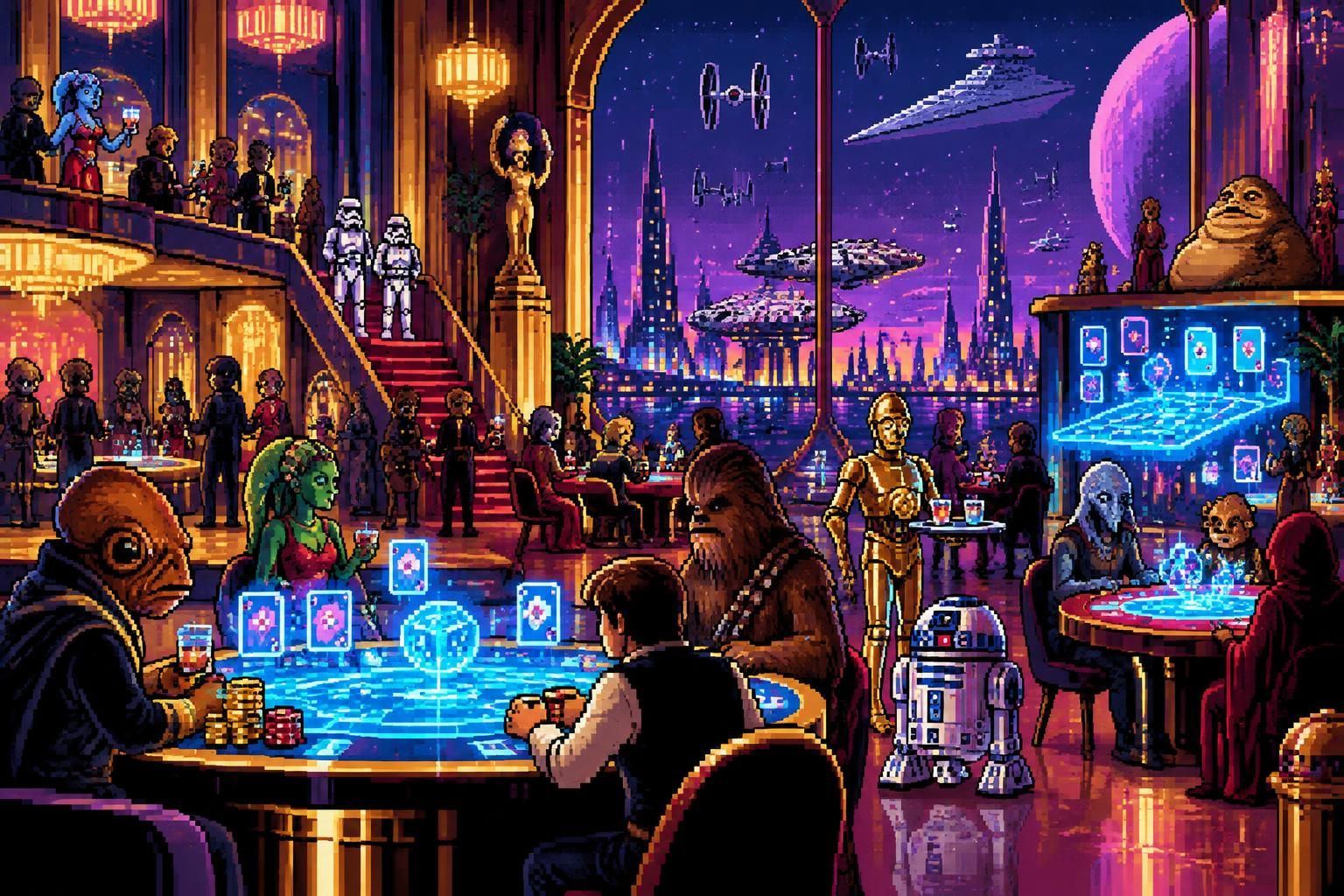
Star Wars-Inspired Casino Design Begins with Rights, Audience, and Mission
I would begin a Star Wars-inspired online casino project with a boundary, not a starfield: recognition does not confer permission. You can identify Darth Vader from a silhouette, but that recognition does not authorize an operator to reproduce the character, his breathing, or his distinctive appearance in commercial gambling entertainment.
I would therefore divide the proposed experience into two defensible routes. You either obtain appropriate authorization for specific franchise assets and uses, or you commission an original science-fiction setting whose characters, music, symbols, and environments stand independently.
For this analysis, I will use a hypothetical platform called Meridian Exchange. Its adult audience wants a space adventure, but its management must establish whether it can deliver an authorized franchise experience or only an original galactic setting.
How Licensed Gaming Determines the Creative Perimeter
I would treat licensed gaming as two separate questions. You need the regulatory permissions required for the gambling product, and you need intellectual-property permissions for any protected entertainment material; neither permission substitutes for the other.
I would require a rights matrix before approving concept art. You should know which characters, territories, devices, promotional channels, musical recordings, and product categories an agreement covers, rather than assume that one approval authorizes every possible deployment.
I would also distinguish an editorial reference from a commercial endorsement. You can examine discussions of how casino operators approach Star Wars fan culture, but such coverage does not establish that a particular operator holds franchise rights.
I would avoid the equally weak assumption that every admirer of the saga is a suitable gambling customer. You are dealing with a multigenerational audience, including children, so adult eligibility and responsible advertising must shape the acquisition strategy before visual familiarity becomes a marketing instrument.
Reading Fan Culture Without Exploiting It
I study cultural preferences because they reveal different expectations. You may encounter one adult visitor who values the political architecture of Coruscant, another who prefers the improvised machinery of the Outer Rim, and a third who wants understandable games rather than extensive lore.
I would translate those differences into optional presentation layers, not psychological pressure. You could offer a restrained navigation mode, a more atmospheric exploration mode, and a clearly explained demonstration area without implying that devotion to the franchise requires participation.
I would reject the claim that online venues have universally replaced physical casinos. You should evaluate the relevant market, jurisdiction, devices, and audience instead; digital competition is substantial, but a broad cultural trend is not evidence of identical behavior everywhere.
I would also separate appreciation from conversion. You should allow someone to inspect visual material, read rules, or leave the site without encountering a deposit prompt at every turn, because informed interest is different from manufactured urgency.
I would give Meridian Exchange a short operational charter: adult access, legitimate rights, transparent mechanics, accessible presentation, and voluntary entertainment. You can then test each proposal against these requirements rather than approve features merely because they resemble something familiar.
I would apply the lesson of Imperial overconfidence at Endor with precision. You gain little from a formidable exterior when an overlooked dependency can compromise the entire operation; here, that dependency may be an unauthorized soundtrack, an unsuitable advertisement, or a misleading product description.
I would settle those dependencies before commissioning the reels. You cannot build a durable galactic identity on permissions that have never been secured.
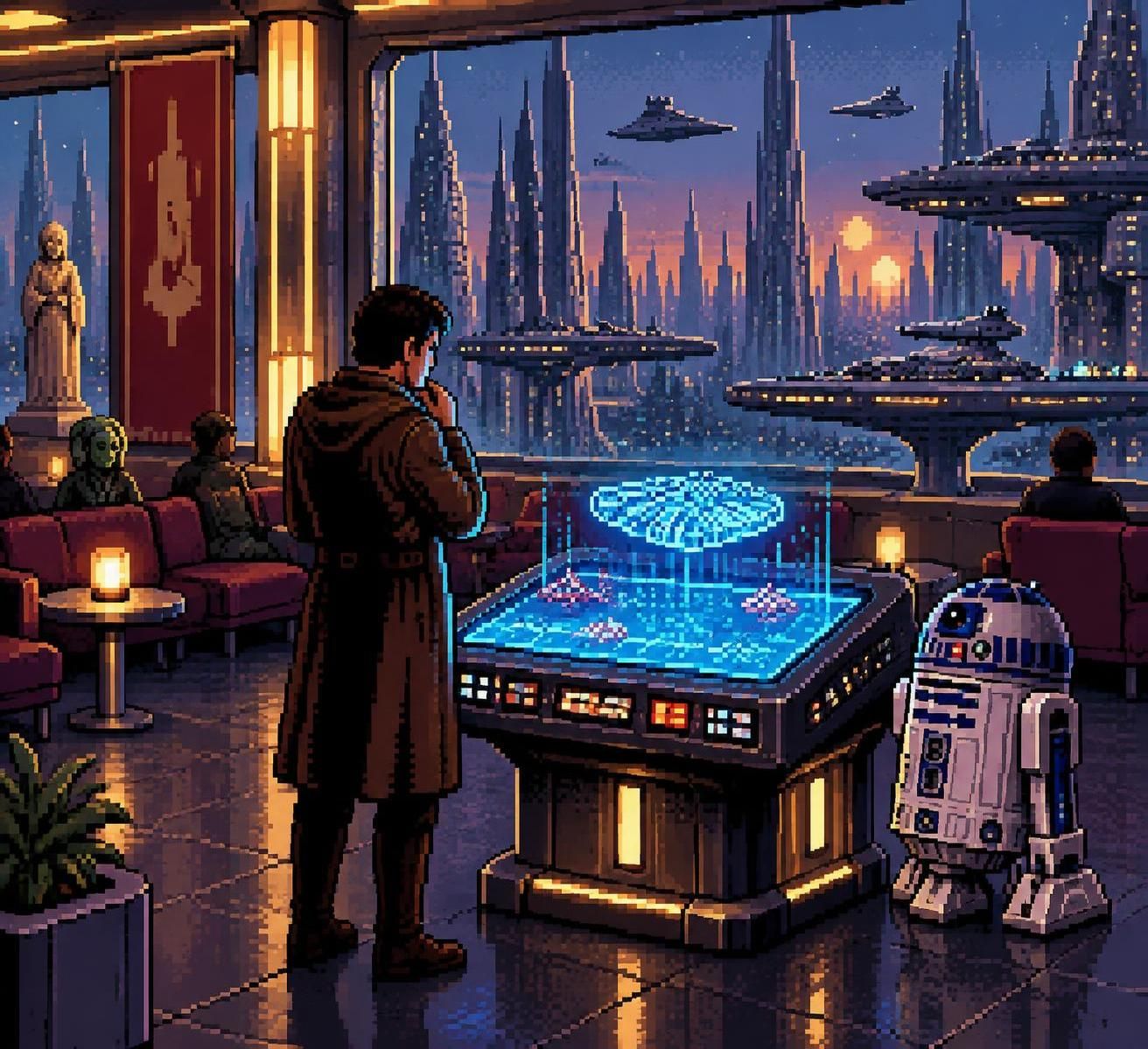
Designing Sci-Fi Slots Without Confusing Spectacle and Probability
I would evaluate the game mathematics before reviewing the animation. You may remember a star destroyer crossing the screen, but the essential questions remain the same: what does a wager cost, how are outcomes determined, and what information can an adult player inspect before participating?
I would give Meridian Exchange a compact initial catalogue rather than demand hundreds of superficially different titles. You gain more from several well-documented experiences than from an extensive library whose filters, rules, and product distinctions are difficult to understand.
I recognize the commercial appeal of large catalogues, including those promoted by sweepstakes platforms such as Yay Casino. You should nevertheless verify any advertised inventory against the current lobby and distinguish sweepstakes products from regulated real-money casino games rather than treat them as interchangeable.
Building Recognizable Themes Around Clear Mechanics
I would organize sci-fi slots around distinct environmental ideas: an orbital shipyard, a desert trading settlement, or an icebound reconnaissance outpost. You can make each setting legible through materials, architecture, and movement without introducing a new rule every time the scenery changes.
I would use named locations, characters, or recognizable franchise designs only within a valid authorization. You should otherwise create original worlds with their own visual logic, because changing a familiar character’s name while retaining its defining appearance is not a reliable rights strategy.
I would ensure that symbols remain distinguishable on a small display. You should not have to identify five nearly identical silver helmets during a brief animation; differences in shape, contrast, and labeling provide more reliable comprehension than decorative complexity.
I would keep the wager control visible and stable. You should never discover that a cinematic transition has concealed a higher stake, enabled a purchase option, or moved the confirmation button beneath your thumb.
I would explain return-to-player information as a theoretical, long-run property of a specified game configuration. You should not be led to interpret it as a personal refund rate, a prediction for the next session, or a promise that losses will reverse.
I would describe volatility separately, using the developer’s verified information where available. You need to understand that differently distributed outcomes can produce different experiences even when two configurations have similar theoretical returns.
Separating Jedi Themes from Claims of Player Control
I would examine Jedi themes particularly carefully because their language suggests foresight and mastery. You must not be told that intuition, alignment with the Force, or selecting a particular character can influence a random result unless a genuine, documented mechanic supports the claim.
I would allow a licensed character selection to change portraits, dialogue, or the background environment while stating its actual effect. You can enjoy a preferred presentation without being encouraged to believe that visual allegiance changes the underlying probabilities.
I would also distinguish a narrative bonus sequence from a skill contest. You should know whether selecting a cargo container affects the result, reveals a predetermined outcome, or simply advances an animation; mystery in fiction does not justify ambiguity in financial rules.
I would reject celebratory treatment of a net loss. You should see the amount wagered and the amount returned clearly, even if the machine produces a small payout accompanied by explosions, music, or a victorious character pose.
I would test every game with sound disabled and animation reduced. You should still understand the outcome, available controls, and current balance, because accessibility is part of mechanical clarity rather than a separate ornamental feature.
I would approve the portfolio only when atmosphere and explanation reinforce each other. You may disguise a reel as a hologram, but you must never disguise the wager.
Creating Star Wars Visual Storytelling That Respects the Player
I would construct the narrative around exploration rather than financial conquest. You can investigate a damaged relay station, recover an archive, or chart a shipping corridor without being told that another deposit is necessary to rescue a beloved character.
I would assign Meridian Exchange a persistent fictional setting: a neutral orbital port whose districts reveal different aspects of galactic life. You would encounter maintenance bays, public transit halls, observation platforms, and trading offices, each serving a recognizable navigational or narrative purpose.
I would keep that fictional continuity separate from real account activity. You should never have to infer whether “repairing the hyperdrive” means viewing a story scene, spending a promotional credit, or making a cash payment.
Using Galactic Art as Functional Information
I study architecture as evidence of priorities. You can read the Empire’s monumental geometry as an expression of centralized authority, while the Rebel Alliance’s improvised equipment communicates adaptation, limited resources, and operational flexibility.
I would use those visual distinctions to create coherent spaces, subject to the necessary rights. You could recognize an administrative area through disciplined lines and restrained lighting, while an exploration gallery might use layered materials and visible repairs to suggest accumulated history.
I would not assume that every world can be represented by its dominant color. You need more than orange sand to distinguish a desert settlement: shaded passageways, worn surfaces, moisture equipment, and the relationship between buildings make the environment intelligible.
I would apply the same discipline to Coruscant. You should perceive vertical density, organized traffic, and contrasting social spaces rather than receive an indiscriminate wall of neon that makes buttons and text difficult to locate.
I would treat sound as a separate rights and usability problem. You may recognize a musical phrase immediately, but the recording and composition can involve permissions distinct from those covering visual assets.
I would therefore commission an original score when appropriate and provide independent volume controls. You should be able to mute ambient machinery, dialogue, and music without losing essential account notifications or access to visual equivalents.
I would use production-design material to examine how environments communicate occupation and history. You should carry those lessons into interface composition, not assume that a video’s public availability authorizes copying its footage, artwork, or soundtrack.
Keeping Story Progress Independent of Gambling Outcomes
I would make the principal story accessible without wagering requirements. You could unlock archive entries by exploring a map, completing an optional lore puzzle, or returning to an unfinished chapter without increasing your financial exposure.
I would avoid plots built around recovering gambling losses. You should never encounter a mission briefing that reframes a losing session as an unfinished military obligation or suggests that persistence demonstrates loyalty.
I would also avoid treating fictional antagonists as explanations for unfavorable outcomes. You may enjoy a smuggler character in a scene, but the platform must not imply that an enemy intercepted a payout when the actual explanation lies in published game rules.
I would give every chapter a clean stopping point. You should be able to leave after a short scene without a countdown, an unresolved payment demand, or a warning that your faction will suffer because you disconnected.
I would measure narrative quality through comprehension and voluntary appreciation rather than increased spending. You can ask whether visitors understood the setting, found the next chapter, and recognized which activities involved money.
I would preserve the distinction between dramatic uncertainty and operational certainty throughout. You may wonder what lies beyond the next hyperspace route; you should never wonder what clicking a control will cost.
Building a Galactic Gaming Interface for Mobile and Accessible Use
I would treat navigation as logistics. You cannot operate efficiently when supplies are mislabeled, routes are obscured, and routine actions require unnecessary movement; an online casino becomes equally unreliable when its interface confuses atmosphere with organization.
I would design Meridian Exchange around familiar destinations: games, rules, account information, payment functions, support, and safer-play controls. You could see a galactic map around those destinations, but the map would not replace clear labels.
I would place search near the main library and support useful filters. You should be able to distinguish product type, provider, accessibility features, demonstration availability, and relevant game characteristics without opening every title individually.
Making Holographic Interfaces Readable
I would borrow the visual suggestion of a hologram without copying its cinematic weaknesses. You need solid contrast, stable text, and recognizable controls rather than flickering blue characters projected over a moving background.
I would reserve fictional scripts for decorative surfaces. You should never need to decode Aurebesh to locate withdrawal information, understand a restriction, or read a warning about a real transaction.
I would keep account balances and bonus balances clearly differentiated. You must know whether a displayed amount is withdrawable money, restricted promotional value, or a fictional currency with no cash value.
I would explain conversions wherever a token system is used. You should not have to calculate the real cost of “fuel cells” or “cargo credits” from a separate pricing page while deciding whether to continue.
I would use cultural context selectively, drawing on discussions of gaming culture within the Star Wars universe to frame familiar motifs. You should still receive plain-language explanations when fictional conventions intersect with actual product behavior.
I would include a low-decoration setting that reduces motion, removes background particles, and simplifies transitions. You can retain a coherent identity through typography and color without requiring every visitor to tolerate a continuous visual performance.
Testing the Mobile Journey Under Real Conditions
I would test on ordinary phones and inconsistent connections before approving a desktop showcase. You should be able to inspect rules on a commuter connection or an older device without waiting for a large cinematic asset to download.
I would prioritize essential information in the loading sequence. You need access to account status, help, and transaction confirmation before optional starfields, animated ships, or ambient video.
I would separate frequently used controls to reduce accidental activation. You should not find a wager button pressed against a menu control, especially when a narrow screen or assistive technology changes the layout.
I would preserve browser navigation and predictable focus behavior. You should be able to return from a rules panel, use a keyboard, or navigate with a screen reader without losing your place or triggering an unintended action.
- 🧭 I would keep essential routes visible: you should reach rules, account tools, and support without exploring a fictional map.
- 📱 I would verify touch accuracy: you should be able to operate controls without relying on unusually precise gestures.
- 🔎 I would support readable scaling: you should retain access to labels and warnings when enlarging text.
- ⏸️ I would protect the exit route: you should find logout, breaks, and limit controls as readily as game selection.
I would test interruptions as rigorously as successful sessions. You should receive an intelligible explanation when a connection fails, a payment remains pending, or an account check requires additional information.
I would judge the interface by completed tasks and reduced misunderstanding. You have achieved effective galactic gaming design when the scenery is memorable and the controls require no interpretation.
Using Virtual Worlds and Immersive Gameplay Without Concealing Risk
I would evaluate immersive technology as an optional delivery method, not an automatic improvement. You can create an impressive room in virtual reality and still produce a worse experience if navigation becomes tiring, financial information becomes obscure, or essential controls require unfamiliar gestures.
I would begin Meridian Exchange’s experiment with a non-wagering observation deck. You could inspect an original starport, converse with scripted guides, and learn the layout before encountering any activity involving money.
I would not assume that headset adoption justifies a headset-first platform. You should retain a complete browser experience, because hardware cost, physical comfort, disability, and personal preference all affect whether a visitor can use a simulated environment.
Turning Exploration into a Controlled Experience
I would use Hoth or the Mos Eisley cantina only where the relevant rights permit it. You could otherwise explore an independently designed ice station or frontier lounge without marketing those locations as concealed substitutes for protected settings.
I would give each environment a functional scale. You should not have to walk across a vast hangar to read the rules, and you should not have to approach an animated character to find account assistance.
I would offer teleportation, seated use, reduced motion, and a conventional menu where technically appropriate. You need alternatives because a movement scheme that suits one person can cause discomfort or exclusion for another.
I would place an unmistakable boundary around any transition into wagering. You should receive the same clear product information available on the ordinary website, not a theatrical invitation whose implications become apparent only after acceptance.
I would keep actual monetary values continuously available during relevant activity. You should never see only piles of fictional credits while the underlying balance changes in a currency you cannot inspect.
I would also make time visible. You can become absorbed in virtual worlds, so a comfortable environment should support session awareness rather than remove clocks, external cues, and opportunities to pause.
I would examine accessibility demonstrations for specific interaction lessons. You should test reach distances, text placement, controller alternatives, and comfort settings with intended users instead of assuming that cinematic immersion proves practical usability.
Maintaining Privacy Inside Social Spaces
I would treat voice chat and avatars as additional responsibilities. You need moderation, reporting tools, blocking functions, and clear conduct standards before an operator invites strangers into a shared entertainment space.
I would prohibit social mechanisms that expose spending or pressure visitors to match another participant’s activity. You should not see public rankings based on losses, deposits, or continuous play presented as evidence of galactic prestige.
I would minimize data collection from headsets and related devices. You should receive a clear explanation of necessary processing, while sensitive movement or behavioral signals should not become instruments for identifying vulnerable moments and increasing gambling prompts.
I would keep support outside the fiction. You may enjoy assistance from a decorative droid interface, but you must be able to reach a clearly identified support service without performing a role-playing exchange.
I would require a persistent exit mechanism that works during dialogue, animation, and network disruption. You should never need to finish a scene before leaving an environment that causes discomfort.
I would assess immersive gameplay through task success, comfort, understanding, and accessible alternatives. You gain little from longer visits if those visits reflect difficulty finding the exit or confusion about what happened.
I would expand the experiment only after these conditions survive testing. You have created useful immersion when the world becomes convincing without making the transaction less visible.
Developing Star Wars Partnerships and Collectibles with Clear Boundaries
I would treat a partnership announcement as the beginning of scrutiny, not the end. You need to know who controls the relevant rights, what the agreement permits, and whether the proposed collaboration is suitable for a gambling environment.
I would give Meridian Exchange a documented approval chain for every commissioned asset. You should be able to trace a character illustration, promotional animation, musical cue, or collectible design to an agreement and an accountable owner.
I would reject language implying official affiliation where none exists. You cannot repair an unauthorized association with a small disclaimer placed beneath a page dominated by protected imagery.
Choosing Collaborations That Add Practical Value
I would favor specialists who solve identifiable problems: experienced game studios, accessibility testers, qualified localization teams, and artists capable of building a coherent original setting. You should expect a collaboration to improve the product, not merely supply a recognizable name.
I would examine commentary on the appeal of galactic themes in casino entertainment as a source of market questions. You should not mistake enthusiastic coverage for verified demand, evidence of authorization, or proof that a proposed campaign will perform well.
I would commission research with eligible adults and separate aesthetic preferences from willingness to gamble. You may discover that participants admire the artwork while preferring a non-wagering exploration experience, which is useful information rather than a failed conversion opportunity.
I would also screen promotional channels for audience composition. You should not place gambling campaigns in spaces whose appeal or reach is substantially directed toward children simply because those spaces discuss the same franchise.
I would make commercial relationships clear when creators or commentators receive compensation. You deserve to know when praise, demonstrations, or links form part of a paid arrangement rather than independent editorial judgment.
Defining What a Digital Collectible Actually Provides
I would describe every collectible in functional terms. You should know whether an item is merely an account decoration, a downloadable artwork, a transferable asset, or a limited-use entitlement.
I would avoid calling a cosmetic object an investment. You cannot reasonably infer future resale value from rarity language, a numbered edition, or a character’s popularity, and an operator should not encourage that inference.
I would state whether access survives account closure, a licensing change, or the retirement of a particular feature. You need these conditions before assigning value to a digital object that may depend entirely on the platform’s continued operation.
I would favor transparent distribution over paid random acquisition. You can offer an approved background image for attending a free event without introducing another chance-based purchase whose cost and value are difficult to assess.
I would ensure that merchandise eligibility does not require escalating wagers. You should not have to chase a physical collectible by increasing financial exposure, particularly when stock availability, delivery restrictions, or additional charges remain uncertain.
I would separate fulfilment information from theatrical language. You need ordinary facts about delivery regions, timing, taxes where applicable, substitutions, and support, even if the parcel is described as cargo from a distant system.
I would plan the end of every collaboration before its launch. You should know what happens to approved artwork, outstanding rewards, and promotional materials when an agreement expires, rather than encounter abruptly missing assets or inaccessible benefits.
I would keep records of approvals and changes so that operational teams can identify which version remains authorized. You reduce avoidable disputes when marketing, development, and support work from the same current specification.
I would approve a partnership only when its obligations are as clear as its creative promise. You should receive a defined experience, not an invitation to assume affiliation, ownership, or future value.
Designing Intergalactic Rewards Without Wagering Pressure
I would separate progress from expenditure at the design stage. You can create satisfying challenges through discovery, comprehension, and creative participation without making larger wagers the principal route to status.
I would give Meridian Exchange an optional civilian exploration programme rather than a ladder of increasingly expensive military ranks. You could inspect a planetary archive, complete a navigation puzzle, or customize a profile through activities that do not require gambling.
I would examine reward systems associated with Star Wars experiences for narrative patterns, then test each proposed adaptation against the actual product. You should not transplant mechanics from an ordinary video game into a financial setting without reconsidering their consequences.
Distinguishing Achievement from Financial Exposure
I would define intergalactic rewards precisely wherever the term appears. You should know whether it refers to a cosmetic badge, a fictional story item, a promotional benefit, or something with a stated cash value.
I would place material conditions beside the offer. You need eligibility rules, relevant expiry information, restrictions, and any withdrawal implications before participation, not after an animated award ceremony.
I would not use daily gambling streaks. You should be able to miss a day without losing status, forfeiting a growing reward, or receiving messages that frame absence as failure.
I would reject “recover the fleet” missions triggered by losses. You should never be given a narrative objective whose practical instruction is to keep wagering until an unfavorable balance changes.
I would also avoid public rankings based on money spent. You can recognize a completed lore challenge without turning financial exposure into a competition between strangers.
| Challenge concept | Safer implementation | Operational purpose |
|---|---|---|
| 🗺️ Planetary exploration | I would award a cosmetic map marker for viewing a free archive. | You gain discovery without a wagering requirement. |
| 🧩 Navigation puzzle | I would disclose the rules and allow untimed participation. | You demonstrate comprehension rather than spending. |
| 🎨 Profile customization | I would provide clearly described, non-transferable decorations. | You receive personalization without implied investment value. |
| ⏸️ Session checkpoint | I would offer a neutral reminder and an immediate break option. | You retain awareness and a practical stopping point. |
I would test whether the proposed reward changes the meaning of a break. You should feel free to stop, not calculate whether leaving will destroy an accumulated advantage.
Running Seasonal Events Without Manufactured Urgency
I would use seasonal events to introduce new environments, stories, or creative activities. You could visit an orbital festival or examine a restored archive without being urged to deposit before a short countdown expires.
I would distinguish an authentic scheduling limit from pressure-based presentation. You may need to know when a moderated event begins, but repeated alarms, shrinking timers, and personalized warnings are not necessary to communicate that information.
I would offer reasonable alternatives when participation depends on time zones or accessibility. You should not be excluded from a narrative chapter merely because its live presentation occurred while you were working or sleeping.
I would avoid describing loyalty to a fictional faction as loyalty to an operator. You can prefer Rebel aesthetics or Imperial architecture without being asked to prove allegiance through repeated financial transactions.
I would scrutinize messaging after inactivity as carefully as the event itself. You should not receive a personalized appeal from a beloved character claiming that your return is needed to save the galaxy.
I would evaluate the programme through rule comprehension, satisfaction, complaints, and voluntary participation. You should not regard higher deposit frequency as sufficient evidence that a reward system benefits its users.
I would retain only mechanics that remain appealing when spending is removed from the equation. You have built a meaningful achievement when the accomplishment belongs to the participant rather than to the size of the wager.
Testing a Star Wars-Inspired Online Casino for Trust and Operational Resilience
I would place the final operational review outside the creative team’s command. You need independent scrutiny because people who have spent months constructing a convincing galaxy can become less sensitive to the confusion it creates.
I would test Meridian Exchange as a collection of obligations: identity checks, game integrity, payment handling, privacy, accessibility, support, and safer-play functions. You should not allow success in visual design to compensate for failure in any of these areas.
I would use Canto Bight as a fictional contrast, not an operating model. You can appreciate its dramatic portrayal of wealth and spectacle while requiring an actual service to provide lawful access, transparent terms, and accountable transaction handling.
Verifying Money Movement and Player Protections
I would establish which jurisdiction governs each offered product and which permissions apply. You should receive information relevant to your location rather than a generic claim that the platform is legal everywhere.
I would explain identity and eligibility checks before they become a surprise. You need to know what information may be required, why it is collected, and where to find the applicable privacy and verification procedures.
I would never present verification as a fictional security encounter that obscures its real purpose. You should understand that a document request concerns actual account obligations, not an optional scene involving an Imperial checkpoint.
I would test deposit and withdrawal explanations separately. You deserve clear information about available methods, applicable conditions, processing stages, and any stated charges, without an assumption that access to one payment route guarantees every other function.
I would ensure that limits, breaks, and self-exclusion tools work across the relevant account experience. You should not be able to bypass a protection simply by entering through a different device, promotional page, or immersive environment.
I would also review communications after those tools are used. You should not receive promotional missions, reward reminders, or personalized return invitations that undermine a decision to stop.
Measuring Understanding Rather Than Mere Activity
I would ask test participants to explain what they believe each important control does before activating it. You can identify a dangerous ambiguity when several people interpret a promotional token as withdrawable cash or assume a cosmetic selection changes their chances.
I would use practical scenarios rather than rely only on survey approval. You should observe whether an eligible adult can find the rules, inspect transaction status, reduce animation, contact support, and end a session without assistance.
I would include people using screen readers, enlarged text, alternative input methods, and lower-powered phones. You will otherwise optimize for the devices and abilities already represented inside the development team.
I would test failure states deliberately. You need a known response when a connection drops during an animation, a game result takes longer to display, or a payment provider returns an incomplete status.
I would require transaction records and game outcomes to remain consistent across recovery. You should never have to infer whether a wager occurred from a balance change that lacks an intelligible history.
I would separate observed evidence from promotional assumptions in every report. You may discover that a simpler lobby produces fewer errors than a cinematic map, even when participants initially describe the map as more impressive.
I would establish a release threshold that cannot be overridden by enthusiasm for launch. You should postpone a feature when it conceals essential information, fails an accessibility requirement, or introduces an unresolved rights issue.
I would continue this review after deployment through complaint analysis, accessibility checks, and controlled updates. You need to know whether a new animation, translation, or promotion has reintroduced a problem that an earlier version solved.
I would record each defect with an owner, a corrective action, and a retest condition. You earn trust through systems that remain understandable when the spectacle stops working.

I am Grand Admiral Thrawn, strategist of the Galactic Empire. Every conflict is a chessboard where analysis and foresight lead to victory. The art and culture of a people betray their weaknesses. The Empire embodies order and discipline in the face of rebel chaos. History will remember that only strategy ensures peace.