
Star Wars Funday Football Turns Super Bowl LXI Into a Galactic Broadcast Operation
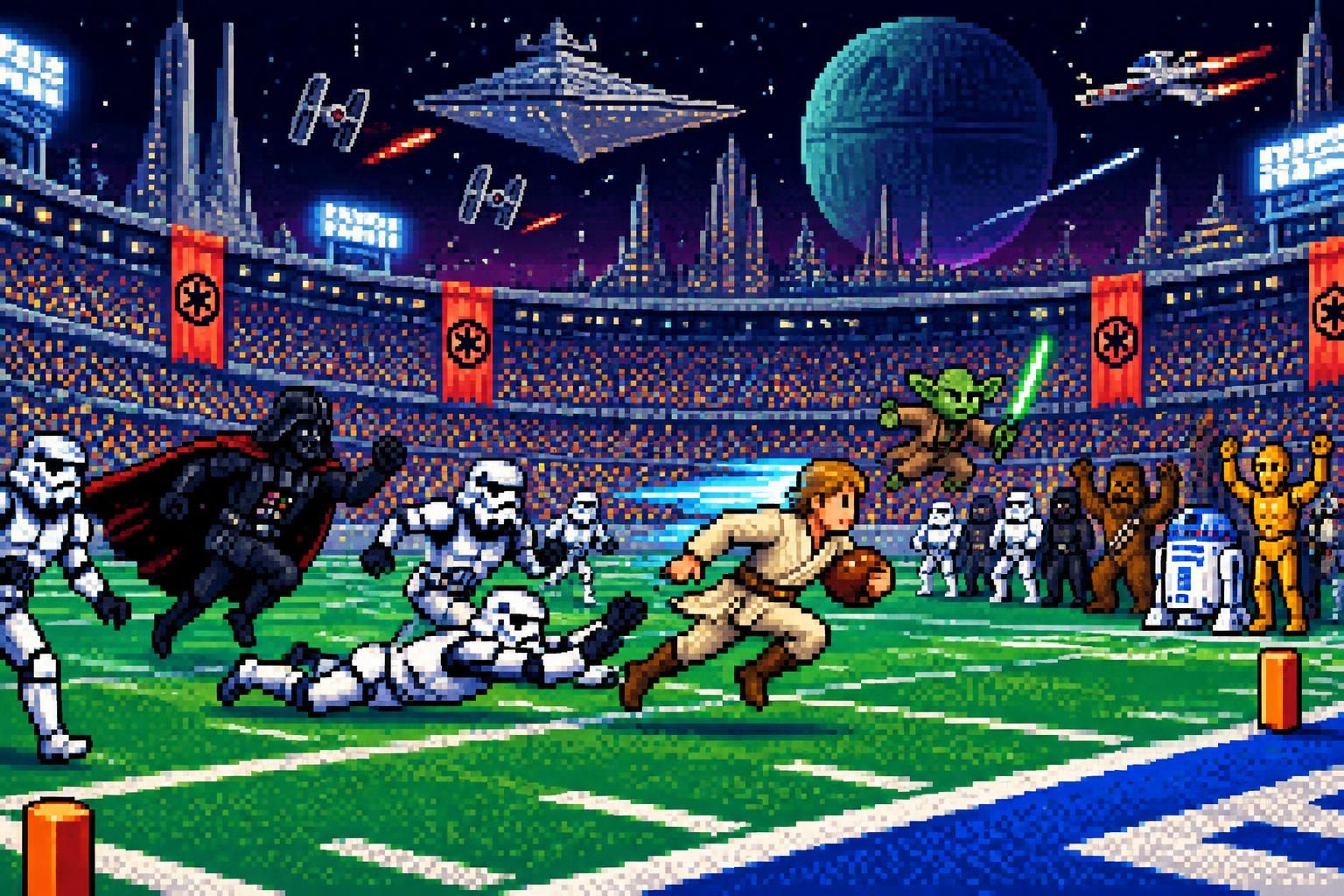
I identify the central objective of Star Wars Funday Football as a translation problem: preserve the competitive reality of the NFL championship while presenting its action through a different visual language. You will still be watching the consequences of actual decisions, tackles, passes, and turnovers, but the field personnel will appear as animated avatars within the Star Wars galaxy.
The announced collaboration brings together ESPN, Lucasfilm, Disney, and the NFL for an alternate presentation of Super Bowl LXI on Sunday, February 14, 2027. According to the official Star Wars announcement, this extends the established Funday Football format to the championship itself, rather than to another regular-season contest.
I distinguish that change in scale from a simple change in scenery. A championship attracts viewers with sharply different levels of knowledge: experienced supporters, occasional spectators, families, and people whose primary interest lies in the entertainment surrounding the contest.
You should therefore assess the project as an additional viewing route, not a replacement for conventional coverage. Its strategic value depends on whether someone attracted by familiar galactic characters can follow the same sporting contest without losing the information that makes each possession meaningful.
Super Bowl LXI Animation Must Preserve the Actual Contest
I would place one requirement above every visual flourish: the animated presentation must remain accountable to the real game. The announcement describes a recreation of every play as it happens, with professional athletes represented by digital counterparts and recognizable characters appearing during selected moments.
That distinction matters. An alternate telecast is not a scripted exhibition in which the score can be adjusted to support a narrative; the competitive outcome remains determined by the athletes on the physical field.
Consider a hypothetical fourth-down attempt near midfield. If a receiver appears to reach the marker in the animated version but the official ruling places the ball short, you need an immediate explanation of the actual decision, not a decorative sequence that conceals the discrepancy.
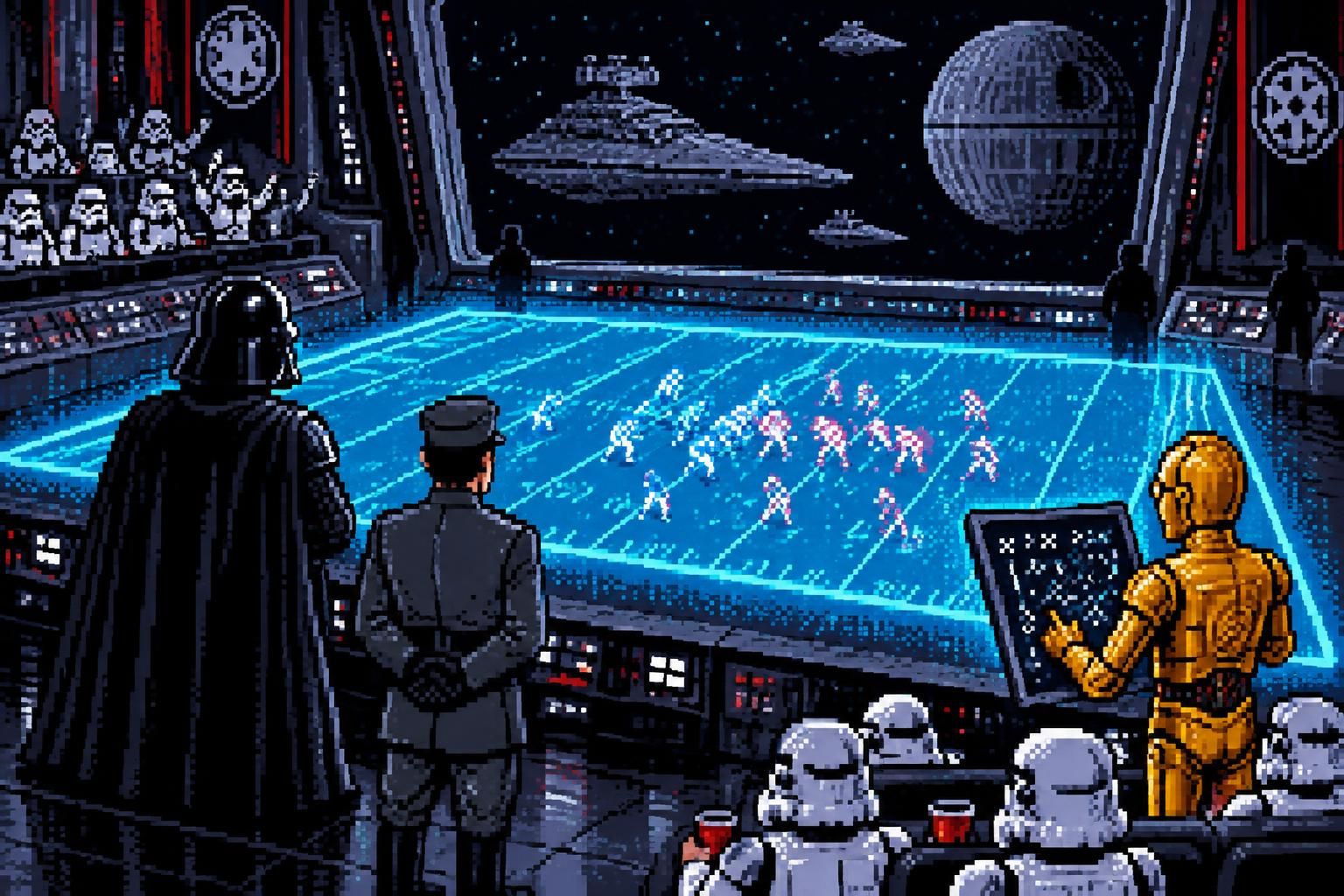
I use the Imperial command table as a useful comparison. A holographic display can simplify a battlefield, but it becomes dangerous when its simplification changes the apparent position of an opposing formation.
The same discipline applies here: presentation may transform appearance, but it must not transform evidence. The location of the ball, the remaining time, the down, and the official result form the informational foundation.
Why Star Wars Changes the Sports Entertainment Equation
I regard the franchise as more than a supply of recognizable costumes. Its visual culture already communicates hierarchy, movement, allegiance, and threat through economical signals: a formation of stormtroopers, the silhouette of a Star Destroyer, or the geometry of an Imperial installation.
You can understand those signals before hearing an explanation. That makes the setting useful for digital storytelling, provided its symbols help organize the action rather than compete with it.
The collaboration also arrives during the franchise’s fiftieth-anniversary year. The original film opened in 1977, making 2027 a relevant historical frame rather than an arbitrary promotional date.
I would not confuse that anniversary with proof of execution. A recognizable cultural asset secures attention; it does not automatically produce a readable broadcast.
For a recurring test case, consider a household containing an experienced supporter and a younger viewer who recognizes C-3PO but cannot yet explain a first down. The production succeeds only when both can follow the same sequence for different reasons.
The experienced viewer needs reliable competitive information, while the newcomer needs an accessible point of entry. The strategic opportunity is shared attention without sacrificing the integrity of the contest.
How Real-Time Animation Must Translate Every Super Bowl LXI Play
I separate real-time animation from conventional animated production because their constraints differ fundamentally. A prerecorded sequence permits repeated revisions; a live sporting event supplies new positions, collisions, and rulings continuously, without waiting for an artist to correct the previous frame.
The announced objective is to reproduce the championship’s plays through animated avatars. You should distinguish that confirmed ambition from any unannounced technical implementation: specific tracking suppliers, processing arrangements, and detailed synchronization procedures should not be invented to make the system sound more impressive.
I can nevertheless identify the operational requirements without pretending to possess an engineering diagram. The presentation must interpret movement, maintain the relationship between participants, represent the ball coherently, and reconcile the display with official game information.
Each requirement depends on the others. A convincing running animation becomes misleading if the ball appears in the wrong location, just as accurate coordinates become difficult to interpret if the camera obscures the relevant boundary.
Live Animation Depends on Spatial and Temporal Discipline
I would test spatial fidelity first. You must be able to distinguish a completed reception from an apparent catch beyond the sideline, and a successful conversion from a runner stopped before the required distance.
These are not cosmetic distinctions. They determine possession, field position, and the range of decisions available on the next snap.
Next comes timing. The expression “real time” describes the live nature of the recreation; it should not be interpreted as a guarantee of zero processing or distribution delay across every device and territory.
You may encounter different delivery delays when comparing streams or checking a phone notification. That possibility makes synchronization within the presentation especially important: commentary, scoreboard, and animated action should describe the same moment.
I compare this to coordinating separate squadrons through a common operational clock. A correct instruction delivered against the wrong tactical moment can become functionally incorrect.
Imagine our household watching a late field-goal attempt. If a mobile alert reveals the result before the animated ball reaches the uprights, the competitive sequence loses its intended suspense, even though the underlying recreation remains accurate.
The practical response is straightforward: select one primary feed and avoid competing live alerts when preserving the viewing experience matters. That is a household decision, not evidence of a defect unique to this production.
Animated Broadcast Clarity Matters More Than Visual Density
I would allocate visual emphasis according to tactical significance. The ball carrier, the immediate defenders, the first-down marker, and the game clock deserve priority over background activity.
A stadium populated by familiar creatures may reward attention between plays. During a decisive pass, however, the same detail can become interference if it draws your eye away from the receiver.
The Star Wars films offer a useful artistic precedent. Their most readable action scenes establish spatial relationships before accelerating the movement; the viewer understands what is being approached, defended, or escaped.
You do not need every participant rendered with equal prominence to understand a contest. You need a clear hierarchy of information.
I would also distinguish visual plausibility from literal reconstruction. An avatar can use stylized proportions while preserving the movement’s sporting meaning, provided that exaggeration does not imply an extra leap, an avoided tackle, or a different result.
A sensible failure response would favor an authoritative score update, a clear explanatory graphic, or another readable view over an elaborate but contradictory image. That is an evaluation principle, not an announced production feature.
The strongest live animation will make its complexity unobtrusive. You should spend your attention interpreting the play, not repairing the presentation in your head.
Star Wars Characters Must Support the Football, Not Rewrite It
I consider the announced character appearances a matter of narrative discipline. The production promises figures from the galaxy alongside the animated contest, including appearances during selected moments, but those additions must remain distinguishable from the athletes’ actual contributions.
Anthony Daniels is announced to return as the voice of C-3PO. That detail provides a specific connection to the franchise’s screen history, rather than merely attaching a familiar name to an unfamiliar performance.
You should separate this confirmed casting from other voice arrangements that have not been identified in the supplied announcement. Recognition of a character does not establish who performs that character in a particular segment.
I see an effective role for a protocol droid in an accessible broadcast: translation between systems. The challenge is to explain unfamiliar rules without turning every stoppage into a lecture or treating the audience as incapable of learning.
C-3PO and Galactic Culture Can Make NFL Rules Readable
Consider the younger viewer in our household encountering a penalty for the first time. A short explanation of what happened, how the enforcement changes field position, and which team benefits would provide immediate practical value.
I would prefer that approach to a joke that names the infraction without explaining its consequences. Recognition produces a moment of amusement; comprehension allows the viewer to follow the next decision independently.
Star Wars culture supplies useful comparisons, but you should apply them carefully. An offensive formation resembles an organized deployment in the limited sense that positioning constrains possible movement; it does not make the players equivalent to combatants in every respect.
The same restraint applies to Imperial imagery. Uniformity can communicate organization, while a Rebel-style visual vocabulary can suggest improvisation, but neither should become a substitute for observing what an actual team does.
I study artistic choices because they reveal how a culture orders information. Mandalorian heraldry, for example, can communicate affiliation and identity through repeated symbols; a broadcast can use consistent team identifiers for a similarly practical purpose without claiming that the traditions are interchangeable.
You benefit when the same colors, emblems, and graphic conventions recur consistently. A newcomer should not need to relearn which side possesses the ball every time the camera changes.
Character Substitutions Need Clear Competitive Boundaries
The announcement describes Star Wars figures entering selected moments. I would evaluate those appearances according to whether you can still identify the underlying athlete, action, and official outcome.
Suppose a celebrated character visually represents a player during a touchdown sequence. The entertainment layer works only if the broadcast still credits the real participant and preserves the scoring play’s actual mechanics.
Otherwise, the adaptation creates a mistaken memory: a recognizable fictional figure becomes the apparent author of an achievement performed by someone else. That would weaken both sporting clarity and the credibility of the alternate presentation.
I apply the same logic to Force-related spectacle. A visual gag between snaps differs from an effect that appears to explain why a pass changed direction during live action.
You should never need to determine whether an unusual movement belongs to the real play or to an embellishment. The production can establish that boundary through timing, framing, and commentary.
Easter eggs require similar restraint. A background reference can reward an attentive fan, but an essential explanation cannot depend on recognizing an obscure species, insignia, or vessel.
For our mixed-experience household, the hierarchy remains stable: first understand what happened, then enjoy how the galaxy reframes it. A character earns a place in the broadcast by clarifying the shared experience, not by displacing it.
What Earlier Funday Football Broadcasts Reveal About the Super Bowl Challenge
I place this project within an established sequence rather than treating it as an isolated experiment. The supplied announcement identifies earlier collaborations built around Toy Story in 2023, The Simpsons in 2024, and Monsters, Inc. in 2025.
Those productions demonstrate that the Funday Football concept predates the galactic adaptation. They do not, by themselves, establish how every element of the championship version will operate.
You should distinguish institutional experience from automatic success. Repeating a production category creates opportunities to refine workflows, but a new setting, audience, and competitive occasion introduce different demands.
The announced Super Bowl edition is described as the first animated alternate presentation of the championship and the fourth NFL animated game-day telecast from these partners. That sequence explains why the undertaking is both an extension of an existing format and a substantial escalation.
From Familiar Animated Worlds to a Galactic Championship
I identify a common mechanism across the earlier concepts: place a real contest inside a recognizable fictional environment. The audience receives an unfamiliar sporting situation through a world that may already feel familiar.
The distinction between those worlds matters. A toy-room setting offers one kind of spatial logic; Springfield supplies another; Monstropolis carries its own industrial imagery and comic expectations.
Star Wars introduces a broader vocabulary of vehicles, species, institutions, and locations. You gain creative flexibility, but the production also faces a greater risk of combining recognizable elements without a coherent organizing principle.
I would therefore ask a practical question: does each setting choice help you locate the action or understand the occasion? If its only function is recognition, its screen time should remain proportionate.
Our hypothetical younger viewer may recognize a droid immediately but know little about its surrounding history. The experienced fan may notice a background reference, yet still need an unobstructed view of the next snap.
A successful design serves both without requiring either to adopt the other’s interests. That is audience coordination, not simply franchise decoration.
Super Bowl LXI Raises the Cost of Confusion
I regard the championship setting as an increase in operational stakes, not a reason to predict specific audience numbers. The supplied material establishes the event and distribution ambitions, but it does not provide verified viewing results for a broadcast that has not yet occurred.
You can still identify the likely pressure points logically. More occasional viewers mean a wider range of rules knowledge, while decisive late-game situations make timing and explanation especially important.
A regular-season viewer might tolerate missing a minor development while exploring a novelty presentation. Someone watching the championship’s final possession needs immediate certainty about possession, clock management, and scoring possibilities.
I would test the format against difficult sequences rather than only against spectacular touchdowns. A replay review, an accepted penalty, an overturned ruling, or an injury stoppage reveals whether the system can explain interruption as competently as movement.
The historical analogy is not a victorious fleet review but a disrupted formation. A system’s strength becomes visible when normal assumptions cease to hold.
This is also why previous animated productions should be studied as case material rather than cited as a guarantee. Their useful contribution lies in identifying repeatable solutions and unresolved friction.
You can find the broader announcement context in Animation Magazine’s coverage of the galactic telecast. The relevant inheritance is production knowledge; the new test is whether that knowledge scales to the championship.
Where to Watch Star Wars Funday Football and How the Feeds Differ
I would resolve distribution before planning the viewing experience. The animated feed and the traditional Super Bowl telecast are distinct presentations, even when the same service appears within the broader distribution arrangement.
The announced alternate version is scheduled for Disney+, the ESPN App, Disney Channel, and Disney XD. The supplied information separately identifies ESPN, ABC, and Disney+ in connection with conventional coverage.
You should therefore select the named presentation rather than assume that every championship listing opens the galactic version. A platform can carry multiple event feeds, and the difference matters when arranging a shared viewing session.
I treat the ESPN announcement of the participating services as the appropriate reference point for the distribution plan, while recognizing that local listings determine the practical route in each territory.
Super Bowl LXI Viewing Routes at a Glance
| Viewing objective | Announced route | Practical distinction |
|---|---|---|
| 🚀 Watch the galactic adaptation live | Disney+, ESPN App, Disney Channel, Disney XD | Select the specifically labeled Star Wars presentation. |
| 🏈 Follow conventional coverage | ESPN, ABC, and Disney+ as identified in the supplied announcement | Keep the standard and animated listings separate. |
| 🌍 Watch outside the domestic market | Expanded international availability across announced territories | Check local service availability and scheduling. |
| ▶️ Watch after the live event | Disney+ replay planned shortly afterward | No precise posting interval is specified in the supplied material. |
I include the final distinction because “shortly afterward” is a scheduling description, not a guaranteed minute-by-minute delivery commitment. You should not plan an immediate replay session around a precise interval that has not been announced.
The same discipline applies to access. A named platform does not establish identical subscription conditions, channel packages, or device support in every country.
International Access Requires Local Timing, Not Just a Global Date
The supplied distribution information names Latin America, the Caribbean, Australia, New Zealand, Canada, the Netherlands, sub-Saharan Africa, Japan, Sweden, Singapore, Malaysia, and the Philippines. Additional supplied coverage describes a reach exceeding 155 markets.
I would read that scale as an announced distribution footprint, not proof that every household receives an identical product. Language options, local rights arrangements, and service availability remain separate practical questions.
You should also distinguish the event’s advertised date from your local calendar. A broadcast scheduled for Sunday in its originating market can fall on Monday for viewers farther east.
That matters particularly for a family-oriented presentation. A convenient evening window in one territory may become an early school-day commitment in another, making replay access more useful than live availability alone.
For our recurring household, I would establish three things before kickoff: the correct feed, the applicable local start time, and a workable alternative if live viewing conflicts with routine obligations. None requires elaborate preparation, but each prevents avoidable friction.
I would also test the selected service before the event rather than at the opening possession. Authentication problems and unfamiliar navigation are distribution issues, not failures of the animation itself.
A second screen can help locate information, but simultaneous playback on mismatched feeds may reveal outcomes early. You should decide whether comparison or uninterrupted suspense is the priority.
The operational principle is simple: global availability creates an opportunity; clear local access determines whether that opportunity becomes an actual viewing experience.
How the Animated Broadcast Can Teach Football Without Slowing It Down
I regard accessibility as a problem of sequencing information, not merely simplifying vocabulary. A newcomer does not need the entire rulebook before the first snap; that viewer needs the right explanation when the next decision becomes relevant.
The Funday Football format appears designed to offer an additional entry point for younger audiences and families. You should treat that positioning as an editorial purpose, not as evidence that every child will prefer animation or that experienced supporters will reject it.
Our hypothetical household illustrates the actual challenge. One viewer anticipates coverage adjustments before the snap, while another is still learning why the offense receives several attempts to advance.
I would not force both viewers through the same level of explanation at every moment. The production needs a layered approach in which essential information remains visible and additional context arrives without obstructing the action.
Star Wars Visual Cues Can Support NFL Learning
A well-timed explanation can connect cause and consequence in seconds. If a team faces third down, you need to know the required distance and why failure changes the next decision.
I would use a consistent graphic rather than repeatedly replacing one visual metaphor with another. The Star Wars setting can supply the appearance, but the meaning must remain stable.
Consider these practical viewing priorities:
- 🏈 Locate the immediate objective: identify the line that the offense must reach and explain why it matters.
- ⏱️ Connect time to choices: show why a timeout, a running play, or an incomplete pass changes late-game options.
- 🚩 Explain enforcement: distinguish the action on screen from the official result after a penalty.
- 🤖 Use characters as guides: let familiar figures clarify a rule without concealing the next snap.
- 🔎 Reward deeper attention: preserve enough detail for an experienced viewer to recognize tactical adjustments.
I would apply these priorities to situations rather than recite them as a lesson. When a runner stays in bounds late in a half, the resulting clock movement supplies the reason to explain time management.
You learn more efficiently when the explanation answers a question the action has already created. Information delivered too early becomes an abstraction; delivered too late, it cannot repair the missed decision.
Family Viewing Works Best When Participation Remains Optional
I would resist the assumption that constant stimulation produces constant understanding. An energetic background, recurring character appearances, commentary, score graphics, and game movement can collectively exceed the attention available on a small screen.
You can see the problem without invoking any audience statistics. If several elements demand attention simultaneously, the viewer must choose among them, and a newcomer may not yet know which matters most.
The solution is emphasis, not emptiness. During a live play, the competitive action should dominate; during a stoppage, a short cultural reference or explanation can occupy the available space.
I would also preserve the experienced supporter’s ability to answer questions naturally. A shared broadcast becomes more useful when it creates room for conversation rather than filling every pause.
Suppose the younger viewer asks why a team punts instead of attempting another offensive play. A concise explanation of field position can turn that moment into a strategic lesson, while an unrelated gag might interrupt the exchange.
The galactic setting provides a productive analogy: commanders do not commit their strongest asset merely because it remains available. They assess position, risk, and the likely consequences of failure.
You need not accept every analogy literally to benefit from its structure. The strongest educational effect occurs when the viewer begins predicting the next decision without requiring another explanation.
Hyperspace Highlights and Darth Vader Interviews Extend the NFL Campaign
I interpret the supporting programming as preparation for the championship presentation. The supplied announcement places Hyperspace Highlights and animated player interviews within SC+, the SportsCenter daily program on Disney+.
These segments serve a different function from the live event. They can introduce the combined visual language in shorter, more controlled encounters before the production must sustain an entire championship game.
The announced schedule begins the Star Wars-themed Monday Night Football highlights on October 20, 2026. Animated interviews pairing an NFL player with Darth Vader are scheduled to begin on October 26, 2026, with Monday appearances associated with the campaign.
I distinguish those dates because the first falls on a Tuesday and the second on a Monday. The supplied schedule therefore describes an initial rollout and a subsequent Monday component, not two identical weekly starting points.
Short-Form Star Wars Sports Entertainment Can Establish Useful Conventions
A highlight segment offers a controlled opportunity to teach the audience what recurring symbols mean. You can introduce a graphic treatment, a transition style, or a character’s explanatory role without carrying the burden of uninterrupted live play.
I would use that opportunity to build consistency. If a particular effect identifies a scoring play in October, changing its meaning during the championship would discard familiarity that the campaign has already established.
The approach resembles training with a common command vocabulary. Repetition becomes useful when it reduces interpretation time, not when it merely repeats a promotional image.
For our household, a short clip may be the first contact with the format. The younger viewer recognizes the setting, while the experienced supporter evaluates whether the sporting action remains legible.
Both observations matter. A visually attractive segment can still fail to communicate what the athlete accomplished, and a technically accurate highlight can remain uninviting to someone unfamiliar with the game.
I would judge each clip by whether it creates a reason to watch another play. That is a more meaningful immediate objective than assuming that a single exposure produces lasting interest.
Darth Vader Interviews Require Clear Performance Attribution
The announced interview concept pairs a real player with a fictional Imperial figure. You should expect an entertainment format rather than mistake that encounter for conventional reporting conducted by an independent interviewer.
The supplied material does not identify the performer or production method behind Vader’s voice in these segments. It also does not establish how long the interview series will continue through the season.
I would not fill those gaps by importing information from an unrelated product. Previous use of an AI-associated Vader voice in Fortnite does not demonstrate that this sports campaign uses the same system, agreements, or performance process.
That separation protects factual clarity. A shared character is not evidence of a shared technical pipeline.
The interview premise also creates a tonal problem worth examining. Vader’s established authority can produce a recognizable comic contrast, but the player’s responses must remain intelligible rather than becoming incidental to the character’s entrance.
You should be able to identify what was learned about the athlete, even in a deliberately theatrical exchange. Otherwise, the segment functions only as an advertisement for its own premise.
I would apply the same restraint to the broader campaign. Short-form material should prepare the audience for the event’s actual viewing language, not imply features that the live telecast has not announced.
The relevant strategic distinction is between anticipation and misdirection. A successful supporting campaign teaches you how to read the coming presentation before asking you to commit an entire evening to it.
How to Assess Star Wars Funday Football During Super Bowl LXI
I would evaluate the finished presentation through observable performance rather than through the strength of its licenses. A famous setting can secure an initial audience, but only reliable execution can justify staying with that feed through the decisive possessions.
You can apply a useful assessment without specialized equipment. Watch whether the display answers basic competitive questions promptly: who has possession, what distance remains, how much time is left, and which ruling controls the next action.
Then observe what happens when the game becomes difficult to represent. A loose ball, a crowded goal-line attempt, or an overturned call places greater demands on an animated broadcast than an uncontested scoring run.
I would treat those moments as diagnostic evidence. Systems reveal their priorities when they must choose between preserving spectacle and restoring clarity.
Five Operational Tests for the Animated Super Bowl Presentation
The first test is fidelity. You should be able to connect the animated outcome to the official outcome without inventing an explanation for missing or contradictory information.
The second is readability. A crowded image is not necessarily an informative one, and a simplified image is not necessarily incomplete.
I would ask whether you can follow the decisive movement on the screen actually being used. A presentation that appears clear on a large television may reveal different practical weaknesses when viewed on a smaller device.
The third test is narrative discipline. Character appearances, jokes, and hidden references should fit the available space around the contest rather than compete with essential developments.
The fourth is accessibility. Our younger viewer should gradually require fewer explanations, while the experienced supporter should retain enough information to understand strategic choices.
The fifth is recovery. If a sequence becomes confusing, the presentation should reestablish the actual situation quickly and plainly.
I consider recovery particularly revealing because uninterrupted perfection is an inadequate planning assumption. A resilient operation anticipates disruption and preserves a route back to a shared understanding.
Digital Storytelling Should Be Measured Beyond Character Recognition
You may recognize a familiar helmet, vessel, or musical cue immediately. That recognition establishes a cultural connection, but it does not prove that the adaptation has communicated the sport.
I would look for a more demanding outcome in our recurring household. Can the younger viewer explain why the team changed its approach late in the game, and can the experienced supporter remain engaged without repeatedly consulting another feed?
Those observations are useful qualitative evidence, not a substitute for measured audience research. The supplied announcements do not provide retention figures, learning outcomes, or post-event viewing results.
Any later evaluation should distinguish reach from sustained attention. A service being available in a territory establishes potential access; an opening click establishes initial interest; continued viewing and return behavior address different questions.
I would also separate enthusiasm for Star Wars from interest in future NFL coverage. The two can reinforce one another, but neither should be inferred automatically from the other.
The same principle applies to production ambition. A technically demanding recreation deserves analysis of its execution, not immunity from it.
You can examine the announced scope through the NFL’s description of the alternate telecast, then compare those commitments with what appears on screen. That creates a concrete standard rather than a contest between enthusiasm and skepticism.
I would carry one operational rule into any future collaboration between live competition and fictional worlds: the setting may change how you enter the contest, but it must never prevent you from understanding what decides it.

I am Grand Admiral Thrawn, strategist of the Galactic Empire. Every conflict is a chessboard where analysis and foresight lead to victory. The art and culture of a people betray their weaknesses. The Empire embodies order and discipline in the face of rebel chaos. History will remember that only strategy ensures peace.