
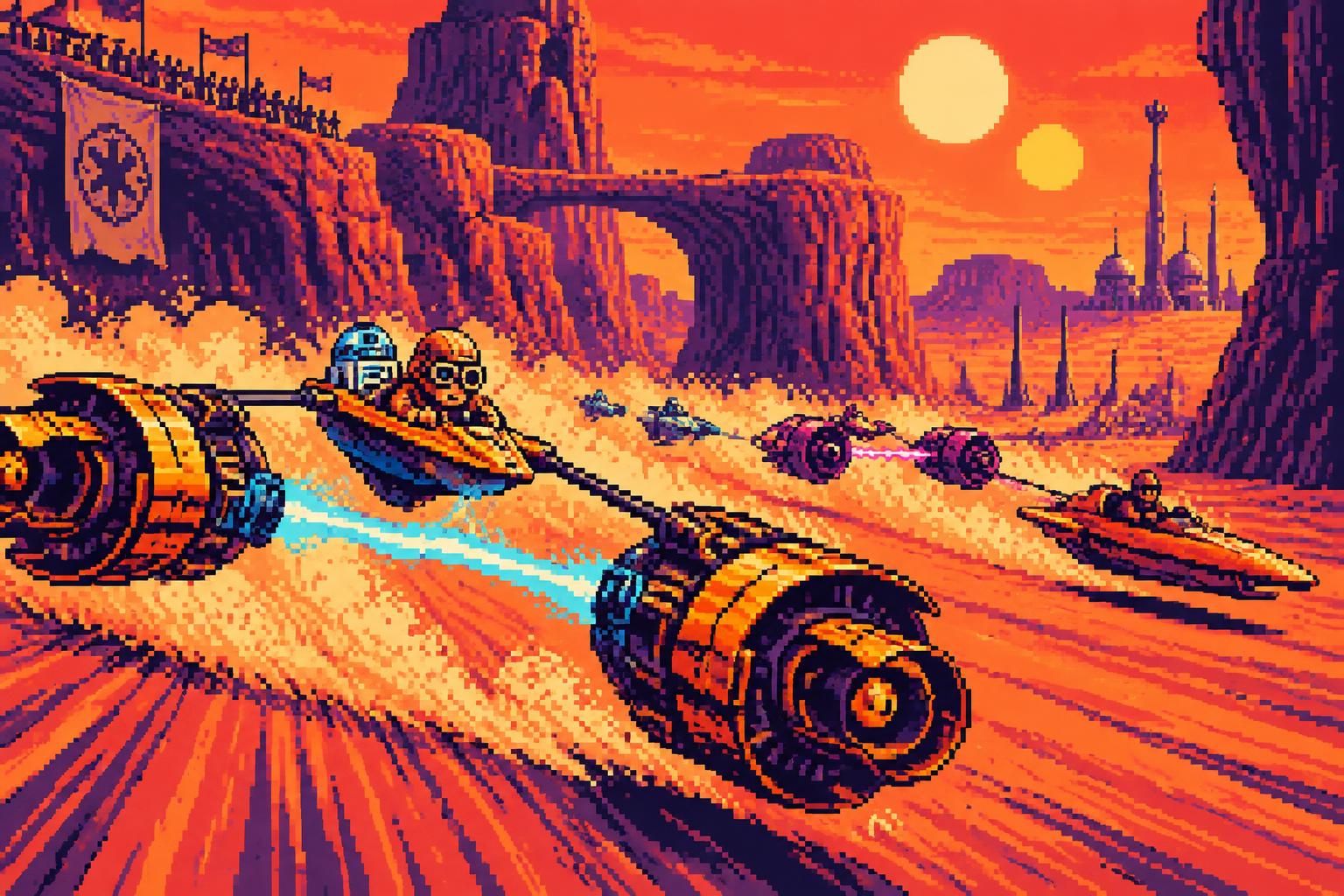
Star Wars: Galactic Racer Review — Speed Is Only One Part of the Battle
I assess Star Wars: Galactic Racer through the supplied review account rather than claim a separate hands-on test. That distinction matters: the reported experience establishes a promising design, while its broader technical reliability and competitive longevity require evidence beyond one player’s sessions.
The central proposition is clear. Fuse Games and Secret Mode have combined high-speed racing with a runs-based progression system, placing vehicle handling, resource management, and survival inside the same contest.
You are not simply attempting to reach a finish line before another competitor. You are preserving an investment across successive events, selecting improvements under uncertain conditions, and deciding whether immediate aggression justifies the possibility of losing an entire tour.
Why This Star Wars Racing Game Moves Beyond Familiar Podracing
Star Wars Episode I: Racer established its reputation in 1999, making the distance between that release and 2026 approximately twenty-seven years. Racer Revenge followed in 2002, but the relevant inheritance is not merely chronological: both games demonstrated that the galaxy’s machines could sustain a racing experience without requiring a lightsaber or a military campaign.
I regard Galactic Racer’s broader vehicle roster as its first meaningful departure from that inheritance. Landspeeders, speeder bikes, skim speeders, and podracers allow different relationships between acceleration, stability, exposure, and precision.
The reported influence of Burnout is equally important, although resemblance should not be mistaken for identical mechanics. The useful connection is a design philosophy in which velocity becomes more convincing when danger remains close enough to demand continuous decisions.
Consider Shade approaching a narrow passage with another driver alongside. A conventional racing model asks which line is quickest; this design also asks whether contact, accumulated damage, or an unfavorable upgrade combination makes that line strategically unacceptable.
That additional layer gives arcade racing a longer memory. A mistake can affect more than the current position, and a successful maneuver can preserve resources needed several events later.
The Outer Rim Makes Competition a Political System
The post-Imperial setting supplies more than scenery. With the New Republic rebuilding and the Outer Rim’s institutions remaining uneven, gambling, sponsorship, local influence, and public spectacle become credible foundations for an underground sporting economy.
I read that arrangement as a struggle over legitimacy. Whoever controls the league can influence access to wealth, recognition, and mobility; consequently, a champion’s dominance may extend beyond the circuit.
This is consistent with the cultural function of racing already established on Tatooine. The Boonta Eve spectacle in The Phantom Menace joins technical skill to wagering and social hierarchy, demonstrating that entertainment can expose a population’s distribution of power.
You therefore gain a more coherent Star Wars game when its competitive systems reflect the society surrounding them. A race becomes more meaningful when the event explains who profits, who takes the risk, and who is permitted to participate.
What the Supplied Evidence Actually Supports
The source account reports forceful acceleration, demanding handling, consequential failures, and enough variation between attempts to encourage experimentation. Those observations support a strong mechanical foundation, but they do not independently establish that every vehicle, difficulty setting, or online configuration is equally balanced.
For wider critical context, you can consult the Galactic Racer review collection. I would separate recurring observations about control and variety from numerical scores, because a rating cannot explain why a system succeeds under pressure.
The same discipline applies to the phrase “ultimate Star Wars racing game.” It is a useful standard to investigate, not an achievement to declare merely because a franchise has gone years without a comparable release.
My evaluation follows Shade as a practical reference point: first selecting a machine, then constructing a viable tour, interpreting the terrain, confronting the league’s hierarchy, and finally testing whether the surrounding modes support continued improvement. The decisive question is whether speed produces meaningful decisions rather than simply impressive motion.
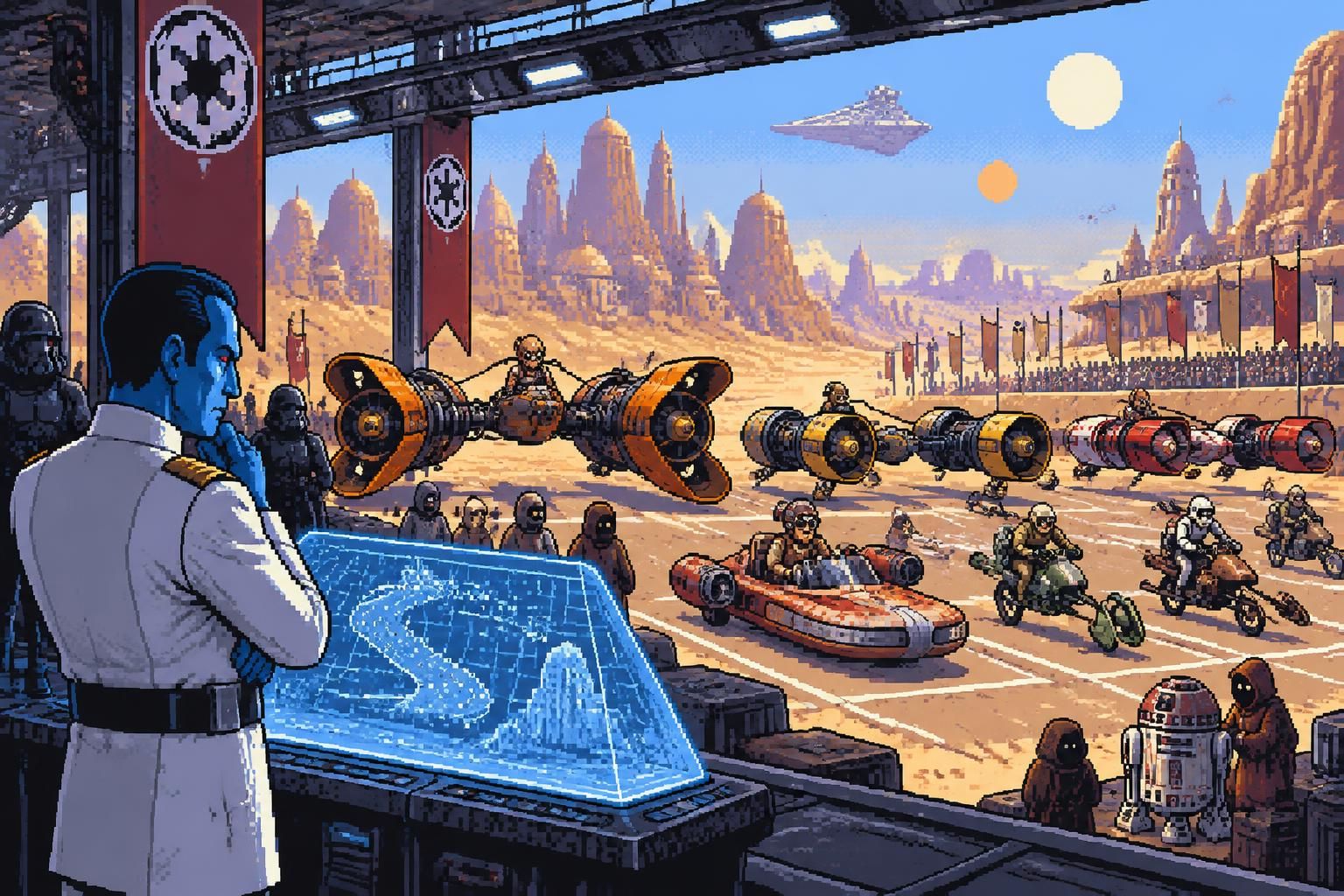
Star Wars: Galactic Racer Vehicles — Choosing a Machine That Matches Your Decisions
I begin vehicle selection with repeatability rather than maximum speed. If you cannot place a machine accurately through successive corners, its theoretical advantage becomes a liability whenever the circuit restricts your available space.
The supplied account distinguishes four categories, each offering a different learning problem. Landspeeders and skim speeders are described as comparatively dependable all-round options, while speeder bikes and podracers demand greater tolerance for speed and instability.
That does not make the first pair safe. The reporting explicitly notes that any class can collide, which means you should treat stability as additional room for correction rather than protection from poor judgment.
Vehicle Customization Begins with Identifying the Actual Weakness
Suppose Shade repeatedly reaches a difficult bend among the leaders but exits against the barrier. I would not solve that problem by pursuing another acceleration advantage, because the failure occurs during positioning rather than approach speed.
Instead, the useful question is whether the current configuration gives you enough control to convert pace into a clean exit. Vehicle customization should address the cause of lost time, not merely improve the most impressive statistic presented on screen.
This distinction becomes sharper across a long tour. An unstable setup can generate several strong opening laps before one substantial mistake removes the benefit of every earlier gain.
A more predictable machine may consequently produce the better overall result even when it loses a direct sprint. Reliability is not the opposite of performance; it is the condition that allows performance to accumulate.
| Vehicle category | Reported character | Practical learning priority |
|---|---|---|
| 🚗 Landspeeder | Balanced, broadly dependable handling | Develop clean lines before adding aggressive upgrades |
| 🛸 Skim speeder | Another all-round platform with its own behavior | Compare correction and cornering responses directly |
| 🏍️ Speeder bike | Fast, demanding, and vulnerable to costly errors | Practice precise positioning through restricted passages |
| ⚡ Podracer | High-velocity challenge associated with the series’ heritage | Learn braking decisions and commit only to readable exits |
Why Assistance Can Become a Strategic Dependency
The reported autopilot upgrade illustrates both the appeal and the danger of temporary assistance. It can help negotiate difficult terrain, but the supplied account also describes an abrupt loss of guidance followed by a collision.
I would distinguish an unfair transition from a poorly anticipated one before condemning the mechanic. If the remaining duration is clearly communicated, you have a planning problem; if the handover is inadequately signaled, the interface has failed to provide necessary information.
You should therefore use assistance to preserve capacity while continuing to read the route. Delegating steering does not remove responsibility for the machine’s position when direct control resumes.
The same logic applies to powerful offensive equipment. A vehicle built around repeated disruption may appear dominant until the route demands sustained precision or the available upgrades stop supporting the original plan.
A Useful Training Sequence for Each Vehicle Class
I would have you establish a baseline before judging any category. Use a familiar circuit, record where control becomes unreliable, and identify whether the problem arises during entry, sustained turning, exit, or recovery after contact.
Then change one relevant variable instead of rebuilding the entire configuration. A controlled comparison reveals whether the improvement solves the weakness or merely conceals it behind greater straight-line speed.
This method also prevents an inaccurate conclusion that one class is universally superior. A machine that suits your current habits may simply be easier to understand, while another becomes more effective after its specific demands are learned.
The artistic identities of Star Wars vehicles reinforce those distinctions. The exposed posture of a speeder-bike rider and the separated engines of a podracer communicate different relationships between operator and machinery before a menu explains them.
That visual language is useful when mechanics support it. You should be able to recognize a vehicle’s intended behavior through its silhouette, sound, and movement, rather than depend entirely on numerical descriptions.
I would reserve judgment on exact class balance until comparable tests exist across the full track selection. Your strongest machine is the one whose advantages remain usable when the environment and your opponents stop cooperating.
Galactic Racer’s Runs-Based Progression — Winning Requires Resource Discipline
I identify the runs-based structure as the feature most likely to distinguish Galactic Racer from an ordinary sequence of championships. Its purpose is to make the events between the opening grid and the final contest part of one connected strategic problem.
The supplied account describes tours containing varying numbers of races and special events. Success allows you to continue developing a vehicle, while failure can return you to the beginning with limited carryover benefits.
You must consequently evaluate two outcomes at once: your present finishing position and the condition in which you reach the next event. A maneuver that improves the first while severely damaging the second may be tactically attractive but strategically unsound.
Random Upgrades Should Create Decisions, Not Replace Them
The review material describes runs built around frequent turbo availability, repeated mine deployment, or assistance systems. Those examples suggest meaningful differences in configuration, although they do not establish that every combination is equally viable.
I consider randomness productive when it changes the problem you must solve. It becomes less defensible when it determines the answer before your driving or purchasing decisions can influence the result.
Imagine Shade receiving offensive components early in a tour while you intended to construct a speed-focused machine. The correct response is not automatically to reject those components; it is to compare the emerging opportunity against the remaining route and your demonstrated control.
Equally, adaptation does not require abandoning every initial principle. If the offered equipment encourages a style you cannot execute consistently, accepting it may exchange a known weakness for a more dangerous unfamiliar one.
- 🧭 Read the route: choose events with their hazards and survival conditions in mind.
- 🔧 Repair the limiting factor: prioritize the weakness most likely to end the attempt.
- 💳 Preserve purchasing flexibility: avoid spending solely because an upgrade is available.
- ⚠️ Inspect rule changes: elimination conditions alter the value of early aggression.
- 🎯 Separate objectives: an achievement attempt and a championship attempt may require different decisions.
Elimination Events Change the Meaning of Position
One reported modifier turns standard races into eliminators. That is not a cosmetic adjustment, because it changes which positions are acceptable and how long you can defer an overtaking attempt.
In a conventional event, temporarily yielding a place can protect your machine while you wait for a safer opportunity. Under elimination pressure, the same restraint may become fatal if the next cutoff arrives before that opportunity appears.
I would therefore reassess equipment and driving behavior whenever the rules change. Defensive consistency remains valuable, but only when it keeps you above the threshold required to continue.
The larger design question concerns communication. A consequential modifier must make its effects understandable before you commit; surprise is useful on the road, but obscurity in a rules menu is not a substitute for depth.
Long Tours Need Failure That Teaches Something
The supplied experience indicates that a tour can occupy several hours. That duration increases tension, but it also raises the cost of unclear failure, inaccessible practice, or poorly communicated hazards.
You should be able to reconstruct why an attempt ended. Was the machine unsuitable, the route unnecessarily dangerous, the spending inefficient, or the final collision a consequence of information arriving too late?
I would judge persistent rewards by whether they expand your options rather than simply compensate for repeated frustration. Carryover progression is most useful when it enables new approaches without making earlier mechanical lessons irrelevant.
Bets and relationship-building add another resource layer, according to the supplied account. Their value depends on how clearly potential rewards and liabilities interact with the main objective, rather than on the number of activities placed around it.
A champion’s tour should feel demanding because its decisions accumulate. The strongest runs-based racing system makes you better at interpreting pressure, not merely better equipped to survive the same mistake.
Galactic Race Tracks and Environmental Hazards — Terrain Is an Active Opponent
I treat the circuit as an adversary because it constrains every other decision. Opponents can force you away from an ideal line, but the environment determines whether that displacement costs a fraction of a second or the entire attempt.
The supplied account identifies destinations including Jakku, Crait, Sentinel I, and Ando Prime, within a selection described as spanning six principal planets. These locations give the game recognizable identities, but recognition alone does not establish mechanical variety.
The important question is whether each setting demands different behavior. A palette change produces a new backdrop; a change in traction, visibility, temperature, or route structure produces a new problem.
Jakku’s Heat Turns Shade into a Racing Resource
Jakku reportedly threatens engine performance through heat, making sheltered sections strategically relevant. Under that rule, the shortest route is not necessarily the route that delivers the fastest sustainable pace.
Suppose you can remain exposed on a direct stretch or take a slightly longer line beneath cover. I would compare the immediate distance penalty against the later cost of overheating rather than assume that every diversion represents lost time.
This is an effective way to give the landscape operational meaning. Wreckage, overhangs, and changes in illumination can become information you use, not merely details passing through peripheral vision.
The implementation must remain readable at speed. If you cannot distinguish usable shelter until you have already passed the decision point, the mechanic risks rewarding prior memorization more heavily than active observation.
Ando Prime Demands a Different Control Doctrine
The account describes cold conditions on Ando Prime as making vehicles harder to control. That shifts attention from maintaining thermal efficiency to preserving reliable placement through corners and recovery zones.
I would respond by reconsidering entry speed, correction timing, and the consequences of contact. A configuration that thrives on a hot, open route may become inefficient when its main advantage encourages commitments the surface cannot support.
You can see why environmental variation strengthens vehicle customization. The upgrade decision gains meaning when it answers a specific terrain problem instead of applying the same preferred package everywhere.
However, the cause of reduced control must be apparent. Visual effects, sound, and interface feedback should explain the condition without forcing you to diagnose it through repeated unexplained collisions.
Star Wars Environments Need Cultural Coherence
Crait’s mineral landscape carries a different visual history from Jakku’s accumulated wreckage. I would expect those distinctions to shape composition, navigation cues, and the surrounding evidence of habitation, even without assuming undocumented hazards for either location.
The galaxy’s strongest environmental design uses architecture and material culture to explain occupation. Industrial structures imply logistical priorities; improvised settlements suggest scarcity; monumental spaces communicate authority or ceremony.
That principle matters in racing because you encounter a place at extraordinary speed. Large silhouettes and consistent material patterns must communicate its character before small decorative objects have time to register.
The same requirement explains why galactic race tracks must be visually legible. A spectacular vista is useful only if its dominant forms help you distinguish the route from an obstacle and an alternative passage from an accidental dead end.
Track Mastery Should Remain More Than Memorization
The supplied multiplayer account mentions a final-course trick that can mislead drivers. Without reproducing an undocumented route detail, I would assess such a moment by asking whether the correct path is discoverable through consistent visual language.
A deceptive corner can reward attention. An arbitrary reversal that contradicts established signage merely transfers advantage to whoever has already encountered it.
Repeated visits are inevitable in a game with a finite selection of locations. The way to preserve depth is not to conceal the road indefinitely, but to let changing opponents, configurations, and conditions alter how you use familiar terrain.
You should eventually know where the road goes while still needing to decide how to approach it. A well-designed circuit becomes predictable in geography and variable in execution; that is the foundation of durable mastery.
Star Wars: Galactic Racer Campaign — Shade, Kestar Bool, and the Politics of Competition
I interpret the campaign’s rivalry as a conflict over access rather than a simple contest between pleasant and unpleasant personalities. The supplied narrative positions Shade within the Gathi population of Gathleon, beneath a powerful Bool family whose influence extends into the league.
Darius Pax, a Besalisk associated with restoring the competition, recruits Shade to challenge the existing order. Kestar Bool stands between that objective and its realization, functioning as both a sporting opponent and a representative of entrenched authority.
This arrangement gives victory a clear consequence. You are not merely adding a trophy to a collection; you are contesting a system whose current champion benefits from advantages established before the starting signal.
A Rival Works Best When Character and Mechanics Reinforce Each Other
The supplied review praises Kestar’s theatrical behavior and attributes the performance to Kris Laudrum. I would evaluate that contribution through its practical effect: a recognizable voice can turn an otherwise abstract leaderboard position into a persistent adversarial presence.
His exaggerated confidence also serves a narrative function. It communicates that public dominance is part of his method, encouraging you to interpret the league as a stage on which reputation and control are continually renewed.
For additional discussion of the performers, the Galactic Racer voice-cast coverage provides a relevant companion topic. The supplied account supports attention to Kestar’s delivery, but it does not justify inventing details about recording methods or the rest of the production.
I would not require every supporting racer to match his prominence. The more useful standard is whether each participant has a distinct role, recognizable incentives, and enough consistency for you to understand why an alliance or rivalry matters.
Gathleon’s Hierarchy Gives the Story a Strategic Center
Political influence becomes convincing when it affects opportunity. If the Bool family controls the conditions under which others can advance, Shade’s participation challenges more than Kestar’s driving ability.
You can understand that structure through parallels elsewhere in Star Wars. The Trade Federation’s economic leverage and the Hutt families’ control of local enterprise demonstrate how domination can operate through institutions and transactions rather than continuous military occupation.
I use those comparisons to interpret the campaign’s stated premise, not to claim that its plot duplicates either example. The common mechanism is the conversion of material advantage into rules that make opposition difficult.
That creates a productive connection between narrative and runs-based play. Repeated setbacks can represent the difficulty of challenging an established order, provided the story does not substitute injustice for mechanical fairness.
Returning Characters Should Contribute More Than Recognition
Sebulba’s reported involvement links the new competition to the franchise’s established podracing tradition. His presence carries immediate meaning because audiences already associate him with aggressive racing and the social world surrounding it.
Griff Halloran and other reported Resistance connections broaden that continuity beyond The Phantom Menace. I would judge these appearances by whether they fit the league’s setting and contribute to its relationships, rather than simply reward recognition.
The relevant artistic principle is restraint. A galaxy seems larger when familiar figures occupy plausible positions within it; it seems smaller when every meeting exists to remind you of another production.
Relationships Need Consequences You Can Understand
The supplied account describes opportunities to build relationships with racers and other characters. That feature can strengthen the campaign if conversations help explain future choices, provide useful context, or change the meaning of a later event.
You should not need an elaborate branching narrative for those interactions to matter. A concise exchange can establish whether a competitor values loyalty, financial return, reputation, or independence, giving you a basis for interpreting subsequent behavior.
I would preserve the story’s later revelations rather than reduce the rivalry to a list of disclosures. Its immediate strength is already visible: personal history, unequal power, and a public competition occupy the same dramatic space.
The campaign becomes strategically credible when defeating Kestar changes who can compete, not merely whose name appears first. That standard also explains why the spaces between events deserve careful examination.
Galactic Racer Modes and Hub Design — Where Momentum Is Preserved or Lost
I consider the spaces between races part of the control system. They govern how quickly you can understand the next decision, reach the relevant character, inspect your options, and return to the activity that gives the game its identity.
The supplied account describes compact hubs with enough conversation, background detail, and returning characters to suggest an inhabited world. Their limited scale is not inherently a weakness; it can keep attention on the league rather than turn progression into unnecessary travel.
The reported inability to run, however, works against that economy. You have already established a rhythm based on rapid movement, so repeated slow traversal can feel disproportionately intrusive even when the physical distance is modest.
Camera Placement Is an Information Problem
The over-the-shoulder view is described as close to Shade and occasionally awkward during NPC interactions. I would examine that issue as a conflict between visual presentation and practical access.
A close camera can emphasize the protagonist and preserve a cinematic relationship to the environment. If that positioning obstructs interaction targets or makes small adjustments difficult, it reduces your ability to perform a routine task.
The correction need not require a larger hub or a different artistic identity. More dependable framing, clear prompts, and reduced friction around conversations could preserve the intended atmosphere while improving navigation.
Consider the contrast with a cockpit decision at speed. There, a fraction of a second has a direct competitive cost; in a hub, the cost is cumulative interruption, repeated whenever you prepare another attempt.
Arcade and Scenario Modes Need Distinct Training Roles
According to the supplied material, arcade mode centers on time trials, while scenario mode offers character-specific challenges. Those formats can serve different purposes if the player understands what each teaches.
I would use a time trial to isolate route execution from the behavior of surrounding competitors. Without traffic determining every line, you can identify whether a poor result comes from braking, positioning, environmental management, or an inefficient exit.
Scenario challenges can then introduce a more constrained problem. Their exact conditions are not detailed in the source, so I would not invent objectives; the useful principle is that restrictions can encourage you to practice techniques a general championship does not force you to learn.
The reported Epic Games account connection allows comparison with friends in relevant leaderboard activity. That can provide a useful benchmark, provided the comparison encourages examination of driving rather than treating a time difference as self-explanatory.
The Missing Free-Play Option Creates a Practical Gap
The source identifies no discernible way to select any circuit and conduct an ordinary unrestricted race. Quick-play multiplayer exists, but reportedly does not provide direct track selection, while arcade’s flexibility remains tied to time trials.
I regard this as a significant omission because practice and competition require different levels of commitment. You may want to study a route with opponents present without risking a lengthy tour or relying on matchmaking to choose the correct destination.
Free play would also serve social use. A group of friends may wish to repeat one location, compare machines, or establish informal rules without entering the progression framework designed for a broader competitive population.
Why should a driver need to negotiate an entire structure simply to rehearse one difficult passage? The question exposes a mismatch between the game’s high skill ceiling and its reported tools for deliberate training.
Small Details Can Support Atmosphere Without Becoming Systems
The Tooka cat described in the hub is a useful example of environmental life rather than competitive utility. Its presence can make the setting feel occupied even if Shade cannot interact with it.
I would not elevate the inability to pet that animal into a major mechanical criticism. The more consequential distinction is whether decorative details enrich your brief stay while essential functions remain efficient and readable.
A racing game does not benefit automatically from longer downtime. The ideal hub gives you context, options, and a reason to return, then releases you before preparation becomes obstruction.
Star Wars: Galactic Racer Multiplayer — Competitive Potential Requires More Than Fast Servers
I separate multiplayer’s promise into three questions: whether the connection remains stable, whether the rules reward meaningful performance, and whether enough variation exists to support repeated competition. Success in one category cannot compensate indefinitely for weakness in another.
The supplied player account reports smooth online sessions with crossplay and no noticeable server problems. It also describes slower matchmaking, but the explanation that a larger launch population will solve that issue remains a projection rather than an established result.
You should therefore treat the available evidence as encouraging early observation. It does not demonstrate resilience during public-launch demand, compatibility under every network condition, or the absence of rare synchronization failures.
Tour Structure Changes How Players Manage Risk
The reported multiplayer tours allow competitors to recover from preliminary crashes and claim the championship by winning the final race. That differs meaningfully from the campaign’s harsher survival requirements.
I see a clear accessibility benefit. A newcomer can remain involved after an error instead of spending the rest of a session watching others complete the decisive event.
The trade-off concerns the value of earlier performance. If the final alone decides the champion, consistent preliminary success may feel less consequential unless those events provide another clear competitive benefit.
I would not assume undocumented seeding, reward, or upgrade rules to resolve that question. The relevant design requirement is straightforward: you should understand what each preliminary event contributes before choosing how much risk to accept.
Crossplay Needs Fairness as Well as Connectivity
A functioning connection allows different platforms to meet, but fair competition also depends on consistent handling feedback, readable effects, and reliable presentation of contact. Small discrepancies become more consequential when vehicles move rapidly through narrow spaces.
Suppose two drivers approach the same opening and both believe they arrived first. If the displayed sequence of events disagrees substantially between clients, a collision can appear arbitrary even when the server follows an internally consistent rule.
I would therefore evaluate online quality through repeatable situations, not only the absence of disconnections. Close overtakes, weapon interactions, recovery after a crash, and final-position confirmation are more informative than an uneventful race with widely separated vehicles.
For another critical perspective, you can examine the IGN review of Galactic Racer. Its value here is as a separate point of comparison, not a substitute for sustained network testing.
Track Knowledge Must Leave Room for Adaptation
The limited planetary selection means experienced drivers will eventually internalize the available routes. That is not automatically a defect: repeated terrain provides a shared language through which competitive skill becomes visible.
The danger emerges when memorization eliminates too many meaningful choices. If one line and one configuration dominate most encounters, familiarity stops deepening the contest and begins narrowing it.
Vehicles, environmental management, traffic, and build variation can resist that narrowing. Their usefulness depends on whether each introduces a legitimate alternative rather than merely a less efficient version of the established solution.
I would have you distinguish spectacle from counterplay when judging weapons and disruptive upgrades. A dramatic impact is not strategically rich unless the targeted driver has understandable ways to anticipate, avoid, or recover from it.
Space Racing Needs an Accessible Social Structure
The phrase space racing describes the broader science-fiction category, but Galactic Racer’s reported action is grounded in planetary circuits and repulsorlift vehicles. That distinction helps set expectations: this is not being presented as a starfighter simulation with orbital navigation.
Its social strength should instead come from recognizable routes, readable machines, and short opportunities to challenge another driver. Standard tours, podracer tours, and quick-play options already suggest multiple entry points.
What remains necessary is a structure that accommodates both committed competitors and players who want a controlled session with friends. Direct track selection and flexible private-event tools would support that aim, although the supplied material does not establish their availability.
Multiplayer endures when losing gives you useful information and returning gives you a credible opportunity to apply it. Stable servers begin that process; fair rules and flexible practice sustain it.
Galactic Racer Performance, Accessibility, and DLC — The Systems That Determine Staying Power
I reserve the technical assessment for what the supplied PlayStation 5 experience actually establishes. It reports short loading times, responsive inputs, clear graphics, a navigable interface, and no noticeable frame drops or game-breaking problems during the reviewer’s sessions.
Those are meaningful observations, but they are not instrumented measurements. They do not establish a locked frame rate, identical behavior on Xbox Series X/S, or the performance range across different PC configurations.
You should therefore distinguish a favorable account of play from a comprehensive platform comparison. The former indicates that technical issues did not dominate the reported experience; the latter would require additional controlled testing.
Audio Clarity Matters When Conversations Carry Decisions
The most specific reported technical weakness concerns quiet NPC dialogue during some campaign exchanges. In a story that uses relationships and rivalry to frame progression, inconsistent speech levels can interfere with more than atmosphere.
I would prioritize dependable dialogue balance before elaborate cosmetic changes. If you miss a line explaining a character’s intentions or the context of an opportunity, the narrative and decision systems become less legible.
Subtitles and adjustable sound categories can reduce that problem when available, but the source does not enumerate the exact settings. It would be inaccurate to claim that a particular control already resolves every affected conversation.
The broader principle is that presentation must distinguish necessary information from ambient detail. An engine should sound powerful without rendering a conversation or a critical warning functionally inaccessible.
Accessibility Should Be Evaluated Through Specific Tasks
The supplied account characterizes the accessibility provision as broad, without listing all options. I treat that as a positive initial impression rather than a basis for claiming support for every sensory or motor requirement.
For this type of racing game, you should examine whether route information depends excessively on color, whether important signals have multiple forms, and whether control demands can be adjusted without removing the core decisions. These are evaluation criteria, not assertions about undocumented features.
Temporary autopilot also should not be conflated with a complete accessibility solution. An upgrade acquired within progression serves a different purpose from a dependable setting available whenever a player needs it.
I would similarly distinguish difficulty from clarity. A demanding circuit can remain fair when its rules are readable; reducing challenge does not repair an unclear warning, an obstructive camera, or an unreliable interaction prompt.
Galactic Racer DLC Should Expand Decisions Before Decoration
New planets and circuits are the most direct route to increasing variety, particularly once players master the existing selection. Their strategic value depends on adding different problems rather than repeating familiar geometry beneath a new skyline.
You could broaden the game through routes that demand different vehicle strengths, alternative environmental pressures, or event structures that change how resources are conserved. These are development possibilities, not announced additions.
The discussion of Galactic Racer DLC is a relevant place to follow that topic, but expansion coverage should be distinguished from confirmed release commitments. I would rank unrestricted practice and flexible event selection alongside additional environments, because new content is more useful when players can access it deliberately.
Cosmetic customization can reinforce the league’s cultural identity, especially when colors and designs suggest different sponsors or local traditions. It should supplement mechanical breadth rather than stand in for it.
Release Information and the Evidence Still Required
The supplied listing places release on October 6, 2026, for PlayStation 5, Xbox Series X/S, and PC. I present that as the schedule contained in the provided material, not as evidence of current storefront availability or an independently verified launch state.
Its proximity to other named Star Wars projects is not necessary to establish this game’s merits. The more useful comparison concerns what Galactic Racer itself delivers: precise control, meaningful variation, understandable failure, and enough freedom to support deliberate improvement.
The reported foundation is substantial, particularly where vehicle behavior and tour progression reinforce one another. The unresolved priorities are equally concrete: unrestricted racing, dependable conversation audio, broader route variety, and online performance tested under a larger population.
Long-term strength will come from protecting the relationship between information, control, and consequence. Every update should make your decisions more meaningful without making the road harder to read.

I am Grand Admiral Thrawn, strategist of the Galactic Empire. Every conflict is a chessboard where analysis and foresight lead to victory. The art and culture of a people betray their weaknesses. The Empire embodies order and discipline in the face of rebel chaos. History will remember that only strategy ensures peace.