

Zuckuss and Gand Culture: Why a Findsman Became a Bounty Hunter
I begin my assessment of Zuckuss with the institution that trained him, not the weapon he carries. You cannot evaluate a specialist accurately until you understand how his society defines competence, failure, and belonging.
On Gand, findsmen occupy a role that combines tracking expertise with traditions outsiders often describe as mystical. Their practices make cultural knowledge operationally useful: interpreting signs, understanding living environments, and locating individuals who would remain concealed from a less patient observer.
The origin account developed in the Bounty Hunters comics connects his departure from home to a failed ritual. He was required to retrieve a flower from a predator’s nest, failed the trial, and was cast out by his community.
I distinguish this account from older explanations found in Legends and continuity-blending references. Narratives involving technological displacement, inherited professional expectations, or other origins should not be combined into a single biography merely because they describe the same character.
Zuckuss’s Exile as a Strategic Turning Point
The ritual matters because its objective was not simply botanical. A flower guarded by a dangerous animal tests observation, timing, controlled exposure, and the ability to extract something valuable without surrendering initiative.
You should recognize the resemblance to a capture contract. Both operations require the specialist to enter hostile territory, distinguish the objective from surrounding hazards, and withdraw before the environment dictates the outcome.
Nevertheless, failure in one controlled trial does not establish permanent professional incapacity. I treat his later career as evidence that institutional rejection and practical usefulness are separate measurements.
Exile changed the market for his abilities. Skills previously exercised within a communal tradition became services that could be sold to employers across the galaxy, including clients with little interest in Gand customs.
This distinction prevents a simplistic reading of his motives. The supplied comic account establishes displacement and subsequent employment; it does not require every later contract to be interpreted as an attempt to prove his tribe wrong.
I would instead examine how separation from a familiar social structure affects professional choices. A displaced specialist needs income, transport, environmental support, and dependable associates before he can exercise meaningful independence.
The Gand Breathing Apparatus and the Mist Hunter
His respiratory equipment makes those requirements visible. Zuckuss belongs to an ammonia-breathing Gand population, and his apparatus allows him to operate in environments whose atmospheric composition would otherwise be unsuitable.
Not all members of his species share identical respiratory needs, so you should avoid turning his equipment into a universal rule about every Gand. For this particular operative, however, environmental support is an essential component of mobility.
The Mist Hunter also serves a purpose beyond transportation. Accounts describe him maintaining an atmosphere aboard the vessel that recalls his homeworld, giving the ship both practical and personal significance.
I read this arrangement as a portable base adapted to its principal operator. An employer who ignores atmospheric compatibility may possess a capable contractor on paper while preventing that contractor from functioning efficiently in practice.
Culture therefore enters the tactical assessment through concrete mechanisms. Ritual shapes standards of achievement; exile changes employment incentives; environmental requirements influence equipment, deployment, and recovery.
The visual language of Gand identity reinforces the same point. His insectoid features, concealed respiration, and enclosed clothing are not merely an intimidating silhouette; they express the distance between his native environment and the worlds where he works.
For orientation, you can compare the IGN character guide to Zuckuss with the more extensive current-continuity character record. I keep their descriptive material separate from tactical deductions drawn from his conduct.
The practical lesson is precise: a society may reject a specialist without eliminating the value of his specialization. Once that specialist enters an external market, the decisive question becomes whether his new partners can convert cultural expertise into reliable operational results.
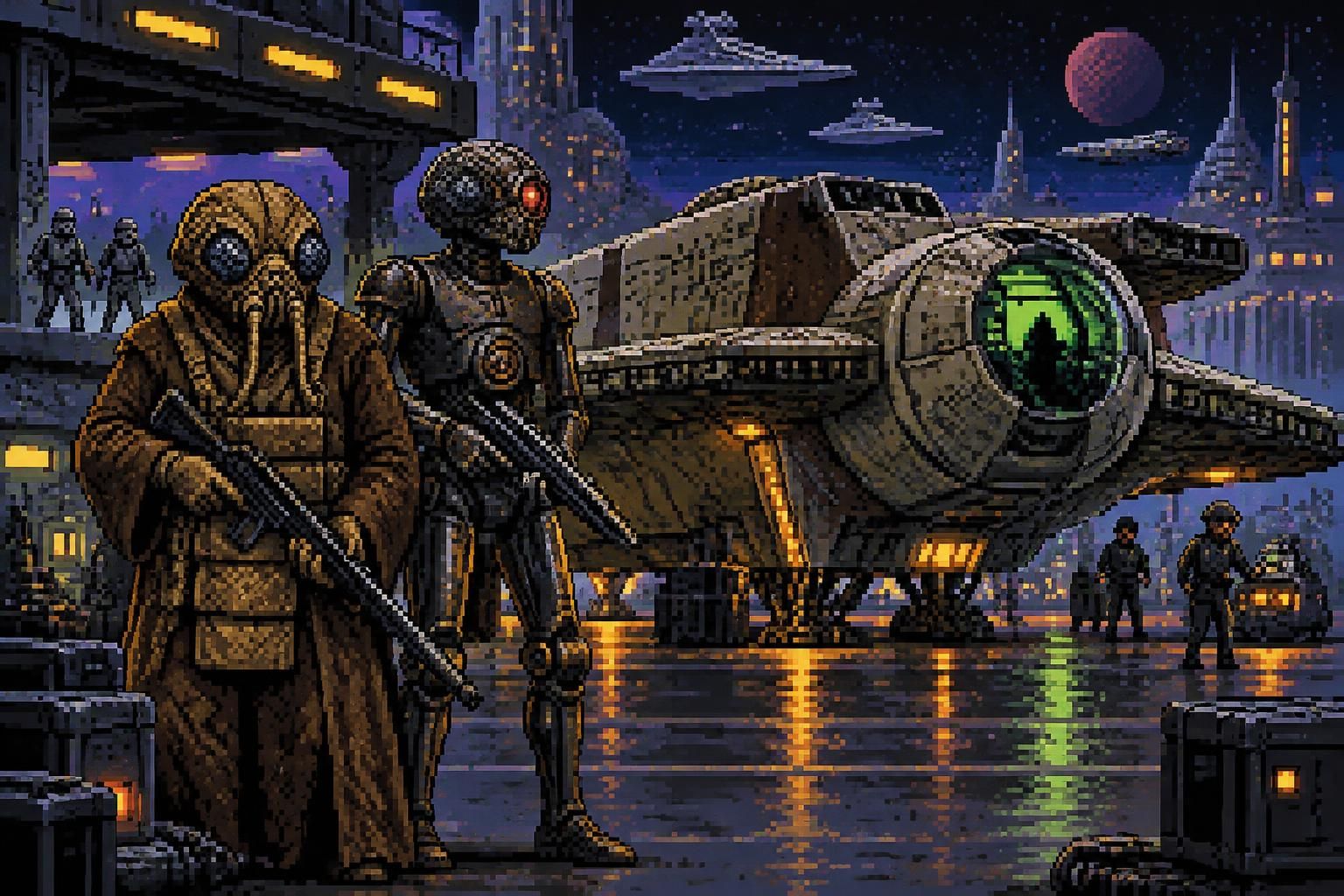
Zuckuss and 4-LOM: How the Bounty Hunter Partnership Works
I assess the association between Zuckuss and 4-LOM as a combination of different capabilities rather than a pairing of interchangeable gunmen. You gain little by describing both as dangerous unless you identify what each contributes to an operation.
The Gand brings tracking traditions, intuition, and sensitivity to circumstances that may escape ordinary observation. His mechanical partner contributes a different form of perception and decision-making, creating opportunities for cross-checking information.
This arrangement does not automatically produce competence. Two specialists can reinforce one another’s mistakes if neither challenges the assumptions that led to the initial target selection.
Their early assignment involving Doctor Cribiriz Idollax demonstrates that danger. They accepted a contract to kill the doctor, but the person Zuckuss killed was his brother, Sribiriz.
The Idollax Contract and Failed Identity Verification
The hunters received their payment without immediately discovering the substitution. From an accounting perspective, the assignment appeared complete; from an intelligence perspective, the central identification had failed.
I consider this distinction essential. A client’s willingness to pay confirms acceptance of a result, not necessarily the factual accuracy of the operation that produced it.
You should separate three questions that are often collapsed into one: Was the target located? Was the individual correctly identified? Was the requested outcome achieved against that individual?
The Idollax affair shows how apparent success can conceal an unresolved threat. The surviving doctor later became capable of retaliating, turning an old identification error into a new operational crisis.
A stronger procedure would have required independent confirmation before the lethal action. Physical resemblance, location, and the confidence of a tracker should have been treated as supporting evidence rather than a complete identity package.
I would assign separate responsibilities within the partnership. One operative would establish the route and opportunity, while the other would verify identifying details and challenge inconsistencies.
That recommendation is a deduction from the failure, not a claim that their early contract included a formal verification system. The available account instead illustrates what happens when the operation reaches execution before its foundational assumption is tested.
Why 4-LOM Is More Than Replaceable Equipment
The later effort to recover the droid demonstrates another feature of the relationship. The organic hunter does not consistently treat his associate as expendable hardware, even when recovering him complicates an already dangerous situation.
When Cribiriz rebuilt 4-LOM with a spider-like body and altered his programming, the doctor weaponized the partnership itself. Familiarity with a trusted companion became a channel through which an adversary could introduce deception and violence.
You should not interpret this simply as a mechanical malfunction. The body, programming, and recognizable identity had been separated, leaving the tracker confronted with a familiar presence whose behavior no longer matched established expectations.
I classify that condition as compromised trust. The same vulnerability can affect an Imperial access system, a criminal contact, or a military courier: recognition continues while control has changed hands.
Restoring the original behavioral state therefore mattered more than recovering the visible chassis. A familiar silhouette without reliable continuity is not a restored partner.
Their association also explains why the Mist Hunter is tactically important. A shared vessel consolidates transport, equipment, and cooperation, but it creates a common point of failure if the craft is disabled or its occupants lose control of it.
Reliable partnerships need more than complementary strengths. They require verification habits, emergency procedures, and clear responses when one member becomes unavailable or compromised.
🔎 I would preserve their complementary abilities while reducing shared assumptions. The strongest two-person team is not the one that agrees most quickly, but the one that detects its own errors before an adversary does.
Zuckuss as a Force-Sensitive Hunter: Tracking Power and Its Limits
I treat the description Force-sensitive hunter as a capability statement, not a guarantee of success. You should ask what that sensitivity enables, how it interacts with trained observation, and where the record shows its limits.
Zuckuss is associated with an unusual ability to locate hidden quarry and interpret circumstances beyond ordinary tracking. Legends material particularly emphasizes the reputation behind the name “the Uncanny One.”
That reputation should not be converted into unlimited foresight. Detecting that something is wrong does not necessarily reveal the source, timing, or exact form of the approaching danger.
His earlier encounter with Han Solo provides a useful example. In the Star Wars Adventures account set in 9 BBY, he and his partner pursued the smuggler after a theft involving ship components.
Han Solo, Chewbacca, and the Unresolved Warning
The initial capture worked: a net discharged from the Gand’s weapon incapacitated the target. The immediate problem was not an inability to locate or restrain Solo, but a failure to secure the surrounding space.
He sensed a disturbance without successfully anticipating Chewbacca’s emergence from a cargo crate. The Wookiee reversed the encounter, and the captor was restrained using his own equipment.
I identify two separate failures. The first concerned interpreting an incomplete warning; the second concerned allowing a captured weapon to become available to an opponent.
You should resist the temptation to merge these into a claim that supernatural perception is useless. The more exact finding is that an ambiguous signal requires a supporting procedure before it becomes actionable intelligence.
If an operative senses an unexplained threat, the appropriate response is not necessarily to fire. It may be to widen distance, inspect concealed spaces, relocate the prisoner, or require a partner to watch likely approaches.
The cargo crate mattered because it turned ordinary freight into concealed combat capacity. Solo’s association with a physically powerful companion should also have influenced the search plan before the capture began.
I would therefore distinguish finding the quarry from controlling the encounter. The former creates an opportunity; the latter prevents that opportunity from being reversed.
When the Environment Defeats Technical Superiority
The pursuit subsequently reached a planet where technological systems ceased functioning. This setting changed the significance of spacecraft, weapons, and the droid partner without removing the need for observation and improvisation.
Once the relevant immobilizing effect was addressed, machinery resumed operation, including hostile scorpion droids. Solving the immediate mobility problem simultaneously restored a separate threat.
I regard this as a dependency trap. A system that obstructs escape may also suppress enemies, so disabling it can improve one variable while worsening another.
You should apply that reasoning whenever a mission depends on a shared infrastructure. Restoring power to a docking complex may reopen the hangar while also reactivating defensive turrets and surveillance.
Solo exploited the developing circumstances and left the pursuing pair stranded. The encounter illustrates how a quarry can defeat a superior tracker by controlling transitions between phases rather than remaining permanently hidden.
The Gand’s tradition still has value in such environments. A practice built around attention to signs and living surroundings may retain usefulness when a scanner does not, although no method removes the need to reassess the situation.
For continuity discipline, the Legends account of his tracking abilities should be read as a separate body of material. I would not import every detail from that account into the current comic chronology.
The resulting assessment is narrower and more useful than either admiration or dismissal. Exceptional perception improves the search, but security procedures determine whether a successful search becomes a successful capture.
Zuckuss in The Empire Strikes Back: Vader’s Hunt for the Millennium Falcon
I consider the gathering aboard the Executor an example of an Imperial command outsourcing a difficult search to independent specialists. Zuckuss stands among the contracted hunters in The Empire Strikes Back, but his presence does not establish that he discovered the fugitives’ eventual destination.
Darth Vader wanted the Millennium Falcon located after the Battle of Hoth. The selection of several contractors distributed the search across individuals with different contacts, methods, and professional incentives.
You should distinguish this operational significance from the character’s limited screen time. A brief appearance can establish participation in a major assignment without showing how that participant conducted the search.
Later stories add context to the summons. His chapter in From a Certain Point of View: The Empire Strikes Back places an Argazdan diamond theft before the pair reports for the Imperial contract.
Why Multiple Hunters Did Not Produce Equal Results
The assembled group included Boba Fett, Bossk, Dengar, IG-88, 4-LOM, and the Gand specialist. Their common employer did not make them a unified intelligence service.
I identify a structural problem in competitive contracting. Each participant benefits from exclusive information, which discourages the sharing that might otherwise improve the overall search.
That arrangement can still succeed if the objective is simply to reward whoever finds the target first. It becomes less efficient when command requires a coherent account of the quarry’s movements and associated threats.
Fett achieved the decisive tracking success. The others’ presence on the bridge should not be mistaken for participation in his discoveries or equal access to his intelligence.
The Falcon eventually reached Bespin, where events at Cloud City created the opportunity to capture Solo. There is no basis in the supplied account for assigning the Gand credit for locating that refuge.
You should also keep the Executor briefing and the later carbon-freezing sequence geographically distinct. Their connection is the pursuit of the same fugitives, not a demonstrated appearance by every hired operative at both locations.
Imperial Procurement and the Limits of Reputation
Why retain several specialists if one ultimately succeeds? I would answer in terms of uncertainty: command cannot know in advance which contact network or inference will match the target’s next decision.
However, reputation is only a selection criterion. It does not replace task definition, evidence standards, communication arrangements, or control over what happens after the quarry is found.
A disciplined employer would specify what constitutes a useful report. Coordinates without timing, confirmation, or an assessment of escape options may become obsolete before an interception force arrives.
The earlier contract to pursue Doctor Aphra in the Darth Vader comic further places Zuckuss within the pool of specialists available to Imperial interests. It demonstrates access to employment, not unrestricted Imperial trust.
I would categorize him as a contractor whose value depends on the assignment. Tracking a concealed individual and maintaining custody of a politically significant prisoner require overlapping but different competencies.
| Operational factor | Evidence in the pursuit | Command implication |
|---|---|---|
| 🔎 Specialist selection | Several independent hunters receive the assignment. | Varied methods expand the search without guaranteeing coordination. |
| 🛰️ Target movement | The Falcon ultimately reaches Bespin. | Predictive judgment matters alongside technical detection. |
| 🎯 Confirmed success | Fett secures the decisive lead. | Evaluate delivered intelligence rather than attendance at a briefing. |
| ⚠️ Custody transition | Solo becomes a transferable prize. | Capture creates new risks involving transport and competing claimants. |
The film’s bounty-hunter scene is consequently more than a display of distinctive silhouettes. It presents a procurement decision made under pressure, with success dependent on contractors whose incentives do not fully match Imperial requirements.
My assessment remains measured: selection by a powerful employer confirms perceived usefulness; only the subsequent result confirms effectiveness on that assignment. The later struggle over the captured smuggler exposes what happens when competitive incentives continue after the search has ended.
Zuckuss in War of the Bounty Hunters: Contracts, Rivalries, and Reversals
I read War of the Bounty Hunters as an environment in which contract value changes faster than professional commitments can stabilize. You must follow the movement of incentives, not merely the movement of armed individuals.
After the events of The Empire Strikes Back, Zuckuss and his partner pursued Cadeliah, whose position connected two criminal syndicates. Her importance arose from succession and political leverage, not simply from the price attached to her capture.
Beilert Valance protected her, making the assignment a contest against a capable cyborg rather than an undefended extraction. An encounter on a space station injured the Gand before the pursuit continued to Lowik.
That injury matters operationally because pursuit often encourages contractors to continue without fully reassessing their condition. Previous investment can make withdrawal appear more costly than it actually is.
Cadeliah and the Price of a Temporary Agreement
On the forest world, the hunters activated super battle droids against rebel defenders. This increased their immediate combat capacity, but additional machinery did not eliminate the need to secure their vessel and anticipate Valance’s movements.
The tracker initially obtained Cadeliah, only to encounter her protector at the ship. Valance offered a valuable ruby in exchange for her return and a three-day postponement of the hunt.
I interpret acceptance as a bounded commercial decision. The pair acquired immediate compensation while retaining the possibility of renewed pursuit after the agreed interval.
You should not assume that every change of objective indicates confusion. A contractor may rationally accept a smaller certain return instead of risking everything for a larger uncertain one.
The weakness lies elsewhere: repeated renegotiation makes behavior easier for opponents to influence through pricing. A protector who understands that structure can purchase time instead of winning every confrontation.
The subsequent encounter with Valance and Dengar produced another change. Information about Jabba’s bounty on Fett, together with his location on Nar Shaddaa, redirected the hunters toward a more profitable target.
Jabba’s response followed the loss of the carbon-frozen Solo and the belief that Fett had diverted the prize to Crimson Dawn. The contract thus arose from incomplete understanding inside a criminal power structure.
Nar Shaddaa and the Cost of Challenging Boba Fett
The pair successfully located their new quarry and entered his ship. That achievement again demonstrates an ability to find a target without establishing the capacity to defeat him on favorable terms.
Fett overcame both intruders. Zuckuss was knocked from the platform, while his mechanical associate lost his body and was taken away as a detached head.
I would classify the operation as an escalation failure. The prospective reward increased, but so did the opponent’s capability; the hunters changed objectives without producing evidence of a corresponding change in preparation.
You should compare that outcome with the earlier Idollax mistake. In one case, inadequate verification corrupted the target selection; in the other, inadequate control corrupted the confrontation.
The subsequent recovery attempt exposed the old surviving doctor’s revenge scheme. By rebuilding and reprogramming the droid, Cribiriz converted a past error into an attack on the pair’s strongest continuing relationship.
The Gand freed his associate from the doctor’s control, but the damaged machine fled into Nar Shaddaa. Immediate extraction therefore did not equal complete restoration.
These encounters reveal the texture of the Galactic underworld: contracts overlap, information becomes payment, and yesterday’s apparent success can return as tomorrow’s adversary. Background material on the death-stick trade in Star Wars offers another example of illicit commerce operating within that broader environment, without implying that this particular tracker participated in it.
The central finding is economic rather than emotional. A higher bounty is not a better opportunity unless the contractor can absorb the additional risk required to collect it.
Zuckuss and T’onga’s Crew: Trust, Betrayal, and Criminal Intelligence
I regard recruitment into T’onga’s crew as a change in operating structure. Zuckuss was no longer functioning only within a two-person partnership; he entered a group whose objectives required shared information and sustained cooperation.
The team sought Cadeliah to protect her and enable a possible unification of the two syndicates connected to her inheritance. That mission involved political consequences extending beyond the delivery of a prisoner.
You should notice how the definition of success changed. Capturing the girl for payment and keeping her alive for a succession strategy are not equivalent tasks, even when both begin with locating the same person.
The crew included figures such as Tasu Leech and Dengar, each bringing useful capabilities and separate incentives. Those incentives required management rather than an assumption that common travel created common purpose.
Jekara and the Reliability of Underworld Sources
The search led toward Valance and the auction of the frozen Solo on Jekara. There the group encountered Bossk restrained after his defeat by the cyborg.
His claim to know Cadeliah’s location represented potentially useful intelligence. It also came from a source with an immediate reason to improve his own circumstances.
I would not discard such information automatically. I would establish what the informant could actually know, when he learned it, and whether his account could be checked independently.
You should apply the same standard to every criminal intermediary. A truthful report can still omit the detail that makes acting on it dangerous.
The group later captured a senior Unbroken Clan figure to support the search. Access to rank, however, does not guarantee access to current information, especially when another organization controls the objective.
Cadeliah was being held by Crimson Dawn. That fact illustrates the difference between understanding a target’s political importance and possessing a reliable account of her present location.
Dengar’s Betrayal and the Vermillion Trap
Dengar eventually betrayed the team to the syndicate and led it into danger aboard the Vermillion. The encounter with the Knights of Ren forced an escape rather than delivering the desired recovery.
I identify the decisive failure as compromised guidance. The crew accepted a route into hostile territory from someone whose cooperation concealed a conflicting arrangement.
A betrayal does not require the victim to be incompetent in combat. It can defeat a competent group by determining where that group stands when the fighting begins.
What should have been done differently? I would separate source handling, navigation approval, and final approach decisions so that a single participant could not quietly control the entire chain.
- 🔎 Verify the destination: compare a contact’s claim with independent movement records or local observation.
- 🛡️ Preserve an extraction option: maintain transport access before entering a syndicate-controlled vessel.
- ⚖️ Review competing incentives: identify who benefits if the stated mission fails.
- 🤖 Validate restored partners: test behavior and system integrity after hostile reprogramming.
- 📡 Limit single-source dependence: avoid treating one intermediary as the sole authority on both the objective and the route.
Each measure addresses a different failure mechanism. Together they reduce the chance that a useful contact becomes an unexamined command channel.
The eventual restoration of 4-LOM shows the value of persistence, but it also creates an obligation to verify recovery. An associate previously turned into a weapon cannot safely be judged by recognition alone.
The same caution applies to market knowledge. Understanding how death sticks fit into illicit galactic commerce can help distinguish commercial context from personal participation; proximity to an illegal trade is not proof that every operative in the area serves it.
My operational finding is direct: trust becomes useful only when supported by procedures that can survive conflicting incentives. The next threat would test those procedures against an adversary able to corrupt machinery rather than merely purchase cooperation.
Zuckuss and the Droid Scourge: Why Memory Became the Objective
I classify the Droid Scourge crisis as a threat to control and identity, not simply a rise in hostile machine activity. You cannot assess the danger by counting armed droids when the corruption can alter allies, technicians, and connected systems.
T’onga’s crew sought help for Valance as his memories deteriorated. Preserving him required more than repairing visible damage; the group needed someone capable of addressing the systems sustaining his cognition.
After assisting Fett against Black Sun figures who had targeted him, the team obtained information pointing to Tarr Kligson. The proposed repair solution therefore depended on a specialist reached through another dangerous transaction.
The hidden problem was that Kligson had already been infected by the Scourge. A location approached as a treatment site became a transmission point.
The Compromised Repair Site
Valance was infected, and corrupted droids attacked the visitors. He escaped and became involved with other affected hybrid beings, including Lobot, in experiments on Epikonia aimed at extending the threat to organic minds.
I see a clear operational chain: a trusted category of service concealed a compromised provider, the intervention introduced the hostile influence, and the affected subject became part of its wider activity.
You should not mistake that chain for a reason to avoid all technical assistance. It is a reason to verify the integrity of a repair environment before granting it access to critical internal systems.
The same principle applies to a starship refit or an Imperial communications update. Maintenance authority often receives deeper access than an ordinary visitor, making a compromised technician unusually dangerous.
A robust response would distinguish physical restraint, system isolation, and identity recovery. These are separate objectives, and success in one does not prove success in the others.
Immobilizing a corrupted ally may prevent immediate harm while leaving the underlying influence intact. Replacing components may restore motion without restoring the memories that govern recognizable behavior.
Mutiny on the Approach to Epikonia
T’onga wanted to pursue the cyborg and recover him again, but most of her crew rejected that course. On reaching Epikonia, they removed her and Zuckuss from the ship and departed.
The split reveals a command problem independent of the technological infection. A leader’s commitment to a rescue does not ensure that subordinates accept the expected cost.
I would analyze the disagreement before the final approach. Mission purpose, acceptable losses, and withdrawal conditions should be made explicit while the group still possesses room to choose.
Nevertheless, the Gand remained with the rescue effort. His conduct provides evidence of loyalty expressed through continued action rather than merely through affiliation.
Elsewhere, Luke Skywalker, Leia, and their allies brought about the wider destruction of the Scourge. The local intervention on Epikonia addressed a different requirement: restoring Valance through an older data drive containing his memories.
These outcomes should not be collapsed into a claim that one small team independently resolved the galactic crisis. Strategic defeat of the hostile entity and individual recovery were related but distinct achievements.
🧠 The memory drive mattered because it supplied information predating the corruption. In tactical terms, it functioned as a preserved reference against which a damaged identity could be reconstructed.
I would derive three practical requirements from this case: protect independent records, restrict access to critical cognitive systems, and establish recovery procedures before a crisis. Waiting until compromise occurs allows the adversary to influence both the system and the evidence used to diagnose it.
The episode also expands the assessment of this bounty hunter. His usefulness extends beyond acquisition of targets to persistence in recovery operations under deteriorating conditions.
When the enemy attacks identity, surviving hardware is insufficient; the decisive asset is a trustworthy record of what existed before the attack.
Zuckuss After Return of the Jedi: Assessing His Place in Star Wars
I separate the documented later career of Zuckuss from expectations about where a recognizable character might appear. You obtain a stronger assessment by identifying established events first and considering narrative possibilities only afterward.
Near the end of the Bounty Hunters comic run, he and his restored partner helped T’onga defeat Jabba’s megadroid on Tatooine. Their action indirectly supported the circumstances surrounding the Rebel rescue of Han Solo in Return of the Jedi.
That connection does not transform the contractors into the architects of the rescue. It shows how an operation undertaken by one group can alter the local conditions encountered by another.
I would call this an indirect operational effect. The actors need not share a command structure for one engagement to remove an obstacle relevant to a separate mission.
The Halcyon Legacy Appearance and Later Employment
The supplied record identifies a New Republic-era appearance in Halcyon Legacy. There he again works with T’onga’s associates, boarding the luxury cruiser on an assignment involving a target sought for Black Sun.
The setting is significant because a passenger vessel imposes different constraints from a criminal landing platform or forest battlefield. Crowds, confined routes, and the target’s ability to blend into legitimate travel all affect the operation.
I infer those constraints from the environment rather than attributing unrecorded tactics to the character. A luxury cruiser creates opportunities for concealment, but the account provided does not establish every measure the hunters used aboard it.
You should also distinguish continued employment from unchanged allegiance. Working together again demonstrates an ongoing professional association; it does not establish a permanent ideological commitment to every employer.
The fall of Imperial authority did not erase criminal demand for tracking and capture. Syndicates still had rivals, assets, fugitives, and disputed obligations, preserving a market for experienced contractors.
His specialized abilities therefore remain relevant in a changed political landscape. The limitation is documentary: a sparse later record supports fewer precise claims about his long-term trajectory.
How to Read Zuckuss’s Reputation Without Inventing His Future
As of 2026, a careful character profile should distinguish published appearances from proposals for future stories. An absent announced continuation is not evidence of an in-universe retirement, death, or disappearance.
I would likewise avoid treating an aggregated chronology as an official merger of continuities. Sources that combine current material with Legends can be useful indexes, but their harmonization remains different from a single published narrative.
The character’s reputation rests on a tension visible across the supplied accounts. He repeatedly succeeds at finding people while encountering difficulties in identification, custody, confrontation, or partner security.
That pattern gives you a more useful understanding than the label “mysterious” alone. His mystery concerns limited exposure and unfamiliar cultural methods; his tactical record can still be examined through observable decisions and consequences.
The breathing apparatus conceals expression, while the findsman tradition separates his method from ordinary surveillance. Neither feature should prevent analysis, and neither should be mistaken for proof of invulnerability.
I would assess future assignments through the same five questions used throughout this record. What is known about the target? How will identity be verified? Who controls the encounter? What dependencies can be compromised? How will the team withdraw?
A pursuit through a New Republic port, for example, would demand political awareness as well as tracking skill. Different jurisdictions, private security, and syndicate intermediaries could all influence whether a successful capture produces a viable delivery.
Such a scenario illustrates applicability, not an unrecorded adventure. Maintaining that distinction preserves the value of both factual biography and strategic interpretation.
The strongest lasting assessment is therefore specific: Zuckuss is a capable specialist whose results improve when exceptional tracking is supported by verification, secure cooperation, and controlled extraction. You should measure his next documented operation against those requirements, not against the intimidating economy of his silhouette.

I am Grand Admiral Thrawn, strategist of the Galactic Empire. Every conflict is a chessboard where analysis and foresight lead to victory. The art and culture of a people betray their weaknesses. The Empire embodies order and discipline in the face of rebel chaos. History will remember that only strategy ensures peace.