
Valorant Bundle Rotation: The Storefront Is Not a Permanent Arsenal
In Valorant, the central error begins when a player treats the Featured Store as if it were a permanent Coruscant bazaar. It is not. It is a controlled display window, designed to move a limited collection through the storefront before replacing it with another. A bundle may remain visible for a defined sale period, allowing you to acquire the complete collection or purchase many of its components separately while the window remains open.
When that window closes, the collection does not automatically enter a predictable return schedule. Its departure resembles a task force making a hyperspace jump without publishing its destination. The skins may become eligible for later individual appearances, depending on their category and availability rules, but the original bundle format does not simply stand in a queue awaiting a routine redeployment.
This distinction determines nearly every misunderstanding surrounding Valorant Bundle Rotation. Players often remember seeing a collection once, then assume that patience will reproduce the same buying opportunity. That assumption confuses two different systems: the featured collection display and the personal daily offers. The first sells a themed set under a limited commercial window. The second is an account-specific random selection of individual eligible items.
Consider a player named Lira, who sees a new collection containing four weapon skins, one melee weapon, a gun buddy, a player card, and a spray. She wants only the Vandal skin, but she also notices that the full collection offers a discount compared with purchasing all items independently. If she declines the bundle, she may later encounter that Vandal in her personal shop. Yet she may never again see the original presentation, its bundle price, or its included accessories offered under the same conditions.
The situation resembles the acquisition of a rare Mandalorian artifact. A collector who sees it in a sanctioned display can act immediately, decline it, or wait for an uncertain private-market opportunity. The collector cannot rationally assume that the artifact will return to the same shelf on the next market cycle. Valorant applies this structure to Digital Collectibles, even though the items cannot be physically displayed in a palace gallery or traded between collectors.
The official Valorant Store guide is therefore more useful than speculation when identifying the broad storefront systems. It describes the mechanisms available to players, but it does not provide a long-range calendar for the reappearance of specific weapon collections. That omission is deliberate in effect, whether viewed as a commercial choice or an operational one.
For you, the practical implication is simple. Do not ask only whether a skin can theoretically return. Ask which route could return it, in what form, at what price, and with what probability. Those are separate questions. A player who fails to separate them treats uncertainty as certainty, which is how resources are wasted.
Why Hyperspace Items Do Not Reappear on a Fixed Schedule
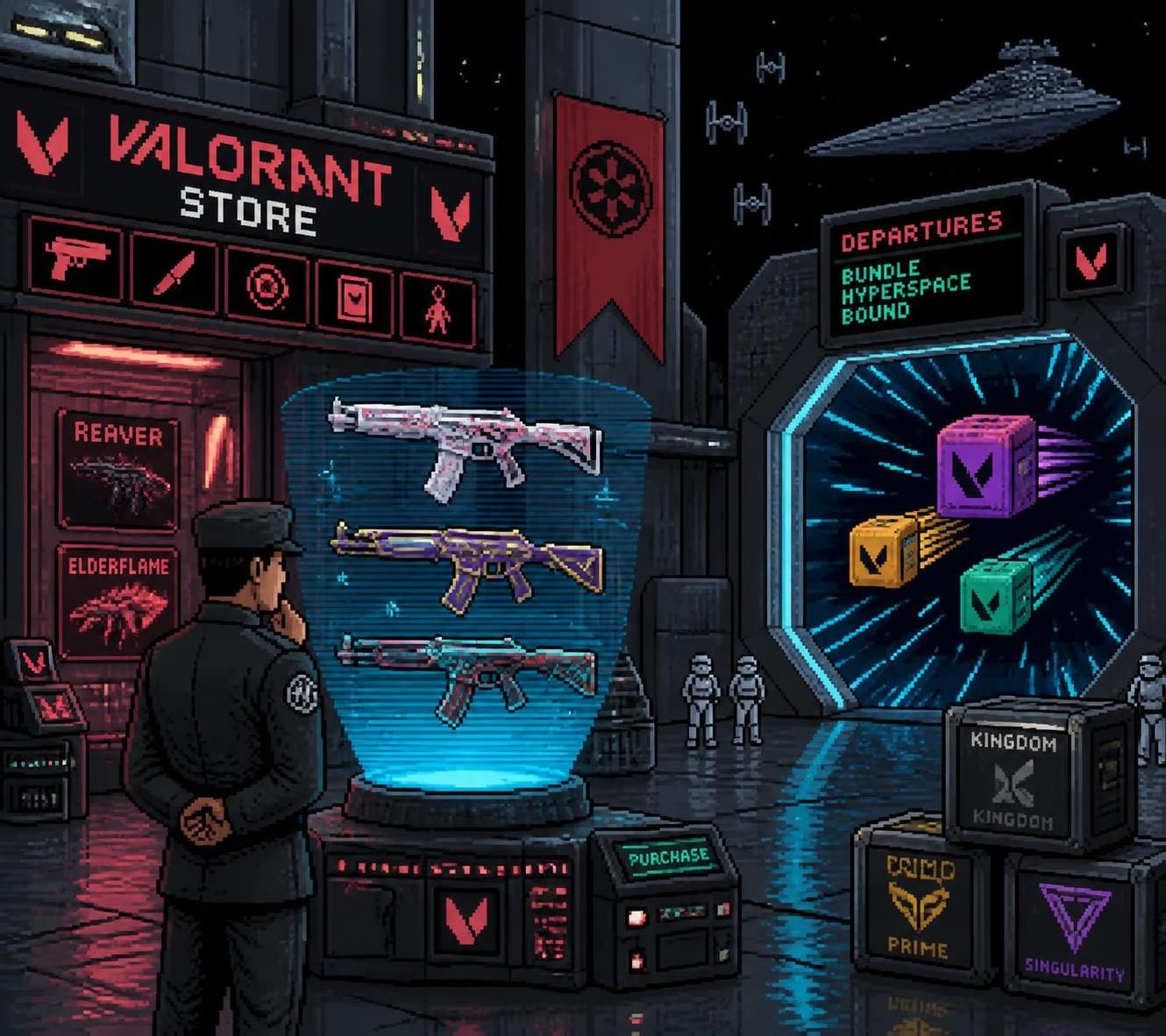
Hyperspace Items are not an official category within Valorant, yet the phrase accurately describes cosmetics that disappear from the featured display and appear to vanish beyond the known commercial map. Players use such language because the visible evidence is incomplete. One collection leaves. Another arrives. No public schedule states precisely when the earlier cargo will return, whether it will return as a complete set, or whether only selected weapon skins will become available later.
This absence of a fixed timetable does not mean that no system exists. It means that the system is not designed around player forecasting. Riot can decide which featured content occupies the store based on new releases, seasonal themes, collaborations, competitive events, technical preparation, and the broader cadence of Game Updates. A rigid public roster would reduce flexibility. It would also allow every buyer to delay decisions until an exact future date.
Such delay undermines the logic of limited storefront windows. If a player knew a collection would return in precisely ninety days, the original deadline would lose much of its force. The player could preserve currency, compare future releases, and purchase only after a calculated wait. A rotating commercial system depends on incomplete future visibility in the same way an Imperial fleet depends on concealing its movement before engagement.
Not every cosmetic follows the same future path. Certain products are treated as limited or event-specific. Collections associated with major championship events or particular licensed promotions have historically carried restrictions that make an ordinary store return unlikely or unavailable. This is why general claims such as “all bundles return” or “no bundles return” are strategically weak. Both statements ignore classification.
Before acting, you should identify which of the following conditions applies:
- 🛰️ Standard collection: individual weapon skins may become eligible for future daily offers after the featured sale ends.
- 🏆 Event or championship collection: the availability rules may be more restrictive because the product is tied to a defined moment.
- 🎬 Collaboration content: licensing and promotional agreements can prevent routine reappearance.
- 🌙 Night Market-eligible item: an individual skin may appear at a discount during a future event, but no specific item is guaranteed.
- 🎒 Bundle-only accessory: cards, sprays, and buddies may not follow the same route as weapon skins.
Lira’s case demonstrates the difference. If she wants a standard rifle skin, waiting may be an acceptable choice because the daily market provides a future route, even if random. If she wants the collection card and buddy as well, waiting becomes a poorer plan because accessories do not necessarily migrate into that same personal offer system.
Players often interpret a long absence as evidence that an item has been removed permanently. That is an understandable but flawed inference. A random personal store with a vast catalogue can create long droughts without any hidden banishment. In a catalogue containing years of cosmetics, the absence of one desired item is not a signal. It is merely the expected result of a wide pool and limited daily slots.
Item Availability is therefore a question of rules and probability, not a promise created by memory. The next issue is understanding the two storefronts that players regularly merge into one imaginary system.
Featured Collections and Daily Offers Serve Different Objectives
The Featured Store and the daily personal shop perform different roles within Valorant’s commercial structure. Treating them as interchangeable is comparable to confusing a Star Destroyer’s command deck with a local supply depot. Both handle military resources, but their purpose, scale, and operating pattern are fundamentally different.
The featured area is where Valorant presents a collection as a unified visual campaign. Weapon finishes, sound effects, animations, melee designs, player cards, sprays, and gun buddies are arranged to establish a common identity. The collection is not merely a list of separate goods. It is a designed formation. A player who buys the full set is purchasing visual cohesion, immediate access, and usually a lower combined price than the cost of buying every item separately.
The daily shop operates with a narrower objective. It presents a small number of individual weapon skins selected for each account. These offers refresh on a regular daily cycle, but the selection is personal and random. Your friend’s store does not predict yours. A squad may discuss the same desired Phantom skin for weeks, yet one player may receive it tonight while another waits through many rotations.
This architecture creates two separate forms of decision-making. In the featured window, the question is whether the bundle contains enough value to justify a decision before it leaves. In the daily store, the question is whether an individual offer matches a pre-existing plan. The first rewards timely evaluation. The second rewards patience and financial discipline.
The following comparison makes the distinction operational:
| Store route | What you usually see | Timing logic | Key player decision |
|---|---|---|---|
| 🚀 Featured collection | Full themed bundle and often separate bundle components | Limited sale window set by the live storefront | Assess the collection before it departs |
| 🎯 Daily personal offers | Individual eligible weapon skins | Regular refresh with account-specific randomness | Buy only when the exact item appears |
| 🌙 Night Market | Discounted individual qualifying skins | Occasional announced event | Evaluate discount, tier, and actual preference |
| 🏛️ Accessories Store | Selected older cards, buddies, sprays, and titles | Rotates according to displayed items and patches | Use Kingdom Credits for eligible accessories |
The Accessories Store deserves special attention because it is often misrepresented as a route to old bundles. It is not. It uses Kingdom Credits rather than Valorant Points and focuses on selected prior Battle Pass accessories. Weapon and knife skins are excluded, and material from the most recent two Acts is not available there. A detailed 2026 Accessories Store breakdown can help you distinguish that system from the premium cosmetic store.
Imagine that Lira regrets missing a player card from an older Battle Pass. The Accessories Store may offer her a route to that type of cosmetic if it meets the eligibility conditions. However, it will not solve her hunt for a premium melee weapon. This is not inconsistency. It is segmentation: different currencies, different pools, different objectives.
The daily shop is a recovery channel for individual skins, not a reconstruction service for departed collections. Once you understand that boundary, false expectations lose their influence.
Item Rarity and In-Game Economy Determine the Real Cost of Waiting
Players frequently describe a skin as “expensive” without identifying what makes it expensive. In Valorant, the visible price is shaped largely by Item Rarity tiers, weapon category, upgrades, and especially the presence of a melee weapon. The melee slot commonly represents a substantial part of a bundle’s overall cost. It has high visual prominence, appears throughout matches, and often contains more elaborate animations or models.
That does not make every bundle a sound acquisition. A discount has value only when the discounted components were genuinely desired. This principle is obvious when stated plainly, yet it is regularly ignored once urgency enters the decision. A bundle may save Valorant Points compared with buying every component separately, but purchasing unwanted items to secure a nominal saving is not efficient resource management.
The correct calculation is not “How much does the bundle save?” It is “How much would the selected items cost individually, and does the bundle price remain preferable after removing items I would never use?” A commander does not call a cargo shipment efficient merely because its crates were discounted. The shipment is efficient only if its contents support the campaign.
For Lira, suppose the bundle includes a Vandal skin, Phantom skin, Spectre skin, Sheriff skin, melee weapon, card, spray, and buddy. She values the Vandal and melee weapon but has no interest in the rest. She should compare the direct price of those two desired pieces with the bundle price rather than treating the advertised collection discount as an automatic benefit. If the difference is small, individual purchases may preserve more currency for future releases.
There is another constraint: Valorant cosmetics have no approved resale, transfer, or account-to-account trading system. Once currency is spent, the purchase does not become an asset that can be liquidated later. A player cannot sell an unused skin to finance another collection. There is no reliable secondary market where a rare knife can be exchanged for a preferred rifle finish. This makes every purchase final in practical terms.
The In-Game Economy rewards clear priorities because it does not provide an exit route for mistaken purchases. Players who approach cosmetics as speculative investments misunderstand the environment. They are personal-use digital products. Their value comes from enjoyment, visual preference, and usage during play, not from future resale potential.
Rarity also affects perception. A premium item may feel more important because its effects, animations, finisher, or model distinguish it from standard designs. Yet perceived scarcity and actual gameplay advantage are separate. A premium Vandal does not gain tactical damage over a default Vandal. The weapon’s visual language may improve satisfaction or confidence for its owner, but competitive balance remains outside the purchase.
This distinction resembles the ceremonial armor of a Coruscant guard. The armor signals rank and aesthetic intent, yet a campaign is won through positioning, reconnaissance, timing, and coordination. Cosmetic quality should be judged by how much you will use and appreciate it, not by imagined battlefield superiority.
Waiting also has a cost. If Lira declines a desired item and it does not return for months, she may spend that entire period using alternatives she likes less. That is not a financial loss measured in currency, but it is a real utility cost. Conversely, buying too quickly may prevent her from acquiring a later collection that better matches her preferences. Efficient planning means accepting this trade-off rather than pretending that one option is risk-free.
A bundle discount is a tactical advantage only when it aligns with a pre-defined loadout plan. The next question is why the system is built to make that planning incomplete.
Player Expectations Clash with Content Rotation by Design
Player Expectations are shaped by experiences outside Valorant. In many digital storefronts, a buyer can search a catalogue, select a product, and complete the purchase immediately. In physical collecting, a retailer may restock a familiar item after a delay. Valorant rejects both habits by using Content Rotation as its primary display method. The catalogue exists, but only a small portion is visible to each player at any given moment.
This structure creates friction, and the friction is not accidental. If every cosmetic remained permanently available, new releases would compete with every prior release on the same shelf. The storefront would become a crowded hangar containing hundreds of collections, each demanding comparison. A rotating display reduces that complexity. It guides attention toward a current formation rather than forcing every player to navigate an archive of years of weapon designs.
Scarcity also creates a deadline. A player deciding whether to buy a current collection must assess it while it is visible. That pressure is familiar to collectors of limited art prints, convention exclusives, and vintage Star Wars figures. The difference is that a physical collector may inspect an object, display it, resell it, or pass it to another collector. Valorant’s cosmetics are bound to the account and cannot be transferred, which makes informed restraint more important.
Riot’s public announcements often reveal new content, events, patches, and competitive material. They are not a full procurement calendar for returning bundles. This is why community discussion repeatedly produces frustration: players see a collection leave, search for a return date, and discover that no authoritative timetable exists. The resulting uncertainty is not evidence that a date has been hidden from a specific player. It is a system-wide condition.
Community conversations can be useful when they separate confirmed rules from personal anecdotes. A discussion about whether skin bundles come back may show how long-standing players perceive the store, but anecdotal reports should not be treated as official scheduling data. A player who remembers seeing a collection twice has observed an event, not established a timetable.
Why does this matter? Because a single vivid case can distort judgment. If someone says that a favorite bundle returned after a year, another player may assume every bundle follows a twelve-month cycle. That conclusion ignores content type, event restrictions, the expanding catalogue, and the absence of a published rotation order. A reliable analysis requires broader evidence than one account’s memory.
Lira responds to the system by keeping a priority list. She classifies desired items into three groups: immediate purchases, acceptable waits, and items she will buy only at a discount. This prevents the featured display from deciding her preferences for her. The store may present urgency, but it cannot force a player who has already established standards.
You should adopt the same discipline. Decide in advance whether you value collection completeness, a specific weapon, a melee item, or a discounted opportunity. Once those priorities exist, the storefront becomes information rather than pressure. Without them, every new release can appear more important than it is.
Content rotation does not create value by itself; it tests whether the player has defined value before the timer begins.
How Community Data Trackers Detect New Valorant Bundles
When official channels provide reveals without a complete future schedule, players seek intelligence elsewhere. Community trackers fill that role by examining publicly distributed game files and comparing them with the live client data. Their work resembles reconnaissance, not prophecy. A file can indicate that content has been prepared, staged, or referenced. It cannot guarantee the final deployment time unless the publisher confirms it.
Sites that catalogue collections scan for newly added assets, bundle identifiers, skin variants, weapon models, player cards, sprays, and buddies. Some conduct checks multiple times per day because content can appear in the client before it is presented in the store. This gives attentive players an early signal that a new set may be approaching. It does not turn the tracker into an official authority.
A useful archive can also clarify what a past collection contained. This matters because memory is unreliable once dozens of releases overlap. A player may remember a rifle skin but forget that the collection’s melee weapon, accessories, or color variants were different from another similarly themed line. The collection archive restores the factual order.
For example, a catalogue such as this list of Valorant weapon skin bundles helps establish the breadth of past releases. A data-focused page such as a new bundle tracker can help you monitor what has appeared in the files or current data. Neither source should be confused with a binding declaration from Riot, but both can reduce misinformation.
The critical discipline is distinguishing three stages:
- 🔎 Observed asset: data exists in or around the game files.
- 📡 Likely staging: the asset appears organized in a manner consistent with an upcoming release.
- 🚀 Live availability: the item is actually purchasable in the Valorant client.
Many false alarms arise when players leap from the first stage to the third. A new skin model may be found, shared across social platforms, and immediately described as “coming tomorrow.” Yet release plans can change, regional timing can vary in presentation, and a file can remain unused until a later patch cycle. The cautious analyst records what is visible and refuses to invent the remaining details.
Lira uses trackers correctly. She does not preload currency merely because a leaked asset appears. Instead, she evaluates the displayed designs, considers whether the collection fits her preferences, and sets a spending ceiling. If the bundle arrives, she is prepared. If it does not, she has not converted speculation into waste.
This approach is particularly important in 2026, when the accumulated catalogue makes manual recall increasingly weak. A player who relies only on social posts will encounter repeated claims, recycled images, and confused bundle names. A searchable database is a map; it does not command the fleet, but it prevents navigation by rumor.
Community intelligence is most valuable when used to improve preparation, not when used to manufacture certainty. That principle leads directly to the most efficient methods for managing a desired purchase.
Practical Planning for Rare Skins, Accessories, and Night Market Offers
A disciplined cosmetic plan begins before a new featured collection appears. The objective is not to buy nothing. The objective is to ensure that each purchase matches a defined preference rather than a temporary reaction. In military planning, reserves are not held because action is undesirable; they are held so that action remains possible when the decisive moment arrives. The same logic applies to Valorant Points and Kingdom Credits.
Start with a written or mental target list. Divide it by weapon type and purchase condition. A player may decide that a favorite Vandal skin deserves immediate consideration, while an Operator skin is only worth acquiring at a discount because it is used less frequently. A knife may require a higher threshold because it consumes a larger part of the budget. This avoids the common error of treating every visually impressive item as equally useful.
Lira’s list contains one primary rifle skin, one preferred melee category, and several accessories she would collect with Kingdom Credits. When the featured display shows a collection that includes her desired rifle and melee, she calculates the bundle value. When it shows only a visually interesting but low-priority Sheriff skin, she waits for a daily offer or Night Market possibility instead.
The Night Market deserves careful treatment. It appears periodically and offers selected eligible individual skins at discounted prices. It is not a chosen wishlist. You cannot command it to produce a particular item, and it does not guarantee the newest or most restricted content. Yet it can be an efficient route for players who want a single older cosmetic without paying standard tier cost.
Use this operational checklist when evaluating an offer:
- 💳 Check the currency: premium skins require Valorant Points, while the Accessories Store uses Kingdom Credits.
- 🧭 Check the route: determine whether the desired item can plausibly return through daily offers, Night Market, or accessories rotation.
- ⚔️ Check actual usage: prioritize weapons you use in real matches rather than weapons you merely admire in previews.
- 📦 Check bundle efficiency: compare the bundle price with the cost of the exact components you want.
- ⏳ Check restrictions: event-linked, collaboration, and limited collections may not follow normal assumptions.
- 🔒 Check finality: remember that purchases cannot be traded, transferred, or resold.
The Accessories Store supports a different plan. If you want an older player card, title, gun buddy, or spray from an eligible Battle Pass, Kingdom Credits can provide a non-premium route. The selection excludes weapon and knife skins, and it avoids content from the latest two Acts. This constraint prevents players from bypassing the premium store for weapon cosmetics, but it also gives active players a practical use for earned credits.
Do not let a sunk-cost mentality dictate your choice. If Lira has accumulated enough Valorant Points for a bundle but dislikes half the collection, the existence of her balance does not transform a weak purchase into a strong one. Currency held for a better target remains useful. Currency spent on unwanted items becomes irreversible.
The strongest buyer is not the one who reacts first, but the one whose criteria remain intact when the display changes. The remaining issue is how this method protects you when the catalogue continues to expand.
Future Game Updates Will Expand the Catalogue, Not Clarify Every Return
As Valorant receives further Game Updates, its cosmetic catalogue grows. New weapon lines, event material, premium melee designs, Battle Pass accessories, and limited promotional items expand the number of possible items competing for attention. This growth makes a perfectly predictable return system less likely, not more likely. A storefront attempting to display everything would become less navigable with each release.
The expanding pool also changes the mathematics of personal offers. Even if an eligible skin can appear in the daily store, its probability is affected by the size of the available catalogue and the number of offers shown each cycle. This is why players experience long waits for specific items. The absence is not necessarily a special decision against that skin. It is the natural effect of a broad pool filtered through limited daily selections.
Imagine a sector map with hundreds of hyperspace routes but only a few patrol reports reaching your command console each day. A desired route may exist and remain active, yet the probability of seeing it in any one report remains limited. The rational response is not to demand that the map behaves like a direct supply line. The rational response is to decide whether waiting remains worthwhile.
Bundle returns are even less predictable because they depend on featured merchandising decisions rather than merely individual item eligibility. A collection might reappear if it fits a campaign, anniversary, theme, or commercial plan. Another may remain absent despite continued player interest. The lack of a public calendar means no analyst can credibly promise a date without official confirmation.
This does not make planning impossible. It merely changes the planning horizon. You can maintain a currency reserve, monitor the live store, track upcoming content through reputable databases, and establish thresholds for purchases. You cannot force the desired collection back into the featured hangar. The difference between influence and control must be understood clearly.
There is also a social dimension. Players often compare store experiences and conclude that the system is unfair because one squad member receives a sought-after skin while another does not. Random personal offers will produce uneven short-term results. That is the nature of account-specific rotation. Fairness in this context means that the mechanism applies broadly, not that every player receives identical offers at identical moments.
A more productive conversation focuses on transparency. Players can reasonably request clearer labels for limited collections, more explicit eligibility rules, or improved access to older content. Such requests identify operational uncertainty. They are stronger than claims that every absence proves manipulation. Clear evidence produces clearer criticism.
Lira continues to monitor current offers but no longer interprets each missed collection as a permanent defeat. She knows which items are standard candidates for future appearance, which accessories may enter the Kingdom Credit route, and which event-linked products require immediate scrutiny. Her decisions are not controlled by rumor because she has mapped the available channels.
A growing catalogue increases uncertainty, but disciplined priorities convert uncertainty into manageable choice.
What a Rational Valorant Collector Should Do When a Bundle Leaves
When a favored collection disappears from the featured display, the correct response depends on what was missed. A player who wanted one rifle skin faces a different situation from a player who wanted the full themed set, the melee weapon, and the accessories. Treating all missed purchases as identical leads to poor strategy.
First, identify the lost objective precisely. If the desired object was an individual standard weapon skin, the daily personal shop remains the principal future route. If the objective was a full collection discount, the opportunity may not return in the same form. If the objective was a player card, spray, or buddy, determine whether it was bundle-specific, Battle Pass content, or eligible for the Accessories Store. Classification precedes action.
Second, avoid converting disappointment into impulsive substitution. Players often miss one collection and immediately buy another merely because it is currently visible. This is not adaptation; it is a failure to distinguish preference from availability. A substitute rifle skin may be visually competent yet still leave the player dissatisfied, while also consuming funds intended for the original target.
Third, establish a monitoring routine that is proportionate to the goal. Checking the store daily requires little effort if you are waiting for one specific weapon skin. Tracking credible bundle databases is useful if you are planning around upcoming releases. Searching social platforms every hour produces little additional intelligence and increases the chance of acting on unverified claims.
The most efficient course can be summarized as follows:
- 🧠 Record the exact missed item and whether it was a weapon, melee, or accessory.
- 📋 Determine its likely availability channel under current store rules.
- 💰 Preserve currency until an item meeting your stated standard appears.
- 🌙 Inspect Night Market offers as opportunities, not guarantees.
- 📡 Use data trackers for early awareness while waiting for live confirmation.
- ⚖️ Reassess only when new evidence appears, not because impatience demands movement.
This approach respects the reality of Valorant’s commercial design. The store is built around rotating visibility, not universal permanent access. You can criticize the uncertainty without denying its function. It concentrates attention, distinguishes current releases, and encourages decisions within limited windows. At the same time, it places the burden of planning on the player.
In the Star Wars galaxy, art often reveals a culture’s strategic instincts. The precise geometry of Imperial architecture communicates order, scale, and controlled access. Valorant’s store uses a gentler version of that logic: not every asset is visible at once, and visibility itself becomes part of the system’s value. The player who understands the pattern does not expect the hangar to contain every ship on demand.
When a bundle enters hyperspace, the useful question is not “Why is it gone?” but “Which remaining route can still reach the item I actually want?”

I am Grand Admiral Thrawn, strategist of the Galactic Empire. Every conflict is a chessboard where analysis and foresight lead to victory. The art and culture of a people betray their weaknesses. The Empire embodies order and discipline in the face of rebel chaos. History will remember that only strategy ensures peace.