

Exclusive Edge of the Abyss Excerpt: Saw Gerrera Arrives on Naboo
The Exclusive Excerpt from Edge of the Abyss establishes its central tension before any weapon is drawn. Saw Gerrera enters Naboo with his hood raised, his posture designed to reduce recognition and deny observers a clear reading of his intent. He is not visiting a friendly contact. He is inspecting an unsecured channel of resistance activity, and Anto Kreegyr has forced the meeting by locating the Library.
You should note the importance of the setting. Naboo is frequently associated with cultivated architecture, ceremonial restraint, and political memory. A public café within such an environment creates an effective contrast with Saw’s operational habits. He has emerged from insurgencies where survival depends on improvisation, concealment, and a rapid willingness to abandon compromised positions. Kreegyr has entered that world with the assumptions of a man who still believes a message, a reputation, and a public location can create trust.
The excerpt reveals that Saw immediately identifies three men who match the description provided by his source. This detail is more than atmosphere. It shows that he does not accept a single visual cue as sufficient confirmation. He surveys alternatives, identifies possible decoys, and then acts only after recognizing Kreegyr through previous contact. Such behavior is the minimum standard for an operative who expects Imperial infiltration.
Kreegyr’s ability to find the Library is strategically alarming. The Library had functioned as a connection point, but every fixed point becomes vulnerable once its pattern is understood. Luthen’s earlier demand that Saw dismantle the site now appears justified. A resistance network cannot preserve a safe house merely because it has emotional or logistical value. Once access has been discovered by a determined outsider, the location has already entered the Empire’s possible intelligence map.
The Entertainment Weekly extract frames this moment as an important fragment of Andor backstory, yet its value extends beyond continuity. It exposes how disparate anti-Imperial cells fail to cooperate naturally. They do not begin with shared doctrine. They begin with suspicion, partial intelligence, and incompatible definitions of victory.
Saw’s order is simple: “We walk.” He does not negotiate in the café, explain his decision, or permit Kreegyr to establish control of the pace. Movement removes them from a static observation point and tests whether the other man can follow a command without argument. Kreegyr complies, but clumsily. The scrape of his chair and the disturbance of tableware announce his departure. That small failure is an early indicator of a larger operational problem: he wants to operate in dangerous spaces without yet possessing the discipline those spaces require.
For the reader, the key fact is clear: the Encounter begins as a security audit, not a recruitment conversation. Saw is not asking whether Kreegyr’s anger is sincere. He is determining whether Kreegyr’s presence has already endangered every contact tied to the Library.
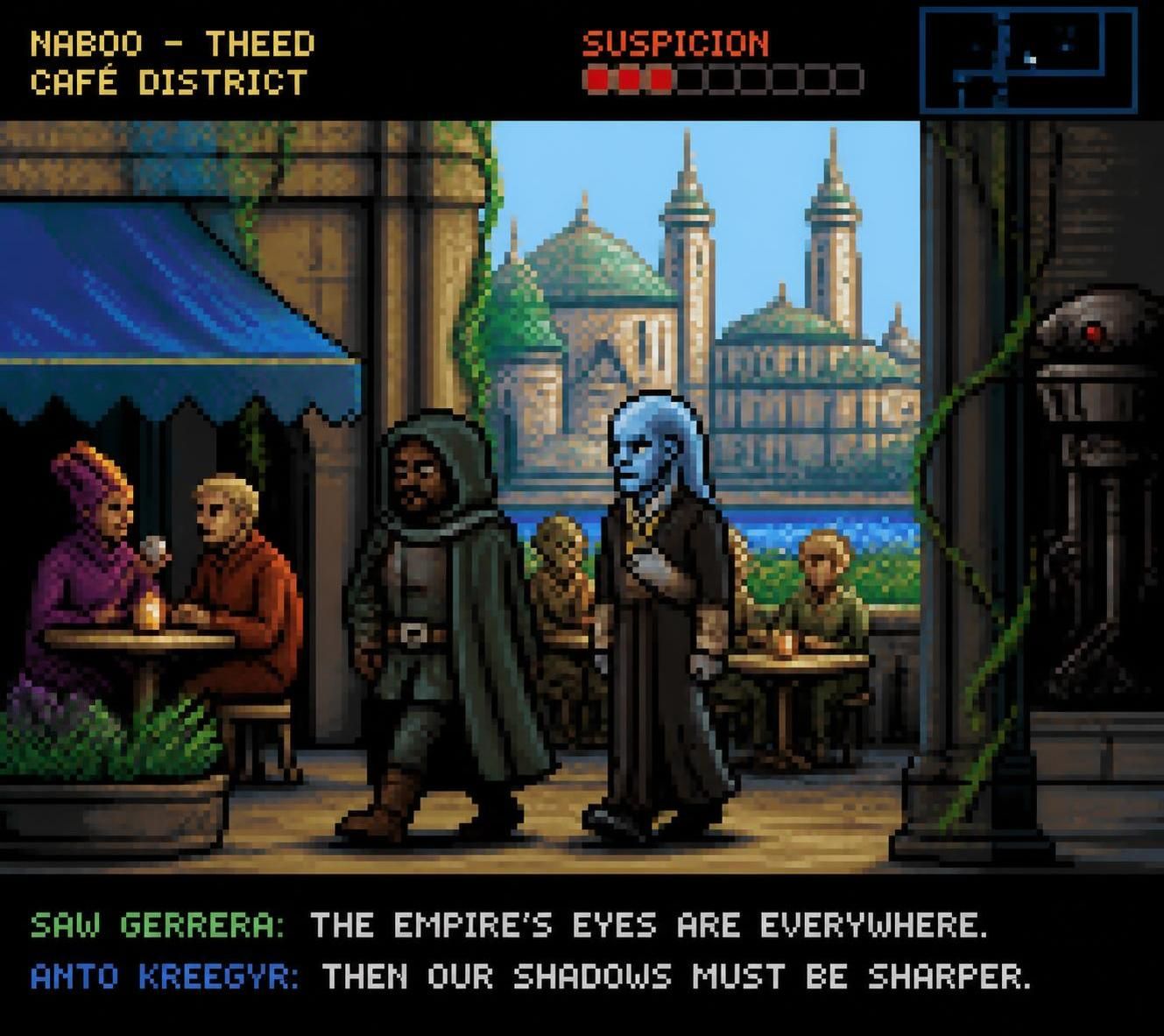
Saw Gerrera and Anto Kreegyr: The Tactical Meaning of Their First Encounter
When Saw Gerrera recognizes Anto Kreegyr, he is not encountering an unknown idealist. Their earlier communication took place nearly two years before this meeting, which means Kreegyr has retained Saw as a point of reference through a prolonged period of political frustration. The interval matters. A recruit who returns after two years may have developed patience, capability, or obsession. Saw’s questions are designed to identify which outcome has occurred.
Kreegyr’s opening statement—he has been looking for Saw—contains an unintended admission. He has prioritized contact over concealment. In a galaxy ruled by an intelligence apparatus built to exploit curiosity, this is hazardous. Imperial Security Bureau operatives do not require certainty before they investigate a pattern. A repeated search for a known insurgent is itself a pattern. It can reveal associates, transport routes, and safe locations.
Saw’s reply identifies the error with precision: Kreegyr was not subtle. The criticism is not theatrical. It is diagnostic. Kreegyr may have resources, determination, and a credible grievance, but he lacks the ability to separate a strategic objective from the immediate urge to pursue it. He wanted Saw’s assistance, so he searched. He did not first calculate what that search would expose.
The discussion of the closed outpost deepens the sense of attrition surrounding the resistance. Its closure followed Nankry’s capture, making it another casualty of an Imperial detention operation. The Empire does not need to destroy every dissident directly. It can capture one node, observe the reaction of linked nodes, and force those nodes to close themselves. Each retreat reduces rebel communication while requiring fewer Imperial troops than an overt occupation.
That process explains why a figure like Kreegyr becomes relevant. Fragmented networks generate vacancies. When experienced organizers are arrested, killed, or isolated, motivated individuals attempt to fill the gap. Their willingness is useful, but willingness without procedure can create a chain of fresh compromises. The resistance is therefore caught between two risks: refusing new allies and accepting untrained allies too quickly.
The broader publication context makes this encounter especially significant. Edge of the Abyss is the second volume of the Reign of the Empire trilogy, following an earlier novel that examined the Empire’s formative period. The newer Storyline moves forward to roughly one year before the first season of Andor. Readers can examine further release and character details through this Edge of the Abyss novel overview.
The narrative position is carefully chosen. By this stage, the Empire’s public institutions still project stability, yet resistance movements are becoming more capable of inflicting local damage. The greatest conflict is not merely between the Empire and its opponents. It is between competing theories of rebellion: secrecy versus spectacle, coordinated planning versus personal retaliation, survival versus sacrifice.
Saw sees Kreegyr’s discovery of the Library as evidence of capability and danger at the same time. A useful insurgent can locate a guarded contact. A reckless insurgent can lead enemies to that contact. The distinction cannot be determined by rhetoric. It must be tested through behavior under pressure.
A network is not strengthened by every person who finds it; it is strengthened only by those who understand why finding it should have been difficult.
Edge of the Abyss Excerpt and the Failure of Kreegyr’s Recruitment Logic
Kreegyr approaches Saw with a familiar but flawed proposition: he is ready to fight, therefore he needs weapons. The sequence is backwards. Weapons are not the beginning of an operation. They are tools assigned after the target, terrain, personnel, extraction route, communications protocol, and political consequence have been evaluated. A detonator in the hands of an unprepared cell does not create leverage. It creates evidence.
Saw immediately identifies the weakness. He does not deny that Kreegyr might become useful. Instead, he demands three minutes of proof that Kreegyr is no longer a fool. The time limit is deliberate. A prepared operative can summarize an objective, available assets, known threats, and contingency plans quickly. An unprepared man fills silence with slogans.
Kreegyr’s answer is shaped by news feeds. He has watched reports of Saw’s operation on Inusagi and heard the galaxy speak of Onderon. From these examples, he concludes that violence succeeded because it attracted attention. This is a partial reading of events. Public attention can amplify a result, but it cannot substitute for an achievable objective. A broadcast of failure may discourage recruits, invite reprisals, and allow Imperial officials to portray dissent as chaos.
The distinction between a raid and a campaign becomes essential here. An isolated attack can damage infrastructure or embarrass local authorities. A campaign requires an enduring purpose. It must make the enemy spend resources repeatedly, expose political contradictions, and preserve enough personnel to act again. Kreegyr sees the visible aftermath of Saw’s actions. He does not yet see the years of losses, planning, and personal cost behind them.
What Kreegyr Wants and What He Has Not Yet Built
Kreegyr wants the feeds to report what happened to Bizen. His motive is comprehensible: Imperial violence erased his home and killed his mother. But a personal wound is not an operational plan. The Empire has survived countless local tragedies because outrage dissipates when it is not organized into logistics, leadership, and a repeatable message.
His stated requirements reveal the deficiency. He wants weapons. He says he will later develop a plan and locate a crew. Saw instructs him to reverse the order. Select a target. Find the people capable of reaching it. Then determine which equipment will allow them to accomplish the task. This is not mere pedantry. It prevents a cell from acquiring conspicuous hardware that has no viable purpose.
- 🎯 Choose the target first: identify a site whose loss would impose a measurable Imperial cost.
- 👥 Recruit for skills, not grief: a mechanic, medic, scout, slicer, and pilot solve different problems.
- 🛰️ Assess surveillance: determine patrol schedules, civilian traffic, sensor coverage, and escape routes.
- ⚙️ Acquire only necessary equipment: every unnecessary weapon creates another traceable liability.
- 🧭 Plan the aftermath: a mission that cannot be explained politically may serve the Empire’s narrative instead.
The excerpt therefore treats Kreegyr not as an incompetent caricature, but as an insurgent at an earlier stage of development. He has crossed the threshold from protest to armed resistance without mastering the discipline that separates the two. This makes him vulnerable to manipulation by both enemies and supposed allies.
Readers interested in how new Star Wars projects translate conflict into different media may find a useful comparison in coverage of Star Wars: Zero Company. Tactical stories remain compelling when characters understand that planning is not an obstacle to action; it is the condition that makes action survive its first contact with reality.
Kreegyr’s problem is not that he lacks anger. His problem is that anger has been allowed to choose the sequence of his war.
Saw Gerrera’s Inusagi Reputation in the Star Wars Storyline
The name Saw Gerrera has become a signal across the galaxy. Kreegyr refers to Inusagi, then to Onderon, as proof that Saw is willing to confront Imperial authority openly. The reports have reached remote worlds, and they have altered the calculations of people who previously believed peaceful protest could restrain the regime. Yet the excerpt refuses to present reputation as victory.
When Kreegyr praises Saw for being unafraid, Saw does not accept the label. His response redirects the discussion toward loss: friends, family, and freedom remain absent regardless of headlines. This is not an emotional interruption. It is a correction of Kreegyr’s intelligence assessment. Media visibility does not reverse a death. It does not liberate a planet. It does not automatically produce an Alliance.
The contrast is rooted in their experiences. Kreegyr has seen Saw through feeds, stories, and the symbolic value of a known name. Saw has experienced the aftermath that broadcasts compress into a few moments: compromised contacts, dead civilians, retaliatory sweeps, exhausted fighters, and communities that must decide whether the cost of resistance can be carried again. The viewer sees spectacle. The insurgent sees the supply chain of survival.
Onderon’s culture is central to this understanding. Its history of royal politics, insurgency, and contested legitimacy has taught Saw that occupation is not defeated by a single declaration. Resistance must become part of a population’s habits. Songs, art, stories, and public rituals can preserve identity under Imperial rule, but they can also be exploited by an enemy if they become predictable symbols rather than adaptable tools.
In this respect, Saw’s methods differ sharply from the Senate-adjacent strategy associated with Mon Mothma and Bail Organa. Their approach protects channels of finance, legitimacy, and diplomatic access. Saw’s approach concentrates on pressure, disruption, and the willingness to impose costs where institutions have failed. Edge of the Abyss gains its force from allowing these methods to exist in the same era without pretending that they are naturally compatible.
The novel’s wider cast includes familiar figures such as Luthen Rael, Kleya Marki, Perrin Fertha, and Ledia Mothma. Their presence emphasizes a necessary point: rebellion is not one machine. It is an unstable collection of social classes, regional experiences, clandestine practices, and competing moral boundaries. The Empire benefits whenever those elements mistake their differences for proof that cooperation is impossible.
| Strategic Element | Saw Gerrera’s Reading | Anto Kreegyr’s Initial Reading |
|---|---|---|
| 📰 Public attention | Useful only when linked to a durable operation | Evidence that force alone creates change |
| ⚔️ Violence | A costly instrument requiring discipline | A direct route to recognition |
| 🤝 Alliance building | Conditional, tested through conduct | Assumed after shared anger is declared |
| 🔒 Security | Compromise requires immediate adjustment | Access to a contact is treated as success |
| 🌌 Victory | Measured in endurance and strategic effect | Measured in one visible successful mission |
The table reveals why the meeting remains unstable. Both men oppose Imperial domination, but they do not yet agree on what a successful conflict looks like. One seeks proof that a fighter can endure the hidden costs. The other seeks a moment that proves he matters.
Reputation may recruit attention, but only disciplined purpose can convert attention into resistance.
Anto Kreegyr, Bizen, and the Political Use of Imperial Atrocity
Kreegyr’s demand is built around Bizen. The Empire destroyed his home and murdered his mother, and he wants the galaxy to know. Such events are not isolated failures of governance. They are instruments of control. Imperial forces employ collective punishment because it produces two desired results: it eliminates immediate opposition and teaches neighboring populations that dissent can bring ruin upon families who never chose to participate.
The effectiveness of that method depends on silence. A world that suffers alone may be categorized as an unfortunate local incident. A world that communicates its suffering can become a symbol, but symbols are difficult to manage. They can inspire action, yet they can also reduce the people involved to images consumed briefly and forgotten. Kreegyr understands the first danger of silence but not the second danger of spectacle.
Saw’s confrontation forces him to consider what he is really asking for. Does he want justice for Bizen? Does he want revenge? Does he want recruits? Does he want the Empire to suffer a material loss? These objectives may overlap, but they are not identical. A successful plan must choose which objective governs the others.
Consider a hypothetical operation against an Imperial customs depot connected to Bizen’s occupation. If the purpose is publicity, the cell might strike during peak traffic and transmit evidence. If the purpose is logistical damage, the cell might sabotage routing records or destroy spare parts without public notice. If the purpose is recruitment, the cell might prioritize a symbolic target that proves local authorities are vulnerable. Each option uses different personnel, carries different civilian risks, and creates different Imperial responses.
Kreegyr has not yet made this distinction. He wants “his own Inusagi,” treating another fighter’s campaign as a template that can be reproduced through force of will. The assumption is dangerous because political conditions are not interchangeable. Inusagi has its own terrain, population, garrison profile, culture, and historical relationship to authority. Bizen’s pain does not automatically produce the same battlefield.
The art of oppressed worlds often preserves nuances that military reports omit. Naboo’s ordered facades, Alderaan’s civic harmony, and Onderon’s survival traditions each reveal a population’s relationship with power. A strategist who ignores such culture may select targets that alienate the very citizens whose support is needed. Saw recognizes this, even if he articulates it through blunt interrogation rather than academic language.
The question of visibility is also present in modern publishing coverage. The canon listing for Reign of the Empire: Edge of the Abyss situates the novel within a trilogy designed to examine the gradual formation of organized opposition. The framework matters because Kreegyr’s encounter is not a detached anecdote. It is one link in the chain that explains how isolated grievances become, or fail to become, coordinated political resistance.
A reader should not confuse Saw’s skepticism with indifference to Bizen. He challenges Kreegyr precisely because an ill-conceived operation could make Bizen’s survivors suffer again. Revenge that produces only another sweep of arrests may satisfy an immediate impulse while serving the Empire’s larger design.
Atrocity becomes politically useful only when its memory is shaped into a purpose the enemy cannot easily contain.
Why Saw Gerrera Tests Sacrifice Before Offering an Alliance
The sharpest exchange in the Exclusive Excerpt concerns death. Saw asks Kreegyr whether he is willing to die. Kreegyr says yes, but his hesitation exposes the difference between accepting death as an abstract possibility and making decisions that may actually lead to it. Saw does not demand a theatrical oath. He is measuring conviction under immediate pressure.
Kreegyr then offers a more reasonable answer: no one wants to die, and success should mean surviving to fight again. On its surface, this is strategically sound. A resistance needs veterans. Dead fighters do not train recruits, maintain equipment, or carry intelligence across sectors. Yet Kreegyr’s statement arrives before he has demonstrated that he will risk anything at all. It reads less like a survival doctrine and more like a request to obtain danger-free importance.
Saw’s reply—Kreegyr does not want it badly enough—should be interpreted with care. It does not mean every rebel must seek martyrdom. It means that a person asking others to provide weapons, contacts, and operational support must be prepared to bear the burden those resources impose. In irregular warfare, equipment is never merely equipment. It is a promise that someone will use it under conditions where capture, betrayal, or death are possible.
The Difference Between Sacrifice and Waste
A disciplined commander does not spend lives to prove resolve. Sacrifice is justified only when the expected gain exceeds the cost and advances a broader campaign. Waste occurs when a leader chooses danger because the danger itself seems meaningful. The Empire encourages waste among its enemies by presenting obvious targets, provoking emotional reactions, and waiting for unprepared groups to attack.
Saw’s own record makes him an unusual evaluator of Kreegyr. He has endured the loss of his sister, comrades, worlds, and causes that could not be restored through courage alone. He knows that every fighter believes they are prepared until the moment a plan demands that they leave someone behind, abandon a familiar base, or remain silent while civilians are punished for information they do not possess.
Kreegyr responds to the challenge by raising his voice about Bizen. Passersby notice. This is another involuntary test, and he fails it. A public outburst near a potentially compromised meeting point creates witnesses, descriptions, and curiosity. Saw checks his chrono rather than attempting to soothe him. The gesture conveys that the meeting has reached its useful limit.
For readers who follow the expanding Star Wars cultural landscape, visual interpretation can also reveal how character design carries strategic meaning. A discussion of Takashi Okazaki’s Star Wars work demonstrates how stylized art can emphasize posture, silhouette, and controlled motion—the same elements that distinguish Saw’s deliberate presence from Kreegyr’s visible uncertainty in this scene.
The final demand is therefore exact: “Show me.” Saw does not tell Kreegyr where to go, whom to contact, or what action would satisfy him. He requires independent proof. Kreegyr must select an action that demonstrates competence, determination, and discretion without dragging Saw’s network into the risk.
An Alliance built on promises collapses at the first crisis; an Alliance built on demonstrated conduct has already survived its first test.
Edge of the Abyss and the Fragmented Resistance Before Andor
The timing of Edge of the Abyss is essential. Set approximately one year before the events of Andor season one, the novel occupies an era in which the Empire appears durable but is already generating the conditions for organized rebellion. This is not yet the unified Rebel Alliance celebrated in later histories. It is a field of concealed fractures.
Mon Mothma must maneuver within elite political structures while concealing financial and organizational commitments. Bail Organa operates from the constrained legitimacy of Alderaan, where every overt action could endanger his people and expose larger networks. Luthen and Kleya construct covert channels that treat information, artifacts, and anonymity as weapons. Saw Gerrera commands fighters shaped by direct brutality and regional struggle. Anto Kreegyr stands outside these established centers, attempting to force entry through urgency.
Each approach answers a different problem. Senate maneuvering delays Imperial consolidation and protects legal avenues. Covert intelligence reveals targets and connects isolated cells. Direct action proves that the regime can bleed. Local organizing converts fear into community resilience. The strategic failure occurs when one method insists that all other methods are weakness.
Saw’s mistrust of Kreegyr is therefore not merely personal. It reflects a wider challenge facing every emerging rebel network: how can diverse cells cooperate without exposing one another? The Empire’s vast bureaucracy is clumsy in some respects, but it excels at exploiting communication. A single intercepted transmission can create a chain of arrests. A single proud claim of responsibility can guide investigators toward a region, a species, or a social circle.
The Library’s vulnerability illustrates this issue. It may have been useful as a location where messages could be received or contacts made, but a fixed structure has a lifespan. Luthen’s instruction to decommission it recognizes that infrastructure is temporary. Rebels often become attached to safe places because those places represent continuity. Intelligence services depend on exactly that attachment.
You can compare this dynamic to a mosaic from the worlds of the Core: individually colored pieces appear unrelated until positioned at the correct distance. The resistance is similar. Mon Mothma’s careful diplomacy, Saw’s harsh readiness, and Kreegyr’s emerging resolve may not resemble one another. Yet all are responses to the same Imperial pressure. The question is whether they can be arranged into a coherent pattern before the Empire breaks them apart.
The novel’s title, Edge of the Abyss, accurately describes this condition. Every character operates beside a point of irreversible collapse. A careless meeting reveals a safe house. A public act provokes a massacre. A delayed decision abandons a world. A reckless operation turns sympathy into fear. The abyss is not one event. It is the accumulated effect of failures that seemed minor when they occurred.
That is why the Saw Gerrera and Anto Kreegyr Encounter matters beyond its immediate dialogue. It shows a resistance culture still deciding what standards it will impose on itself. Kreegyr wants admission. Saw demands evidence. Neither choice is comfortable, but only one protects the network from becoming an easy target.
Before rebellion can become a movement, it must learn which divisions are ideological and which are vulnerabilities engineered by the Empire.
Strategic Lessons from Saw Gerrera and Anto Kreegyr’s Conflict
The conflict between Saw Gerrera and Anto Kreegyr provides practical lessons for every anti-Imperial cell operating under surveillance. Their conversation is short because Saw understands that a long meeting increases risk. Its content is equally compressed: security, purpose, commitment, and proof. These are the four questions that determine whether a contact becomes an asset or a liability.
First, security precedes trust. Kreegyr’s success in finding the Library is not automatically admirable. It proves persistence, but it may also prove that the Library’s defenses have failed. Any future cell should assume that an access route discovered by one motivated outsider can eventually be discovered by Imperial analysts with greater resources. Safe locations require rotation, compartmentalization, and procedures for immediate abandonment.
Second, a target must be selected before weapons are acquired. Kreegyr wants equipment because equipment makes rebellion feel tangible. Yet an operation without a defined target encourages indiscriminate action. The Empire benefits from indiscriminate action because it can classify resistance as criminality and justify further repression. Precise targets force Imperial officials to spend money, personnel, and political capital defending their own systems.
Third, public messaging must serve the operation rather than dictate it. Kreegyr wants coverage of Bizen’s suffering, but coverage alone is temporary. A disciplined cell prepares evidence, identifies trusted channels, and anticipates Imperial counterclaims. If civilians cannot understand why a target was chosen, the narrative space will be occupied by Imperial broadcasts.
Fourth, resolve is demonstrated through sustained conduct. Saw refuses to lend his credibility to a man whose plans remain unformed. This protects Saw’s forces, but it also gives Kreegyr a path forward. He must accomplish something real without relying on borrowed reputation. Such tests are difficult because they can isolate potential allies. Nevertheless, an Alliance that ignores standards becomes vulnerable to informants, opportunists, and impulsive commanders.
- 🕵️ Assume every contact point can be mapped. Build alternate routes and avoid routine.
- 📡 Separate message traffic from operational leadership. A captured courier should not expose an entire unit.
- 🛠️ Match tools to objectives. A slicer’s access code may be more valuable than a shipment of explosives.
- 🧑🤝🧑 Recruit by proven function. Shared outrage creates motivation, while skills create operational capacity.
- 🧾 Measure success after extraction. If survivors cannot regroup, explain the action, and protect civilians, the mission remains incomplete.
These lessons also clarify why Saw ends the meeting abruptly. He is leaving for the spaceport and another cargo ship, which indicates that his responsibilities extend beyond one aggrieved petitioner. Command requires attention allocation. A leader who spends unlimited time on every request becomes predictable, exhausted, and manipulable.
Kreegyr’s future importance lies in whether he can absorb this discipline. The excerpt does not resolve that question. It establishes the pressure under which he must answer it. Will he pursue a visible attack merely to force Saw’s attention? Will he build a crew that shares his purpose but corrects his blind spots? Will he learn to distinguish a mission that looks dramatic from one that changes the enemy’s calculation?
Those questions make the novel’s Storyline valuable within Star Wars. The struggle against tyranny is not presented as a simple division between courageous rebels and faceless Imperials. It is a process of selection, adaptation, and hard-earned coordination. Saw recognizes that an intelligent adversary avoids direct confrontation until the strike has meaning. Kreegyr must decide whether he can become that kind of adversary.
The final test is not whether Kreegyr can speak of Bizen’s pain. It is whether he can transform that pain into a campaign the Empire cannot predict, dismiss, or easily destroy.

I am Grand Admiral Thrawn, strategist of the Galactic Empire. Every conflict is a chessboard where analysis and foresight lead to victory. The art and culture of a people betray their weaknesses. The Empire embodies order and discipline in the face of rebel chaos. History will remember that only strategy ensures peace.