
Behind the Scenes of the Star Wars: Galactic Racer Promo: The Strategic Purpose of Under the Hood With Hibi
The Star Wars: Galactic Racer Promo does not merely announce a racing game. It establishes an operational language for the project. Its central device, Under the Hood With Hibi, presents technical instruction as an in-universe programme, allowing the audience to learn vehicle behaviour without receiving a conventional tutorial disguised as advertising.
I observe a calculated decision in this format. Rather than placing developers in front of a neutral studio backdrop, the Promo gives Hibi, an Ardennian mechanic, the responsibility of explaining machinery to Shade. You are therefore positioned beside the racer, not outside the Star Wars Universe examining a product catalogue. This distinction matters because a mechanic’s advice has immediate stakes: incorrect tuning can leave a pilot behind the pack, damaged, or stranded on terrain that does not forgive delay.
The programme-within-a-programme design serves several objectives at once. It introduces the relationship between Shade and Hibi, presents a vehicle class, communicates the danger of Galactic League competition, and signals that the game’s systems will reward informed choices. A direct list of features would communicate data. Hibi’s workshop communicates why that data affects survival.
The visual language also connects the project to the practical culture of Star Wars. Throughout the galaxy, machinery has personality because it is repaired, modified, inherited, and pushed beyond its intended limits. A landspeeder is not a sterile performance unit. It is a repulsorcraft that carries scars from canyon walls, dust from harsh worlds, and improvised components fitted by mechanics who understand that official specifications rarely survive a real race.
This structure recalls the way Rebel technicians adapted damaged starfighters during the Galactic Civil War. Their advantage was not industrial scale. It was the ability to understand individual systems rapidly and use them in conditions their designers had not anticipated. Galactic Racer transfers that principle into Space Racing: victory emerges from studying limitations before the first acceleration burst.
Hibi’s role is particularly efficient because she does not function only as a presenter. She is described as one of Shade’s strongest allies and as the person responsible for helping keep the racer intact in a lethal environment. Her technical explanations acquire narrative force. When she identifies a landspeeder’s durability or drift capacity, you understand that these traits may determine whether Shade reaches the next objective in his campaign against Kestar Bool.
The Galactic League provides the political background for this instructional framing. It has risen after the fall of the Galactic Empire, when former military routes, abandoned infrastructure, informal economies, and regional rivalries created opportunities for new entertainment industries. Racing becomes a public spectacle, but it also becomes a method of controlling reputation, commerce, and local influence. Darius Pax’s League must turn chaos into an organised event, while racers attempt to exploit the disorder for status or revenge.
A useful Making Of analysis begins with this observation: the Promo is designed to make rules memorable by attaching them to people. Shade needs guidance. Hibi supplies it. The League provides the arena. Kestar Bool represents the competitive pressure that turns vehicle selection from decoration into strategy. The audience receives information through conflict, which is the most efficient form of instruction.
- 🔧 Hibi’s workshop perspective converts technical systems into practical advice.
- 🏁 Shade’s position gives each mechanical choice a narrative consequence.
- 📡 The Galactic League explains why dangerous races attract sponsors, crews, and spectators.
- ⚠️ Kestar Bool ensures that competition is treated as a threat assessment, not casual sport.
- 🛰️ The in-universe format maintains continuity with the worn, repair-driven technology of Star Wars.
The greatest strength of this opening approach is restraint. It does not claim that every machine is optimal. It presents a tactical environment in which a strong vehicle can still be the wrong vehicle. That distinction will govern the landspeeder analysis that follows.
Star Wars: Galactic Racer Landspeeder Promo Analysis: Drift Control, Durability, and Terrain
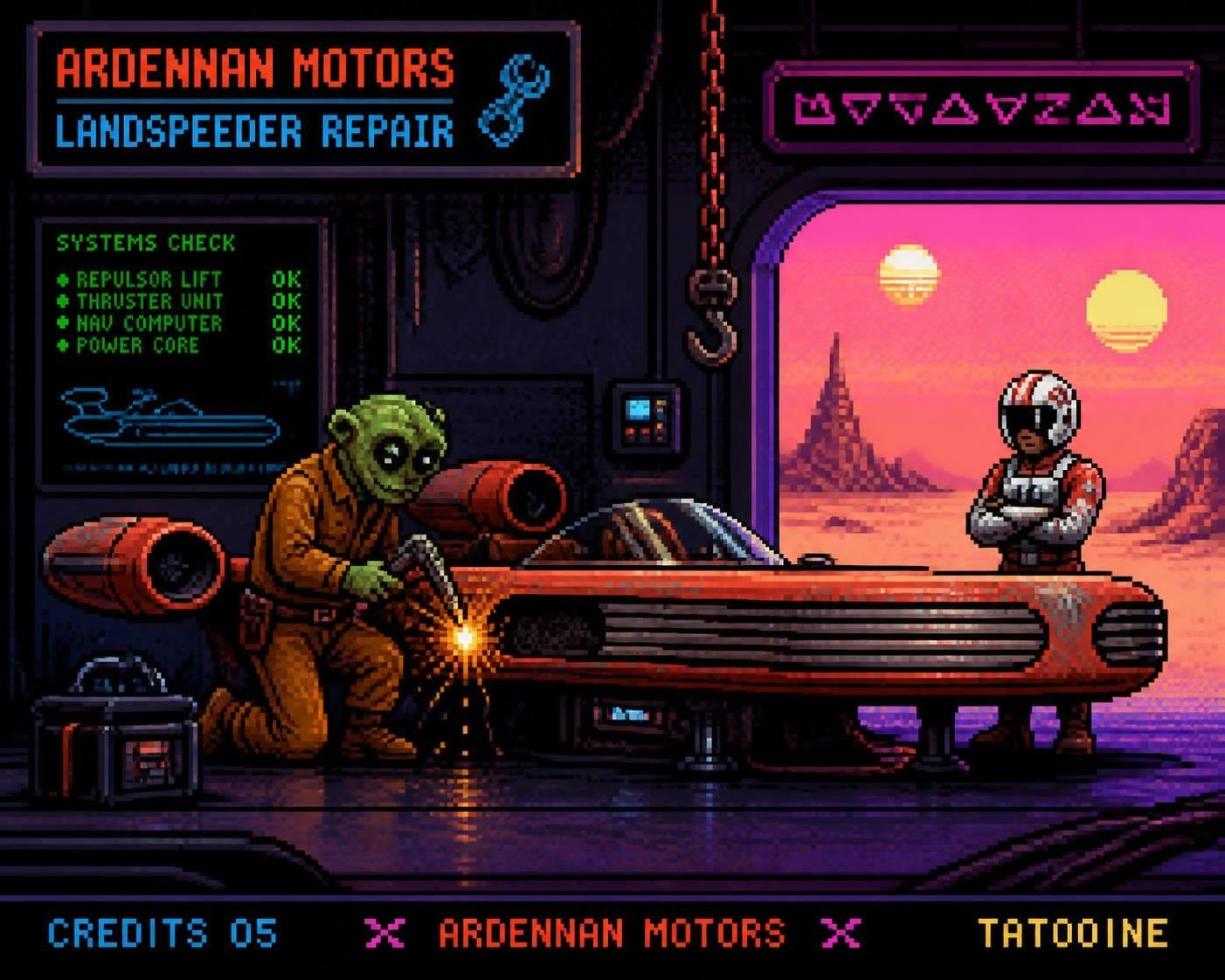
The first Under the Hood With Hibi episode concentrates on landspeeders because they provide a readable example of balanced design. Their advantages are clear: they can drift effectively through corners and endure contact better than more fragile racing craft. Their weaknesses are equally important, because a machine that survives collisions may still lose decisive seconds on an unsuitable route.
I would advise you to examine the landspeeder as a tactical platform rather than a beginner’s vehicle. Its repulsorlift system gives it a relatively controlled relationship with uneven ground, while its broader chassis suggests resistance to lateral impacts. In a race where competitors use physical contact to disrupt lines, this resilience permits an aggressive defensive posture. The driver can hold an inside route rather than surrendering every contested corner to lighter rivals.
Drifting is not merely a visual flourish in arcade-style racing. It is a means of converting momentum into positional advantage. On a narrow route, a racer who begins the turn early may occupy the preferred exit line and block an opponent’s acceleration path. Landspeeders appear designed to make that manoeuvre accessible, but they will require discipline. Entering a drift without accounting for barriers, loose material, or the next curve transforms a controlled slide into a collision sequence.
The Promo’s mechanical focus signals that terrain is not cosmetic. A desert basin, an industrial settlement, a forest crossing, and a ruined military route impose different demands. Repulsorcraft may glide above the surface, yet they still respond to slope, debris, air turbulence, traction simulations, obstacles, and the force of contact. The player must therefore assess more than maximum speed.
| Racing factor | Landspeeder advantage | Operational risk | Recommended use |
|---|---|---|---|
| 🏎️ Cornering | Strong drift behaviour supports tight turns. | Early slides can expose the rear to impact. | Use on dense technical circuits. |
| 🛡️ Contact | Durable chassis tolerates clashes with rivals. | Repeated impacts still reduce racing rhythm. | Defend narrow lanes and exits. |
| 🏜️ Uneven terrain | Repulsorlift profile supports adaptable handling. | Hazards can disrupt a poorly timed boost. | Choose routes with mixed surfaces. |
| ⚡ Straight-line pace | Stable acceleration creates reliable recovery. | Specialist craft may exceed top speed. | Prioritise consistency over raw velocity. |
The question for you is simple: what does the circuit demand at the moment when the pack compresses? If the answer is stability under pressure, the landspeeder is efficient. If the route consists of long, open stretches where a fragile interceptor can remain untouched, its comparative durability may not compensate for lower outright pace.
This approach has precedent within Star Wars culture. The podracers of Tatooine were brutally specialised machines. Their engines generated extreme output, but each racer was effectively a collection of vulnerabilities held together by cables and nerve. A landspeeder follows a different doctrine. It is closer to a field vehicle adapted for civilian travel and then forced into competition, a machine built to endure imperfect conditions rather than dominate only ideal ones.
That contrast supports Galactic Racer’s stated arcade orientation. The game is positioned as a spiritual successor to Star Wars: Episode I Racer and Racer Revenge, but it does not appear to repeat their formula mechanically. Podracing emphasised exposed speed and dangerous control. The new title introduces varied vehicle types, upgrades, collision consequences, and planetary conditions. A modern arcade system succeeds when it gives you quick feedback while preserving difficult decisions.
A thoughtful landspeeder build could prioritise reinforced flank plating, a drift-response adjustment, and recovery acceleration after collision. Such a configuration would not produce the highest result in every statistical category. It would create a vehicle aligned with a clear role: controlling contested portions of the course while remaining functional after rivals attempt to force mistakes.
This is the weakness of undisciplined customisation. Players often install upgrades according to numerical size rather than strategic compatibility. A maximum-speed enhancement may be irrelevant if the vehicle cannot safely exit the next three corners. Hibi’s technical guidance is therefore not background texture. It establishes the game’s governing principle: the right machine is the one that converts the course’s threats into manageable variables.
Making Of the Galactic Racer Promo: Why an In-Universe Film Production Format Creates Trust
The phrase Film Production usually invokes cameras, stages, editing suites, performers, and visual composition. In this case, the term remains useful even though Galactic Racer is a game. The Promo constructs a short piece of fictional media with its own host, setting, instructional rhythm, and implied audience. It is a production asset that behaves as if the inhabitants of the galaxy created it for one another.
I assess this as a superior method for communicating a complex game system. Standard promotional material often faces a problem: it must explain mechanics without draining them of atmosphere. A designer explaining a drift meter can be informative, but the viewer remains external to the fiction. Hibi explaining the same system within a workshop makes the information feel native to the world.
The method also avoids a frequent failure of franchise advertising. When every message relies only on familiar icons, the result may signal brand recognition but reveal little about the new work’s identity. Galactic Racer must establish its own terrain. It takes place between the collapse of Imperial authority and the later conflict with the First Order. That period contains uncertainty, fragmented governance, and commercial reinvention. A racing league emerging from those conditions is credible because spectators need spectacle, entrepreneurs need circulation of credits, and skilled pilots need a legal or semi-legal means to gain power.
The promotional team appears to understand that authenticity comes from consequences. Hibi does not discuss vehicles as toys. She discusses them as machines that can fail at high speed. Shade does not function as an anonymous avatar. He is part of a campaign involving Darius Pax and a shared vendetta against Kestar Bool. By placing technical instruction inside this relationship, the promo links handling decisions to character survival.
A useful comparison can be made with military briefings. A competent briefing does not flood personnel with every available detail. It identifies the terrain, the likely adversary action, available equipment, and the decision points that matter once pressure begins. Under the Hood With Hibi follows this logic. Its subject is narrow enough to retain clarity: landspeeders. Yet that narrow focus implies a larger hierarchy of vehicle categories and possible tactical identities.
The Movie Promo language reinforces this structure. Short-form footage must create anticipation, but anticipation without information is weak. The promo makes a specific promise: racers will need to understand their craft. It supports that promise by demonstrating a mechanic explaining tangible advantages and disadvantages. This is more reliable than announcing “deep customisation” without defining what customisation changes.
You can see similar emphasis in reporting surrounding the game’s broader design, including an explanation of its track-focused structure and story mode. Choosing a controlled sequence of tracks rather than an open-world map permits the production to shape each route as a deliberate encounter. Terrain, hazards, sightlines, and vehicle suitability can be authored with purpose rather than dispersed across a vast but less focused area.
That decision is not restrictive when used correctly. A well-designed track is like a defensive position. Every turn can force an approach, every obstacle can create a choice, and every straight can offer a calculated reward for a previous risk. In open space, speed may become the only dominant measure. On an authored circuit, steering discipline, route memory, contact management, and build selection remain relevant.
The promo’s audio-visual treatment must support this operational clarity. Engines need distinct tonal signatures so a landspeeder feels separate from lighter or more exotic craft. Workshop noises, tool movement, repulsorlift hum, and the pause before acceleration establish material weight. These elements are forms of Visual Effects and sound design in the broader cinematic sense: they persuade the viewer that the vehicle occupies space and responds to force.
The strongest production choice is the refusal to separate lore from mechanics. Each feature has an in-world reason, and each in-world element serves a playable function. The promo therefore acts as a controlled demonstration rather than a decorative trailer. When fiction explains the system and the system reinforces fiction, audience understanding becomes durable.
Behind the Scenes of Galactic Racer Physics: Destruction, Collision, and Arcade Readability
Galactic Racer’s reported physics-based destructive technology is central to its identity. Racing games frequently treat impact as spectacle with negligible consequence, or they simulate damage so severely that a single mistake ends the useful portion of a race. This project appears to pursue a more disciplined middle position: collisions should be forceful, visible, and strategically meaningful while preserving the momentum of arcade competition.
I would direct your attention to the word “readability.” A high-speed system fails when players cannot identify why an event occurred. If a landspeeder spins after contact, the game must communicate whether the cause was angle, speed differential, surface condition, an exposed obstacle, or a damaged component. The player need not calculate every variable numerically. However, the feedback must be consistent enough that experience produces improvement.
Destruction has a narrative purpose as well. The Star Wars Universe has always treated machines as imperfect companions. Droids are dented. Fighters return with scorched hulls. Freighters survive through patchwork repair. A racing vehicle that visibly absorbs damage belongs to that tradition. It reveals the price of an aggressive line or an unsuccessful attempt to force an opponent wide.
There is a tactical difference between a collision that slows both racers and one that transfers advantage to the prepared driver. A durable landspeeder entering a corner on the inside may accept light contact because its chassis and drift profile permit a rapid recovery. A lightweight racer may be forced away from the preferred exit, losing acceleration. The action is not random; it is a contest of mass, position, and timing.
The following decision model is useful when selecting upgrades before a dangerous event:
- 🧭 Identify the route’s pressure points. Locate narrow turns, destructible barriers, unstable surfaces, and high-speed approaches.
- 🔩 Match vehicle resilience to expected contact. Do not equip a delicate speed build for a track where the pack remains compressed.
- ⚡ Protect recovery capability. The vehicle that resumes speed first often gains more than the vehicle that caused the initial impact.
- 🎯 Use damage as information. A damaged rival may defend poorly, take safer lines, or avoid future contact.
- 🏁 Preserve the final-lap system. A machine that dominates early but cannot survive the closing contest has been misconfigured.
Such logic resembles the tactical choices made in starfighter engagements. An interceptor may achieve superior speed, yet it is vulnerable if forced into repeated turns with a more resilient opponent. A pilot who understands the limits of the craft avoids the engagement geometry that favours the enemy. Galactic Racer translates this relationship to the ground and to repulsor lanes, where barriers and terrain substitute for asteroid fields and debris belts.
The available technical coverage suggests that physical destruction is intended to give tracks a changing character. A barrier removed by the leading group can alter the options available to those behind. A damaged section may create a shortcut, expose a hazard, or eliminate a defensive lane. This is important because a race should not be a static memorisation exercise. Players need course knowledge, but they also need the ability to revise plans after the environment changes.
For a more detailed assessment of this technical direction, the physics and high-speed technology preview provides valuable context. Its relevance lies not in promotional excitement but in the question it raises: can destructive systems remain stable and readable when several craft occupy the same space at speed? The answer will determine whether chaos becomes meaningful competition or merely visual noise.
A competent system must also account for fairness. A player should be able to cause a meaningful collision through position and timing, not through invisible advantages. Likewise, the racer who suffers impact should retain agency. Recovery routes, counter-steering, boost conservation, and vehicle durability must offer ways to respond. Otherwise, the first collision decides too much.
The target is not realism for its own sake. It is credible consequence at arcade speed. Galactic Racer can honour its predecessors by retaining immediate excitement while giving every scrape, shattered obstacle, and overloaded repulsor unit a comprehensible effect on the race.
Star Wars Galactic Racer Story Mode Promo: Shade, Darius Pax, and the Kestar Bool Conflict
The narrative framework behind Galactic Racer is defined by a limited but effective conflict. Shade, a racer operating within a dangerous competitive circuit, joins Darius Pax of the Galactic League to confront Kestar Bool. Both characters hold a personal grievance against this opponent. The story does not require a galactic superweapon to create pressure. In a post-Imperial society, local influence, reputation, and control over a popular league can become strategically significant.
I find the scale appropriate. The fall of the Galactic Empire did not create instant order. It produced space in which private organisations could grow quickly, particularly where they offered transport, entertainment, sponsorship, or security. The Galactic League appears to operate within precisely this environment. It channels public demand for spectacle, but it also gives individuals like Darius Pax a network of contacts, facilities, resources, and leverage.
Kestar Bool’s position should therefore be examined beyond the role of simple rival. A successful racer can command audience loyalty, sponsor investment, intimidation networks, and access to restricted routes. If he has built influence around the League or its territories, defeating him on a track may be necessary but insufficient. Shade and Darius must understand the systems that allow him to maintain power between events.
This is where the Promo’s mechanic-focused format becomes more useful than it first appears. Hibi equips Shade with knowledge. Knowledge narrows uncertainty. A racer who knows a vehicle’s drift strengths, collision tolerances, and upgrade potential is less vulnerable to an opponent who relies on intimidation or superior preparation. The workshop becomes an intelligence cell in miniature.
The story mode benefits from a structure built around distinct worlds. A race on a familiar planet may carry cultural expectations established by earlier Star Wars stories, while an unseen location can introduce new hazards and local visual language. The designers can use each setting to alter not only the course but also the political situation around it. A sponsor on one world may demand clean spectacle. Another may reward destructive aggression. A third may force Shade to compete with damaged equipment or limited support.
The historical influence of post-war hot rod culture is relevant here. After real-world conflicts, veterans and mechanics often returned with technical skills, surplus materials, restless ambition, and little patience for passive life. Racing communities became places where machines were rebuilt into expressions of identity and competition. Galactic Racer reportedly draws on that history, but its adaptation within Star Wars must be more than decorative. The collapse of Imperial structures leaves military hardware, industrial remnants, and trained personnel distributed across the galaxy. Racing is a plausible arena for transforming those remains into local power.
You should expect the strongest missions to combine personal motivation with mechanical context. Shade might need to win a particular event, but the route may favour a vehicle type he has not mastered. Hibi’s preparation then becomes a story event rather than a menu action. Darius may provide access to a League contact, but that contact may impose conditions. Kestar Bool may not need to appear in every scene; his influence can be felt through opponents, altered rules, hostile sponsorship, and tracks designed to exhaust Shade’s resources.
Story-driven racing has one central danger: narrative scenes can interrupt the reason players entered the game, which is to race. The remedy is integration. Dialogue should clarify the stakes of the next event. Rivalry should shape opponent behaviour. Vehicle improvements should result from allies, victories, losses, and discoveries. The campaign should make every race feel like a position in a wider campaign rather than a detached tournament bracket.
The setting between Imperial collapse and the war against the First Order permits a valuable thematic contrast. Grand institutions have weakened, yet smaller organisations are still capable of coercion. The Galactic League may offer opportunity, but opportunity attracts exploitation. Shade’s path through this environment must depend on judgment, technical readiness, and alliances that can withstand pressure.
Hibi keeps Shade’s machine alive; Darius provides access to the competitive battlefield; Kestar Bool defines the enemy pressure. The story succeeds when those three functions repeatedly intersect on the track.
Galactic Racer Vehicle Choices in the Star Wars Universe: Upgrades as Strategic Commitments
Vehicle selection in Galactic Racer should be treated as force composition. A racer does not choose a craft simply because it looks impressive in a hangar. The choice determines available lines, tolerance for contact, acceleration rhythm, response to terrain, and the degree of risk required to achieve a leading position. The Promo’s landspeeder focus establishes the first example of this doctrine.
The danger in most upgrade systems is false abundance. If every component raises performance without imposing a meaningful trade-off, players eventually identify a universal optimum and the rest of the catalogue becomes decorative. The evidence surrounding Galactic Racer points toward a more useful model. Players must make careful choices if they intend to finish first and remain intact. This phrase implies that raw pace can conflict with resilience, control can conflict with burst speed, and specialisation can create vulnerability.
I would organise upgrades according to operational purpose. Reinforced parts may help a craft remain competitive after collisions. Handling modifications may improve route precision in dense environments. Boost-focused systems may dominate broad straights but become dangerous if a vehicle cannot stop or turn at the necessary point. Cosmetic changes may express identity, yet the strongest customisation systems ensure that visual identity often reflects actual racing philosophy.
Consider a hypothetical event on a world marked by tight market streets, broken elevated lanes, and intermittent service tunnels. A durable landspeeder with reliable drifting offers several advantages. It can contest confined corners, absorb glancing hits, and recover after a poor line. On a wide salt flat with long visibility and few obstructions, a faster but less protected craft may be the better choice. The mistake would be carrying the same configuration into both situations merely because it succeeded once.
Culture influences these choices. The art of a people often reveals its strategic preferences. A society that favours elaborate asymmetry in architecture may create routes with deceptive lines and hidden entrances. A community that values ceremonial machines may field craft that are heavy, durable, and imposing. A scavenger culture may reward vehicles built from incompatible but resourceful components. These signals can allow a perceptive racer to anticipate the local racing environment before the starting signal.
Vehicle builds should also respond to rival behaviour. If Kestar Bool’s teams use intimidation and repeated contact, a fragile high-speed setup may become an invitation to defeat. If his racers defend aggressively through narrow turns, a boost system that supports overtaking on exit lines could be more valuable than additional top speed. You must ask not only what the course contains, but what the opposition intends to make of it.
The game’s arcade character should make these decisions accessible. Complexity is valuable only if it produces readable outcomes. A player should be able to understand, after several races, why a reinforced landspeeder survived an encounter that destroyed a lighter build’s momentum. The design must reward adaptation rather than conceal cause and effect behind unexplained statistical layers.
Official materials describe the title as launching on October 6, 2026 for Xbox Series X/S, PlayStation 5, and PC. Platform parity will matter because high-speed racing depends on consistent response, stable visual communication, and reliable performance when track destruction and multiple competitors create maximum pressure. A vehicle system cannot be evaluated separately from the responsiveness of the environment in which it operates.
Coverage of the broader launch announcement can be found through Fuse Games’ racing adventure release information. Its practical importance is that Galactic Racer is positioned as the studio’s debut project, which makes clarity of identity essential. The game must prove that its systems are not borrowed references but an integrated racing doctrine built for this particular era of Star Wars.
A vehicle is a plan made visible. If its upgrades, route, and driver behaviour contradict one another, the race will expose the contradiction before the finish line.
Behind the Scenes of Star Wars Space Racing Tracks: Why Galactic Racer Avoids an Open World
The decision not to build Galactic Racer as an open-world racing game deserves close examination. Open maps provide freedom, scale, and prolonged travel. They can also dilute competition. A focused track structure permits every route to possess an intended tactical identity, which is particularly valuable for a game built around vehicle classes, destructive terrain, and narrative events.
I would define a successful racing track as a sequence of forced decisions. A driver must decide whether to hold the inside line, take a dangerous shortcut, conserve boost, risk contact, or accept temporary loss to gain a superior later position. An open environment can contain such decisions, but it often cannot guarantee that the racer encounters them at the correct pace. Purpose-built circuits can.
For Galactic Racer, this matters because each planet must function as more than a scenic destination. A world associated with Star Wars cinema brings visual recognition, but recognition alone produces shallow design. The course must translate environment into racing behaviour. Desert terrain should affect visibility, stability, or alternate routes. Dense urban sectors should create cornering pressure and collision risk. Industrial zones should place machinery, elevation, and destructible structures into the racing equation.
The post-Empire setting strengthens the case for authored locations. Imperial infrastructure may remain scattered across many worlds: abandoned depots, damaged checkpoints, derelict transit corridors, and unfinished military installations. These spaces are ideal for controlled courses because they contain strong visual geometry and plausible hazards. A race can pass through a place once used for occupation and transform it into a contested commercial spectacle. This is not simply visual recycling; it shows how societies repurpose the remains of authority.
Track-based construction also supports story mode pacing. Shade can travel from world to world with a defined objective. One circuit may introduce a vehicle category. Another may test the same craft against more aggressive rivals. A later event may revisit a mechanic after the player has gained enough knowledge to exploit it differently. This creates a campaign of escalating understanding rather than a collection of disconnected errands across a large map.
Open worlds often encourage an illusion of choice while silently directing players toward the same efficient route. A race circuit is more honest. It declares its boundaries and then asks what you will do within them. The answer can still vary widely if the track includes breakable obstacles, route changes, vehicle-specific options, and competitors whose behaviour forces adaptation.
The track approach aligns with the legacy of Episode I Racer and Racer Revenge. Those games were remembered for courses that possessed strong silhouettes, escalating danger, and distinct speed signatures. Galactic Racer needs to preserve that immediate legibility while applying modern environmental interaction. A canyon should be recognisable at a glance, but it should not behave as a static tunnel. A collision, shortcut, or opponent’s disruption should make the second lap different from the first.
There is also an economic logic inside the fiction. The Galactic League needs events that spectators can understand and sponsors can control. Defined circuits allow broadcasting, betting, security arrangements, and branded infrastructure. An unbounded race across a planet may be exciting, but it is difficult to regulate. The League’s growth after Imperial collapse depends on converting danger into a repeatable commercial system.
A precise track can therefore serve three masters without contradiction: the player receives a dense challenge, the story receives a meaningful location, and the in-universe league receives a viable public event. You should regard the lack of an open world not as reduced ambition, but as a choice to concentrate design effort where speed and conflict are most visible.
In Galactic Racer, terrain is expected to operate as an opponent with rules, habits, and exploitable weaknesses. That requires deliberate construction, not limitless geography.
Star Wars Galactic Racer Promo Visual Effects: Building Speed, Danger, and Mechanical Identity
The Promo must persuade the audience that Galactic Racer is fast before it has explained a single system. This is the responsibility of motion design, editing, sound, colour, and physical response. In a project centred on high-velocity repulsorcraft, Visual Effects are not secondary ornament. They communicate distance, mass, impact, and the narrowing time available for decision-making.
A landspeeder’s movement must appear distinct from a wheeled racing machine or a pod-powered craft. Its repulsorlift technology suggests hovering stability, but hovering does not mean weightlessness. The viewer needs to see suspension-like response through body tilt, dust displacement, sparks from contact, engine strain, and changes in posture as the craft enters a drift. Without these signs, the machine becomes an object sliding across a background rather than a vehicle fighting the course.
The Under the Hood With Hibi format allows the visual team to move between two scales. In the workshop, close views can show panels, engine components, worn surfaces, tools, and repair marks. On the track, wide shots can show the consequences of that engineering: controlled slides, impact tolerance, and the vehicle’s place within a dense pack. This alternation creates trust because the audience sees both cause and effect.
The best Star Wars visual design has historically combined recognisable silhouettes with evidence of use. A TIE fighter is understood through its shape before it is understood through technical detail. An X-wing shows wear, access panels, and moving components, which reveal function. Galactic Racer’s craft should follow that rule. You should be able to identify a landspeeder’s broad role quickly, then discover the customised details that reveal its owner’s strategy.
Colour is equally tactical. A promotional edit can use bright energy trails and harsh environmental contrasts to make speed legible, but it must not erase the track. If every frame is saturated with effects, players lose the ability to identify hazards and routes. The visual hierarchy should remain clear: the course first, immediate threats second, rivals third, and decorative effects last. This principle is shared by military cockpit design, where information that is visually impressive but operationally unclear becomes a liability.
The promo’s editing rhythm should reflect a race’s decision cycle. A brief shot establishes the approach. A tighter shot shows the steering or drift commitment. A collision or environmental change delivers consequence. A longer exit shot reveals whether the decision gained position. This sequence teaches the viewer how to read the game while preserving the pace expected from a Movie Promo.
Sound reinforces the same hierarchy. Engines should not blend into an undifferentiated roar. The landspeeder needs a signature repulsor tone, while damage should create audible warning states: stressed power flow, scraping armour, fluctuating stabilisers, or sputtering acceleration. Hibi’s workshop dialogue can then give those sounds context. When a player hears a system fail later, the Promo has already taught what the warning means.
The cultural specificity of Star Wars helps avoid generic science-fiction imagery. Racing infrastructure may be assembled from local materials, adapted Imperial components, droid labour, hand-painted signage, and sponsor technology. The result should feel like a galaxy in transition rather than a polished future disconnected from history. The Galactic League’s brand may be new, but the worlds it enters retain memories of conflict and different artistic traditions.
A promotional piece succeeds when it lets you infer rules from images. A drifting landspeeder that holds its line after a side impact tells you more about durability than a floating numerical statistic. A barrier that fractures and changes the route tells you more about destruction than a slogan. The strongest effects are those that make mechanics visible without interrupting momentum.
Galactic Racer Future Conflict Lessons: What the Promo Reveals About Racing Strategy in 2026
The current promotional material reveals a coherent strategic model for Galactic Racer. The game is not organised around a single measure of speed. It combines vehicle suitability, terrain awareness, physical contact, narrative rivalry, and technical customisation. This mixture creates a useful lesson for any future conflict within the Star Wars Universe: superior equipment has limited value when its operator misunderstands the environment.
I would begin with the landspeeder. It is presented as durable and capable of effective drifting. These strengths make it reliable in compact, contested races. Yet reliability is not dominance. A competitor who selects it for a wide, high-speed route without anticipating specialist rivals may discover that survival alone does not create victory. The machine must be chosen because it answers the course’s specific questions.
This is the same error made by commanders who deploy a powerful fleet formation without studying local conditions. At Endor, the Imperial military possessed overwhelming force, but its plan treated several variables as insignificant: Rebel timing, local resistance, command overconfidence, and the vulnerability created by dependence on a single strategic asset. The Ewoks were not an impossible threat. They were a neglected variable. Galactic Racer’s tracks will reward players who do not neglect variables simply because they are inconvenient.
Hibi’s role offers the second lesson. Technical personnel are not support figures to be consulted after failure. They are intelligence assets. A mechanic understands how a system behaves under stress, what modifications create hidden weaknesses, and when a machine should be used conservatively. Shade’s alliance with Hibi gives the campaign a practical foundation. He does not face Kestar Bool with determination alone; he faces him with preparation.
Darius Pax and the Galactic League provide a third lesson about institutions. In a fractured post-war environment, influence belongs to those who organise movement, public attention, resources, and rules. The League is a sponsor, a competitive authority, and a social structure. It can create opportunity, but it can also become a battleground for private agendas. A racer who ignores the organisation behind the race may win an event while losing the wider conflict.
The game’s track-focused design provides a fourth lesson. Freedom without pressure rarely produces mastery. Defined courses expose weaknesses because they concentrate decisions. Each circuit can test a particular capability: drift control, collision management, boost timing, terrain reading, or upgrade discipline. A player who repeatedly fails in one environment receives a clear signal about what must be corrected.
For players preparing for the October release, the most productive mindset is not to search immediately for the fastest configuration. Instead, construct several roles. Keep a resilient build for hostile packs. Prepare a precision setup for technical routes. Develop a speed-focused option for open sectors. Learn what each configuration sacrifices. The difference between a catalogue of parts and a winning garage is the ability to assign a purpose to every component.
The Promo also indicates that the project understands the value of layered communication. The Behind the Scenes concept presents a fictional mechanic, a protagonist, a League, and a tangible vehicle class. At one level, it is advertising. At another, it is a concise training document for how the game expects you to think. The audience is not asked merely to admire a landspeeder. It is asked to consider where, when, and why that craft should enter competition.
That is the practical value of the Galactic Racer approach to Space Racing. A track is not neutral ground. A rival is not only a moving obstacle. An upgrade is not a number. Every element becomes part of an operational system, and every system can be studied before the moment of contact.
The racer who reaches the finish first will not necessarily be the one with the greatest velocity. It will be the one who has identified the decisive variable before the others recognise it exists. 🏁

I am Grand Admiral Thrawn, strategist of the Galactic Empire. Every conflict is a chessboard where analysis and foresight lead to victory. The art and culture of a people betray their weaknesses. The Empire embodies order and discipline in the face of rebel chaos. History will remember that only strategy ensures peace.